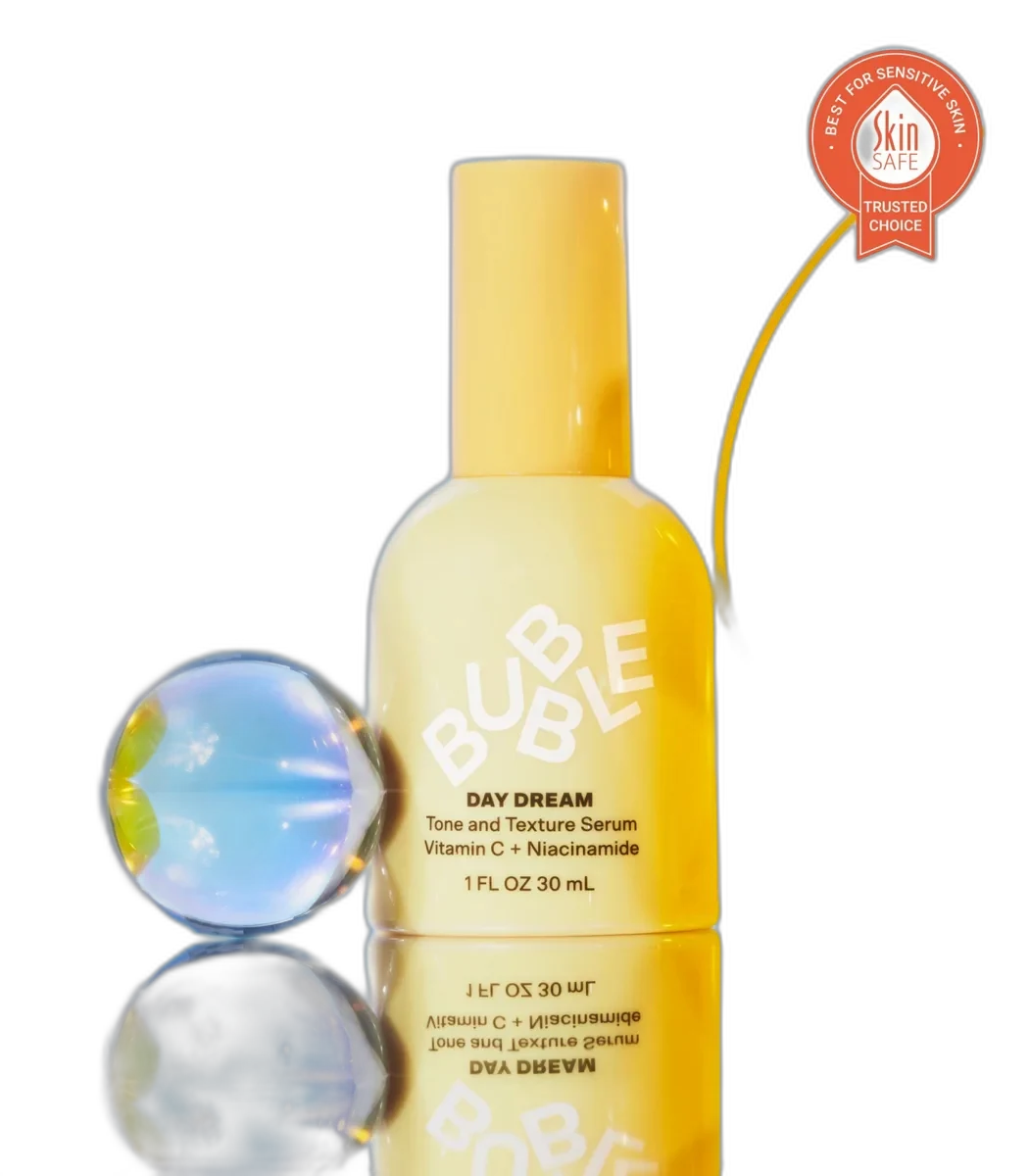
Day Dream Tone & Texture Serum
Brightening Overachiever
 Verified reviewer
Pros & cons.
- +Five distinct brightening mechanisms targeting hyperpigmentation from multiple pathways simultaneously
- +Five-ceramide barrier-repair complex protects skin health during brightening treatment
- +Stable vitamin C derivative won't oxidize, sting, or require refrigeration
- +Fragrance-free and silicone-free with exceptionally low irritation potential
- +Remarkably sophisticated ingredient list for a $17 price point
- +Well-suited to post-inflammatory hyperpigmentation from acne — a top Gen Z concern
- +Compatible with most other actives including retinol and AHAs
- −Small 1 oz bottle runs out in about 5 weeks with twice-daily use
- −Sodium ascorbyl phosphate is less potent than L-ascorbic acid for stubborn pigmentation
- −Active ingredient concentrations not disclosed on the label
- −Results require 6-12 weeks of consistent use — no quick fix for impatient users
- −Some users report no visible difference, suggesting individual response varies
The full review.
Read the ingredient list on Bubble’s Day Dream serum, and then look at the price tag, and something doesn’t quite compute. Sodium ascorbyl phosphate, niacinamide, alpha-arbutin, tranexamic acid, a five-ceramide complex with cholesterol, licorice root extract — this reads like the INCI list of a serum that should cost $45 or more. At $17, you start wondering what the catch is.
The honest answer: there isn’t really one. Bubble has done something genuinely clever here — building a multi-mechanism brightening serum that’s gentle enough for teens and young adults but sophisticated enough to earn respect from anyone who reads ingredient lists for fun. The formula attacks hyperpigmentation from five different angles simultaneously, and the barrier-repair complex ensures it does so without compromising skin health in the process.
Let’s start with the vitamin C. Day Dream uses sodium ascorbyl phosphate rather than the more potent L-ascorbic acid, and this is a deliberate formulation choice, not a cost-cutting one. SAP is a stable, water-soluble vitamin C derivative that converts to ascorbic acid on contact with skin enzymes. It doesn’t require the low pH that makes pure L-AA sting, it doesn’t oxidize and turn brown in the bottle, and it’s shown clinical efficacy for brightening at concentrations as low as 5%. For a serum designed to be someone’s first brightening product, stability and tolerability matter more than raw potency.
Niacinamide amplifies the brightening work through a completely different pathway — rather than inhibiting melanin production (which the vitamin C handles), niacinamide blocks the transfer of melanin from melanocytes to keratinocytes. Think of it as intercepting the package after it’s been made but before it’s been delivered. The persistent myth that vitamin C and niacinamide can’t be used together has been thoroughly debunked; in a formulated product at a near-neutral pH, they’re perfectly complementary.
Alpha-arbutin adds a third mechanism by directly inhibiting tyrosinase, the enzyme responsible for the first step of melanin synthesis. It’s gentler than hydroquinone (which works through a similar but more aggressive mechanism) and has strong clinical evidence for reducing hyperpigmentation.
Tranexamic acid is perhaps the most interesting inclusion. Originally developed as a blood-clotting medication, topical tranexamic acid has emerged as a remarkably effective brightening agent, particularly for pigmentation triggered by inflammation — which is exactly the kind of dark spots that follow acne breakouts. For the young, acne-prone demographic that Bubble targets, this ingredient choice is almost surgically precise.
And then there’s the licorice root extract, which adds yet another tyrosinase inhibitor (glabridin) along with anti-inflammatory properties that help prevent new pigmentation from forming.
The five-ceramide complex deserves its own paragraph because it transforms this from a pure brightening serum into something more holistic. Ceramides NP, AP, AS, NS, and EOP paired with cholesterol mirror the skin’s natural lipid barrier composition. This isn’t just an afterthought — brightening actives can sometimes compromise barrier function with extended use, and the ceramide complex proactively addresses that risk. It’s the kind of formulation consideration that distinguishes thoughtful product development from simply listing trendy ingredients.
Texturally, Day Dream is a lightweight milky emulsion — thicker than a pure water-based serum but lighter than a cream. It spreads easily, absorbs within a minute, and leaves skin feeling soft and slightly dewy without any greasiness or tackiness. There’s no fragrance, no tingling, no adjustment period. You apply it, it disappears, and it gets to work.
In practice, users report visible brightening within two to four weeks, with more significant dark spot fading at the six-to-twelve-week mark. This timeline is entirely consistent with how melanin turnover works — there’s no shortcut to fading hyperpigmentation, and any product promising overnight results is lying. What Day Dream does well is provide steady, measurable improvement without irritation, which means you can actually stick with it long enough to see results.
The limitations are honest ones. Sodium ascorbyl phosphate is less potent than L-ascorbic acid, so if you have stubborn, deep melasma or years of accumulated sun damage, you may eventually need to graduate to a more aggressive formula. The concentrations of the brightening actives aren’t disclosed, so there’s some opacity about how much of each ingredient you’re actually getting. And at 1 oz, the bottle is small — if you’re using it twice daily as recommended, you’ll go through it in about five weeks, which makes the subscribe-and-save option at $15.30 worth considering.
But taken on its own terms — as a gentle, multi-mechanism brightening serum designed to be someone’s first serious active product — Day Dream is extraordinarily well-formulated for its price. It takes the clinical approach to depigmentation that usually costs $50-80 and packages it in a format that a teenager can afford, tolerate, and actually want to use. That’s not just good skincare. That’s good democratization of skincare.
Ingredient analysis.
Full INCI list
Water (Aqua), Sodium Ascorbyl Phosphate, Coco-Caprylate/Caprate, Glycerin, Niacinamide, Alpha-Arbutin, Tranexamic Acid, Ceramide NP, Ceramide AP, Ceramide AS, Cholesterol, Ceramide NS, Ceramide EOP, Xanthan Gum, Brassica Campestris Seed Oil, Ethylhexylglycerin, Glycyrrhiza Glabra (Licorice) Root Extract, Polyglyceryl-3 Diisostearate, Sorbitan Isostearate, Hydrogenated Lecithin, Althaea Officinalis (Marshmallow) Root Extract, Oryza Sativa (Rice) Bran Extract, Dipropylene Glycol, Glyceryl Stearate, Hydroxyethyl Acrylate/Sodium Acryloyldimethyl Taurate Copolymer, Sodium Polyacryloyldimethyl Taurate, Sodium Polyacrylate, Sucrose Distearate, Phenoxyethanol
Skin match.
The science.
The Science
Research supports Day Dream's multi-target depigmentation approach. Sodium ascorbyl phosphate reduces melanin synthesis by inhibiting tyrosinase activity once it converts to ascorbic acid on the skin surface. Kameyama et al. (Journal of the American Academy of Dermatology, 1996) showed that stable vitamin C derivatives reduce hyperpigmentation through this mechanism.
Day Dream uses tranexamic acid and alpha-arbutin, following research on combination brightening. Janney et al. (Dermatologic Therapy, 2019) ran a randomized controlled trial on a serum with tranexamic acid, niacinamide, and alpha-arbutin. They found significant improvements in skin brightness and pigmentation intensity after four weeks, with efficacy comparable to hydroquinone. This validates the multi-active strategy in Day Dream.
Multiple studies document alpha-arbutin's efficacy as a tyrosinase inhibitor. A review by Boo (Antioxidants, 2021) confirms its depigmenting and antioxidant properties. Alpha-arbutin achieves these effects without the cytotoxicity risks of hydroquinone.
The five-ceramide complex maintains barrier integrity during active treatment. Research shows that ceramides NP, AP, and EOP, plus cholesterol, restore and maintain the stratum corneum's lamellar lipid structure. This prevents the transepidermal water loss often caused by actives.
References
- Randomized control trial outcomes of tranexamic acid combination serum as a depigmenting agent for the use in healthy individuals — Dermatologic Therapy (2019)
- Arbutin as a Skin Depigmenting Agent with Antimelanogenic and Antioxidant Properties — Antioxidants (2021)
Dermatologist Perspective
Dermatologists view this multi-mechanism depigmentation approach as clinically sound. Targeting melanin production, transfer, and inflammation simultaneously usually yields better outcomes than single-active treatments. Board-certified dermatologists note sodium ascorbyl phosphate is a good vitamin C choice for younger patients lacking tolerance to stronger actives. The ceramide complex shows formulation sophistication rare at this price point. Pediatric and adolescent dermatologists value that the formula treats post-inflammatory hyperpigmentation without the irritation risks of hydroquinone or high-concentration L-ascorbic acid.
Where it fits in your routine.
Apply 3-4 drops to clean skin after toning and before moisturizer. Press it into the face and neck, targeting hyperpigmentation or uneven tone. Use morning and evening. In the morning, always follow with SPF 30+ sunscreen because brightening actives increase UV-induced pigmentation risk. Wait 30 seconds for absorption before applying moisturizer.
Day Dream offers high ingredient value at $17 for 1 oz. This serum combines vitamin C, niacinamide, alpha-arbutin, tranexamic acid, ceramides, and licorice root extract. Most brightening serums from Good Molecules, Cos De BAHA, or The Ordinary cost $12-25 but lack the ceramide barrier complex. The $15.30 subscribe-and-save option increases the value. The small bottle size is the main concern — using it twice daily lasts about five weeks, making the annual cost roughly $150-175.
This brightening serum works for anyone with post-acne dark spots, uneven skin tone, or dullness seeking gentle, effective results at an accessible price. It suits teens and young adults with their first post-inflammatory hyperpigmentation, and sensitive skin types that cannot tolerate L-ascorbic acid.
Those with deep, stubborn melasma or significant sun damage may need a more potent vitamin C derivative or prescription-strength treatment. Anyone expecting overnight results will be disappointed — brightening takes consistent use over weeks to months. If you already use multiple brightening products, adding Day Dream may not provide additional benefit.
Product details.
Lightweight, milky emulsion with a slight slip from the coco-caprylate/caprate base. Absorbs smoothly without stickiness or residue. Not as watery as pure serums but thinner than a cream.
Fragrance-free. It has no scent except a faint neutral note from the base ingredients.
A small glass-style bottle uses a dropper or pump in Bubble's colorful branded aesthetic. The 1 oz size is compact and travel-friendly.
The first application leaves a smooth, slightly dewy finish and makes skin feel soft immediately. There is no tingling, stinging, or adjustment period. The stable vitamin C derivative and gentle brightening actives are non-irritating from day one. The emulsion base feels hydrating instead of active-heavy.
4-6 weeks with once or twice daily facial application
12 months
All Year
The backstory.
Day Dream was Bubble's answer to the Gen Z dark-spot problem: post-acne hyperpigmentation is one of the most common skin concerns for teenagers and young adults, but most brightening serums were either too harsh (high-concentration L-ascorbic acid) or too expensive for a young person's budget. By using sodium ascorbyl phosphate and pairing it with complementary brightening actives, Bubble created an entry-level brightening serum that's gentle enough for daily use on young skin.
About Bubble Skincare
Emerging Brand (2–5 years)Shai Eisenman founded Bubble Skincare in 2020 as the first modern skincare brand for Gen Z. TikTok virality and Walmart distribution drove rapid brand growth. Bubble Skincare uses well-studied ingredients at accessible prices, but independent clinical validation for specific Bubble Skincare products is limited.
Common myths.
Vitamin C and niacinamide cancel each other out; do not use them together.
This skincare myth relies on outdated chemistry that only applies in extreme laboratory conditions (high heat, low pH). In a formulated product like Day Dream, sodium ascorbyl phosphate and niacinamide are compatible and complement each other—the vitamin C targets melanin production while niacinamide inhibits melanin transfer.
Vitamin C serums need to be expensive to be effective.
Vitamin C effectiveness depends on the derivative, stability, and formula, not price. Day Dream uses sodium ascorbyl phosphate, a stable vitamin C derivative that brightens skin, plus four additional brightening actives. The $17 price comes from affordable sourcing and distribution, not inferior ingredients.
FAQ.
Can I use Bubble Day Dream serum with retinol?
Yes — the gentle vitamin C derivative (sodium ascorbyl phosphate) in this serum works with retinol. Apply Day Dream in the morning with sunscreen, and use your retinol product at night for a brightening and anti-aging routine. This prevents sensitivity from layering multiple strong actives at once.
Is Bubble Day Dream serum good for acne scars?
This serum works for post-inflammatory hyperpigmentation (the dark marks left after acne). The tranexamic acid targets inflammation-driven pigmentation, and alpha-arbutin and vitamin C address melanin overproduction. For textured acne scarring (indentations or raised marks), use retinoids or professional procedures that address skin structure.
Do I need to wear sunscreen with Bubble Day Dream serum?
Sunscreen is essential when using any brightening product. The vitamin C and brightening actives in Day Dream fade existing pigmentation, but UV exposure creates new pigmentation that undoes your progress. You must use an SPF 30+ broad-spectrum sunscreen every morning to see results from this serum.
Is Bubble Day Dream suitable for sensitive skin?
Yes — the sodium ascorbyl phosphate form of vitamin C is chosen because it is gentle. It converts to active ascorbic acid on the skin gradually instead of all at once. The five-ceramide complex and marshmallow root extract support the barrier to reduce irritation. Users with sensitive skin report no stinging or redness.
What the community says.
"Visibly brighter skin within a few weeks of use"
"Lightweight and absorbs well without greasiness"
"No irritation even on sensitive skin"
"Affordable price for the ingredient quality"
"Helps fade post-acne dark spots effectively"
"Results take time — not an overnight fix for hyperpigmentation"
"Small 1 oz bottle may not last long with twice-daily use"
"Vitamin C derivative is less potent than pure L-ascorbic acid"
"Some users notice no visible difference after extended use"
Featured in.
People also looked at.