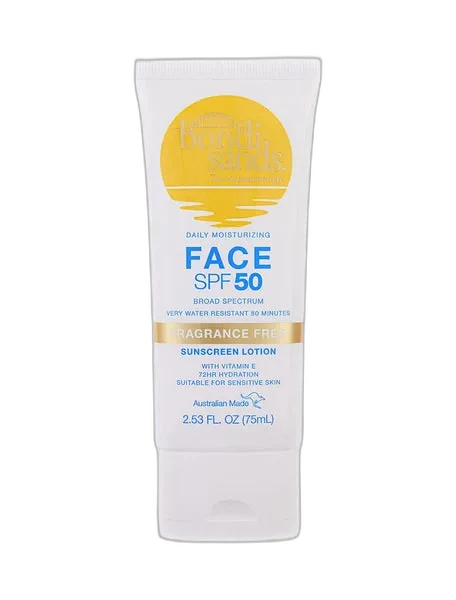
Fragrance Free Face Sunscreen Lotion SPF 50+
Sensitive Skin Daily Driver
 Verified reviewer
Pros & cons.
- +Formulated to Australia's stricter TGA sunscreen testing standard
- +Zero white cast on all skin tones including deep complexions
- +Genuinely fragrance-free with no masking agents or essential oils
- +Lightweight satin finish layers cleanly under makeup
- +Water-resistant for 80 minutes
- +Accessible drugstore price and widely stocked at US retailers
- +Gentle enough for reactive, rosacea-prone, and post-procedure skin
- −Contains beeswax so not suitable for vegans
- −Not fungal-acne safe due to fatty esters and beeswax
- −75ml tube empties quickly at correct dosing
- −Can sting the eye area during heavy sweating or swimming
- −Chemical filters not suitable for anyone preferring mineral-only
The full review.
Most Americans miss this sunscreen fact: an SPF 50+ label on an Australian-formulated sunscreen differs from an SPF 50+ label on a US-formulated one. Australia’s Therapeutic Goods Administration requires any SPF 50+ product to provide a UVA protection factor of at least one-third the SPF value and pass a separate critical wavelength test. The US FDA’s OTC sunscreen monograph lacks an equivalent rule — a drugstore SPF 50+ here can legally offer much weaker UVA coverage than a TGA-tested one. This regulatory gap is why Bondi Sands’ Fragrance Free Face Sunscreen Lotion matters. It is a drugstore chemical SPF 50+ formulated and tested to the stricter Australian standard, then shipped to American shelves for about fifteen dollars.
The formula uses a four-filter chemical blend: avobenzone at 3%, homosalate at 10%, octisalate at 5%, and octocrylene at 8%. Avobenzone handles UVA; homosalate and octisalate handle UVB; octocrylene boosts UVB coverage and photostabilizes the avobenzone so the formula lasts through a day’s wear. The tube contains no zinc oxide or titanium dioxide. This is a pro because it leaves zero white cast on any skin tone, but a con if you want a mineral option.
The texture outperforms the price. It pumps out as a medium-weight white cream, rubs out without the greasy drag of pure homosalate-heavy US sunscreens, and settles into a soft satin finish within about a minute. It is not a glowy Korean sunscreen or a matte mineral; it is a neutral, skincare-like feel that works under makeup and disappears on skin. The beeswax in the base gives it a subtle slip to prevent drag, while saccharide isomerate and aloe keep the after-feel hydrating rather than filter-heavy.
The fragrance-free claim is notable because it actually works. Many products labeled ‘fragrance-free’ contain masking agents that reactive skin still detects. This one’s INCI list lacks fragrance components, essential oils, and scented extracts; the base has only the faint cosmetic note from the filters. For skin that reacts to perfumed sunscreens, this neutrality is the main appeal.
There are real limitations. The lotion contains beeswax, so it is not vegan — a surprise if you assume fragrance-free means animal-free. The beeswax, isopropyl palmitate, and a few fatty alcohols mean this is not fungal-acne safe; malassezia-prone skin should look elsewhere. The 75ml tube feels small for the price if you apply the recommended two-finger dose twice a day, as you will use a tube in roughly six to eight weeks. Like most chemical sunscreens, it can sting the eye area during heavy sweating or swimming when filters dilute and migrate — not an issue for daily office wear, but important to know before a long gym session.
The lotion earns its place as a daily face SPF for sensitive, reactive, or fragrance-sensitive skin that wants broad-spectrum coverage without the compromises of American chemical sunscreens or the white cast of American minerals. It is not exotic or innovative, and it won’t give you the filtered-Instagram glow of a Japanese fluid. It sits quietly on your face, does not smell, does not turn you white, and protects your skin to a higher UVA standard than most drugstore options. For many, that is the exact sunscreen they want.
Formula
Ingredient analysis.
Full INCI list
Active: Avobenzone 3%, Homosalate 10%, Octisalate 5%, Octocrylene 8%. Inactive: Water, Beeswax, Aloe Barbadensis Leaf Juice, Isopropyl Palmitate, Cetearyl Alcohol, Cyclopentasiloxane, Cyclohexasiloxane, Ceteareth-20, Hydroxyacetophenone, Carbomer, Benzyl Alcohol, Saccharide Isomerate, Phenoxyethanol, Sodium Stearoyl Glutamate, Triethanolamine, Tocopheryl Acetate, Sodium Chloride, Citric Acid
Skin match.
The science.
The Science
SPF 50+ broad-spectrum protection needs strong UVB coverage to stop erythema and enough UVA coverage to block deeper wavelengths that cause photoaging and melanoma risk. This lotion uses a textbook filter combination: homosalate and octisalate act as high-concentration UVB absorbers, avobenzone serves as the primary UVA absorber, and octocrylene works as a UVB booster and a photostabilizer for avobenzone. Unstabilized avobenzone breaks down fast under sun exposure—some published measurements show roughly 36% degradation within an hour—so the octocrylene pairing is essential for any sunscreen claiming all-day protection.
This formula differs from the average US drugstore chemical sunscreen because of its regulatory testing standard. Australia's TGA sunscreen monograph (AS/NZS 2604) requires an SPF 50+ product to show a UVA-PF of at least one-third its labeled SPF and a critical wavelength of at least 370 nm. The US FDA's monograph requires no equivalent UVA-PF threshold for an SPF 50+ claim, only broad-spectrum labeling based on critical wavelength. This means a TGA-compliant SPF 50+ protects more thoroughly against UVA than a US-only SPF 50+ can legally claim. Peer-reviewed comparisons of international sunscreen standards repeatedly flag US rules as among the weakest in the developed world for UVA protection. Australian-tested formulas are a better choice for anyone prioritizing long-term photoaging prevention over just preventing a burn.
Dermatologist Perspective
Dermatologists often recommend fragrance-free chemical sunscreens to sensitive and rosacea-prone patients who dislike the greasy finish or white cast of mineral alternatives. Board-certified dermatologists note that patient adherence is the strongest predictor of real-world photoprotection outcomes—the best sunscreen is the one a patient wears every day—and a cosmetically elegant, fragrance-free chemical lotion often wins that adherence battle over a cosmetically challenging mineral. This formula's TGA-compliant UVA protection is a frequent reason to prefer Australian and European sunscreens over US-monograph ones when photoaging prevention is the main clinical goal.
Where it fits in your routine.
Apply at least two finger-lengths of lotion as the final step of your morning skincare routine to cover the face, neck, and exposed ears. Rub it in fully and wait 60 seconds to settle before applying makeup. Reapply every two hours in direct sun exposure, or immediately after swimming or towel drying. One morning application works for daily office or indoor wear, but people near windows should use a midday powder or stick SPF. Avoid the lash line if you get sunscreen-in-eyes sting when sweating.
At $14.99 for 75ml, this sunscreen is a mid-range drugstore face SPF with broad-spectrum performance that exceeds its price. Using the two-finger dosing rule for adequate protection, one tube lasts 6–8 weeks with daily face and neck application. The daily cost is not cheap, but matches other drugstore face-specific SPFs of this size. No larger size exists, which is a disappointment since adequate sun protection requires significant product. However, the UVA protection level and fragrance-free formula offer fair-to-strong value compared to US drugstore chemical sunscreens and premium Asian face SPFs costing two to three times more.
This works for sensitive, reactive, rosacea-prone, or post-procedure skin needing broad-spectrum protection without fragrance, alcohol, or white cast. It also suits active hyperpigmentation or anti-aging routines requiring Australian-standard SPF 50+ UVA coverage on a drugstore budget.
Beeswax makes this unsuitable for strict vegans. Fatty esters make it a poor choice for fungal acne. Those wanting a mineral zinc-or-titanium sunscreen should look elsewhere. This formula also fails during heavy-sweat athletic use due to eye sting and frequent reapplication.
Product details.
Medium-weight white lotion that rubs out to a satin finish
Genuinely fragrance-free — faint clean cosmetic base note only
Opaque white plastic squeeze tube with flip cap — travel friendly
The lotion looks white in the tube but blends without a white cast on all skin tones. It leaves a brief satin finish that settles within a minute. It does not sting or tingle. This neutral, skincare-like experience sets the standard for a reactive-skin sunscreen.
Apply the recommended two-finger dose to the face and neck twice daily for 6–8 weeks.
12 months
All Year
The backstory.
Bondi Sands started in 2012 as a self-tanning brand trying to bottle the golden Australian beach aesthetic. As the brand expanded internationally, sun care became a logical next step, and the Fragrance Free Face lotion was part of the 2021 US launch of its Australian Gold Standard SPF range — the line that translated TGA-tested Australian formulas into a drugstore price point Americans could actually find on shelves.
About Bondi Sands
Established Brand (5–20 years)Bondi Sands launched in Melbourne in 2012 and built its reputation on self-tanning products before expanding into sun care. Its SPF range is formulated to Australia's TGA testing standards — widely regarded as among the strictest in the world — which gives Bondi Sands' sunscreens a reliability advantage over most US-formulated OTC options.
Common myths.
Chemical sunscreens always sting sensitive skin
The chemical filters pair with aloe and a fragrance-free base to avoid the alcohol and fragrance irritants that usually cause sunscreen sensitivity reactions — most reactive-skin users tolerate it without issue, though the eye-area sting during heavy sweating is a real limitation.
SPF 50+ US and SPF 50+ Australian are the same thing
They are not. Australia's TGA sunscreen testing requires the minimum UVA protection factor to be roughly 1/3 the SPF value, making it stricter than US FDA rules. A TGA-formulated SPF 50+ generally provides stronger UVA protection than a US-only SPF 50+ with the same label value.
FAQ.
Is Bondi Sands Fragrance Free Face Sunscreen chemical or mineral?
It uses only chemical filters — avobenzone, homosalate, octisalate, and octocrylene. It lacks zinc oxide or titanium dioxide, so the lotion rubs into every skin tone without a white cast. This beats mineral alternatives at this price.
Is this sunscreen truly fragrance-free?
Yes. The INCI list lacks added fragrance, essential oils, or masking scents — rare even for 'fragrance-free' sunscreens. Reactive-skin users report no sensory irritation from scent.
Does Bondi Sands Fragrance Free Face SPF work under makeup?
Yes — the lotion dries to a satin finish in about a minute and layers cleanly under liquid and powder foundations. It contains silicones, so it pairs smoothly with most primers and does not pill under coverage.
Is this sunscreen vegan or fungal acne safe?
Neither. Beeswax makes it non-vegan, and the beeswax and fatty emollients combination means it isn't fungal-acne safe. Look elsewhere in the sunscreen category for strict vegan or fungal-acne-safe needs.
How does this compare to Australian SPF regulation?
Bondi Sands meets Australia's TGA standards for formulation and testing. These standards require more UVA protection than the US FDA monograph for an SPF 50+ claim. This makes the sunscreen's broad-spectrum performance stronger than most US-only SPF 50+ drugstore options.
Will it sting my eyes?
Some users report eye sting during heavy sweating or swimming. This happens because moisture dilutes chemical sunscreens, causing them to run. A stick format around the eye area works well for pool and gym days.
How much should I apply for full SPF 50+ protection?
Apply roughly two full finger-lengths to cover the face and neck. Using less reduces the actual SPF delivered. Reapply every two hours in direct sun or after towel drying.
What the community says.
"Zero white cast on all skin tones"
"Truly fragrance-free with no masking scent"
"Lightweight finish under makeup"
"Affordable compared to Asian and European SPFs"
"Can sting eyes when sweating heavily"
"Contains beeswax so not vegan"
"75ml size feels small for the price"
"Not ideal for fungal acne due to fatty ingredients"
Featured in.
People also looked at.