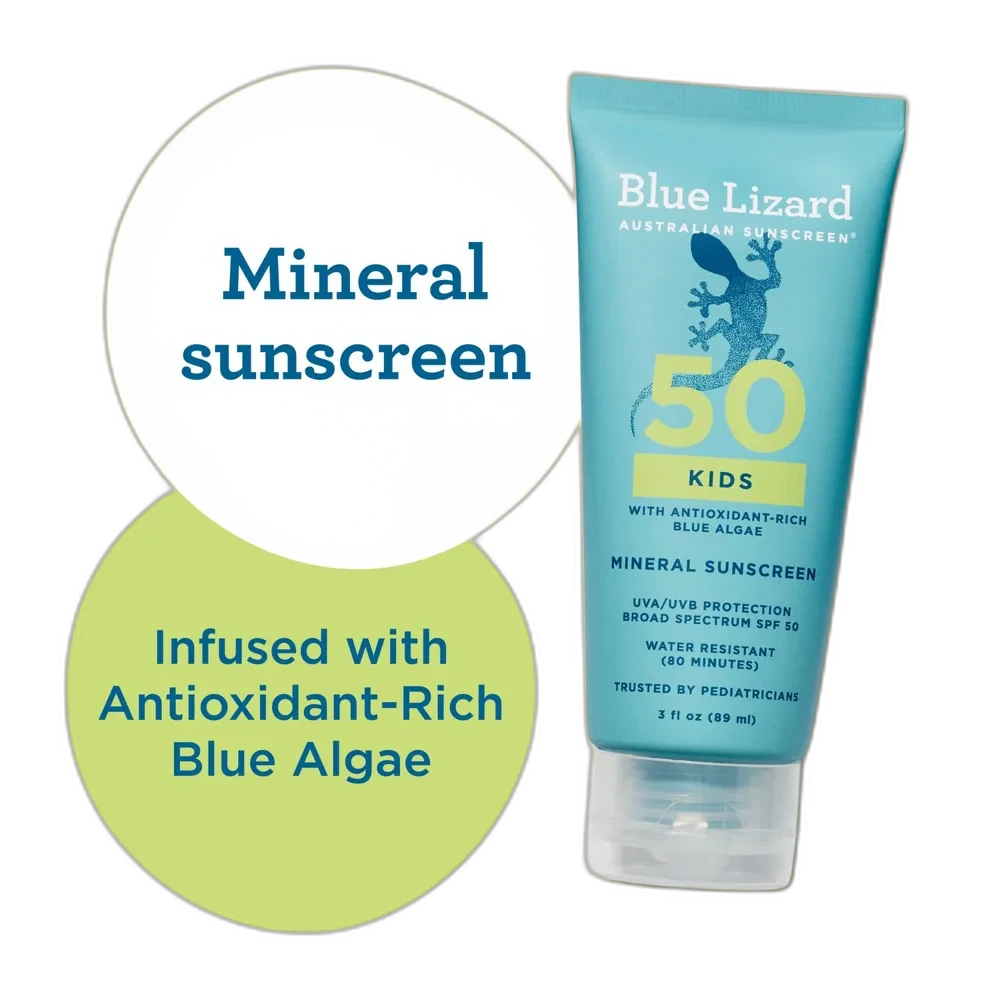
Kids Mineral Sunscreen SPF 50+
Active Kids SPF
 Verified reviewer
Pros & cons.
- +Easier to spread than the 100% mineral Baby formula, reducing application time for active children
- +Full 10% zinc oxide maintains robust UVA protection matching the Baby formula
- +80-minute water resistance at FDA maximum provides reliable outdoor and swimming protection
- +Excellent value at approximately $3 per ounce for SPF 50+ protection
- +Fragrance-free with no oxybenzone, octinoxate, or parabens
- +SmartCap UV-reactive technology provides a helpful visual cue for parents
- +Reduced white cast compared to the 100% mineral formulas
- −Contains octisalate (chemical UVB filter) despite 'mineral sunscreen' marketing
- −Still leaves some white cast, particularly on deeper skin tones
- −Beeswax makes the formula non-vegan
- −Can feel greasy and heavy in hot, humid conditions
- −Not suitable for parents seeking a strictly 100% mineral formula
The full review.
There’s a scene that plays out at every pool, beach, and park across the country every summer: a parent wrestling a squirming child who has zero interest in standing still for sunscreen application. The thicker the sunscreen, the longer the battle. And the longer the battle, the more likely patches of skin get missed. Blue Lizard seems to have studied this particular form of domestic warfare carefully, because the Kids formula is designed to solve a problem that the brand’s excellent Baby formula couldn’t: application speed.
The solution Blue Lizard chose is pragmatic but requires honesty. Despite the prominent ‘Mineral Sunscreen’ branding, the Kids formula includes 5% octisalate — a chemical UVB absorber — alongside the mineral actives. This matters because many parents specifically choose Blue Lizard to avoid chemical UV filters, and the Kids formula doesn’t deliver on that expectation. The Baby formula is truly 100% mineral. The Sensitive formula is truly 100% mineral. The Kids formula is a hybrid.
But here’s the thing: that hybrid approach solves a real problem. Octisalate allows the formula to reduce the titanium dioxide from 8% (in the Baby formula) to 5.36%. That reduction directly translates to improved spreadability, faster application, and less white cast. When your audience is a five-year-old who is going to give you approximately forty-five seconds of cooperation before sprinting toward the water, those improvements aren’t cosmetic luxuries — they’re the difference between adequate coverage and missed spots.
The zinc oxide stays at 10%, matching the Baby formula, which means the critical UVA protection — the wavelengths most associated with long-term skin damage and photoaging — is maintained at full strength. UVA rays penetrate deeper into the skin than UVB and are present at relatively constant levels year-round, making robust UVA protection the non-negotiable element of any children’s sunscreen. Blue Lizard didn’t compromise there.
The 80-minute water resistance is the FDA maximum, and it holds up well in practice. Kids splashing in pools, running through sprinklers, sweating on playgrounds — the formula maintains its protective barrier through activity that would defeat less robust formulations. The dimethicone and beeswax-based film resists water without being so occlusive that it feels like wearing a plastic bag in the sun.
The texture is the immediate differentiator from the Baby formula. It’s still thicker than a chemical sunscreen — no mineral sunscreen is going to feel like Coppertone — but it spreads with noticeably less effort. You can cover an arm or a leg in a single pass rather than the multiple rubbing sessions the Baby formula requires. For parents applying sunscreen to multiple children before a day outside, this time saving is meaningful.
The white cast is reduced but not eliminated. On lighter skin tones, it’s minimal. On darker skin tones, some residual cast will be visible, though less pronounced than the Baby version. The triethoxycaprylylsilane coating on the mineral particles helps, as does the lower mineral load overall.
Fragrance-free, paraben-free, and formulated without oxybenzone or octinoxate — the Kids formula meets all the basic safety criteria parents look for. The beeswax makes it non-vegan, which is worth noting for families with that preference. Octisalate, while a chemical filter, is one of the less controversial ones — it doesn’t have the endocrine disruption concerns of oxybenzone and is generally well-tolerated on children’s skin.
The SmartCap technology carries over from the rest of the Blue Lizard line, changing color under UV light to remind parents when protection is needed. It’s a small feature, but in practice, it’s one of those things that works exactly as intended — a quick visual check that costs nothing and prevents the ‘I forgot to reapply’ regret.
Value is excellent. At around $15 for 5 ounces, this is affordable enough to use liberally — which is exactly how sunscreen should be used on children. The instructions recommend generous application, and at this price point, parents can follow that advice without wincing at the cost.
The bottom line for parents: if 100% mineral is non-negotiable, choose the Baby formula. If practical wearability for active children matters more, the Kids formula delivers better application experience at the cost of including one chemical UV filter. Blue Lizard should be more transparent about this distinction in their marketing — the ‘mineral sunscreen’ label sets an expectation the product doesn’t fully meet. But as a sun protection product evaluated on its primary job of keeping kids’ skin safe from UV damage, it does that job well, affordably, and with the reliability of a brand that’s been focused on exactly this for three decades.
Formula
Ingredient analysis.
Full INCI list
Active Ingredients: Octisalate 5%, Titanium Dioxide 5.36%, Zinc Oxide 10%. Inactive Ingredients: Alumina, Aluminum Stearate, Beeswax, Butyloctyl Salicylate, C12-15 Alkyl Benzoate, Caprylic/Capric Triglyceride, Caprylyl Glycol, Cetyl Dimethicone, Cetyl PEG/PPG-10/1 Dimethicone, Diisopropyl Sebacate, Dimethicone, Disodium EDTA, Ethylhexylglycerin, Hexyl Laurate, Hydrogenated Castor Oil, Isostearyl Isostearate, L-Arginine, Methyl Glucose Dioleate, Methylpropanediol, Octyldodecyl Neopentanoate, PEG-7 Hydrogenated Castor Oil, Phenoxyethanol, Phenylpropanol, Polyglyceryl-4 Isostearate, Polyhydroxystearic Acid, Polyurethane-35, Propanediol, Purified Water, Sorbitan Oleate, Stearic Acid, Tocopheryl Acetate, Triethoxycaprylylsilane, Trimethylsiloxysilicate, VP/Hexadecene Copolymer
Skin match.
The science.
The Science
This hybrid formula uses mineral and chemical UV filtration. Zinc oxide (10%) provides broad-spectrum protection, especially in the UVA range (320-400nm), while titanium dioxide (5.36%) covers shorter-wavelength UVB and UVA2. Octisalate (ethylhexyl salicylate) at 5% absorbs UVB radiation in the 280-320nm range; this supplements the minerals and allows a lower titanium dioxide concentration than the purely mineral Baby formula.
The FDA's 2019 JAMA study on sunscreen absorption found that chemical UV filters like octisalate exceed the threshold for exemption from additional safety testing at maximum use conditions. However, the study's authors noted that exceeding this threshold does not mean the ingredients are unsafe—it means formal GRASE determination requires more safety data. The American Academy of Dermatology states that sunscreen benefits outweigh the potential risks of chemical UV filter absorption.
A film-forming matrix of beeswax, dimethicone, trimethylsiloxysilicate, and polyurethane-35 provides 80-minute water resistance. Studies on sunscreen water resistance testing (per FDA's 2011 monograph) show that water-resistant formulations keep a higher percentage of their initial SPF after water immersion than non-resistant formulas. Some protection loss is inevitable, which is why reapplication is mandatory.
References
- Effect of Sunscreen Application Under Maximal Use Conditions on Plasma Concentration of Sunscreen Active Ingredients — JAMA (2019)
Dermatologist Perspective
Pediatric dermatologists generally prioritize consistent sunscreen application over the specific UV filter type. Board-certified dermatologists call the hybrid mineral-chemical approach in this formula a reasonable compromise: the 10% zinc oxide mineral base provides robust UVA protection, while the octisalate improves application, which may increase compliance in children who resist thicker mineral sunscreens. For families committed to 100% mineral sun protection, dermatologists typically recommend the Baby or Sensitive formulas.
Guidance
Where it fits in your routine.
Apply a thick, even layer to all exposed skin at least 15 minutes before going outdoors. Use a nickel-to-quarter sized amount for each body area. Rub it in well, especially on ears, the back of the neck, and the tops of feet — areas children often miss. Reapply every 2 hours, or right after swimming, toweling off, or sweating heavily. The improved spreadability makes application faster than the Baby formula.
At about $15 for 5 ounces ($3 per ounce), the Kids formula offers the same value as the Baby formula. Both cost the same, so parents choose based on formula preference rather than budget. Blue Lizard's 30-year history and pediatrician recommendation provide credibility newer brands lack. For families using SPF 50+ daily on multiple children, this is a highly cost-effective option.
Parents of active children need a sunscreen that balances SPF 50+ protection with practical wearability. This works for kids who resist sunscreen application — improved spreadability and reduced white cast make application faster and less contentious.
Parents who specifically want a 100% mineral sunscreen with no chemical actives — choose Blue Lizard Baby or Sensitive instead. Families seeking a vegan formula should look elsewhere due to the beeswax content. Those with known sensitivity to salicylate-based ingredients should exercise caution.
Product details.
Unscented — no fragrance added
Available in squeeze bottle (5 oz) and tube (3 oz) formats. Features Blue Lizard's SmartCap technology that changes color under UV light. Kid-friendly blue/yellow color coding. Finish naturallightweight
It spreads easier than the Baby formula. The lower octisalate mineral load improves application. A white cast exists but is manageable. It does not sting or burn. The formula feels protective but is not heavy for active children.
1-2 months with regular full-body application on a child
12 months
spring summer
The backstory.
Blue Lizard designed the Kids formula to address a specific problem: parents who struggled to apply thick mineral sunscreen to active, impatient children. The hybrid mineral-chemical approach makes the formula more spreadable without abandoning mineral protection entirely. The addition of Blue Algae as an antioxidant reflects the brand's 2025 reformulation efforts to add skincare benefits beyond basic UV protection.
About Blue Lizard
Legacy Brand (20+ years)Blue Lizard started in Australia in 1995 and entered the US market in 1998, first via dermatologist offices. Crown Laboratories has owned Blue Lizard since 2000. ProVoice verifies Blue Lizard is the number one pediatrician-recommended mineral sunscreen brand in the US. Nearly 30 years of market presence and consistent dermatologist endorsement give Blue Lizard credibility in mineral sun protection.
Common myths.
Blue Lizard Kids is 100% mineral; the label says "mineral sunscreen."
The Kids formula uses octisalate (5%), a chemical UVB filter, with mineral actives. This makes it a hybrid mineral-chemical sunscreen. Parents wanting a 100% mineral formula should use the Baby or Sensitive versions.
Chemical sunscreen ingredients are unsafe for children.
Octisalate is an established chemical UV filter used in sunscreens for decades. The 2019 FDA study questioned systemic absorption of some chemical filters, but using octisalate at 5% in a primarily mineral formula is a conservative approach most dermatologists consider appropriate for children.
FAQ.
Is Blue Lizard Kids Sunscreen 100% mineral?
No — despite the 'mineral' branding, the Kids formula uses octisalate (5%), a chemical UVB filter, with titanium dioxide (5.36%) and zinc oxide (10%). This hybrid formula spreads easier for active children. For a strictly 100% mineral formula, use Blue Lizard Baby or Sensitive instead.
How is the Kids formula different from the Baby formula?
The Kids formula uses octisalate as a chemical UVB booster to lower the titanium dioxide concentration. This makes it easier to spread and reduces white cast, which works for active children who won't stay still during application. The Baby formula is 100% mineral (no chemical actives) and targets the most sensitive infant skin.
Is Blue Lizard Kids water resistant?
Yes — the formula has 80 minutes of water resistance, the FDA labeling maximum. Reapply after swimming, toweling off, or heavy sweating, and at least every 2 hours during sun exposure.
At what age can children start using Blue Lizard Kids?
Blue Lizard Kids works for children of all ages. For babies under 6 months, the American Academy of Pediatrics recommends shade and protective clothing for primary protection, using small amounts of mineral sunscreen on exposed areas when necessary — the Baby formula is designed specifically for infants.
Does Blue Lizard Kids leave a white cast?
The Kids formula has less white cast than the 100% mineral Baby and Sensitive formulas because octisalate reduces the mineral content. Some white cast remains—zinc oxide and titanium dioxide always cause this—but thorough application makes it more manageable.
What the community says.
"Easier to apply than the Baby formula with less white cast"
"Water resistant holds up well during swimming and active play"
"Affordable for a family-sized sunscreen"
"Fragrance-free and gentle on children's skin"
"SmartCap UV reminder is useful for parents"
"Contains octisalate despite 'mineral' branding which confuses parents"
"Still leaves some white cast, though less than the Baby formula"
"Can feel greasy in hot weather"
"Thick consistency can be hard for kids to apply themselves"
"Contains beeswax which is non-vegan"
People also looked at.