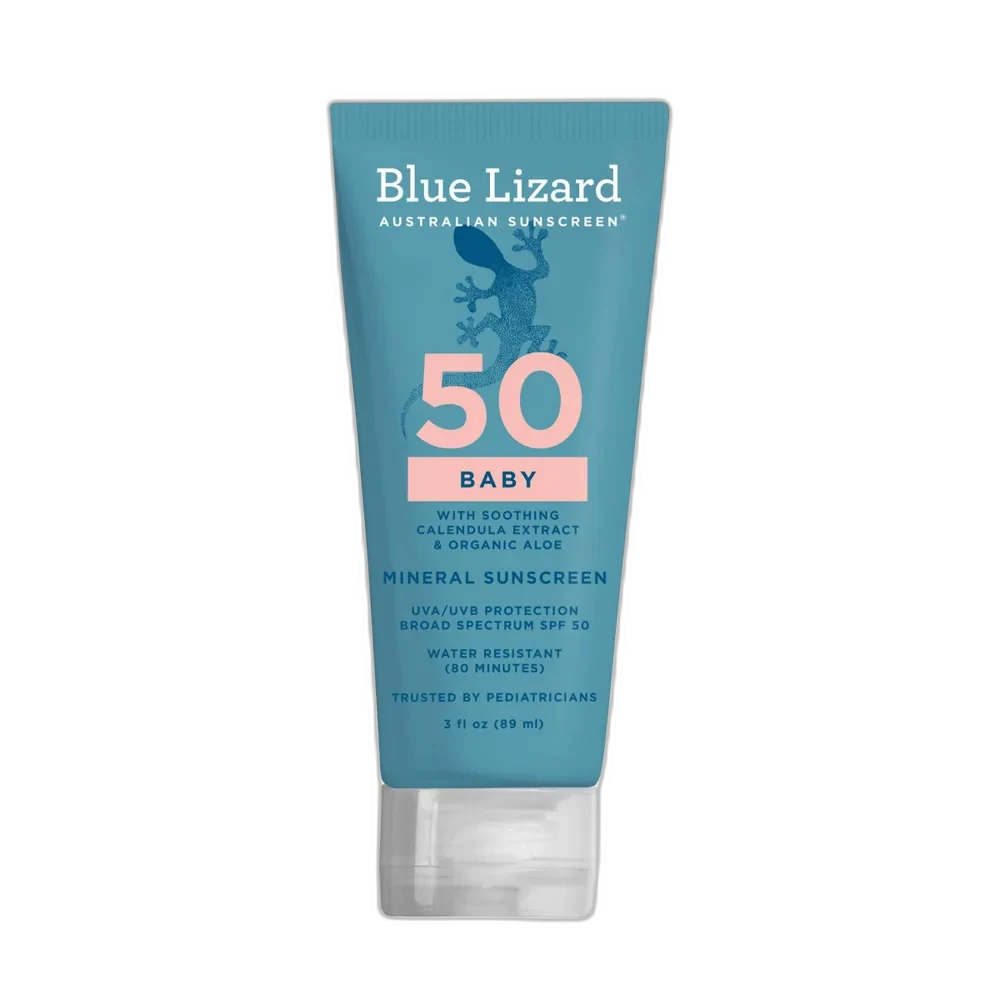
Baby Mineral Sunscreen SPF 50+
Pediatrician's Top Pick
 Verified reviewer
Pros & cons.
- +100% mineral formula with zero chemical UV filters — the safest option for infant skin
- +Number one pediatrician-recommended mineral sunscreen brand in the United States
- +80-minute water resistance at the maximum FDA-allowed level for reliable outdoor protection
- +Completely fragrance-free with no essential oils or masking scents
- +Exceptional value at approximately $3 per ounce for a premium mineral SPF 50+
- +SmartCap UV-reactive technology provides a practical visual cue for UV intensity
- +Nearly 30 years of brand heritage backed by Australian sun protection standards
- −Thick, paste-like texture requires significant effort to spread evenly
- −Leaves a noticeable white cast that's particularly visible on deeper skin tones
- −Can feel heavy and occlusive in hot, humid conditions
- −Contains beeswax, making it unsuitable for vegan households
- −Not cosmetically elegant enough for most adults' daily facial use
The full review.
Australia has the highest rate of skin cancer on Earth. When you grow up there, sunscreen isn’t a wellness trend or a skincare step — it’s a public health measure, drilled into kids through the ‘Slip, Slop, Slap’ campaigns that have been running since the 1980s. Blue Lizard came out of that culture in 1995, and it shows. This is not a sunscreen that’s trying to be your moisturizer, your primer, or your skincare moment. It’s trying to stop UV radiation from reaching skin, and it does that job with the seriousness of a country that knows what happens when you don’t.
The Baby formula is Blue Lizard’s most cautious offering — a product designed for the most vulnerable skin that exists. The active ingredients are simple and unambiguous: 10% zinc oxide and 8% titanium dioxide. That’s it. No chemical UV filters, no hybrid approach, no compromises. Both minerals are FDA-approved, GRASE-classified, and have decades of safety data behind them. They work by sitting on the skin’s surface and physically reflecting UV radiation, meaning nothing is absorbed through the stratum corneum into the body. For parents concerned about what goes on their baby’s skin, this is as straightforward as sun protection gets.
The formula surrounding those minerals is equally no-nonsense. There’s no fragrance — not ‘lightly scented,’ not ‘naturally fragranced,’ not ‘infused with essential oils.’ Zero. There are no chemical actives, no parabens, no oxybenzone, no octinoxate. The inactive ingredients are functional: dimethicone for spreadability, beeswax for water resistance, various emulsifiers to keep the formula stable. Tocopheryl acetate provides antioxidant backup. It reads like a formula designed by people who asked ‘what’s the minimum we need to make this work?’ rather than ‘what can we add to make this marketable?‘
Texture
Let’s talk about the elephant in the room: the texture. This sunscreen is thick. It is paste-like. It requires effort to spread. If you’re used to the fluid, almost water-like chemical sunscreens that dominate the market, applying Blue Lizard Baby will feel like spreading spackle on a wall. It takes time, it takes patience, and it leaves a visible white cast that no amount of rubbing will completely eliminate — especially on deeper skin tones. There’s no getting around this. It is the fundamental trade-off of a high-concentration mineral sunscreen.
Reality
But here’s what’s worth understanding: that white cast is the protection. You can literally see the mineral barrier sitting on the skin, doing its job. Modern mineral sunscreens have gotten clever at micronizing particles and using cosmetically elegant bases to minimize the cast, but those formulation tricks sometimes come at the cost of protection uniformity. Blue Lizard doesn’t chase elegance. It chases coverage.
Works for
The 80-minute water resistance is the maximum allowed under FDA labeling rules, and it holds up well in real-world testing. Kids splashing in pools, drooling, sweating — the formula stays put better than most. The dimethicone and beeswax create a film that resists water without being completely occlusive. Reapplication is still essential after swimming or toweling off, but you can trust that the initial application is doing its job until then.
Packaging
The SmartCap technology deserves mention because it’s genuinely useful rather than gimmicky. The bottle cap contains UV-reactive material that changes from white to blue or purple when exposed to UV radiation. Leave the bottle in the shade and the cap stays white. Put it in sunlight and it shifts color, providing an instant visual cue about UV intensity. For parents trying to judge whether ‘it’s not that sunny today’ actually means anything, it’s a simple, low-tech solution to a real problem.
Common Praise
Blue Lizard’s pediatrician recommendation — number one in the US as verified by ProVoice — isn’t just a marketing claim. It reflects the reality that this formula has been recommended in clinical settings for years before it ever appeared on a Walmart shelf. The brand spent its early US years selling through dermatology offices, building credibility one patient recommendation at a time. That slow-burn approach to market credibility means something different than a brand that launches with an influencer campaign.
Best for
The value proposition is excellent. At around $15 for 5 ounces, this is significantly cheaper per ounce than most clean beauty mineral sunscreens. The 3-ounce tube is available for those who want a more portable option. Either way, the price-per-application is remarkably reasonable for a 100% mineral SPF 50+ product.
Not ideal for
The practical limitations are straightforward. The thick texture makes it less suitable as a face-only sunscreen for adults who want cosmetic elegance — Blue Lizard makes a separate Sheer Face product for that purpose. The beeswax makes it non-vegan. And the white cast is a genuine issue for anyone with medium to deep skin tones who wants to wear this visibly.
But Blue Lizard Baby isn’t trying to be everything. It’s trying to be the safest, most reliable mineral sunscreen you can put on a baby, and it succeeds at that singular mission with the quiet confidence of a brand that’s been doing exactly this for three decades. No hype, no viral moments, no celebrity endorsements. Just zinc oxide, titanium dioxide, and the institutional knowledge of a country that takes sun protection seriously.
Formula
Ingredient analysis.
Full INCI list
Active Ingredients: Titanium Dioxide 8%, Zinc Oxide 10%. Inactive Ingredients: Alumina, Aluminum Stearate, Beeswax, C12-15 Alkyl Benzoate, Caprylyl Glycol, Cetyl Dimethicone, Cetyl PEG/PPG-10/1 Dimethicone, Chlorphenesin, Dimethicone, Disodium EDTA, Ethylhexyl Palmitate, Ethylhexyl Stearate, Hexyl Laurate, Hydrogenated Castor Oil, Methyl Glucose Dioleate, Octyldodecyl Neopentanoate, PEG-7 Hydrogenated Castor Oil, Phenoxyethanol, Polyglyceryl-4 Isostearate, Polyhydroxystearic Acid, Propanediol, Purified Water, Sorbitan Oleate, Stearic Acid, Tocopheryl Acetate, Trimethylsiloxysilicate, VP/Hexadecene Copolymer
Skin match.
The science.
The Science
The FDA classifies zinc oxide and titanium dioxide as the only two GRASE (Generally Recognized as Safe and Effective) UV filters. This means they have enough evidence of safety and efficacy to bypass the extra testing required for chemical UV filters. Using both minerals provides complementary UV coverage: titanium dioxide absorbs and scatters shorter-wavelength UVB radiation (290-320nm), while zinc oxide covers the broader UVA range (320-400nm).
The 10% zinc oxide and 8% titanium dioxide concentrations reach SPF 50+, blocking about 98% of UVB radiation. These minerals use a physical mechanism—reflecting and scattering UV photons instead of absorbing and converting them to heat like chemical filters. This matters for infant skin: a 2019 FDA study in JAMA shows that chemical sunscreen actives (avobenzone, oxybenzone, octocrylene, and ecamsule) enter the bloodstream at levels above the FDA's safety testing waiver threshold after one use. Mineral filters do not absorb significantly because of their large particle size.
Beeswax and silicone (dimethicone/trimethylsiloxysilicate) create the matrix that keeps mineral particles on the skin surface for 80-minute water resistance. Studies in the Journal of the American Academy of Dermatology show that even water-resistant formulations lose protection after water immersion, so you must reapply after swimming.
References
- Effect of Sunscreen Application Under Maximal Use Conditions on Plasma Concentration of Sunscreen Active Ingredients — JAMA (2019)
Dermatologist Perspective
Pediatric dermatologists recommend 100% mineral sunscreens for infants and children because they are safe. Board-certified dermatologists note that zinc oxide and titanium dioxide stay on the skin surface without penetrating the stratum corneum, making them the best UV filters for developing skin. Blue Lizard Baby's fragrance-free, chemical-active-free formula follows the American Academy of Dermatology's pediatric sun protection recommendations. Dermatologists often recommend this specific product for babies with eczema-prone or highly reactive skin, as the mineral-only formula avoids the contact sensitization risk found in some chemical UV filters.
Where it fits in your routine.
Apply a thick, even layer to all exposed skin at least 15 minutes before sun exposure. For babies over 6 months, apply to the face, arms, legs, and other exposed areas. Use a nickel-to-quarter sized amount per body area. Reapply every 2 hours, or after swimming, toweling off, or excessive sweating. For babies under 6 months, consult a pediatrician — the AAP recommends shade and protective clothing as primary protection at this age.
At about $15 for 5 ounces ($3 per ounce), Blue Lizard Baby offers high value for a mineral sunscreen. Premium 100% mineral SPF 50 sunscreens often cost $20-35 for 1.7-3 ounces. The brand's 30-year history and number one pediatrician recommendation provide credibility that expensive newcomers lack. A 3-ounce tube is also available for travel. For families applying sunscreen to children daily during summer, the cost-per-application is budget-friendly.
Parents want the safest, most reliable mineral sunscreen for babies and toddlers over 6 months. It also works for adults with sensitive, eczema-prone, or reactive skin who prioritize protection and ingredient safety over cosmetic elegance.
Adults wanting a cosmetically elegant daily facial sunscreen can use Blue Lizard's separate Sheer Face product. People needing a vegan formula should skip this due to the beeswax. Those with deeper skin tones who dislike a white cast may prefer a tinted mineral sunscreen.
Product details.
Thick mineral lotion with a paste-like consistency. It needs more rubbing to spread than chemical sunscreens. It sets to a slightly white, protective film.
Unscented — no fragrance of any kind
Available in both squeeze bottle (5 oz) and tube (3 oz) formats. Features Blue Lizard's signature SmartCap technology — the cap changes color from white to blue/purple when exposed to harmful UV rays, serving as a visual reminder that sun protection is needed.
The thick texture takes time to spread evenly; this formula does not absorb quickly. A visible white cast appears and requires rubbing to minimize. The texture is heavier than many modern mineral sunscreens, but it shows a substantial mineral barrier is applied. It causes no stinging, burning, or irritation — even on the most sensitive infant skin.
1-2 months with regular full-body application on a child
12 months
spring summer
The backstory.
Blue Lizard was born in Australia — the country with the highest rates of skin cancer in the world and correspondingly the strictest sunscreen standards. When Crown Laboratories brought it to the US in the late 1990s, they initially sold it through dermatologist offices, building clinical credibility before retail expansion. The Baby formula represents the brand's most cautious, stripped-down formulation: zero chemical actives, zero fragrance, and only the most essential inactive ingredients needed to make the minerals wearable.
About Blue Lizard
Legacy Brand (20+ years)Blue Lizard started in Australia in 1995 and entered the US market in 1998, first through dermatologist offices. Crown Laboratories has owned Blue Lizard since 2000. ProVoice verifies Blue Lizard is the number one pediatrician-recommended mineral sunscreen brand in the US. Nearly 30 years of market presence and consistent dermatologist endorsement give Blue Lizard credibility in mineral sun protection.
Common myths.
Babies don't need sunscreen because their skin is too sensitive for it.
The American Academy of Pediatrics recommends sunscreen for babies over 6 months. For babies under 6 months, use shade and protective clothing. Small amounts of mineral sunscreen on exposed areas are acceptable if other protection is unavailable.
Sunscreen that leaves a white cast does not work properly.
The white cast from mineral sunscreens like this one shows that zinc oxide and titanium dioxide particles sit on the skin's surface. This placement is where they reflect UV radiation. The cast is the protection at work.
FAQ.
Is Blue Lizard Baby Sunscreen safe for newborns?
The American Academy of Pediatrics recommends shade and protective clothing instead of sunscreen for babies under 6 months. For babies 6 months and older, this 100% mineral formula with zinc oxide and titanium dioxide is one of the safest options because the minerals sit on the skin surface without absorption.
Does Blue Lizard Baby Sunscreen leave a white cast?
Yes — this 100% mineral sunscreen uses 10% zinc oxide and 8% titanium dioxide, so it leaves a visible white cast. This is inherent to mineral UV filters and shows the protective particles sit on the skin surface. Rubbing thoroughly minimizes the cast, but it won't disappear completely, especially on deeper skin tones.
Is Blue Lizard Baby Sunscreen water resistant?
Yes — this formula has 80 minutes of water resistance, the FDA maximum for sunscreen labeling. Reapply after swimming, toweling off, or heavy sweating, and at least every 2 hours during sun exposure.
Can adults use Blue Lizard Baby Sunscreen?
The Baby formula is the most gentle, stripped-down version of Blue Lizard's mineral sunscreens. Adults with sensitive, reactive, or eczema-prone skin often choose the Baby formula because it lacks all potential irritants. The SPF 50+ protection works just as well on adult skin.
What is the SmartCap on Blue Lizard sunscreen?
The SmartCap is Blue Lizard's signature technology. The bottle cap has UV-sensitive material that turns from white to blue or purple under harmful UV rays. This visual reminder shows when UV protection is needed, which helps parents track sun intensity quickly.
What the community says.
"Completely fragrance-free and gentle on baby's sensitive skin"
"Excellent broad-spectrum protection with 100% mineral actives"
"80-minute water resistance holds up well during water play"
"Affordable price for a high-quality mineral sunscreen"
"SmartCap technology is a clever reminder to apply"
"Leaves a noticeable white cast, especially on deeper skin tones"
"Thick, paste-like texture can be difficult to spread evenly"
"Can feel heavy and greasy in hot weather"
"Takes effort to rub in completely"
"Contains beeswax which makes it non-vegan"
People also looked at.