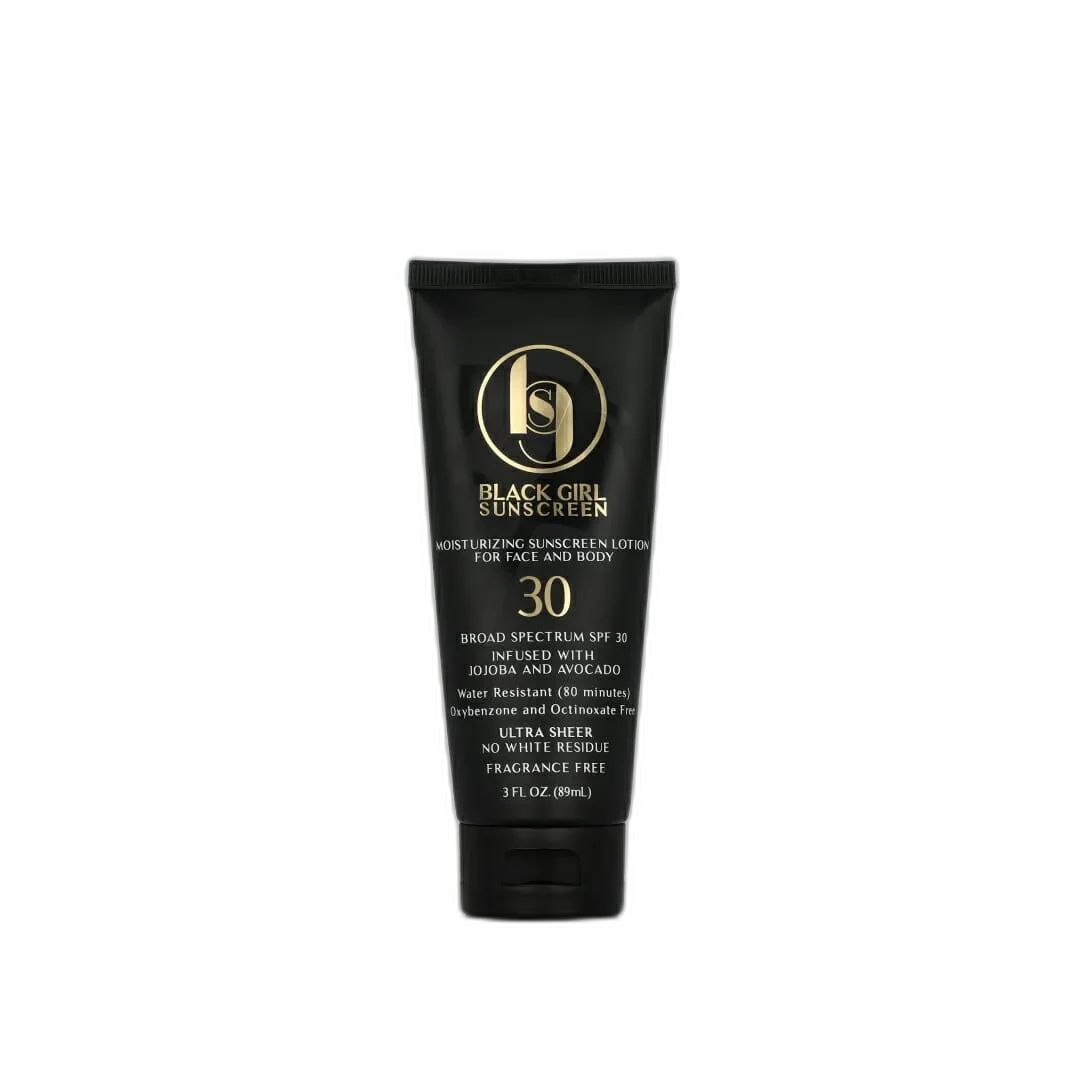
SPF 30 Broad Spectrum Sunscreen
Melanin-Friendly Pioneer
 Verified reviewer
Pros & cons.
- +Truly invisible finish on melanin-rich skin with zero white or gray cast
- +Moisturizing botanical oil base eliminates need for separate AM moisturizer on dry skin
- +Fragrance-free formula reduces irritation risk from a chemical sunscreen
- +Lightweight lotion texture absorbs quickly and layers well under makeup
- +80-minute water resistance provides decent durability for an everyday sunscreen
- +Affordable price point under $16 for the standard 3 oz size
- +Cruelty-free and vegan with no oxybenzone or octinoxate
- −Oil-rich formula feels too heavy on oily and acne-prone skin types
- −SPF 30 is adequate for daily use but insufficient for extended outdoor exposure
- −Homosalate at maximum 10% concentration is under FDA review for additional safety data
- −Not fungal-acne safe due to botanical oils and cocoa butter
- −Cocoa butter and sorbitan oleate may clog pores on breakout-prone skin
The full review.
Shontay Lundy used $33,000 of her savings to solve a problem the sunscreen industry ignored for decades: people with darker skin tones skipped sun protection because every product left them looking ashy, gray, or purple. Black Girl Sunscreen launched in 2016 as a practical answer to a practical question—can we make a sunscreen that actually disappears on brown and dark skin?
The answer is yes, and the formula is straightforward. The UV protection uses a standard four-filter chemical system: avobenzone at 3% handles UVA coverage, homosalate at 10% (the FDA maximum) carries most of the UVB load, octisalate at 5% adds supplementary UVB absorption, and octocrylene at 2.75% acts as both a UV absorber and an avobenzone stabilizer. This common combination delivers solid broad-spectrum protection at SPF 30.
The UV filters aren’t what sets this formula apart; it is the inactive ingredients. The list reads like a body oil: avocado oil, jojoba seed oil, sunflower seed oil, cocoa seed butter, carrot seed oil, and aloe vera. These botanical emollients do two things. First, they provide the slip and absorption that allows the sunscreen to vanish on application without leaving white or gray residue. Second, they make the product feel like a light moisturizer rather than a chemical sunscreen.
The texture is a smooth, lightweight lotion that spreads easily and sinks in within about a minute. On deeper skin tones, the finish is virtually invisible. On lighter skin, it leaves a subtle dewy quality that works under makeup. The formula is fragrance-free, which avoids adding more potential sensitizers to a four-filter chemical sunscreen. A faint natural scent from the botanical oils disappears almost immediately.
Independent testing shows this sunscreen reduces UV exposure by roughly 82%, which matches expectations for a well-formulated SPF 30. The 80-minute water resistance claim is standard for this filter combination. This provides adequate protection for daily commuting, errands, and incidental sun exposure. For a day at the beach or extended outdoor activity, use something with higher SPF and more frequent reapplication.
The moisturizing quality is the product’s greatest strength and its most obvious limitation. If you have normal-to-dry skin, the oil-rich base means the sunscreen does the job of a morning moisturizer. But if your skin is oily, particularly in the T-zone, this richness can feel heavy and cause midday shine. The cocoa butter and avocado oil are excellent emollients but do not create a mattifying formula.
The active ingredient lineup is effective but does not push boundaries. Homosalate at the 10% FDA maximum has drawn scrutiny, as the FDA requested additional safety data on this filter and most other chemical UV filters. Dermatological organizations maintain that the proven benefits of UV protection outweigh theoretical absorption concerns.
The formula is not fungal-acne safe. The combination of oils and cocoa butter makes it a poor fit for anyone prone to comedonal acne or fungal folliculitis. A minority of users with eczema have reported flare-ups.
Black Girl Sunscreen succeeds through accessibility—not just in price, but by making sunscreen welcoming to people excluded by the category’s default aesthetic. When sunscreen makes you look worse, you stop wearing it. This is a public health problem, not a vanity problem. Black Girl Sunscreen changed behavior, which matters more than having the most elegant INCI list on the shelf.
Formula
Texture
The texture is a smooth, lightweight lotion that spreads easily and sinks in within about a minute. On deeper skin tones, the finish is virtually invisible. On lighter skin, it leaves a subtle dewy quality that works under makeup.
Scent
The formula is fragrance-free, which avoids adding more potential sensitizers to a four-filter chemical sunscreen. A faint natural scent from the botanical oils disappears almost immediately.
Best for
This provides adequate protection for daily commuting, errands, and incidental sun exposure.
Works for
If you have normal-to-dry skin, the oil-rich base means the sunscreen does the job of a morning moisturizer.
Not ideal for
If your skin is oily, particularly in the T-zone, this richness can feel heavy and cause midday shine. The cocoa butter and avocado oil are excellent emollients but do not create a mattifying formula.
The formula is not fungal-acne safe. The combination of oils and cocoa butter makes it a poor fit for anyone prone to comedonal acne or fungal folliculitis. A minority of users with eczema have reported flare-ups.
Ingredient analysis.
Full INCI list
Active Ingredients: Avobenzone 3%, Homosalate 10%, Octisalate 5%, Octocrylene 2.75%. Inactive Ingredients: Acrylates/C10-30 Alkyl Acrylate Crosspolymer, Acrylates/C12-22 Alkyl Methacrylate Copolymer, Aloe Barbadensis Leaf Juice, Butylphthalimide, Carbomer, Daucus Carota Sativa (Carrot) Seed Oil, Disodium EDTA, Ethylhexylglycerin, Helianthus Annuus (Sunflower) Seed Oil, Hydroxypropyl Methylcellulose, Isopropylphthalimide, Lecithin, Persea Gratissima (Avocado) Oil, Phenoxyethanol, Propylene Glycol, Simmondsia Chinensis (Jojoba) Seed Oil, Sodium Hydroxide, Sorbitan Oleate, Theobroma Cacao (Cocoa) Seed Butter, Tocopheryl Acetate, Water
Skin match.
The science.
The Science
The four-filter UV protection system in this sunscreen represents a well-established approach to broad-spectrum coverage. Avobenzone remains the gold standard for UVA1 protection in the United States, absorbing wavelengths in the 310-400nm range where UVA rays cause photoaging and trigger melanin overproduction that leads to hyperpigmentation. A key formulation consideration is avobenzone's inherent photolability — it degrades when exposed to the very UV light it's designed to absorb. The inclusion of octocrylene addresses this directly, as octocrylene acts as a photostabilizer for avobenzone, a relationship documented in photoprotection research (Lhiaubet-Vallet et al., Journal of Photochemistry and Photobiology B, 2010).
Homosalate at 10% and octisalate at 5% provide the UVB absorption responsible for the SPF 30 rating. A 2020 randomized clinical trial published in JAMA (Matta et al.) demonstrated that all four of these chemical filters are systemically absorbed above the FDA's 0.5 ng/mL threshold after maximal application, prompting the agency to request additional safety studies. Importantly, this finding represents a data gap, not a safety determination — the American Academy of Dermatology and most dermatological organizations continue to recommend chemical sunscreens as safe and effective.
The botanical oil blend serves a purpose beyond aesthetics. Jojoba oil's molecular structure closely resembles human sebum, which aids in even distribution across the skin surface. Avocado oil contributes phytosterols and oleic acid that support skin barrier function. Independent UV testing of this specific product showed 81.65% UV Index reduction, 81.94% UVA filtration, and 76.43% UVB blocking — consistent with a well-formulated SPF 30 product.
References
- Effect of Sunscreen Application on Plasma Concentration of Sunscreen Active Ingredients: A Randomized Clinical Trial — JAMA (2020)
Dermatologist Perspective
Dermatologists widely agree that the best sunscreen is the one you'll actually wear, and Black Girl Sunscreen addresses a legitimate barrier to daily SPF compliance in communities with melanin-rich skin. Board-certified dermatologists note that the white-cast problem is more than cosmetic — it directly impacts adherence to sun protection recommendations, particularly for preventing hyperpigmentation and post-inflammatory dark spots that disproportionately affect darker skin tones. The SPF 30 broad-spectrum rating meets the Skin Cancer Foundation's minimum recommendation for daily use. Dermatologists typically suggest this product for patients with normal-to-dry skin seeking an everyday chemical sunscreen, while directing those with oily or acne-prone skin toward mattifying mineral or hybrid alternatives.
Where it fits in your routine.
Apply a thick layer to face and body 15 minutes before sun exposure. Use a nickel-sized amount for the face and a shot-glass amount for exposed body areas. Reapply every two hours during continuous sun exposure, or immediately after swimming, sweating, or towel-drying. The moisturizing formula works as a morning moisturizer for normal-to-dry skin — apply after cleansing and any treatment serums. For oily skin, use a lightweight, oil-free moisturizer underneath and apply this sunscreen in thin layers.
At $15.99 for 3 oz (a 2 oz travel size is also available), Black Girl Sunscreen has a reasonable price for an indie brand. The cost per ounce competes with mass-market sunscreens from larger brands. This is notable because this independently owned company lacks the manufacturing scale of conglomerates. The moisturizing formula replaces a separate morning moisturizer, adding value for dry-skin users. For its specific purpose — an invisible-finish chemical sunscreen formulated for melanin-rich skin — the price is fair, even though the ingredient technology is straightforward rather than premium.
People with melanin-rich skin who skip sunscreen to avoid white-cast. It also works for normal-to-dry skin of any tone wanting a moisturizing chemical sunscreen that acts as a lightweight daily moisturizer.
Oily or acne-prone skin types will find this formula too thick and potentially pore-clogging. People with fungal acne should avoid the botanical oils and cocoa butter. This formula lacks SPF 50+ for extended outdoor exposure.
Product details.
Unscented — no added fragrance. Botanical oils leave a faint natural scent that dissipates quickly.
Opaque squeeze tube available in 2 oz travel size and 3 oz standard size.
The lotion spreads smoothly on first application and absorbs within 30-60 seconds. It leaves no visible residue on melanin-rich skin tones. The moisturizing effect shows immediately. Most users will not feel tingling or irritation.
2-3 months with daily face application from the 3 oz tube
12 months
All Year
The backstory.
Founded in 2016 by Shontay Lundy after she couldn't find a sunscreen that didn't leave white residue on her skin, Black Girl Sunscreen was bootstrapped with $33,000 in personal savings. It became the first Black-owned sunscreen brand stocked in Target, Walmart, and Ulta, helping normalize daily sunscreen use in communities where the white-cast problem had been a genuine barrier to sun protection.
About Black Girl Sunscreen
Emerging Brand (2–5 years)Shontay Lundy founded Black Girl Sunscreen in 2016 to solve the white-cast problem that stops people with melanin-rich skin from daily sunscreen use. Black Girl Sunscreen is the first Black-owned sunscreen company in Target, Walmart, and Ulta. The brand builds credibility through inclusive formulation and community trust instead of clinical research partnerships.
Common myths.
Melanin provides enough protection that people with dark skin do not need sunscreen.
Melanin offers some natural UV protection (roughly SPF 4-13), but this does not prevent sun damage, hyperpigmentation, or skin cancer. This sunscreen addresses the barriers that stop people with darker skin from wearing daily SPF.
Chemical sunscreens are unsafe because they enter the bloodstream.
FDA studies found chemical UV filters in blood above 0.5 ng/mL, which prompted calls for more safety data rather than a finding of harm. The filters in this product (avobenzone, homosalate, octisalate, octocrylene) have decades of safe topical use. Dermatologists say the known risks of unprotected UV exposure outweigh theoretical absorption concerns.
FAQ.
Does Black Girl Sunscreen SPF 30 leave a white cast?
No — the product delivers on its core promise. The chemical UV filter system (avobenzone, homosalate, octisalate, octocrylene) absorbs UV light instead of reflecting it. The botanical oil base helps the formula melt into all skin tones without a white, gray, or purple cast.
Is Black Girl Sunscreen SPF 30 enough protection for daily use?
SPF 30 blocks about 97% of UVB rays. Most dermatologists consider this level adequate for daily incidental exposure. For extended outdoor activities, beach days, or high-UV environments, use a higher SPF or reapply more often than every two hours.
Can I use Black Girl Sunscreen SPF 30 under makeup?
Yes — the lightweight, quick-absorbing formula works well under makeup. The moisturizing oils create a smooth foundation base, and the lack of white cast does not change your skin tone. Wait 1-2 minutes for full absorption before applying makeup.
Is Black Girl Sunscreen SPF 30 good for oily skin?
This formula works best for normal, dry, and combination skin. The avocado oil, jojoba oil, sunflower oil, and cocoa butter create a thick base that feels heavy or adds shine to oily skin. People with oily skin can use the brand's Make It Matte SPF 45 instead.
Is Black Girl Sunscreen SPF 30 reef safe?
This sunscreen lacks oxybenzone and octinoxate, the two UV filters Hawaii and Key West most often restrict via reef-protection legislation. It does contain octocrylene, which some studies flag. It meets most current 'reef safe' legal definitions but lacks reef-safe certification.
Is Black Girl Sunscreen only for Black skin?
This sunscreen works on all skin tones, despite its name. It solves the white-cast problem that affects darker skin tones most, but the invisible finish and moisturizing formula appeal to everyone. Anyone wanting a chemical sunscreen that disappears completely can use it.
How often should I reapply Black Girl Sunscreen SPF 30?
Reapply every two hours during continuous sun exposure, or immediately after swimming or heavy sweating. The formula is water-resistant for 80 minutes, but you must reapply to maintain protection — no sunscreen provides all-day coverage from a single application.
What the community says.
"No white cast on dark skin tones"
"Feels like a moisturizer rather than a sunscreen"
"Lightweight and non-greasy"
"Absorbs quickly without residue"
"Pleasant texture for daily use"
"SPF 30 may not be sufficient for extended outdoor exposure"
"Can feel slightly greasy on oily skin"
"Some users with eczema reported breakouts"
"Oil-based formula not ideal for acne-prone skin"
People also looked at.