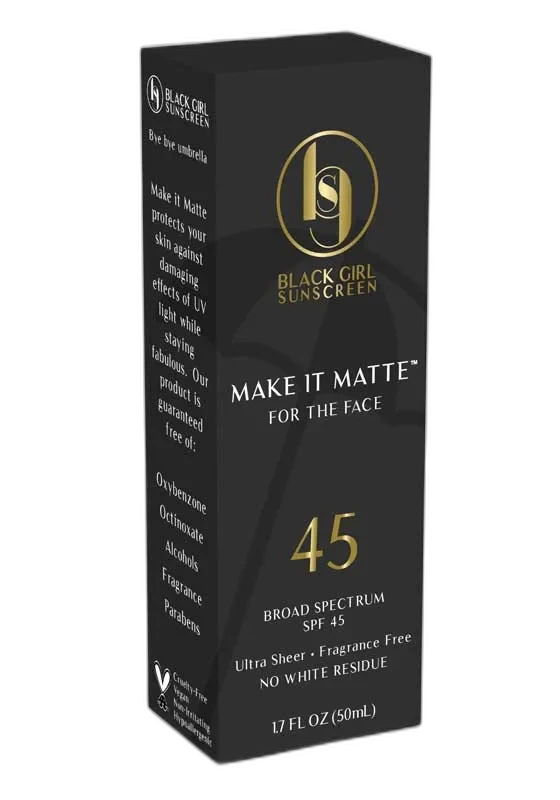
Make It Matte SPF 45
Shine-Control Sun Shield
 Verified reviewer
Pros & cons.
- +Absolutely no white cast on melanin-rich skin — completely invisible application
- +Four-filter broad-spectrum SPF 45 provides robust UV protection
- +Gel texture is lighter and less greasy than cream sunscreens
- +Works well as a makeup primer once fully set
- +Fragrance-free and paraben-free formulation
- +Affordable at $17.99 and widely available at mass retailers
- −Matte finish claim is only partially delivered — closer to satin than true matte
- −Takes 1-2 minutes to set and can feel tacky before fully absorbing
- −Contains coconut oil, which is comedogenic and counterintuitive for oily skin
- −Can transfer to phone screens, clothing, and hands throughout the day
- −Very oily skin types may experience breakthrough shine by midday
- −Only 1.7 oz — small size for the price compared to body sunscreens
The full review.
Black Girl Sunscreen built its reputation on one idea: sunscreen that does not make dark skin look ashy. The original formula proved the concept. The Kids SPF 50 extended it to children. Then came Make It Matte, the brand’s attempt to solve a second problem for melanin-rich sunscreen wearers: the shine most chemical sunscreens leave behind.
The logic is sound. Chemical UV filters avoid white-cast by absorbing UV light rather than reflecting it, but they use oily or emollient bases that leave a dewy-to-greasy finish—especially on skin that produces abundant sebum. This frustrates anyone wearing makeup over sunscreen or trying to avoid a reflective look during a workday. Make It Matte aims to balance these needs: chemical filters for invisible protection, gel texture for lightweight wear, and silica-based mattifying agents for shine control.
The UV filter system improves on the Kids formula. Four chemical filters—avobenzone at 3%, homosalate at 10%, octisalate at 5%, and octocrylene at 10%—deliver broad-spectrum SPF 45. The octocrylene is notable because it absorbs UV and stabilizes avobenzone, which is prone to photodegradation. This combination maintains protection better during sun exposure than simpler three-filter systems.
The gel format is lightweight. It spreads easily, and a nickel-sized amount covers the face. There is no white cast—no ashiness at all. Black Girl Sunscreen delivers on this promise. The gel is clear and stays clear on every skin tone.
The matte claim is more complex. User experiences vary. Some find the silica-based finish adequately matte, noting it controls shine and works as a makeup base. Others describe a silicone-heavy feel—a slippery, slightly tacky sensation that never reaches a true matte finish. Skin type likely dictates this: those with moderately oily skin find the mattifying effect sufficient, while those with very oily skin see breakthrough shine within hours.
This sunscreen produces a satin finish rather than the powder-dry matte the name implies. If you expect a setting powder or a truly oil-free mattifying primer, it will not meet that expectation. If you compare it to a standard dewy sunscreen, it is meaningfully less shiny. The matte-ness is relative.
The inactive ingredient list includes coconut oil. Including a comedogenic oil in a product for oily skin is a puzzling choice. Its concentration is likely low, as it sits deep in the inactive list, but acne-prone users who scan for coconut-derived oils will find this a legitimate concern. This detail matters to the target audience of oily-skinned consumers.
Squalane and aloe vera provide comfort, preventing the formula from feeling drying despite the silica mattifying agents. This is a balanced approach—pure mattifying formulas can leave skin feeling tight and stripped, which triggers reactive oil production. Squalane keeps skin comfortable without adding visible shine.
The texture needs a brief setting period. Unlike water-light Japanese gel sunscreens that absorb in seconds, Make It Matte needs one or two minutes to set. During this time, the product feels tacky and transfers to anything touching your face. Once set, it holds up reasonably well, though some users report transfer to phone screens and clothing.
At $17.99 for 1.7 fluid ounces, the price is fair for a face-specific sunscreen with four UV filters. It costs less than many comparable products at Sephora and is available at Target, Ulta, CVS, and Walmart. For a specialized face sunscreen in mass-market retail, this is reasonable value.
The product delivers about seventy percent of its promise. The no-white-cast claim is fulfilled completely—this remains Black Girl Sunscreen’s core competency. The broad-spectrum protection is robust due to the four-filter system. The matte finish is partial—better than most sunscreens, but not as good as the name suggests. For melanin-rich consumers with oily skin seeking an invisible, non-greasy option, this is worth trying. It is not a perfect solution, but it is a meaningful improvement over most alternatives, and the brand continues to address the specific needs of an underserved market.
Ingredient analysis.
Full INCI list
Active Ingredients: Avobenzone 3%, Homosalate 10%, Octisalate 5%, Octocrylene 10%. Inactive Ingredients: Aloe Barbadensis Leaf Juice, Butyrospermum Parkii (Shea) Butter, Cetyl Ethylhexanoate, Cocos Nucifera (Coconut) Oil, Diisopropyl Adipate, Diisopropyl Sebacate, Neopentyl Glycol Diethylhexanoate, Silica, Silica Silylate, Squalane, Tocopheryl Acetate, VP/Hexadecene Copolymer
Skin match.
The science.
The Science
This formula uses a four-filter UV protection system covering the UVA and UVB spectrum. Avobenzone (butyl methoxydibenzoylmethane) at 3% protects against UVA from 310-400 nm, peaking at 357 nm. To solve avobenzone's photostability issues, the formula includes 10% octocrylene. This acts as a triplet-state quencher, absorbing energy from degrading avobenzone to regenerate its protection.
Homosalate at 10% and octisalate at 5% cover UVB in the 295-315 nm range. These salicylate esters are gentle chemical UV filters with low sensitization potential, making the formula suitable for daily facial use. These four filters create overlapping absorption profiles to meet the broad-spectrum SPF 45 claim.
Silica and silica silylate provide mattification instead of high-alcohol formulations. Silica particles absorb sebum via their porous structure, reducing shine without the barrier-disrupting effects of denatured alcohol. Silica silylate, a surface-modified silica, creates a hydrophobic network that repels oil on the skin surface. This mechanical oil control usually tolerates better than chemical mattifying agents, though effectiveness depends on individual sebum production.
The formula includes squalane because dehydrated skin often compensates by overproducing oil. This lightweight, biomimetic lipid aims to stabilize the skin barrier to minimize reactive sebum overproduction—a preventive method for shine control rather than just absorption.
Dermatologist Perspective
Dermatologists note that for patients with melanin-rich skin, cosmetic elegance dictates compliance; poor aesthetics lead to inconsistent use. Board-certified dermatologists say the four-filter chemical system provides reliable broad-spectrum protection without the white cast that causes many patients with darker skin tones to skip sunscreen. Dermatologists may recommend this as a reasonable daily face sunscreen for oily or combination skin, though very oily skin might still need blotting papers or mattifying powder. Dermatologists also observe that many patients of color prefer chemical UV filter sunscreens over mineral formulations, a preference supported by compliance-focused dermatology practice.
Where it fits in your routine.
Apply a nickel-sized amount to a clean, dry face 15 minutes before sun exposure. Spread it evenly over your forehead, cheeks, nose, chin, and neck. Let the formula set for 1-2 minutes before you apply makeup or touch your face. Reapply every 2 hours during prolonged sun exposure. For midday reapplication over makeup, use a cushion compact sunscreen or setting spray with SPF. Remove it thoroughly at night using an oil-based cleanser and then a water-based cleanser.
At $17.99 for 1.7 fl oz, this face-specific gel sunscreen with four UV filters is competitively priced. Other brands' mattifying face sunscreens often cost $20-35 for similar sizes. Mass retailers (Target, Walmart, CVS, Ulta) sell the product, making it accessible. The small size requires frequent repurchasing for daily users, but 1.7 oz lasts 4-6 weeks on the face. The value is solid because of the specialized no-white-cast formulation.
Oily and combination melanin-rich skin types want broad-spectrum face sunscreen without white cast or shine. This works well under daily makeup. It suits anyone who avoids face sunscreen because of greasy or ashy finishes.
Dry skin types need more moisture from this sunscreen. Anyone with a coconut oil sensitivity must check the ingredient list. Those seeking a powder-dry finish may find the satin finish different from a full matte. This is not for consumers who prefer mineral-only formulations.
Product details.
Clear gel spreads easily. It is thicker than expected for a gel, acting more like a gel-cream hybrid. It takes 1-2 minutes to set on skin.
Fragrance-free. Minimal inherent scent from the chemical UV filters.
Squeeze tube with screw cap. The compact 1.7 oz size travels easily. Black and orange branded design.
This clear gel takes one minute to absorb. It feels slightly tacky or silicone-like before it sets. The finish is satin rather than matte; users with very oily skin may see shine by midday. The first application shows no white cast. It works well under makeup once fully absorbed.
4-6 weeks with daily face-only application
12 months
spring summer
The backstory.
After establishing itself with the original moisturizing SPF 30 and the Kids line, Black Girl Sunscreen recognized that oily-skinned consumers — particularly those who wear makeup daily — needed a mattifying option. Make It Matte launched as the brand's first face-specific sunscreen, targeting the combination of concerns that had kept many melanin-rich consumers from consistent sunscreen use: white cast and excess shine.
About Black Girl Sunscreen
Established Brand (5–20 years)Shontay Lundy founded Black Girl Sunscreen in 2016 using $33,000 in personal savings to fix the lack of sunscreens for melanin-rich skin. The brand now reaches over 12,000 retail locations like Target, Walmart, and Ulta. It is the first Black-owned sunscreen brand in major US retailers.
Common myths.
Gel sunscreens offer less protection than cream sunscreens.
The vehicle (gel, cream, lotion) does not determine UV protection — the UV filters and their concentrations do. This gel uses four chemical UV filters at substantial concentrations to provide broad-spectrum SPF 45 protection. The gel format only affects texture and aesthetics, not the sun protection level when applied correctly.
SPF 45 is significantly weaker than SPF 50.
SPF 45 blocks about 97.8% of UVB rays, and SPF 50 blocks about 98%. This difference is negligible. Reapplication frequency and application amount matter more than the gap between SPF 45 and 50.
FAQ.
Does this sunscreen leave a white cast?
Like all Black Girl Sunscreen products, this formula uses only chemical UV filters that absorb invisibly. It contains no zinc oxide or titanium dioxide, so it leaves no white residue on any skin tone.
Can I wear this under makeup?
Yes — the gel texture creates a smooth, relatively matte base for foundation. Wait 1-2 minutes for the sunscreen to set before applying makeup. Many users find it works as well as or better than a dedicated primer to keep makeup in place.
How does this compare to the original Black Girl Sunscreen?
The original BGS SPF 30 is a moisturizing lotion for face and body that leaves a dewy finish. Make It Matte is a face-only gel with SPF 45 that uses silica mattifying agents to control shine. Use the original for dry/normal skin and body; use Make It Matte for oily/combination skin and a matte face finish.
Is this sunscreen water resistant?
The formula is water resistant. But because this face sunscreen is designed for daily wear under makeup, reapply after heavy sweating or water exposure to maintain protection.
What the community says.
"No white cast at all on melanin-rich skin"
"Lightweight gel texture"
"Good as a makeup base"
"Affordable price for a face sunscreen"
"Finish is not truly matte — can feel greasy or silicone-heavy"
"Takes longer to absorb than expected for a gel"
"Transfers to clothing and hands"
"Coconut oil inclusion seems counterintuitive for oily skin"
Featured in.
People also looked at.