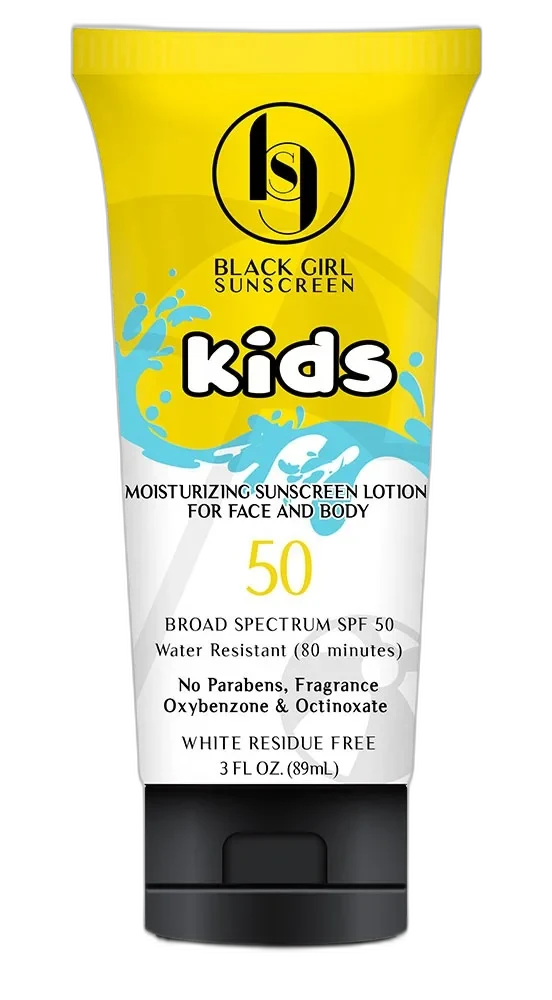
Kids SPF 50
No-White-Cast Kids Essential
 Verified reviewer
Pros & cons.
- +Zero white cast on melanin-rich skin — the core promise is genuinely delivered
- +Accessible pricing at $9.99-$18.99 makes daily sun protection affordable
- +Moisturizing botanical base with shea butter, jojoba, and avocado conditions skin
- +Fragrance-free and paraben-free with a low irritation profile
- +80-minute water resistance suitable for active outdoor play and swimming
- +Available at major retailers nationwide including Target, Walmart, and Ulta
- +Children find the texture comfortable, reducing resistance to application
- −Homosalate at maximum 15% concentration may concern cautious parents
- −3 oz size empties quickly with full-body application on active children
- −Can feel slightly heavy in very humid or tropical conditions
- −Does not include newer-generation UV filters not yet FDA-approved
- −Limited to chemical UV filters — not suitable for those preferring mineral-only
The full review.
Getting sunscreen on a child is already an exercise in negotiation, bribery, and occasionally mild deception. Now imagine that every sunscreen option available makes your child look like they have been dusted with chalk. For parents of melanin-rich children, this was not a minor cosmetic annoyance — it was a barrier to consistent sun protection that the sunscreen industry, in its decades of formulating for lighter skin tones, simply never prioritized.
Shontay Lundy invested thirty-three thousand dollars of her own money in 2016 to change that. Black Girl Sunscreen launched as a direct response to the industry’s blind spot, and the Kids SPF 50 represents the most important extension of that mission: protecting the skin of children who have been historically underserved by sun care products.
About Black Girl Sunscreen
The formula uses a trio of chemical UV filters — avobenzone at 3%, homosalate at 15%, and octisalate at 5% — to deliver broad-spectrum SPF 50 protection. This filter combination is standard in American sunscreen formulation but is deployed here with a specific purpose: chemical filters absorb UV radiation rather than reflecting it, which means they absorb invisibly into the skin without the white or ashy cast that mineral filters (zinc oxide and titanium dioxide) leave on darker skin tones. The choice of chemical over mineral is not about filter superiority in the abstract — it is about creating a product that melanin-rich children will actually wear.
Homosalate at 15% is at the FDA maximum allowed concentration, which is how the formula achieves SPF 50 without zinc oxide. It is the most commonly used UVB filter in the American market and has decades of safety data, though it has attracted some regulatory scrutiny in recent years regarding potential endocrine effects at high systemic exposure. For a sunscreen applied to children’s skin, this is worth noting — though dermatological consensus still firmly supports the position that UV damage poses a far greater health risk than the theoretical concerns around chemical sunscreen absorption.
What Sets It Apart
What sets this formula apart from generic SPF 50 products is the inactive ingredient list. Shea butter, jojoba oil, avocado oil, sunflower seed oil, chamomile extract, aloe vera, and carrot seed oil transform what could be a clinical sun protection product into something that genuinely moisturizes. For children who spend hours outdoors in chlorinated pools, salt water, and direct sun, a sunscreen that also conditions the skin is a meaningful advantage. Parents consistently report that their children find this lotion more comfortable than standard sunscreens, which reduces the resistance that turns every reapplication into a negotiation.
Texture
The texture is smooth and lotion-like — thicker than a spray sunscreen but nowhere near the paste-like consistency of many mineral formulas. It spreads evenly, absorbs within a minute or two, and leaves a natural-looking finish with no visible residue on any skin tone. The fragrance-free formula has only the faint inherent scent of the chemical UV filters, which dissipates quickly. For children with sensory sensitivities who resist scented products, this is a practical benefit.
Water Resistance
Water resistance for 80 minutes meets the FDA maximum claim for sunscreen, making it suitable for pool days, beach trips, and active outdoor play. The moisturizing oils help the formula resist wash-off better than some lighter chemical sunscreens, though reapplication after toweling is still essential — and this is where the smaller 3-ounce size becomes a limitation. Full-body application on a child uses a significant amount of product, and the 3-ounce tube can empty within a week of daily outdoor use. The 6-ounce size is the more practical choice for families, offering better per-ounce value.
Price
The price is genuinely democratic. At $9.99 for the smaller size and $18.99 for the larger, this undercuts many comparable SPF 50 products while offering the specific no-white-cast benefit. For a brand that markets itself on inclusivity, the accessible pricing is consistent with the mission — sun protection should not be a luxury, and this product makes it affordable.
The Broader Significance
There is an honest conversation to be had about the broader significance of this product. The fact that a founder had to self-fund a sunscreen brand to create something that works on darker skin tones says something uncomfortable about an industry that generated billions in revenue while effectively telling a significant portion of the population that looking chalky was an acceptable trade-off for sun protection. Black Girl Sunscreen did not invent new UV filter chemistry. What it did was apply existing chemistry with a specific audience in mind — and that should not have been revolutionary, yet it was.
Caveats
The product is not perfect. The 15% homosalate concentration, while standard, may give pause to parents who prefer to minimize their children’s exposure to chemical UV filters. The formula does not include newer-generation filters that offer superior photostability — those filters remain in regulatory limbo in the US. And in very humid conditions, the rich botanical base can feel slightly heavy compared to gel-based sunscreens.
Conclusion
But for what it set out to do — provide melanin-rich children with a sunscreen that actually works for their skin, at a price their families can afford, with a texture that minimizes the daily sunscreen battle — the BGS Kids SPF 50 delivers. It is effective, accessible, and addresses a need that should have been met decades ago.
Ingredient analysis.
Full INCI list
Active Ingredients: Avobenzone 3%, Homosalate 15%, Octisalate 5%. Inactive Ingredients: Acrylates/C10-30 Alkyl Acrylate Crosspolymer, Acrylates/C12-22 Alkyl Methacrylate Copolymer, Aloe Barbadensis Leaf Juice, Butyrospermum Parkii (Shea) Butter, Carbomer, Chamomilla Recutita (Matricaria) Flower Extract, Daucus Carota Sativa (Carrot) Seed Oil, Disodium EDTA, Ethylhexylglycerin, Helianthus Annuus (Sunflower) Seed Oil, Hydroxypropyl Methylcellulose, Lecithin, Persea Gratissima (Avocado Oil), Phenoxyethanol, Propylene Glycol, Simmondsia Chinensis (Jojoba) Seed Oil, Sodium Hydroxide, Sorbitan Oleate, Tocopheryl Acetate, Water
Skin match.
The science.
The Science
Three established chemical filters drive the UV protection in this formula. Avobenzone at 3% provides UVA protection, absorbing radiation from 310-400 nm with a 357 nm peak. Avobenzone is the most common UVA filter in the American market, but it is photounstable and degrades under UV exposure. The formula stabilizes avobenzone's molecular structure using homosalate and octisalate, two UVB-absorbing salicylate esters.
Homosalate at 15% — the FDA-permitted maximum — absorbs UVB in the 295-315 nm range. A 2020 FDA maximal usage trial in JAMA found that homosalate and other chemical sunscreen ingredients absorb systemically at levels above the FDA threshold for additional safety studies. However, the American Academy of Dermatology still recommends sunscreen for everyone, as the known risks of UV-induced skin damage — skin cancer, photoaging, and hyperpigmentation — outweigh theoretical absorption concerns.
The inactive botanical blend offers benefits beyond UV filters. Butyrospermum parkii (shea butter) contains triterpene esters that support barrier function and reduce transepidermal water loss. Helianthus annuus (sunflower) seed oil has linoleic acid, which shows barrier-restorative properties in studies in Pediatric Dermatology. Chamomilla recutita extract provides anti-inflammatory bisabolol to soothe UV-exposed skin and reduce erythema.
The formula leaves no white cast because it uses organic (chemical) UV filters instead of inorganic (mineral) filters. Zinc oxide and titanium dioxide — the mineral filters that cause white cast — scatter and reflect UV radiation. Their high refractive index creates visible opacity on the skin, especially on darker skin tones. Chemical filters absorb UV photons and dissipate energy as heat, so they stay invisible on any skin tone.
Dermatologist Perspective
Pediatric dermatologists say the best sunscreen is the one children actually wear; compliance matters more than formulation debates. Board-certified dermatologists note that Black Girl Sunscreen fills a clinical gap: children with melanin-rich skin who refuse white-cast sunscreens remain unprotected, which is riskier than theoretical chemical UV filter absorption. The SPF 50 broad-spectrum protection meets dermatological recommendations for children, and the 80-minute water resistance aligns with American Academy of Dermatology guidance for outdoor activities. Dermatologists recommend applying approximately one ounce for full-body coverage on a child and reapplying every two hours during continuous sun exposure. This product is not for parents who strictly prefer mineral-only formulations, but for families struggling with white-cast issues, this formula improves real-world sun protection compliance.
Where it fits in your routine.
Apply generously to all exposed skin 15 minutes before sun exposure. Use about one ounce (one shot glass full) for a child's full-body coverage. Spread evenly over often-missed areas: ears, back of neck, tops of feet, and hairline edges. Reapply every 2 hours during continuous sun exposure, and immediately after swimming, toweling, or heavy sweating. Avoid the immediate eye area when applying to the face. Layer over moisturizer if you need more hydration.
At $9.99 for 3 fl oz and $18.99 for 6 fl oz, this is one of the cheapest SPF 50 kids' sunscreens available, particularly because it eliminates white cast. The 6 fl oz size has better per-ounce value and works best for regular use. Premium mineral kids' sunscreens cost $20-30 for similar sizes and still leave a visible cast; this product costs less and looks better. Availability at mass retailers like Target, Walmart, and Walgreens makes it accessible rather than aspirationally affordable.
Parents of children with melanin-rich skin need sunscreen that protects without leaving a white, chalky residue. This fragrance-free, moisturizing kids' SPF 50 also works for families wanting a comfortable formula for active outdoor play.
Parents who prefer mineral-only sunscreen formulations for their children. Parents with children sensitive to chemical UV filters (avobenzone, homosalate, or octisalate) should use a mineral alternative.
Product details.
This smooth, moisturizing lotion spreads easily and absorbs without a white cast or chalky residue on melanin-rich skin. It is slightly thicker than a typical moisturizer.
Fragrance-free. UV filters cause a faint chemical sunscreen scent, but there is no added fragrance.
Squeeze tube with a flip-top cap. The bright, colorful design targets kids. It is easy to squeeze and travel-friendly.
It applies smoothly without an immediate white cast — the primary selling point shows from the first use. The lotion feels moisturizing instead of dry or tight. Most children feel no stinging around the eyes. The texture is comfortable enough that children resist application less.
2-4 weeks using the 3 oz size daily on a child's full body; 4-8 weeks using the 6 oz size
12 months
spring summer
The backstory.
Black Girl Sunscreen was born from founder Shontay Lundy's frustration with sunscreens that left visible white residue on her skin. She invested $33,000 of her own savings to develop a formula specifically for melanin-rich skin. The Kids SPF 50 extended that mission to children, addressing the critical gap in sun protection for kids of color whose parents had few options that did not leave their children looking ashy or ghostly.
About Black Girl Sunscreen
Established Brand (5–20 years)Shontay Lundy founded Black Girl Sunscreen in 2016 using $33,000 in personal savings to fix the lack of sunscreens for melanin-rich skin. The brand now sells in over 12,000 retail locations, including Target, Walmart, and Ulta, making it the first Black-owned sunscreen brand in major US retailers.
Common myths.
Melanin provides natural protection, so dark skin doesn't need sunscreen.
While melanin does provide some baseline UV protection (estimated SPF 2-4), it is nowhere near sufficient to prevent sun damage, hyperpigmentation, or skin cancer risk. People with melanin-rich skin are less likely to get sunburned but are not immune to UV damage, and delayed detection of skin cancers in darker skin tones makes sun protection equally important.
All sunscreens leave a white cast on dark skin — it is unavoidable.
Mineral UV filters (zinc oxide and titanium dioxide) primarily cause white cast. This formula uses chemical UV filters (avobenzone, homosalate, octisalate) to absorb UV light instead of reflecting it. This removes the visible white residue that makes traditional sunscreens unwearable for many people with darker skin tones.
FAQ.
Does Black Girl Sunscreen Kids SPF 50 leave a white cast?
No — this is the product's defining feature. It uses chemical UV filters (avobenzone, homosalate, octisalate) rather than mineral filters. This means it absorbs into the skin without leaving white or ashy residue. The formula targets melanin-rich skin tones.
Is this sunscreen water resistant?
Yes, it is water resistant for up to 80 minutes, so it works for swimming and outdoor water activities. Reapply after toweling off, heavy sweating, or once the 80-minute water resistance period ends.
What ages is this sunscreen appropriate for?
The Kids SPF 50 targets children. Black Girl Sunscreen offers a separate Baby SPF 50 for babies and very young children using gentler ingredients like oats and chamomile. This product works for children old enough for chemical sunscreen (typically 6 months and older per AAP guidelines).
Is this sunscreen safe for sensitive skin?
The formula is fragrance-free, paraben-free, and silicone-free. It uses soothing inactive ingredients like chamomile, aloe, and jojoba. Independent reviews show a low irritation potential rating. Because it contains chemical UV filters, children with known sensitivity to chemical sunscreens should patch test first.
How often should I reapply this sunscreen?
Reapply every 2 hours during continuous sun exposure, or immediately after swimming, toweling, or heavy sweating. Reapplication is essential to maintain protection even with 80-minute water resistance. Apply generously; most people under-apply sunscreen and reduce effective SPF.
Can adults use this sunscreen too?
The SPF 50 broad-spectrum formula and moisturizing botanicals work for adults too, even though it is formulated for children. Many parents use the same product as their children for convenience. The fragrance-free, no-white-cast formula works for adults with melanin-rich skin who want comfortable daily sun protection.
What sizes does this sunscreen come in?
The BGS Kids SPF 50 comes in 3 fl oz ($9.99) and 6 fl oz ($18.99) sizes. The 6 fl oz size costs less per ounce for full-body use on children.
Community
What the community says.
"Absolutely no white cast on dark skin tones"
"Moisturizing without being greasy"
"Kids actually like wearing it"
"Affordable and accessible at major retailers"
"Can feel slightly heavy in very humid conditions"
"Smaller 3 oz size runs out quickly with full-body application"
"Chemical filter scent detectable despite being fragrance-free"
"Limited availability in some regions"
Featured in.
People also looked at.