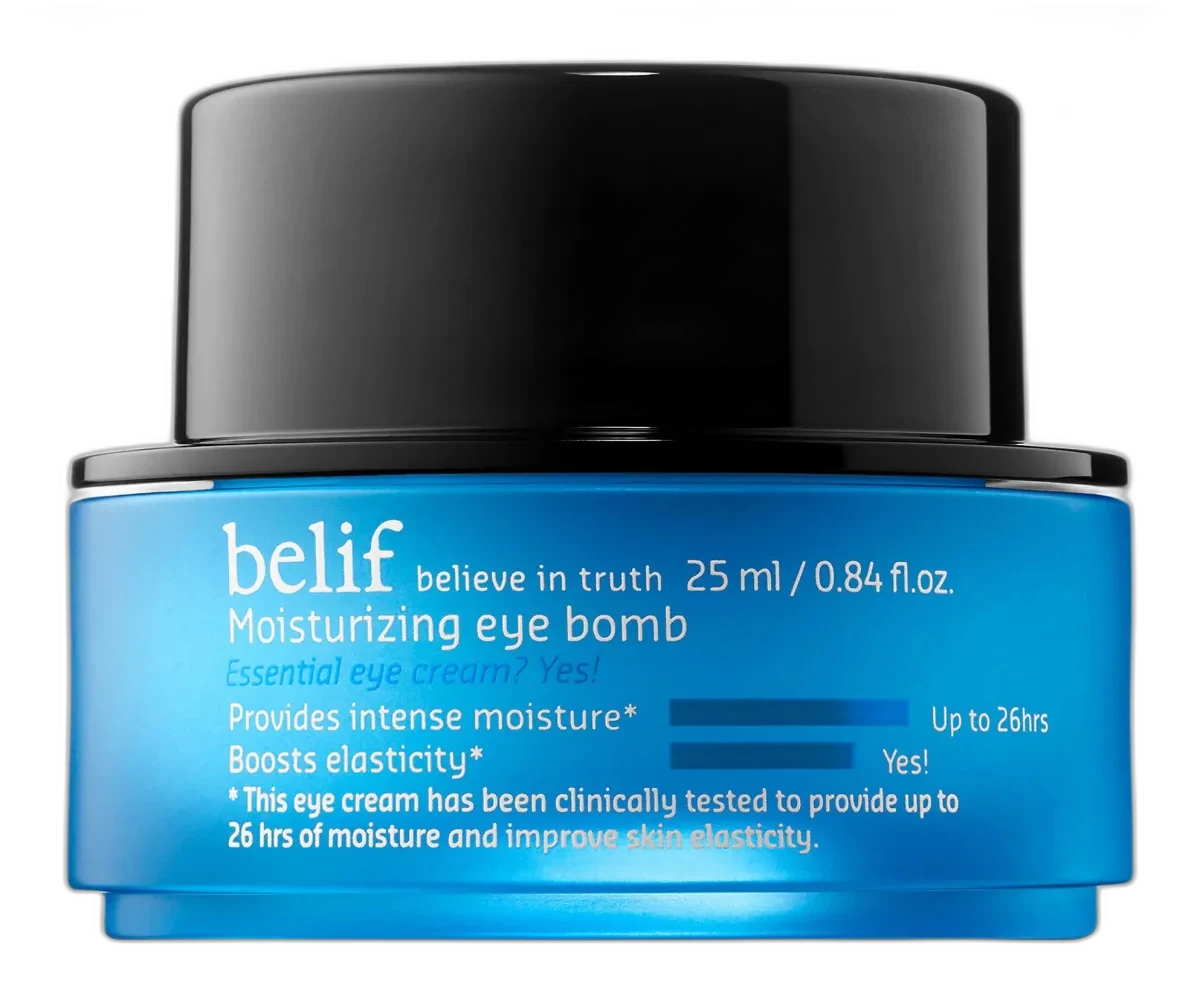
Eye Bomb Moisturizing Eye Cream
K-Beauty Cushion Eye Pick
 Verified reviewer
Pros & cons.
- +Cushiony gel-cream texture is genuinely pleasant to use
- +Glycerin-heavy formula delivers immediate plumping of dehydration lines
- +Ceramide NP and squalane support barrier function
- +Layers beautifully under concealer and makeup
- +Distinctive Napiers botanical heritage adds character
- +Airless pump packaging keeps the formulation fresh
- +Reasonable middle-of-the-range pricing for K-beauty
- −Contains essential oils and fragrance markers near the eye area
- −Not suitable for sensitive eyes or rosacea-prone users
- −Does not address dark circles or deep wrinkles
- −Botanical extracts are mostly marketing rather than active doses
- −belif is not currently certified cruelty-free
The full review.
Most brand origin stories fall apart under five minutes of scrutiny. belif’s does not. The Korean brand, owned by LG Household & Health Care and launched in 2010, is built around a genuine link to Napiers of Edinburgh, a Scottish herbalist founded by Duncan Napier in 1860 that is still operating today. Napiers developed its own library of traditional herbal preparations, and belif’s original formulations licensed parts of that library and translated them into K-beauty skincare — which is why the INCI list for this eye cream includes an unusual botanical cast of chickweed, lady’s mantle, raspberry leaf, catnip, marshmallow root, bogbean, bloodroot, meadowsweet, clover, violet, yarrow and a dozen more. This is not a clean-beauty marketing gesture. belif actually traces these ingredients to something that predates K-beauty by more than a century, which is genuinely unusual and part of why the brand has built a distinct identity in a crowded Sephora aisle.
That botanical heritage is what gives Eye Bomb its character, for better and worse. The formulation itself is fundamentally modern: a humectant-heavy water phase of dipropylene glycol, butylene glycol and glycerin does the immediate hydration work, squalane and ceramide NP provide the lipid and barrier-repair layer, a silicone quartet of cyclopentasiloxane, caprylyl trimethicone, dimethicone and a vinyl dimethicone crosspolymer delivers the cushion-to-satin texture that makes the cream feel like it is made of small bouncy pillows, and panthenol adds a further humectant note. Then, draped over this modern skeleton, are the Napiers-derived herbal extracts in a slightly theatrical long tail. Most of these are present at concentrations too low to have meaningful individual effects — Centella asiatica and oat kernel extract sit high enough to contribute to the soothing claim, the rest are a botanical bouquet supporting the story. None of this is wrong, exactly, but it is worth understanding that the heavy lifting is being done by the glycerin, silicones and ceramide, not the rose or yarrow extracts.
On skin, Eye Bomb is immediately pleasant in the way that good K-beauty eye creams often are. The pump releases a small cushiony dollop of pale cream, you press it around the orbital bone with a ring finger, and it flattens into a bouncy gel-cream that absorbs within about a minute. There is no tingle, no sting, and the finish is a soft satin that layers under concealer without pilling or disturbing the silicone in most foundation formulas. The immediate visual effect on shallow dehydration lines — the little crêpe-like creases that show up when your undereye has been dry — is real and quite satisfying. Over longer use, the cream supports a more consistently hydrated undereye that weathers air conditioning, screen glare, and the miserable cabin air of long-haul flights better than a bare routine would.
What Eye Bomb will not do is erase actual wrinkles, fade dark circles, or treat structural under-eye hollowing. Those jobs belong to other categories entirely — retinoid eye creams and in-office procedures for wrinkles, concealer and colour-correction for circles, fillers and surgery for hollowing. belif positions this product as a hydration-and-barrier eye cream and it delivers exactly that. Reviewers who expected wrinkle-erasing tend to be the ones leaving disappointed three-star reviews; within its actual lane, the cream performs well.
Now the complicated part: the fragrance. The formula contains orange peel oil, rosemary leaf oil, geranium flower oil and a full deck of citrus-floral fragrance markers — citral, citronellol, limonene, geraniol and linalool — declared at the bottom of the INCI. This is not unusual for K-beauty or European skincare, where sensory pleasure is considered part of the product experience, but the eye area is the single most fragrance-sensitive area of the face. Dermatologists who specialise in periocular contact dermatitis consistently flag essential oils and fragrance markers as one of the top causes of delayed contact reactions around the eyes, and while many users tolerate this specific blend without issue, a meaningful minority will develop redness, itchiness or a subtle persistent flare with daily use. If you have a history of reactive eyes, rosacea, or confirmed contact dermatitis to fragrance components, this is not the eye cream for you — full stop. If you have robust, normal skin and enjoy a lightly herbal scent as part of your routine, the risk is lower but still non-zero. Beauty press coverage of this product has generally under-flagged the fragrance issue, so I want to be direct: Eye Bomb smells noticeably herbal-floral, and the scent is coming from actual essential oils, not a synthetic fragrance accord.
Textually, the cushiony feel is the best thing about it. K-beauty has spent the last decade perfecting this specific gel-cream sensorial experience, and Eye Bomb sits near the top of the category for that tactile pleasure. If you love eye creams that feel like tiny cosmetic events — the press, the bounce, the pump action, the cool spread — you are going to enjoy this one. If you prefer minimalist fragrance-free eye creams that function invisibly, belif is not your brand.
Value is a middling conversation. At $38 for 25ml the per-ml cost is in the upper middle of the Sephora eye-cream aisle. belif is not the most expensive K-beauty option and not the cheapest, and the 25ml bottle lasts a reasonable three to four months with twice-daily use. You can find simpler, fragrance-free, ceramide-led eye creams for less money — CeraVe Eye Repair and La Roche-Posay Toleriane Eye Cream are both excellent at significantly lower prices — and you can find more luxurious eye creams with peptides and retinoids for more. Eye Bomb occupies the middle ground that K-beauty often occupies: sensory-forward, mid-priced, competent on the fundamentals, and distinctive enough to stand out from the dermatology-led options.
Ingredient analysis.
Full INCI list
Water, Dipropylene Glycol, Butylene Glycol, Glycerin, Squalane, Cyclopentasiloxane, Caprylyl Trimethicone, Dimethicone, HDI/Trimethylol Hexyllactone Crosspolymer, Sucrose Polystearate, 1,2-Hexanediol, PCA Dimethicone, Panthenol, Triethylhexanoin, Cellulose, Ceramide NP, Centella Asiatica Leaf Extract, Avena Sativa (Oat) Kernel Extract, Calendula Officinalis Flower Extract, Nepeta Cataria Extract, Rubus Idaeus (Raspberry) Leaf Extract, Baptisia Tinctoria Root Extract, Stellaria Media (Chickweed) Extract, Alchemilla Vulgaris Leaf Extract, Viola Tricolor Extract, Rosa Damascena Flower Extract, Spiraea Ulmaria Flower Extract, Althaea Officinalis Root Extract, Achillea Millefolium Flower Extract, Symphytum Officinale Leaf Extract, Trifolium Pratense (Clover) Flower Extract, Menyanthes Trifoliata Leaf Extract, Salix Alba (Willow) Bark Extract, Dimethicone/Vinyl Dimethicone Crosspolymer, Silica, Hydrogenated Polyisobutene, Glyceryl Stearate, PEG-100 Stearate, Hydrogenated Lecithin, PEG-10 Rapeseed Sterol, Glycereth-20, C14-22 Alcohols, C12-20 Alkyl Glucoside, Hydroxyethyl Acrylate/Sodium Acryloyldimethyl Taurate Copolymer, Polysorbate 60, Hydroxyproline, Carbomer, Tromethamine, Trisodium EDTA, Citrus Aurantium Dulcis (Orange) Peel Oil, Rosmarinus Officinalis (Rosemary) Leaf Oil, Pelargonium Graveolens Flower Oil, Citral, Citronellol, Limonene, Geraniol, Linalool
Skin match.
The science.
The Science
Evidence supports the humectant-and-ceramide core of this eye cream. Glycerin is a widely studied topical humectant in dermatology; it affects transepidermal water loss, stratum corneum hydration, and barrier recovery. Ceramide NP (also called Ceramide 3) is a skin-identical ceramide with strong published evidence for barrier repair, especially in atopic and dry-skin contexts. Squalane is a documented biomimetic lipid with a structural profile comparable to sebum and well-tolerated occlusive behaviour.
Centella asiatica is a well-documented botanical active in cosmetic literature. Peer-reviewed studies on its triterpene components — madecassic acid, asiatic acid, and madecassoside — show anti-inflammatory and wound-healing effects on skin. Oat kernel extract has a long history in dermatology for soothing reactive skin and appears in many prescription-adjacent moisturizing products. Panthenol and hydroxyproline also have established literature supporting barrier hydration and skin comfort.
Evidence is thinner for the Napiers-derived herbal extracts. Chickweed, lady's mantle, marshmallow root, yarrow, violet and clover have traditional herbalist use but few peer-reviewed human dermatology studies. At their likely concentrations in this formula (fractions of a percent, based on INCI position), their individual contribution is narrative rather than clinical. This is common in K-beauty formulations and does not reduce the cream's effectiveness — the humectant, ceramide and silicone backbone does the real work — but the botanical bouquet is a brand identity feature rather than a clinical efficacy driver.
The essential oil blend requires careful label reading. Published research on periocular contact dermatitis identifies fragrance markers like linalool, limonene, geraniol and citral as common causes of delayed hypersensitivity reactions around the eyes. These reactions do not affect everyone, but they are well documented; sensitive users should choose fragrance-free alternatives.
Dermatologist Perspective
Dermatologists generally view hydrating eye creams as useful adjuncts to a broader skincare routine, especially for patients with dry or dehydration-prone periocular skin. Most dermatologists view the humectant-heavy, ceramide-supported core of this formula positively. Board-certified dermatologists typically raise concerns about the essential oil fragrance content, which can trigger periocular contact dermatitis in some patients — a key consideration for anyone with reactive eyes, rosacea, or confirmed fragrance sensitivities. Dermatologists treating eczema or atopic periocular skin would generally recommend a fragrance-free alternative. For patients with robust skin who enjoy sensory-forward products and have no fragrance history, this is a reasonable option, provided they understand this is a hydration-focused rather than wrinkle-correcting eye cream.
Where it fits in your routine.
Apply morning and night after serums and before facial moisturizer. Use a rice-grain-sized amount on the back of your hand. Pick it up with your ring finger and press it along the orbital bone from the inner to the outer corner. Avoid the waterline and the mobile lid area. Do not rub; patting helps the delicate skin absorb the cream without tugging. Let it absorb for about a minute before applying SPF or concealer. Contact lens wearers should apply it well before inserting lenses and let the cream absorb fully first.
At $38 for 25ml, Eye Bomb sits in the mid-range of the Sephora eye-cream aisle. Pharmacy dermatology brands with fragrance-free ceramide-focused eye creams offer better ingredient value, providing similar hydration and barrier support for less. The higher price pays for Napiers botanical heritage, the K-beauty cushiony texture, and the brand aesthetic — all real and subjective. The 25ml size is standard for the category and lasts about three to four months with consistent use, making the cost-per-day reasonable for regular use.
K-beauty fans who like cushiony gel-cream textures, people with dehydration-related fine lines around the undereye, and shoppers who value belif's botanical heritage. This works for normal to dry skin that tolerates fragrance and wants a sensory-forward eye routine.
Use this if you have sensitive eyes, rosacea, periocular contact dermatitis, or confirmed fragrance allergies. Skip this if you target dark circles, deep wrinkles, or structural under-eye concerns — this is a hydration and barrier product, not a treatment product.
Product details.
Lightweight gel-cream has a soft bouncy cushion and turns into a thin satin layer when massaged.
Herbal-floral with citrus top notes from the essential oil blend; you notice it on application.
Airless pump tube in belif's signature blue-green packaging
The first application feels like K-beauty — the pump dispenses a small, cushiony dollop that becomes a bouncy gel-cream as you press it around the orbital bone. The herbal-floral scent is obvious but fades within minutes. It does not sting or tingle, and concealer layers cleanly one minute after application. Most users see softer undereye fine lines immediately and better makeup wear after the first few weeks.
Approximately 3-4 months with twice-daily under-eye use
12 months
All Year
The backstory.
belif was launched in 2010 by LG Household & Health Care, positioned as the Korean brand that translated the Napiers Scottish herbalist tradition into K-beauty formulations. The Eye Bomb range is part of belif's 'Moisturizing Bomb' franchise — the best-selling True Cream Moisturizing Bomb has been a Sephora K-beauty staple since 2015 — and this eye version, launched around 2018, extends the same humectant-heavy approach to the periocular area.
About belif
Established Brand (5–20 years)belif is a Korean skincare brand owned by LG Household & Health Care. It launched in 2010 using a Scottish herbalist (Duncan Napier) heritage concept. Sephora carries belif widely in the US. The brand has a track record of dermatology-friendly, fragrance-light formulations, but its published clinical work is less than Western dermatological brands.
Common myths.
Eye creams need to be completely fragrance-free to be safe.
Fragrance near the eye area is a concern, but context matters. Small, targeted applications tolerate fragrance better than generous face cream application. This formula is not the best choice for reactive eyes, but it is not automatically disqualifying for everyone.
K-beauty eye creams are gentler than Western ones.
K-beauty formulation philosophies range from ultra-minimalist to heavily fragranced. belif uses a sensory-forward approach with essential oils. This is less gentle than many Western fragrance-free eye creams from dermatology brands.
FAQ.
Is belif Eye Bomb good for fine lines?
The humectant-heavy formula plumps dehydration-related fine lines within minutes by improving surface hydration. It does not erase deep set wrinkles, which need sustained retinoid or peptide treatment over months.
Does it contain fragrance?
Yes — the formula has orange peel oil, rosemary leaf oil, geranium flower oil, and fragrance markers like limonene, linalool, citral, citronellol and geraniol. This formula does not suit people with reactive eyes or fragrance-sensitive skin.
Can I use belif Eye Bomb with retinol?
Yes, if you time them carefully. Most users apply retinol at night in a different step, or on alternate nights, to prevent irritation near the delicate eye area.
Does it help with dark circles?
Not directly. Dark circles have multiple causes (pigmentation, vascular, structural) and hydration alone does not fix them. Eye Bomb makes the undereye look smoother and more hydrated, which can slightly brighten the appearance, but Eye Bomb is not a dark-circle treatment.
Is it safe for contact lens wearers?
Yes, with normal care — apply far from the waterline and let it absorb for one minute before inserting contacts. The fragrance components irritate eyes if the product migrates, so use a light hand.
How does it compare to belif True Cream Moisturizing Bomb?
Eye Bomb uses the same humectant-and-ceramide core but adds silicone for a lighter texture. This version targets the thinner skin of the eye area. The face version is thicker and works better as an overall moisturizer.
Is belif cruelty-free?
No — LG Household & Health Care owns belif, and this company sells in markets that may require animal testing. belif lacks a cruelty-free certification.
What the community says.
"Cushiony, plumping texture"
"Immediate visible smoothing of fine dehydration lines"
"Layers well under concealer"
"Distinctive Napiers botanical story"
"Pump packaging is hygienic"
"Essential oil fragrance near the eyes is divisive"
"Not ideal for very sensitive skin"
"25ml goes quickly at the price"
"Not a dark-circle or wrinkle eraser"
People also looked at.