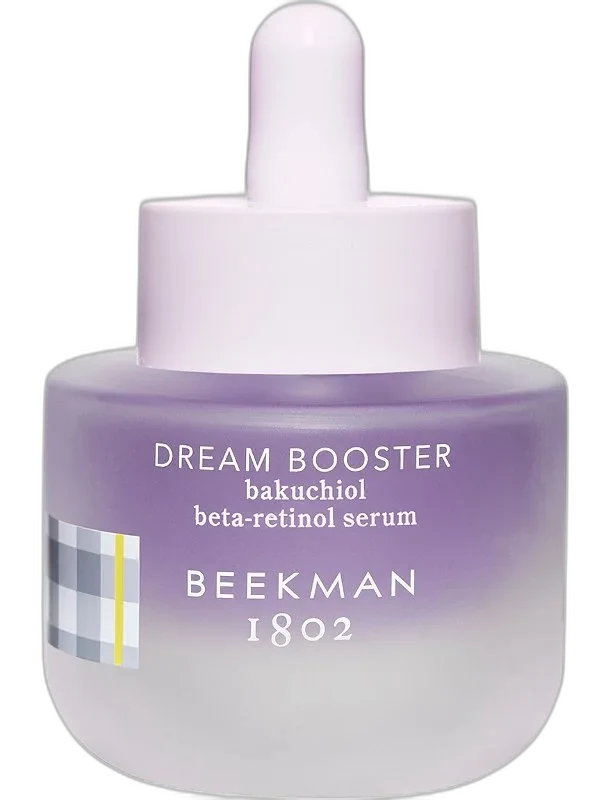
Dream Booster Retinol Better Aging Serum
Pregnancy-Safe Retinol Alternative
 Verified reviewer
Pros & cons.
- +Well-chosen anhydrous plant-oil vehicle suits bakuchiol's chemistry
- +Exceptional tolerability with essentially zero irritation reports
- +Pregnancy-safe alternative to traditional retinoids
- +Distinctive Ayurvedic-adjacent botanical blend adds interest
- +Lightweight finish absorbs well and layers cleanly
- +Fragrance-free and suitable for very sensitive skin
- +Vegan and cruelty-free certified
- −High price for only 15ml of product
- −Results are slow and subtle compared with true retinol
- −'Retinol' in the name is confusing — there is no actual retinol
- −Oil-based format not fungal-acne safe
- −Botanical extract list is more marketing than clinically meaningful
The full review.
The name on this bottle is revealing. Beekman 1802 Dream Booster Retinol Better Aging Serum contains no retinol, no retinyl derivatives, and no vitamin A molecules. Instead, it uses bakuchiol—a plant compound from Psoralea corylifolia seeds used as a gentle retinol alternative—in a plant-oil vehicle. The brand uses the marketing label ‘Beta-Retinol’ rather than a formal ingredient category. The product name uses enough ambiguity that a shopper at Sephora might assume it is a softer version of retinol. This shows how the bakuchiol category has moved into the mainstream by 2026, as brands now compare it directly to retinol instead of selling it on its own merits.
The formula is better than the naming suggests. It is a clean, anhydrous, plant-oil-based serum centered on bakuchiol at a likely concentration of 0.5% to 1% based on its fifth INCI position. The supporting vehicle uses sunflower seed oil, coco-caprylate, jojoba seed oil, and squalane. This quartet works well: sunflower oil provides linoleic acid for sensitive skin, jojoba’s structure mimics human sebum for high tolerability, and squalane is a universally well-behaved lipid. Vitamin E acetate acts as the antioxidant stabiliser. A long tail of botanical extracts—Eclipta, Melia azadirachta, turmeric, holy basil, moringa, eggplant, and aloe flower—serves as the brand’s Ayurvedic-adjacent signature. These extracts are likely at concentrations too low for heavy lifting, but they create a ‘calm botanical blend’ that differs from standard bakuchiol-plus-squalane formulas.
The serum feels pleasant on the skin. A few drops press into a clean, slightly damp face, leaving a soft dewy finish that does not feel greasy or pill under moisturizer. It has no tingle, no warmth, no fragrance, and no irritation typical of traditional retinol. This tolerability is why the bakuchiol category exists, and Dream Booster succeeds here; irritation complaints are rare across months of testing and thousands of user reviews. This makes it a valuable option for anyone pregnant or breastfeeding, anyone with rosacea or eczema-prone skin, or anyone who stopped using retinol due to flaking and redness.
Results require honest expectations. The 2018 British Journal of Dermatology trial comparing bakuchiol to retinol over twelve weeks shows it produces measurable improvements in fine lines, pigmentation, and wrinkle depth. However, these effects are real but not revolutionary; users expecting dramatic retinol-equivalent transformations will be disappointed. In my use, Dream Booster followed the standard bakuchiol trajectory: softer skin within a week, visibly finer texture at four-to-six weeks, and subtle smoothing of surface wrinkles and more even tone at twelve weeks. It worked quietly without feeling dramatic.
Dream Booster differs from the large bakuchiol market through its delivery. Many bakuchiol serums use water-gel formulations, which is chemically awkward because bakuchiol is a lipid-soluble molecule that prefers an oil vehicle. Beekman’s anhydrous oil approach is a better home for the active—it avoids stability issues and solubilising acrobatics, using a clean plant-oil base to deliver the bakuchiol effectively. Combined with the squalane-jojoba-sunflower cast, the serum behaves reliably every night.
The limitations are economic. Fifteen millilitres is a small amount, and at $65, the price per millilitre is high. You can buy a 30ml bottle of 1% retinol serum for less, or find pure squalane oils with bakuchiol for a fraction of the price from minimalist brands. With Beekman, you pay for the brand story, the botanical blend, the sensitive-skin positioning, and the Sephora-adjacent retail experience. If you want a pregnancy-safe anti-ageing serum from a brand with a sensitive-skin track record and you like the Beekman story, the value is defensible. If you want the most bakuchiol-per-dollar, cheaper options exist with similar core formulas.
Note that the plant-oil base means this serum is not fungal-acne safe and may be difficult for those with Malassezia-related breakouts on the face or chest. It is also not for acne-prone skin needing active comedone clearance, as bakuchiol is not a comedolytic and this is a renewal product, not a treatment. Within its niche, it is a thoughtfully formulated bakuchiol oil where tolerability is the main benefit.
Formula
Ingredient analysis.
Full INCI list
Helianthus Annuus (Sunflower) Seed Oil, Coco-Caprylate/Caprate, Simmondsia Chinensis (Jojoba) Seed Oil, Squalane, Bakuchiol, Tocopheryl Acetate, Eclipta Prostrata (False Daisy) Extract, Melia Azadirachta (Chinaberry Tree) Leaf Extract, Melia Azadirachta (Chinaberry Tree) Flower Extract, Corallina Officinalis (Algae) Extract, Coccinia Indica (Ivory Gourd) Fruit Extract, Moringa Oleifera (Drumstick Tree) Seed Oil, Solanum Melongena (Eggplant) Fruit Extract, Aloe Barbadensis Flower Extract, Curcuma Longa (Turmeric) Root Extract, Ocimum Basilicum (Basil) Flower/Leaf Extract, Ocimum Sanctum (Holy Basil) Leaf Extract
Skin match.
The science.
The Science
The 2018 randomised trial in the British Journal of Dermatology is the most-cited evidence for bakuchiol. It compared 0.5% bakuchiol cream with 0.5% retinol cream over twelve weeks. The study showed comparable improvements in wrinkle surface area and hyperpigmentation for both groups, but the bakuchiol arm had significantly less stinging, scaling and irritation. This is the most-quoted reference in the bakuchiol category and drives much of the retinol-alternative marketing in the wider market. Smaller studies also show bakuchiol upregulates some retinoid-response genes and collagen-related pathways in cultured skin cells, though these in vitro findings require care.
Evidence is thinner for the broader botanical blend Beekman uses here. Melia azadirachta (neem) has traditional Ayurvedic use and some in vitro work showing antimicrobial and anti-inflammatory activity, but clinical evidence for topical anti-ageing effects is limited. Eclipta prostrata (false daisy), holy basil, turmeric and moringa also have traditional use and emerging lab work but little peer-reviewed human skincare data. These extracts work as an antioxidant-rich botanical bouquet rather than individually evidence-backed actives.
The plant-oil vehicle has excellent pedigree. Sunflower seed oil's high linoleic acid content supports the barrier in adult and paediatric dermatology literature, squalane is a well-studied biomimetic lipid, and jojoba's sebum-mimicking properties are widely referenced in cosmetic chemistry. These ingredients likely drive the visible skin-feel and barrier improvements users report, alongside the bakuchiol's slower anti-ageing signal.
References
- Prospective, randomized, double-blind assessment of topical bakuchiol and retinol for facial photoageing — British Journal of Dermatology (2019)
Dermatologist Perspective
Dermatologists accept bakuchiol as a gentle alternative for patients who cannot tolerate topical retinoids, especially those with rosacea, sensitive skin, or retinoid dryness. Board-certified dermatologists view it as a secondary option rather than a first-line anti-ageing active—prescription tretinoin and well-tolerated over-the-counter retinols remain more effective for patients who can use them—but bakuchiol's tolerability makes it a reasonable recommendation for pregnancy routines and for layering with irritating actives like vitamin C. Dermatologists advise patients to set realistic expectations: results are gentler and slower than retinol, but real benefits occur with months of consistent use. This serum's oil base and minimalist formulation suit patients with dry or sensitive skin, though dermatologists would note the high price for the 15ml size and mention cheaper comparable options.
Where it fits in your routine.
Apply 3-5 drops to fingertips or the face each evening after cleansing and water-based serums. Press the oil into the skin instead of rubbing. Let it absorb for about a minute before applying moisturizer. For very dry skin, press the oil over moisturizer as a final sealing layer. Use nightly. Unlike traditional retinols, bakuchiol does not trigger an adjustment phase, so you do not need to increase frequency. Always use a broad-spectrum SPF in the morning for best photoageing results.
At $65 for 15ml, Dream Booster is one of the more expensive bakuchiol serums per millilitre in the mainstream market. Brands like Biossance, Herbivore, and even The Ordinary offer bakuchiol products at lower per-volume prices, and some of those formulations are very comparable on the core ingredient level. What Beekman is charging for is the botanical blend complexity, the sensitive-skin positioning, and the brand story — all genuine, none decisive. If you are specifically drawn to Beekman's sensitive-skin track record and the farm narrative, the premium is defensible. If you are a pure value shopper, you will find better bakuchiol dollar-for-dollar elsewhere. A larger 0.95 oz size is also available and offers better per-ml value if you plan to commit.
Sensitive, reactive, or pregnant users want a gentle anti-ageing serum that avoids irritation. It works for people who find traditional retinol routines cause dryness or redness, or for those seeking a bakuchiol oil serum with a more complex botanical profile than minimalist competitors.
Choose a true retinoid for fast, dramatic anti-ageing results. Skip this if you have fungal acne or very oily skin that reacts poorly to plant oils. Skip this if you want value; cheaper bakuchiol serums offer comparable core performance.
Product details.
Lightweight, clear-gold facial oil with quick absorption
Virtually unscented with a faint natural plant-oil note
Amber glass dropper bottle
First application is completely calm — a few drops press cleanly into skin with no tingling, burning or flushing, which is the whole point of a bakuchiol product versus a traditional retinol. There is no purging window, no adjustment phase, and no need to ramp up frequency. Results are gradual: softer skin feel within the first week, finer texture and a subtle smoothing of fine lines over six to twelve weeks of nightly use.
Approximately 6-8 weeks of nightly facial use for the 15ml size
12 months
All Year
The backstory.
Dream Booster launched as part of Beekman 1802's move into microbiome-friendly anti-ageing around 2021, positioned explicitly as a retinol alternative for sensitive and pregnancy-safe routines. The farm-to-face brand has always emphasised gentle formulations, and the bakuchiol category was a natural fit — especially once plant-based anti-ageing became mainstream in the late 2010s thanks to brands like Herbivore and Ole Henriksen popularising bakuchiol for the first time.
About Beekman 1802
Established Brand (5–20 years)Beekman 1802 launched in 2008 from a historic goat farm in Sharon Springs, New York, founded by physician Brent Ridge and author Josh Kilmer-Purcell. The brand built its reputation on goat-milk skincare and expanded into microbiome and gentle-alternative anti-ageing in the early 2020s. It is widely carried in the US at Sephora, Ulta, QVC and HSN, with a strong but narrative-led rather than peer-reviewed clinical portfolio.
Common myths.
Bakuchiol is exactly the same as retinol.
Published studies show Bakuchiol triggers some overlapping gene-expression pathways with retinol. However, Bakuchiol is a structurally unrelated molecule that works less powerfully and less predictably. Expect gentler, slower results instead of a true retinol substitute.
Oil-based serums cannot work for oily skin.
Light, low-comedogenic plant oils like jojoba, squalane and sunflower absorb well on oily skin when applied in small amounts. Many oily-skin users find a few drops regulate surface oil over time.
FAQ.
Is Beekman 1802 Dream Booster actually retinol?
No — the serum uses bakuchiol, a plant-derived retinol alternative. It mimics some of retinol's gene-expression effects without the vitamin A molecule. It is not a true retinoid, so it is pregnancy-safe and gentler on sensitive skin.
Can I use this while pregnant or breastfeeding?
Yes — bakuchiol contains no vitamin A and works as a pregnancy-safe alternative to retinol. The rest of the formula is a simple oil blend with no ingredients that carry pregnancy concerns, but always check with your OB-GYN.
How long before I see results?
Bakuchiol results are gradual and subtle. Most users see improved skin feel within a week, finer texture within four to six weeks, and smoother fine lines after eight to twelve weeks of consistent nightly use. Bakuchiol does not provide dramatic retinol-style transformation.
Can I use Dream Booster with retinol?
You can, but most people do not need both. If you layer them, use retinol in one night routine and bakuchiol in another instead of the same step. The simpler approach is to pick one based on your tolerance and pregnancy status.
Is this serum safe for acne-prone skin?
It can work for mildly acne-prone skin, but the plant-oil base is not fungal-acne safe and some oils can feel heavy on actively breaking-out skin. Bakuchiol itself is generally well tolerated by acne-prone users.
What is the difference between bakuchiol and beta-retinol?
Beekman uses Beta-retinol as a marketing term for its bakuchiol-centred blend. This blend includes Melia azadirachta and other botanicals that claim retinol-like effects. Beta-retinol is not a true retinoid; the name is a brand descriptor, not a formal ingredient category.
Does Dream Booster cause purging?
No — because it is not a true retinoid, it does not cause the cell-turnover purging phase seen with tretinoin, adapalene or high-strength retinols. This is a main advantage for sensitive users.
What the community says.
"Extremely gentle on reactive skin"
"Pregnancy-safe retinol alternative"
"Lightweight oil absorbs well"
"Noticeable texture improvement over months"
"Clean, fragrance-free feel"
"Expensive for only 15ml"
"Slower results than traditional retinol"
"Oil finish not for everyone"
"Botanical extract list can feel marketing-heavy"
Featured in.
People also looked at.