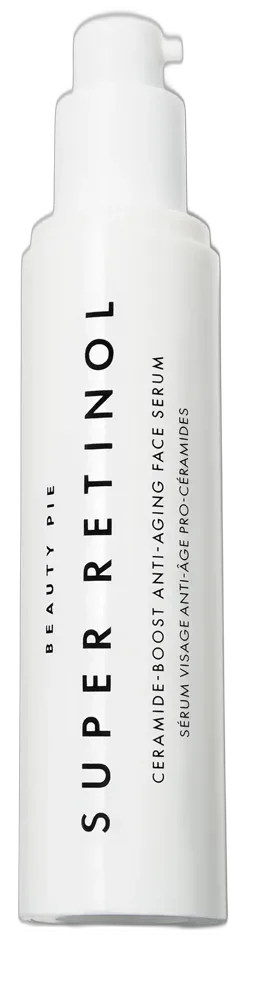
Super Retinol Ceramide-Boost Anti-Aging Face Serum
Ceramide-Buffered Retinol
 Verified reviewer
Pros & cons.
- +Encapsulated retinol delivery reduces irritation during initiation
- +Ceramide NP at meaningful concentration for barrier protection
- +Hydrating base with hyaluronic acid and glycerin
- +Lightweight texture absorbs cleanly
- +Member pricing makes the value math very attractive
- +Vegan and cruelty-free with intentional formulation philosophy
- −Non-member retail price is hard to justify
- −Soybean oil disqualifies it for fungal acne sufferers
- −Silicone-heavy texture won't appeal to silicone-averse users
- −Membership model can feel like a subscription trap
- −Not pregnancy-safe due to retinol content
The full review.
About Beauty Pie
Beauty Pie has an unusual position in the skincare market.
Texture
The texture works. The serum exits an airless pump as a lightweight white emulsion. It absorbs in 30-60 seconds and leaves a slight silicone slip. Beauty Pie uses dimethicone and a dimethicone crosspolymer to create smoothness. This works well under makeup and other routine layers but won’t appeal to users who avoid silicones.
Not ideal for
The soybean oil makes the formula unsuitable for users with confirmed fungal acne. The silicone-heavy texture won’t appeal to silicone-averse users, even though it functions well under makeup.
Ingredient analysis.
Full INCI list
Aqua (Water), Dimethicone, Glycerin, Butylene Glycol, Dipentaerythrityl Hexacaprylate/Hexacaprate, Dimethicone/Vinyl Dimethicone Crosspolymer, Hydroxyethyl Acrylate/Sodium Acryloyldimethyl Taurate Copolymer, Glycine Soja (Soybean) Oil, Lauroyl Lysine, PEG-8, Phenoxyethanol, Squalane, Glycine Soja (Soybean) Seed Extract, Polysorbate 60, Acrylates/C10-30 Alkyl Acrylate Crosspolymer, Caprylyl Glycol, Polyurethane Crosspolymer-1, Chlorphenesin, Polysorbate 20, Sodium Hydroxide, Disodium EDTA, Lactic Acid, Retinol, Olive Glycerides, Sorbitan Isostearate, Ceramide NP, Sodium Hyaluronate, Phenethyl Alcohol, Glyceryl Caprylate, Phenylpropanol, Opuntia Ficus-Indica Stem Extract, Opuntia Ficus-Indica Callus Culture Extract
Skin match.
The science.
The Science
Encapsulated retinol delivery is a major formulation advance for retinoids in the last decade. This mechanism loads retinol molecules into liposomes, polymer microspheres, or cyclodextrin complexes to release the active gradually instead of all at once. A 2014 review in Skin Pharmacology and Physiology summarized evidence on encapsulated retinoid delivery and concluded that controlled-release systems deliver comparable cumulative retinoid activity to bare formulations with much less surface irritation. This reduction in irritation matters because users usually stop retinol routines due to cumulative dryness and reactive flares during the first four to six weeks, not a lack of effect. The ceramide pairing uses separate research on barrier function. Ceramide NP is a well-studied skin-identical ceramide that supports stratum corneum integrity in multiple studies. A 2018 study in the Journal of Dermatological Science looked at combining ceramides with topical retinoids and found that pre-existing ceramide deficiency in the skin links to greater retinoid intolerance. It also found that adding topical ceramides during retinoid initiation reduced clinical dropout rates. The 0.25-0.45% Ceramide NP concentration in Beauty Pie's serum falls within the range showing measurable barrier-supportive effects in published research. The lactic acid addition uses a low concentration to provide mild surface exfoliation without adding to the retinol's irritation profile. Dermatology research since the 1970s documents lactic acid's keratolytic and humectant effects. Combining it with retinol at compatible concentrations is a logical formulation choice that uses two complementary mechanisms for surface renewal.
Dermatologist Perspective
Dermatologists often recommend encapsulated retinol formulations to start retinoid initiation, especially for patients who failed previous retinol use due to irritation. Board-certified dermatologists note that controlled-release delivery is a major advance in over-the-counter retinoid technology and improves long-term compliance compared to bare retinol formulations. Pairing it with meaningful ceramide concentrations is also clinically supported, as dermatology literature documents how barrier integrity affects retinoid tolerance. Clinicians typically recommend layering a separate ceramide moisturizer over any retinol serum during the initiation period. They also emphasize daily broad-spectrum SPF use during retinol use because all retinoids increase photosensitivity.
Where it fits in your routine.
Apply at night to clean, dry skin after toner and before moisturizer. Use 2-3 pumps for the entire face. Use 2-3 nights per week to test tolerance, then increase use as skin acclimates — most users reach nightly use within 4-6 weeks. Always layer a ceramide-rich moisturizer on top, even though the serum contains ceramides. Do not use with other retinoids, AHAs, BHAs, or vitamin C in the same evening. Always pair with broad-spectrum SPF in the morning — retinoids increase photosensitivity. Skip use during barrier compromise or post-procedure recovery.
Beauty Pie products use a different value math because of the membership model. At the non-member retail price of around seventy dollars for 50ml, this serum is competitive but not exceptional — Medik8 Crystal Retinal or The Inkey List Retinol Serum offer comparable or stronger retinoid activity for similar or lower prices. At the member price of around twenty-five to thirty dollars for the same product, the value is among the best in the encapsulated retinol category, especially with the high ceramide content. The membership math depends on how many Beauty Pie products you use each year — users who consolidate multiple routine steps into the brand see real savings. For one-off buyers, retail alternatives are the smarter financial move.
Beauty Pie members seeking a gentle, well-built retinol serum. Retinol beginners using an encapsulated delivery system to reduce initiation irritation. Anyone whose previous retinol attempts caused dryness and barrier disruption.
Non-members seeking better value at this price tier can choose Medik8 or Inkey List. Pregnant or breastfeeding users should avoid this due to the retinol. Confirmed fungal acne sufferers should avoid this due to the soybean oil. Silicone-averse users may dislike the dimethicone-based textures.
Product details.
A lightweight white emulsion with a slight silicone slip
Essentially scentless
50ml airless pump bottle that protects the retinol from light and air exposure
Apply 2-3 pumps to clean skin at night. The emulsion absorbs in 30-60 seconds and leaves a slight smooth-silicone finish. You may feel mild dryness during the first week as the retinol works. This acclimation is normal and less aggressive than bare 0.5% retinol because of the encapsulation. A visible glow usually arrives within 2-3 weeks; texture changes show around the 6-8 week mark.
About 2.5-3 months with twice-weekly use ramping to nightly
12 months
All Year
The backstory.
Beauty Pie was founded in 2016 by Marcia Kilgore, who previously founded Bliss Spa, Soap & Glory, and FitFlop. The brand operates on a membership-based model that bypasses traditional beauty industry markups and sources from the same European factories that produce luxury and premium skincare. The Super Retinol Ceramide-Boost serum launched in 2019 as part of the brand's flagship Super Retinol line and quickly became one of its bestsellers, particularly among UK beauty editors who used the membership pricing to access the formula at near-cost.
About Beauty Pie
Established Brand (5–20 years)Marcia Kilgore (also founder of Bliss Spa, Soap & Glory, and FitFlop) founded Beauty Pie in 2016. The brand uses a membership-based model to bypass traditional beauty markups. Transparent factory sourcing and heavy press coverage in the UK and US build its credibility.
Common myths.
Encapsulated retinol is weaker than bare retinol.
Encapsulation doesn't reduce the retinol content; it controls the release rate. The skin receives the same total dose of retinol over a longer period. This reduces surface irritation spikes while maintaining cumulative cellular activity.
A ceramide-containing retinol removes the need for a separate moisturizer.
The ceramides in this formula reduce barrier disruption, but they do not replace the emollient and occlusive layers in a dedicated moisturizer. For most users, layering a ceramide moisturizer on top produces better results than using the serum alone.
FAQ.
How does this compare to Drunk Elephant A-Passioni?
A-Passioni uses a 1% retinol concentration in a more aggressive vehicle than Beauty Pie's encapsulated approach. Beauty Pie's serum is gentler for retinol beginners or sensitive skin. A-Passioni delivers faster, more dramatic results for users who tolerate it. The price difference is large — Beauty Pie membership pricing costs much less than Drunk Elephant retail.
Do I really need the membership to get a fair price?
Yes. Beauty Pie's non-member retail prices are much higher than member prices. The brand uses its membership model to fund its sourcing approach. The membership math usually works if you buy this product, but decide if you will use enough Beauty Pie products to justify the cost.
Can I use this with vitamin C?
Yes — use your vitamin C in the morning and this serum at night. These two ingredients use different mechanisms and complement each other. Do not use both in the same evening; the lactic acid and retinol combination provides enough surface activity for one routine.
Is it safe during pregnancy?
No. Retinol is a vitamin A derivative. It follows the same pregnancy and breastfeeding precautions as other retinoids. Most dermatologists recommend bakuchiol or peptide-only alternatives during this period.
Will it cause purging?
Users with active congestion may experience this. Retinol accelerates the surfacing of clogged pores during the first 4-6 weeks of use, causing temporary worsening. The encapsulation in this formula makes purging less intense than bare retinol, but it still happens.
Is the soybean oil a problem?
For most users, no. Soybean oil is generally well tolerated by acne-prone skin. The exception is users with confirmed fungal acne (Malassezia folliculitis) — soybean oil contains fatty acids that some Malassezia strains can metabolize, which can worsen fungal acne flares.
Community
What the community says.
"Gentler than expected for an encapsulated retinol"
"Ceramides genuinely reduce the dryness"
"Visible glow within a few weeks"
"Member pricing makes it surprisingly affordable"
"Non-member retail price is high"
"Soybean oil disqualifies it for fungal acne"
"Slightly silicone-heavy texture"
"Membership model can feel like a subscription trap"
People also looked at.