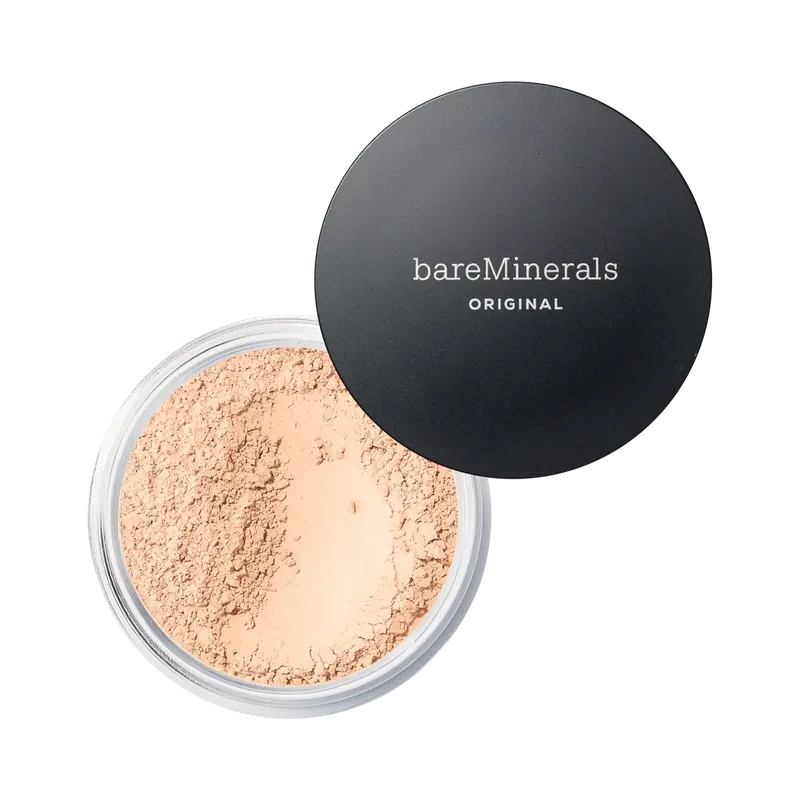
Original Loose Mineral Foundation SPF 15
Sensitive Skin Staple
 Verified reviewer
Pros & cons.
- +Radically simple five-ingredient formula with no fragrance, preservatives, or water
- +One of the few foundations dermatologists recommend for rosacea and post-procedure skin
- +Fungal acne safe — no fatty acids, esters, or oils that feed Malassezia
- +Sits beautifully on oily skin without sliding or oxidizing
- +Soft satin finish that looks like skin, not makeup, when buffed correctly
- +Iron oxides provide meaningful protection against visible and blue light
- +Jar lasts four to six months with daily use — strong value per application
- +Cruelty-free and pregnancy-safe with a decades-long consumer safety record
- −Clings mercilessly to dry patches and flaking skin
- −SPF 15 is lower than current daily-use guidance prefers for a standalone sunscreen
- −Loose powder format is messy and requires a learning curve
- −Bismuth oxychloride can cause mechanical itching in a small subset of users
- −Not ideal for mature skin where emphasis on texture becomes obvious
The full review.
In 1997, Leslie Blodgett went on QVC with a sifter jar of loose powder and did something almost unheard of for a beauty brand at the time: she read the entire ingredient list on camera. Mica, titanium dioxide, zinc oxide, bismuth oxychloride, iron oxides. That was the whole product. No emulsifiers, no fragrance, no preservatives, no water. The audience — exhausted by cosmetics with twenty-ingredient labels and vague promises — responded by buying so many jars that bareMinerals became one of the first cult objects of televised beauty commerce. Nearly three decades later, that same five-ingredient formula is still on shelves, still doing the same thing, and still earning a place in the medicine cabinets of people whose skin can’t tolerate anything else.
Let’s talk about what this actually is. It is a loose mineral powder that functions as foundation, powder, and reinforcing SPF in a single step. There is no water in the jar, which is why the ingredient list can be so short — water requires preservatives, preservatives require emulsifiers, and the whole supporting cast comes along for the ride. Remove the water and you remove the need for most of it. What’s left is pigment plus two physical UV filters plus the mica base that makes the whole thing glide. The SPF 15 comes from the titanium dioxide and zinc oxide doing their day jobs as both colorant and sunscreen simultaneously. It is one of the most elegant ingredient-to-function ratios in mainstream makeup.
Texture
The texture, once you learn to use it, is the quiet star. You swirl the powder into the lid, tap the excess off your brush — this is the step people skip and then wonder why they look chalky — and buff in small circles. Done correctly, the finish is a soft satin: not matte, not dewy, not powdery, just skin that looks like better skin. Oily skin types in particular report that the mineral particles sit on sebum without sliding, which is the specific problem that sinks most liquid foundations on oily complexions. If you have rosacea or reactive skin, the absence of fragrance and preservatives means that for many people this is the only foundation that doesn’t trigger a flush. Dermatologists have quietly recommended it for post-laser skin for years, which is less an endorsement of the brand than an acknowledgment that there aren’t many alternatives this clean.
Reality
Now the honest part. If your skin is dry, this powder will find the driest patch on your face and park itself there, and no amount of brush technique will fully hide it. The formula has nothing to grip moisture with — no glycerin, no hyaluronic acid, no emollients — so the condition of the canvas underneath is doing nearly all the work. A ceramide-rich moisturizer and a genuine exfoliation routine aren’t optional; they’re a prerequisite. Bismuth oxychloride, while perfectly stable and safe, is also the ingredient a small minority of users blame for a mid-afternoon itching sensation. The mechanism is mechanical, not allergic, but that distinction doesn’t help if your cheeks start to prickle around lunchtime. If you’re in that group, bareMinerals makes a bismuth-free version worth trying instead.
SPF
The SPF 15 deserves a direct conversation. At the time of this product’s launch, SPF 15 was the default number on nearly every daytime product in the United States. Current dermatology guidance has moved firmly toward SPF 30 minimum for daily use, and the reality is that powders applied at normal makeup thickness don’t deliver the laboratory-tested SPF number anyway because you simply can’t apply enough. Treat this product’s SPF rating as a bonus layer of reinforcement on top of a proper liquid sunscreen, not as your primary sun defense. Applied that way, the mineral pigments also help scatter visible light, which matters for anyone managing melasma.
Value
Value is reasonable without being a bargain. Thirty-three dollars for an 8g jar that lasts most users four to six months lands squarely in mid-tier territory — less expensive per month than most liquid foundations from Sephora, more expensive than drugstore powders. What you’re actually paying for is the formulation’s restraint. It is harder to make a five-ingredient foundation that works than to make a forty-ingredient one, which is the opposite of what most people assume. The fact that it still performs after three decades of reformulation pressure is its own credential.
Ingredient analysis.
Full INCI list
Mica, Titanium Dioxide (CI 77891), Zinc Oxide, Bismuth Oxychloride. May Contain: Iron Oxides (CI 77491, CI 77492, CI 77499).
Skin match.
The science.
The Science
This product relies on the evidence for physical mineral sunscreens and consumer-dermatology literature on minimalist formulations for reactive skin. Titanium dioxide and zinc oxide are the two FDA-recognized physical UV filters; their combined use in mineral makeup creates this category. Zinc oxide provides broad-spectrum UVA and UVB coverage, while titanium dioxide is strong in the UVB range. This combination in a single powder vehicle lets bareMinerals claim broad-spectrum SPF 15 from just two actives.
The practical question for any mineral powder is whether the applied dose matches the laboratory-tested dose. It almost never does. Studies on powder sunscreen application thickness show real-world users apply a fraction of the amount used in SPF testing. This is why even a well-formulated SPF 15 powder performs like SPF 5 to 8 in actual wear. This is not a flaw unique to bareMinerals; the powder format has this structural limitation. Layering is the appropriate response, not abandonment.
This specific formulation earns clinical credibility on reactive skin. Fragrance, preservatives, and emulsifiers are the three most common triggers for makeup-induced contact dermatitis, and this formula contains none of them. For patients with rosacea, seborrheic dermatitis, or post-procedure sensitivity, the absence of these components makes the product tolerable when others are not. Iron oxides, the pigments that give every shade its color, also block visible and high-energy visible light. This light contributes to melasma pigmentation beyond UV exposure alone. This makes tinted mineral makeup more than cosmetic for people managing melasma; it is an active part of the visible-light defense strategy that dermatologists now routinely recommend.
Dermatologist Perspective
Dermatologists have recommended this foundation for decades because it has one of the shortest ingredient lists in mainstream makeup. For patients with rosacea, seborrheic dermatitis, or skin recovering from procedures, the absence of fragrance, preservatives, and emulsifiers removes the most common triggers for cosmetic contact dermatitis. Board-certified dermatologists frequently green-light this as the first makeup product for patients weeks after laser resurfacing or chemical peels, when skin is still barrier-compromised and reactive to almost everything else. The iron oxide pigments also provide visible-light protection, which dermatologists managing melasma increasingly factor into patient recommendations. The standard clinical caveat is that SPF 15 from a powder is supplementary rather than primary sun protection.
Where it fits in your routine.
Start with well-moisturized skin; this is required for all but very oily complexions. Twist the sifter open, tap a small amount of powder into the lid, swirl the brush in the lid, then tap the brush firmly against the rim to remove excess. This tapping step prevents cakey application. Buff onto skin in small circular motions, moving from the center of the face outward. Build coverage in thin layers instead of one heavy pass. Close the sifter between uses to prevent spills. To reinforce SPF throughout the day, press additional powder over existing makeup with a dense kabuki brush instead of buffing.
At $33 for an 8g jar that lasts four to six months, this is mid-tier. Monthly costs run $5.50 to $8.25 — less than most Sephora liquid foundations and more than drugstore powders. Only the larger jar sells at full retail; a 2g travel size exists for sampling but has worse per-gram value. You pay for formulation restraint instead of ingredient extravagance, the right way to judge a minimalist product. Because bareMinerals is a legacy brand with a multi-decade track record rather than a trend-driven launch, the price also reflects proven tolerability data that newer mineral competitors cannot match.
Oily, combination, and sensitive skin types want a foundation that stays put, avoids redness, and does not clog pores. It works well for people with rosacea, fungal acne, or post-procedure skin, and those who react to fragrance or preservatives in conventional makeup.
Dry, dehydrated, or mature skin types will see powder emphasize texture and cling to dry patches. Skip this if you want a full-coverage, dewy, or foundation-forward finish — this product looks like skin, not a transformation.
Product details.
Ultra-fine loose powder feels silky between the fingers and buffs into skin without visible particle residue when applied correctly.
Completely unscented.
A plastic sifter jar uses a twist-lock cap, the same design bareMinerals has used for decades. Sifter holes let you tap powder into the lid, which works as an application tray.
The first few uses feel awkward if you use liquid foundation. You must learn to buff the product onto the brush instead of painting it. You will likely use too much on day one; refine your technique over a week.
An 8g jar lasts 4-6 months with daily use; the 2g travel size lasts about 6 weeks.
24 months
All Year
The backstory.
About bareMinerals
Common myths.
Mineral powder foundation has enough SPF for all-day sun exposure.
A thin layer of SPF 15 powder does not equal a dedicated liquid sunscreen. Use this as a reinforcement layer over a proper SPF 30+ base, not as your only sun protection.
Bismuth oxychloride is toxic or dangerous.
This stable, inert mineral is safe for topical use. Its plate-like structure causes mechanical irritation or itching in a small subset of users, not toxicity.
FAQ.
Is bareMinerals Original Loose Mineral Foundation good for sensitive skin?
Yes — the five-ingredient formula has no fragrance, preservatives, or water, removing the most common reactive ingredients. Dermatologists regularly green-light this makeup product for rosacea and post-procedure skin.
Does the SPF 15 in this foundation replace sunscreen?
No. SPF 15 in a powder applied at normal makeup thickness reinforces, but does not replace, sunscreen. Wear a dedicated broad-spectrum SPF 30 or higher underneath, especially if you are outdoors for more than a few minutes at a time.
Why does bareMinerals Original look patchy on my dry skin?
The titanium dioxide, zinc oxide, and mica base lacks hydrating or emollient ingredients. This causes it to cling to dry patches or flaking skin. Dry skin types need thorough exfoliation and a thick moisturizer underneath.
Is the bismuth oxychloride in this formula safe?
Yes, it is a stable mineral with a long history of safe topical use. A minority of people feel mechanical itching from its platey particles, so some users prefer bareMinerals' bismuth-free formulations.
Is bareMinerals Original fungal acne safe?
Yes. The entire INCI list — mica, titanium dioxide, zinc oxide, bismuth oxychloride, and iron oxides — lacks the fatty acids, esters, or oils that feed Malassezia. This makes it one of the safest foundation options for fungal acne sufferers.
How long does a jar of Original Loose Mineral Foundation last?
The 8g full size lasts four to six months with daily use. The formula has no water, so the powder stays stable for up to two years after opening if stored dry.
Can I wear this foundation during pregnancy?
Yes. Its mineral composition and lack of retinoids, salicylic acid, or hormone-disrupting ingredients make it a safe makeup choice during pregnancy and breastfeeding.
What the community says.
"feels weightless"
"doesn't clog pores"
"great for sensitive and rosacea-prone skin"
"buildable coverage"
"lasts all day on oily skin"
"clings to dry patches"
"messy to apply"
"can look dry or chalky on mature skin"
"SPF 15 is lower than some prefer"
People also looked at.