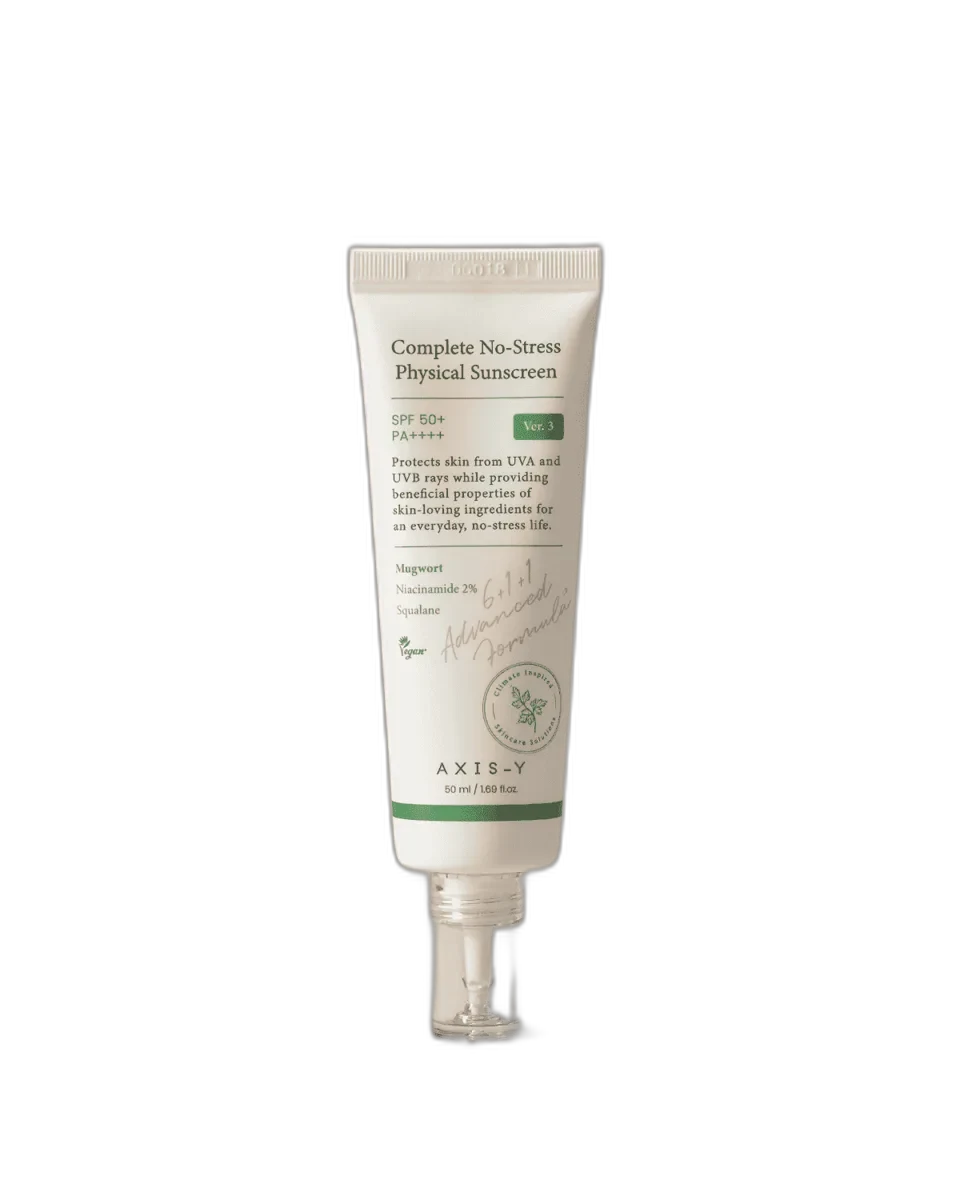
Complete No-Stress Physical Sunscreen SPF 50+
Sensitive-Skin Mineral Hybrid
 Verified reviewer
Pros & cons.
- +No white cast despite zinc-forward formulation
- +Gentle enough for rosacea and sensitive skin
- +Niacinamide, centella, and adenosine provide meaningful supporting actives
- +Lightweight, semi-matte finish that layers under makeup
- +Strong value for a Korean SPF 50+ PA++++
- +Fragrance-free and alcohol-free
- −Labeled 'physical sunscreen' but technically a hybrid
- −50ml tube is small for correct daily application amounts
- −Not fungal acne safe due to fatty ester content
- −Isoamyl p-methoxycinnamate is not FDA-approved in the US
- −Slightly tacky on very oily skin before setting
The full review.
There’s something mildly philosophical about a sunscreen labeled ‘physical’ that technically isn’t. Axis-Y’s Complete No-Stress Physical Sunscreen contains zinc oxide as its primary mineral UV filter, but it also contains isoamyl p-methoxycinnamate, a modern organic UVB filter that’s common in Korean and European sunscreens but not approved for sale in the United States. That makes this a hybrid sunscreen, not a true physical. And whether that’s a problem depends entirely on what you were looking for when you bought it — and on whether you believe the ‘physical’ label implies something more than a marketing gesture toward the zinc content.
Here’s the thing: in practice, the hybrid approach is the whole reason this sunscreen works. Pure zinc oxide sunscreens, and zinc-plus-titanium-dioxide mineral options, have one persistent problem that has plagued the category for decades — white cast. You can reduce it with nano-sized particles, or with color correction, or with thinner applications that compromise the protection, but pure mineral UV filters are fundamentally white, and putting enough of them on your skin to achieve SPF 50 protection means accepting some degree of visible residue. Korean formulators have been working around this by adding modern organic UV filters that aren’t approved by the US FDA but are fully legal and thoroughly tested under Korean and European cosmetic regulations. Isoamyl p-methoxycinnamate is one of the better ones — photostable, broad UVB coverage, gentle on skin. Adding it alongside zinc oxide lets the formulator reduce the zinc load without losing protection, which eliminates the white cast.
So this sunscreen is hybrid-mineral-dominant. The label should probably say something like ‘mineral-forward hybrid’ rather than ‘physical,’ but since Korean consumers tend to interpret ‘physical sunscreen’ more loosely than Americans do, the name survives. If you’re looking for a true pure physical because you specifically need to avoid all organic UV filters — maybe due to a diagnosed sensitivity or a personal ingredient-avoidance goal — this is not your pick. If you’re looking for a sunscreen that’s gentle, feels good, doesn’t cast white, and is mostly mineral, this is an excellent pick.
The rest of the formula is exactly what you’d want in a modern Korean SPF. Niacinamide appears relatively high on the list, which reinforces barrier function and adds a brightening angle that supports the anti-photoaging story. Adenosine contributes a well-evidenced anti-aging active. Centella asiatica and madecassoside calm reactive skin, making this a popular pick for rosacea-prone users who need a gentle SPF that won’t inflame their baseline redness. Panthenol and sodium hyaluronate add hydration. The emulsifier system produces a satin-semi-matte finish that layers reasonably well under makeup, which is a harder target than it sounds with any mineral-leaning formulation.
On the skin, it performs like a modern Korean sunscreen should. A full two-finger-length application spreads evenly without drag, blends invisibly within about thirty seconds, and sets to a comfortable finish that doesn’t feel heavy or waxy. There’s no sting on compromised skin. There’s no offensive smell. It doesn’t pill under typical Korean or Western morning routines unless you’ve layered too many silicone-based products underneath. The finish is slightly more matte than dewy, which makes it suitable for combination and oily skin and slightly less ideal for very dry skin that wants a glowy finish — but this is a minor texture preference, not a formulation flaw.
The limitations are real but small. The 50ml tube is on the small side if you’re applying the correct amount daily — expect six to eight weeks per tube with proper face-and-neck coverage, which makes this a sensible-value but not exceptional-value sunscreen on a per-application basis. The product name is technically misleading in a way that matters to some buyers. And the fatty esters in the emulsion mean this isn’t fungal-acne safe, which is worth knowing if malassezia is a factor in your breakouts.
At twenty-four dollars, it’s competitively priced against other thoughtful Korean sunscreens and meaningfully cheaper than Western dermocosmetic alternatives with similar profiles. For the sensitive-skin, hybrid-mineral-seeking buyer who wants something gentle, effective, and wearable under makeup, this sits comfortably in the recommended tier. Just go in knowing that you’re buying a hybrid, not a pure mineral — and appreciating that the hybrid is exactly why the skin feel is as good as it is.
Formula
Ingredient analysis.
Full INCI list
Water, Zinc Oxide, Isoamyl p-Methoxycinnamate, Propanediol, Butyloctyl Salicylate, Cetyl Ethylhexanoate, Dicaprylyl Carbonate, Niacinamide, Glycerin, Caprylic/Capric Triglyceride, Polyglyceryl-3 Polyricinoleate, Isononyl Isononanoate, Glyceryl Stearate, PEG-100 Stearate, C30-38 Olefin/Isopropyl Maleate/MA Copolymer, Polyhydroxystearic Acid, Cetyl PEG/PPG-10/1 Dimethicone, Magnesium Sulfate, Disteardimonium Hectorite, Stearic Acid, Aluminum Hydroxide, Tocopheryl Acetate, Adenosine, Panthenol, Sodium Hyaluronate, Centella Asiatica Extract, Madecassoside, Glyceryl Caprylate, 1,2-Hexanediol, Ethylhexylglycerin, Xanthan Gum, Phenoxyethanol
Skin match.
The science.
The Science
The broad-spectrum UV protection in this sunscreen relies on two complementary UV filters: zinc oxide and isoamyl p-methoxycinnamate. Zinc oxide is one of only two true broad-spectrum mineral filters (the other being titanium dioxide), providing coverage across the UVA and UVB ranges. Its broad-spectrum profile is well-documented in photobiology and dermatology literature, and it's approved by virtually every regulatory framework globally for sunscreen use. Research on zinc oxide particle size, surface coating, and photostability has been extensive over the past two decades.
Isoamyl p-methoxycinnamate (also known as Amiloxate or Neo Heliopan E 1000) is a modern organic UVB filter developed as a more photostable alternative to older cinnamate filters. It's approved for sunscreen use in the European Union, South Korea, Japan, Australia, and most of Asia, but is not currently among the FDA-approved UV filters in the United States — a result of the FDA's conservative sunscreen approval process rather than any safety concern identified in other jurisdictions. Research on its photostability and UVB protection has been published in journals including Photochemistry and Photobiology, with generally favorable results on its ability to maintain UV filtering capacity under sun exposure.
Niacinamide's role in photoaging is supported by clinical research, with studies in the British Journal of Dermatology and the Journal of Cosmetic Dermatology demonstrating effects on pigmentation, fine lines, and barrier function at concentrations starting around 2%. The combination of daily sunscreen and niacinamide is often cited in photoaging prevention protocols. Centella asiatica and madecassoside have a growing evidence base for anti-inflammatory and barrier-supporting effects, relevant for sensitive and post-procedure skin.
Dermatologist Perspective
Dermatologists generally support hybrid sunscreens — those combining mineral and organic UV filters — as a practical solution to the cosmetic challenges of pure mineral formulations, particularly the white cast that can reduce user compliance. Board-certified dermatologists often recommend Korean and European sunscreens with modern organic UV filters for patients who need strong broad-spectrum protection and struggle with the heavier feel of pure zinc options. This Axis-Y sunscreen is one of several Korean imports that appear in derm commentary as reasonable picks for sensitive and rosacea-prone skin, and the inclusion of centella and niacinamide is considered a formulation positive. The labeling question — calling a hybrid sunscreen 'physical' — receives some criticism in clinical discussions, though dermatologists generally consider the underlying formula sound regardless of the marketing language. Isoamyl p-methoxycinnamate has a well-established safety profile in jurisdictions where it's approved.
Where it fits in your routine.
Apply two full finger-lengths (about a quarter teaspoon) to the face and neck as the last step of your morning skincare routine. Spread it evenly and wait 60-90 seconds to set before applying makeup. Reapply every two hours during extended sun exposure, or more often if swimming or sweating. Use daily year-round, not just on sunny days — incidental UV exposure drives photoaging and pigmentation, and daily use delivers long-term benefits.
At twenty-four dollars for 50ml, this sunscreen sits in the upper-mid range of Korean SPF options. Per milliliter, it's slightly more expensive than the very best K-beauty value picks (Beauty of Joseon, Round Lab) but comparable to Axis-Y's own price tier and substantially cheaper than Western dermocosmetic alternatives like La Roche-Posay Anthelios or Elta MD UV Clear. Coming from an emerging indie brand, the pricing reflects quality without leaning on prestige. For sensitive skin buyers who specifically want a mineral-dominant hybrid with modern Korean UV filters, this is one of the more sensible options in the category.
Sensitive, rosacea-prone, or reactive skin types want a gentle mineral-dominant sunscreen without white cast. Users of Korean and European modern UV filters want a lightweight semi-matte finish for daily use. Axis-Y fans want to build the complete brand routine. People want a sunscreen that layers well under makeup.
Users needing a pure physical sunscreen without organic UV filters for medical or ingredient-avoidance reasons. Very oily skin types wanting a matte finish. People with fungal acne, as the emulsion's fatty esters may feed malassezia. US buyers needing only FDA-approved sunscreens for regulatory reasons.
Product details.
All Year
The backstory.
Axis-Y launched this sunscreen in 2021 as part of their expanded routine lineup, targeting the gap in the Korean market for a gentle, hybrid-mineral sunscreen that didn't leave a white cast or feel heavy on the skin. The 'Complete No-Stress' naming aligned with the brand's emphasis on minimalist, reactive-skin-friendly formulations.
About Axis-Y
Emerging Brand (2–5 years)Axis-Y launched in 2018 using a transparent, ingredient-led philosophy. This mineral sunscreen follows their standard practice of publishing formulation rationale. Korean sunscreens benefit from stricter domestic cosmetic sunscreen regulations. This one is tested and rated SPF 50+ PA++++ under the KFDA framework.
FAQ.
Is this a true physical sunscreen?
Technically no. Zinc oxide is the primary mineral filter, but isoamyl p-methoxycinnamate, an organic UVB filter, is also present. This makes it a hybrid sunscreen with a physical-dominant profile. For most users, this prevents a white cast, but it matters if you must avoid all organic UV filters.
Does it leave a white cast?
No, or at least not noticeably. The hybrid formulation uses a modest zinc load with the organic filter, so it blends invisibly on most skin tones. Very deep skin tones may see a faint mineral residue, but it is less pronounced than with pure-zinc alternatives.
Is it safe for rosacea-prone skin?
Yes — the formula is fragrance-free, zinc-forward, and uses calming actives like centella and madecassoside. Many rosacea sufferers tolerate it well, but individual sensitivity to isoamyl p-methoxycinnamate varies. Patch test first if you have had issues with organic UV filters before.
Can I wear it under makeup?
Yes — the semi-matte finish makes it one of the better Korean sunscreens for makeup layering. Let it set for 60-90 seconds before applying foundation, and most users report good adhesion without piling or sliding.
How much should I apply?
Apply two full finger-lengths to the face and neck, or about a quarter teaspoon for the face. Most people apply less than this. You need this amount to reach the labeled SPF. Applying less dilutes the protection.
Is it reef-safe?
The formula contains zinc oxide (typically considered reef-safer than oxybenzone and octinoxate) and isoamyl p-methoxycinnamate. The reef status of isoamyl p-methoxycinnamate is less clear. If reef safety is your primary concern, a pure zinc sunscreen is the more conservative choice.
Is it approved for sale in the US?
You can purchase it through international retailers like YesStyle and Stylevana, but isoamyl p-methoxycinnamate is not among the UV filters currently approved by the FDA for sale in US sunscreens, which is why most Korean sunscreens with this filter are imported rather than sold domestically.
Community
What the community says.
"No white cast despite being labeled physical"
"Pleasant, lightweight texture under makeup"
"Gentle enough for sensitive and rosacea-prone skin"
"Strong value for a Korean SPF 50+"
"The 'physical sunscreen' name is technically misleading — it's a hybrid"
"50ml bottle feels small if you use the correct amount daily"
"Slight tackiness on oily skin before setting"
Featured in.
People also looked at.