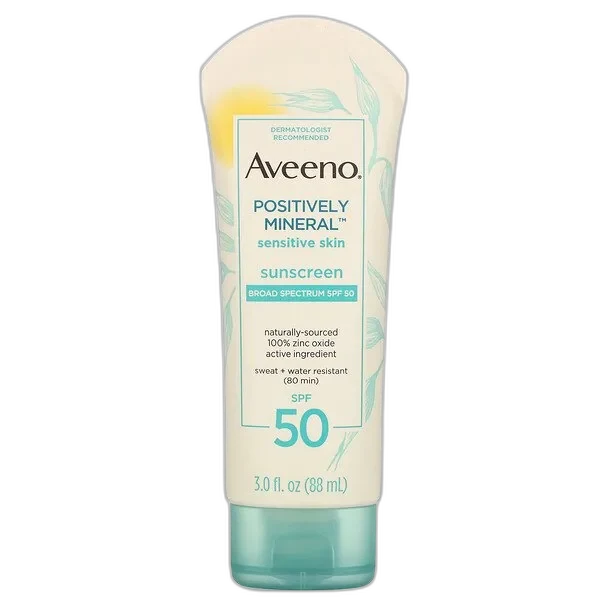
Positively Mineral Sensitive Skin Sunscreen SPF 50
Sensitive Skin Shield
 Verified reviewer
Pros & cons.
- +100% zinc oxide provides broad-spectrum SPF 50 without chemical UV filter irritation
- +Colloidal oatmeal actively soothes sensitive and reactive skin during sun exposure
- +Feverfew extract adds antioxidant protection against UV-generated free radicals
- +Completely fragrance-free, paraben-free, and hypoallergenic formulation
- +80-minute water and sweat resistance — maximum allowed by FDA standards
- +Silicone base makes the formula significantly more elegant than traditional zinc pastes
- +Safe for pregnancy, rosacea-prone skin, and post-procedure recovery
- +HSA/FSA eligible as an OTC drug product
- −Leaves noticeable white cast, especially on medium-to-dark skin tones
- −Thicker texture requires 1-2 minutes of patient blending for even coverage
- −Product has been discontinued by Aveeno — limited remaining stock
- −Small 3 oz size runs through quickly with daily face-and-body application
- −Higher per-ounce cost than chemical sunscreens at comparable SPF levels
The full review.
There is a particular frustration in the sensitive-skin world that goes something like this: you need sunscreen more than anyone because your skin is already reactive, already inflamed, already dealing with enough. And yet most sunscreens — even the ‘gentle’ ones — contain chemical UV filters, fragrances, or alcohol that make your face feel like it’s been lightly slapped. Aveeno’s Positively Mineral Sensitive Skin Sunscreen SPF 50 was designed precisely for this catch-22, and its quiet disappearance from the market has left a genuine gap that its users are still mourning.
The formula is elegant in its protective philosophy. Zinc oxide serves as the sole UV filter — a physical blocker that sits on the skin’s surface and reflects UV radiation rather than absorbing and converting it the way chemical filters do. For skin that reacts to avobenzone, oxybenzone, or octinoxate, this is not a preference but a necessity. And Aveeno doesn’t stop at the filter. The formula layers colloidal oatmeal — the same FDA-recognized skin protectant that anchors the brand’s eczema line — directly into the sunscreen base. So while the zinc oxide handles the UV, the oat is calming the inflammatory response that sensitive skin mounts against pretty much everything.
The feverfew extract is a lesser-known but clever addition. Chrysanthemum parthenium has been studied for its antioxidant properties, specifically its ability to neutralize the free radicals that UV exposure generates even when physical SPF is in place. Aveeno uses a parthenolide-depleted version — meaning they’ve removed the compound in raw feverfew that can cause contact dermatitis. It’s the kind of ingredient detail that separates a formula designed by people who understand sensitive skin from one designed by people who just removed the obvious irritants and called it sensitive.
The silicone base is what makes this formula wearable. Multiple silicones — dimethicone, cetyl dimethicone, phenyl trimethicone, ethyl methicone — create a smooth, slippery vehicle that distributes the zinc oxide particles more evenly and reduces that chalky, paste-like feel that makes traditional mineral sunscreens a daily discipline in patience. The result is genuinely smoother than you’d expect from a 100% zinc formula, though it doesn’t reach the invisible elegance of the best chemical sunscreens.
Because honesty matters: the white cast is real. On fair skin, it settles into a slightly luminous finish that many users actually appreciate — a soft-focus effect that works as a subtle primer. On medium-to-dark skin tones, it’s more of a problem. The triethoxycaprylylsilane coating on the zinc particles helps, and the phenyl trimethicone adds some refractive trickery, but this is still a zinc-oxide-forward mineral sunscreen. If white cast is a dealbreaker, this isn’t your product, and pretending otherwise would be dishonest.
The texture requires a moment of commitment. It’s thicker than a chemical SPF, denser than a moisturizer, and asks you to spend a solid minute or two blending it in. Some users describe it as ‘difficult,’ which is fair relative to a La Roche-Posay fluid sunscreen but generous relative to the zinc oxide paste sunscreens of a decade ago. Context matters with mineral formulations.
Water and sweat resistance for 80 minutes — the maximum allowed by FDA labeling rules — adds genuine utility for outdoor activities. The silicone base that makes the formula cosmetically elegant also helps it adhere to skin during perspiration, which is a meaningful advantage for the active-lifestyle user who also happens to have sensitive skin.
The fragrance-free, paraben-free, phthalate-free claims are all genuine — no masking fragrances, no hidden irritants in the inactive ingredients. This is a sunscreen that earns its sensitive-skin credentials through what it excludes as much as what it includes.
The discontinued status is the elephant in the review. Aveeno has pulled this product from its active lineup, and while remaining stock is trickling through retailers, supply is finite. For users who built their daily routine around this sunscreen, the loss is tangible. The combination of zinc oxide, oat, and feverfew in a cosmetically acceptable base at a drugstore price point was uncommon, and Aveeno’s current sunscreen lineup doesn’t replicate it exactly.
At roughly eleven dollars for three ounces — when you can find it — the value was reasonable for a mineral SPF 50 with these ingredient credentials. The small format means frequent repurchases for daily face use, and full-body application burns through a tube in about a week. This was always a face-focused product masquerading as a face-and-body option.
For the time it was available, this sunscreen represented exactly what sensitive-skin consumers needed: genuine protection, genuine gentleness, and genuine formulation intelligence from a brand with eighty years of skin science behind it. Its discontinuation is a loss the market hasn’t fully replaced.
Formula
Texture
The texture requires a moment of commitment. It’s thicker than a chemical SPF, denser than a moisturizer, and asks you to spend a solid minute or two blending it in. Some users describe it as ‘difficult,’ which is fair relative to a La Roche-Posay fluid sunscreen but generous relative to the zinc oxide paste sunscreens of a decade ago. Context matters with mineral formulations.
Scent
The fragrance-free, paraben-free, phthalate-free claims are all genuine — no masking fragrances, no hidden irritants in the inactive ingredients. This is a sunscreen that earns its sensitive-skin credentials through what it excludes as much as what it includes.
Best for
For the time it was available, this sunscreen represented exactly what sensitive-skin consumers needed: genuine protection, genuine gentleness, and genuine formulation intelligence from a brand with eighty years of skin science behind it. Its discontinuation is a loss the market hasn’t fully replaced.
Ingredient analysis.
Full INCI list
Active Ingredient: Zinc Oxide (Sunscreen). Inactive Ingredients: Acrylates/Dimethicone Copolymer, Avena Sativa (Oat) Kernel Flour, C12-15 Alkyl Benzoate, Caprylyl Glycol, Cetyl Dimethicone, Cetyl Dimethicone/Bis-Vinyldimethicone Crosspolymer, Cetyl PEG/PPG-10/1 Dimethicone, Chlorphenesin, Chrysanthemum Parthenium (Feverfew) Flower/Leaf/Stem Juice, Dimethicone, Ethyl Methicone, Glycerin, Glyceryl Behenate, Octyldodecyl Citrate Crosspolymer, Phenethyl Alcohol, Phenoxyethanol, Phenyl Trimethicone, Polyhydroxystearic Acid, Silica, Sodium Chloride, Styrene/Acrylates Copolymer, Triethoxycaprylylsilane, Water
Skin match.
The science.
The Science
Zinc oxide is the sole UV filter in this formula. It provides UVA and UVB protection via a physical mechanism: particles scatter and reflect ultraviolet radiation instead of absorbing it through chemical conversion. This physical action is why dermatologists often recommend zinc oxide for patients with rosacea, post-procedure skin, or chemical sunscreen sensitivities. A 2019 review in the Journal of the American Academy of Dermatology confirmed that mineral sunscreens containing zinc oxide generally tolerate better in sensitive skin populations than chemical counterparts.
The colloidal oatmeal component provides the anti-inflammatory activity documented in the 2016 Journal of Drugs in Dermatology study, which showed oat enhances epidermal barrier function through multiple mechanisms at once. This matters for sunscreen: UV exposure triggers inflammatory cascades even in protected skin, and the oat's avenanthramides help modulate that response at the NF-κB pathway level.
Feverfew (Chrysanthemum parthenium) extract, specifically the parthenolide-depleted version used here, has antioxidant and anti-inflammatory properties. Research in the Journal of Investigative Dermatology showed feverfew extract reduces UV-induced oxidative damage and inflammatory markers in human skin cells. Parthenolide removal is critical; native feverfew contains compounds that cause allergic contact dermatitis, but the depleted version keeps the antioxidant benefits without the sensitization risk.
References
- Colloidal Oatmeal (Avena Sativa) Improves Skin Barrier Through Multi-Therapy Activity — Journal of Drugs in Dermatology (2016)
Dermatologist Perspective
Dermatologists routinely recommend mineral sunscreens for patients with rosacea, sensitive skin, and chemical sunscreen allergies. Board-certified dermatologists note that zinc oxide-only formulas like this one avoid common sunscreen allergens — specifically avobenzone and oxybenzone — while providing reliable broad-spectrum coverage. Adding colloidal oatmeal follows dermatological guidance to treat sensitive skin with anti-inflammatory ingredients at every routine step. Dermatologists also recommend this sunscreen for post-procedure use because the gentle mineral formula won't irritate freshly treated skin.
Guidance
Where it fits in your routine.
Apply liberally at least 15 minutes before sun exposure. Use a nickel-sized amount for the face and a full shot glass for all exposed body areas. Blend with upward strokes; warm the thick texture between your palms first. Reapply every 2 hours during continuous sun exposure, and immediately after swimming, sweating, or towel drying. One midday touch-up after morning application is enough for a daily commute.
At about $10.99 for 3 fl oz, this mineral SPF 50 is competitively priced and includes active skincare ingredients like oat and feverfew. The cost per application for face-only use is reasonable, but full-body coverage lowers the value quickly. Because the product is discontinued, remaining stock prices vary by retailer. Finding this ingredient combination at this price point is difficult.
This works for sensitive, reactive, rosacea-prone, or post-procedure skin needing mineral sun protection without chemical UV filters or fragrance. It suits people with known sensitivities to chemical sunscreen ingredients, pregnant individuals seeking the safest UV protection option, and anyone wanting more than just UV blocking.
People with medium-to-dark skin tones who dislike white cast should use tinted mineral alternatives. Those needing a thin, invisible sunscreen texture for layering under makeup may find this too thick. Anyone needing a long-term daily sunscreen should find a non-discontinued alternative, as this product's availability is limited and diminishing.
Product details.
It is fragrance-free. It has no scent except a faint mineral/silicone note that vanishes quickly.
The 3 oz compact squeeze tube is travel-friendly. This small size is TSA-compliant but requires frequent repurchasing for daily use. It works well for face application but costs more for full-body coverage. ***
The first application shows a thicker texture than expected and needs patient blending. A white cast shows on medium-to-dark skin tones. The silicone base feels smooth and non-greasy once fully blended. It causes no stinging or irritation, even on freshly sensitized skin.
3-4 weeks with daily face-only application (3 oz size) ***
12 months ***
All Year ***
The backstory.
Aveeno developed this sunscreen to fill a gap for sensitive-skin individuals who needed mineral sun protection without the heavy, paste-like textures of traditional zinc oxide formulas. By leveraging their oat expertise and adding feverfew for antioxidant support, they created a sunscreen that treated the application as a skincare step rather than just a protection layer. Though now discontinued, it earned a devoted following among sensitive-skin and rosacea communities.
About Aveeno
Legacy Brand (20+ years)Aveeno launched in 1945 with the Mayo Clinic and has dermatologist recommendations for over 70 years. Note: Aveeno discontinued this specific product, but some retailers may still have stock.
Common myths.
Mineral sunscreens can't provide high SPF protection
This formula uses zinc oxide alone for SPF 50 broad-spectrum protection. Modern formulation techniques — including the silicone dispersal system and surface-treated zinc oxide particles used here — let mineral sunscreens match the protection levels of chemical sunscreens.
All mineral sunscreens leave a heavy white cast
This formula leaves some white cast, especially on darker skin tones, but the silicone base and surface-treated zinc oxide reduce it compared to basic zinc oxide formulas. The triethoxycaprylylsilane coating on the zinc particles and the phenyl trimethicone in the base both minimize visible residue.
FAQ.
Does Aveeno Positively Mineral Sunscreen leave a white cast?
The formula leaves some white cast, especially on medium-to-dark skin tones. The silicone base and surface-treated zinc oxide reduce this compared to basic mineral formulas, but it remains visible. Users who dislike white cast may prefer tinted mineral alternatives.
Is Aveeno Positively Mineral Sunscreen safe for pregnancy?
Yes — because it uses 100% zinc oxide and no chemical UV filters, it is one of the safest sunscreen choices during pregnancy. The fragrance-free, hypoallergenic formula excludes ingredients most commonly flagged by prenatal care guidelines.
Can you use Aveeno Positively Mineral Sunscreen on your face?
The non-comedogenic, fragrance-free formula works for both face and body. Aveeno also sells a separate face-specific version (2 fl oz) using the same formula in a smaller, face-focused package.
Is Aveeno Positively Mineral Sunscreen water resistant?
Yes — it resists water and sweat for up to 80 minutes, the maximum water-resistance claim the FDA allows. Reapply after swimming, heavy sweating, or towel drying regardless of the resistance rating.
What the community says.
"Gentle on sensitive and reactive skin without stinging"
"100% zinc oxide formula feels safer than chemical sunscreens"
"Fragrance-free and lightweight for a mineral sunscreen"
"Water and sweat resistant for up to 80 minutes"
"Leaves a noticeable white cast especially on darker skin tones"
"Thick texture requires significant blending time"
"Small 3 oz bottle runs out quickly with regular body use"
"Product has been discontinued by Aveeno"
Featured in.
People also looked at.