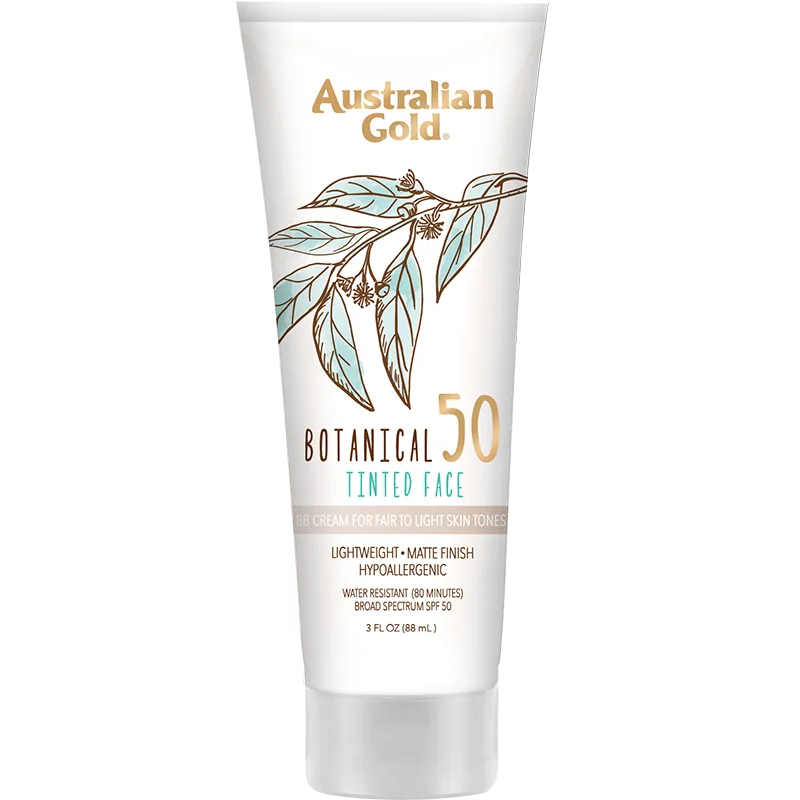
Botanical SPF 50 Tinted Face Mineral Lotion
Drugstore Mineral Favorite
 Verified reviewer
Pros & cons.
- +SPF 50 mineral-only protection with remarkably elegant, non-chalky matte finish
- +Iron oxide tint provides additional visible light and HEV protection beyond UV coverage
- +Under $18 — significantly cheaper than most comparable tinted mineral sunscreens
- +Doubles as a makeup primer with its silicone-based, pore-blurring finish
- +Fragrance-free and Leaping Bunny certified cruelty-free
- +Australian botanical antioxidants (Kakadu plum, red algae) add genuine photoprotective value
- +80-minute water resistance confirmed through FDA testing
- −Only three shade options — significant gaps for many medium and deep skin tones
- −Silicone-heavy formula can pill over water-based serums or heavy moisturizers
- −3 oz tube depletes quickly at proper sunscreen application amounts
- −Can feel drying on very dry or dehydrated skin without a hydrating base layer
- −Eucalyptus extract may be sensitizing for individuals with botanical allergies
The full review.
In 2015, few expected a brand known for tanning oils to produce a top-recommended mineral sunscreen on skincare Reddit. Yet Australian Gold’s Botanical SPF 50 Tinted Face Mineral Lotion became a cult product, proving the best sunscreens can come from unexpected brands.
The formula provides SPF 50 broad-spectrum protection using only 4% zinc oxide and 4% titanium dioxide. These concentrations are low for mineral-only protection at this level. A silicone-based vehicle acts as a dispersion system that distributes mineral particles more evenly than water-based formulations. This results in equivalent protection from less mineral content and better cosmetic elegance.
Cosmetic elegance defines this sunscreen’s reputation. The tinted formula applies like a silicone primer, blending into skin with natural coverage that softens imperfections without looking like makeup. The iron oxides in the tint provide dual purpose: they offer additional protection against visible light and high-energy visible light, which zinc oxide and titanium dioxide do not fully address. This visible light protection is meaningful for melasma or hyperpigmentation.
A matte finish develops within about a minute, making it a favorite for combination and oily skin types who dislike the greasy finish of many mineral sunscreens. It sits under makeup like a primer; many users skip primer when using this product. Shea butter and squalane provide enough emollience to prevent the matte finish from feeling tight, though users with dry skin may need a hydrating layer underneath.
Australian Gold uses botanical additions that serve a purpose rather than acting as marketing window dressing. Kakadu plum extract contains one of the highest natural concentrations of vitamin C in any fruit, providing antioxidant backup against free radicals from UV exposure. Red algae extract adds polysaccharide-based antioxidant and hydrating properties. Eucalyptus extract provides antioxidant benefits but can be sensitizing for some; however, its position low on the ingredient list suggests a minimal concentration.
The formula is fragrance-free, paraben-free, and Leaping Bunny certified cruelty-free. It meets major consumer checkboxes without a premium price. At under $18 for 3 fluid ounces, it undercuts most mineral tinted sunscreens. Because 3 ounces does not last long when applied at the dermatologist-recommended amount for the face and neck, budget-conscious users should replace the tube every four to six weeks.
The shade range is the product’s main limitation. With only three categories—Fair to Light, Medium to Tan, and Rich to Deep—it is not for precise shade matching. It works best for users wanting a subtle tint rather than foundation-level coverage; those between categories may find the tint reads slightly off. The Rich to Deep shade was a later addition, but the three-shade system still leaves gaps.
The silicone-heavy base provides an elegant feel but requires practical steps. It can pill if applied over water-based serums or heavy moisturizers. Users must let skincare absorb fully or use silicone-compatible products underneath. Thorough cleansing at night is important; a double cleanse with an oil-based first step ensures no silicone residue remains to clog pores.
FDA-mandated testing verified the 80 minutes of water resistance, making it practical for outdoor activities. However, the matte finish breaks down with sweat faster than the SPF protection; the cosmetic appearance degrades before the protection does.
Australian Gold has produced a serious sun protection product despite its tanning oil origins. The formula is smart, the price is fair, and the finish is pleasant. Shade limitations prevent a universal recommendation, but for the skin tones it serves, it is difficult to beat at any price point, especially under twenty dollars.
Formula
Ingredient analysis.
Full INCI list
Active Ingredients: Titanium Dioxide (4%), Zinc Oxide (4%). Inactive Ingredients: Alumina, Butyrospermum Parkii (Shea) Butter, Caprylyl Glycol, Cetyl PEG/PPG-10/1 Dimethicone, Cyclopentasiloxane, Dimethicone Crosspolymer, Disodium EDTA, Disteardimonium Hectorite, Eucalyptus Globulus Leaf Extract, Glycerin, Hexyl Laurate, Iron Oxides, Panthenol, PEG-10 Dimethicone, Phenoxyethanol, Polyglyceryl-4 Isostearate, Polymethylsilsesquioxane, Porphyra Umbilicalis (Red Algae) Extract, Silica, Squalane, Stearic Acid, Terminalia Ferdinandiana (Kakadu Plum) Fruit Extract, Tocopheryl Acetate, Triethoxycaprylylsilane, Water.
Skin match.
The science.
The Science
This sunscreen relies exclusively on two mineral UV filters — zinc oxide and titanium dioxide — each at 4% concentration. A 2019 review by Schneider and Lim published in Photodermatology, Photoimmunology & Photomedicine examined the UV filtering mechanisms of these inorganic compounds, confirming that they protect primarily through absorption of UV photons rather than the commonly cited reflection mechanism. Zinc oxide provides broader UVA coverage while titanium dioxide excels in the UVB range, making their combination at equal concentrations a logical approach to full-spectrum protection.
The addition of iron oxides for the tint is not merely cosmetic. A growing body of evidence, including research published in the Journal of the American Academy of Dermatology, demonstrates that iron oxides provide meaningful protection against visible light (400-700 nm), a wavelength range that mineral UV filters alone do not adequately address. This is clinically significant for conditions like melasma, where visible light can trigger hyperpigmentation independent of UV exposure.
The relatively low 4% concentration of each mineral filter achieving SPF 50 protection is notable. The silicone-based vehicle (cyclopentasiloxane, dimethicone crosspolymer) creates a more uniform film on the skin surface than water-based vehicles, optimizing the distribution of mineral particles. Research has shown that the evenness of sunscreen film formation significantly impacts actual SPF delivery — an uneven film can reduce effective protection by 50% or more compared to the labeled SPF. This formulation approach prioritizes film quality over filter quantity.
The Kakadu plum (Terminalia ferdinandiana) extract provides one of the highest natural concentrations of ascorbic acid found in any botanical source, offering antioxidant support that addresses the gap between what UV filters prevent and the oxidative damage that still occurs. Porphyra umbilicalis (red algae) extract contributes mycosporine-like amino acids, natural UV-absorbing compounds produced by marine organisms as their own photoprotection.
References
- A review of inorganic UV filters zinc oxide and titanium dioxide — Photodermatology, Photoimmunology & Photomedicine (2019)
- Metal oxide sunscreens protect skin by absorption, not by reflection or scattering — Acta Dermato-Venereologica (2016)
Dermatologist Perspective
Dermatologists frequently recommend tinted mineral sunscreens for patients with melasma, rosacea, and post-inflammatory hyperpigmentation, as the iron oxides provide visible light protection that untinted mineral sunscreens lack. Board-certified dermatologists note that this Australian Gold formula is one of the most accessible options in this category, making it a practical first recommendation for patients who need daily mineral sun protection without a prescription-level price. The fragrance-free, non-comedogenic formulation is particularly valued in dermatological practice for patients with sensitive or acne-prone skin who struggle with chemical sunscreen ingredients. Dermatologists commonly advise patients to apply a hydrating serum or moisturizer underneath the matte formula if they have dry skin, and to double-cleanse in the evening to fully remove the silicone-based film.
Where it fits in your routine.
Apply a generous amount to your face and neck after moisturizer absorbs. Use a nickel-sized amount for the face, or more for the neck and ears. Blend quickly; the silicone base sets fast and gets hard to spread as it dries. Wait 1-2 minutes before applying makeup. Reapply every 2 hours during direct sun exposure. To remove, double cleanse in the evening: use an oil-based cleanser or micellar water to dissolve the silicone base, then use a water-based cleanser.
At about $18 for 3 fluid ounces, this offers top value for tinted mineral sunscreen. Brands like EltaMD, Colorescience, and Supergoop usually cost $30-50 for similar or smaller sizes. The trade-off involves a smaller shade range and simpler packaging, but the sun protection and formula quality exceed the price. One value factor is the fast depletion rate — using proper amounts for face and neck, a tube lasts four to six weeks. This costs roughly $4-5 per week of daily use, which stays competitive in the mineral sunscreen category.
This mineral sunscreen offers affordable, matte protection. It suits combination to oily skin, sensitive skin, or conditions like melasma or rosacea that need visible light protection. It works as an everyday sunscreen for those wanting light coverage without foundation.
People with very dry skin who dislike matte sunscreens, anyone unable to match the three available tints, and those seeking silicone-free formulations will find this unsuitable. Users with eucalyptus sensitivity should also avoid this product.
Product details.
Thick cream applies like a tinted primer. The silicone-based formula sets fast to a velvety matte finish.
Fragrance-free with minimal product scent
3 fl oz squeeze tube, compact and travel-friendly
The lotion dispenses as a tinted cream, thicker than most facial sunscreens. It blends fast and sets to a matte, primer-like finish in about 60 seconds. Apply it quickly because the silicone base dries fast. This works best over a hydrating layer on dry or dehydrated skin.
4-6 weeks with daily facial application at proper sunscreen amounts
12 months
All Year
The backstory.
Australian Gold spent decades as a tanning lotion brand before pivoting to sun protection, and this tinted mineral formula became one of their most acclaimed products. It gained viral popularity on skincare forums and social media around 2018-2019 as users discovered it could double as a matte primer, bringing a tanning brand into the serious sun protection conversation.
About Australian Gold
Legacy Brand (20+ years)Trevor Gray founded Australian Gold in 1985 in Indiana, inspired by Australia's sun-loving culture. The brand has 40 years of sun care experience and sells accessible, cruelty-free mineral sunscreen formulations at Target, CVS, Ulta, and other mass retailers.
Common myths.
Mineral sunscreens leave a white cast, even tinted versions.
The iron oxide tint in this formula counteracts the white cast from zinc oxide and titanium dioxide. Choosing the correct shade lets this sunscreen blend into the skin with a natural, even finish.
4% zinc oxide and 4% titanium dioxide alone do not provide SPF 50 protection.
The silicone-based vehicle in this formula distributes mineral filters evenly across the skin. This achieves SPF 50 protection, as confirmed by FDA-mandated testing. Filter concentration is not the only factor; the vehicle's ability to form an even film matters equally.
FAQ.
Does Australian Gold Botanical Tinted SPF 50 leave a white cast?
No, if the shade matches. The iron oxide tint counteracts the white cast from zinc oxide and titanium dioxide. The Fair to Light shade works for very light to light skin tones, and the Rich to Deep shade works for medium to deep tones. The wrong shade causes an ashy or orangey appearance.
Can you wear Australian Gold Tinted SPF 50 under makeup?
Yes — this is one of its most popular uses. The silicone-based, matte-finish formula works like a primer to create a smooth base for foundation or concealer. Let it set for 1-2 minutes before applying makeup. Some users report pilling when applied over heavy moisturizers; a lightweight hydrating layer works best underneath.
Is Australian Gold SPF 50 Tinted Mineral Lotion reef safe?
This formula uses only zinc oxide and titanium dioxide as UV filters. Neither ingredient is on Hawaii's banned sunscreen ingredients list. The brand does not market it as 'reef safe' because definitions vary and no universal certification standard exists.
How often should you reapply Australian Gold Tinted SPF 50?
Reapply every two hours during sun exposure, or right after swimming or heavy sweating, even with the 80-minute water resistance rating. The tinted formula builds coverage with each reapplication — some users use a mineral powder SPF to touch up over makeup.
Is this sunscreen good for acne-prone skin?
Yes. The mineral-only formula is non-comedogenic and fragrance-free. Its matte finish controls oil all day. Zinc oxide has mild anti-inflammatory properties. For very acne-prone skin, the silicone base is the only concern, as some users find it traps debris without proper nighttime cleansing.
What shades does Australian Gold Botanical Tinted SPF 50 come in?
The product comes in Fair to Light, Medium to Tan, and Rich to Deep shade ranges. This shade selection is limited compared to tinted moisturizers or foundations. It works best for users seeking a subtle tint instead of full-coverage shade matching.
What the community says.
"Affordable mineral sunscreen with elegant matte finish"
"Light tint provides natural coverage without looking cakey"
"No white cast when shade is matched correctly"
"Wears well under makeup"
"Limited shade range — only a few tint options available"
"Can feel drying on very dry skin types"
"Silicone-heavy formula may pill over certain moisturizers"
"3 oz tube runs out quickly with proper application"
People also looked at.