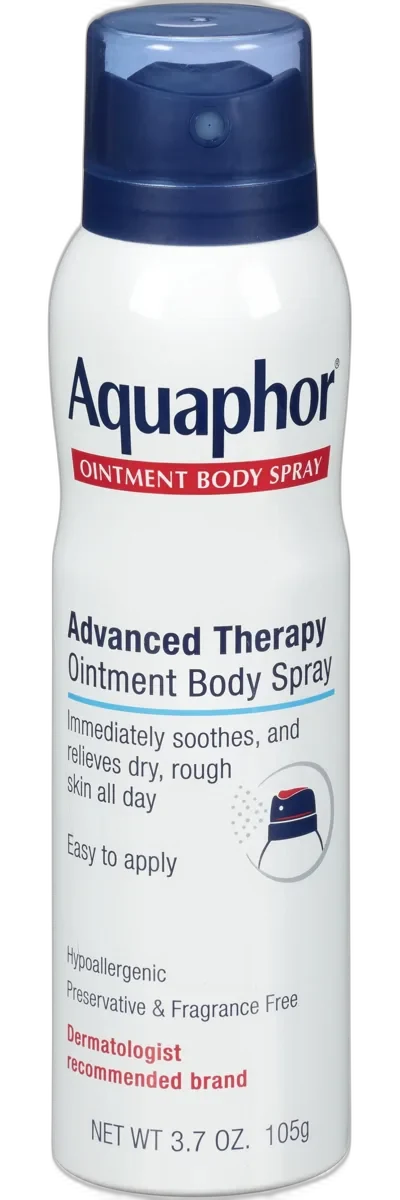
Healing Ointment Body Spray
Hands-Free Barrier Shield
 Verified reviewer
Pros & cons.
- +Touchless 360-degree spray reaches back, legs, and other hard-to-reach body areas
- +Same trusted Aquaphor core formula — petrolatum, panthenol, glycerin, bisabolol
- +Lighter deposit than the jar version means less greasiness for body-wide application
- +Cool mist feels immediately soothing on dry, irritated, or eczema-affected skin
- +Fragrance-free, preservative-free with the same minimal ingredient approach
- +Sprays upside down for easy application to backs of legs and lower body
- −Spray nozzle clogs frequently, sometimes rendering the can unusable with product remaining
- −Significantly higher per-ounce cost than the jar format of the same formula
- −Uneven spray pattern requires hand-spreading for consistent coverage
- −Thinner deposit provides less intensive occlusion than the jar for severe dryness
- −Some product waste from aerosol overspray missing the target skin area
- −Not practical for facial application — jar or tube format needed for the face
The full review.
Texture
The texture on your skin is lighter than what you scoop from the jar. This is a feature. The spray deposits a thin, even layer of petrolatum-based protection. It provides occlusion without the thick, greasy coating that makes the jar version impractical for full-body application after a shower. You can spray your legs, arms, and torso, dress within minutes, and not ruin your clothing. Less grease is the trade-off for slightly less intensive occlusion.
Common Praise
The soothing quality is noticeable on contact. The propellant creates a cooling sensation as it evaporates, and the bisabolol’s anti-inflammatory properties comfort irritated skin. For eczema sufferers who dread rubbing ointment into inflamed patches, the touchless application improves quality of life.
Common Complaints
The nozzle clogs. This is the most consistent complaint across thousands of reviews and affects the product’s overall rating. Users report that after a few weeks, the nozzle dispenses in spurts instead of a fine mist, then stops working entirely—sometimes with half the product left in the can. The thick ointment solidifies in the nozzle mechanism between uses, and warm water provides inconsistent relief. At roughly $3.65 per ounce—nearly three times the $1.31 per-ounce cost of the 14-ounce jar—a failing delivery mechanism creates a value problem.
The spray pattern is uneven even when working, so most users report spreading the product by hand after spraying. This negates the touchless convenience of the format. You spray to reach difficult areas, then finish by spreading manually. It is more practical than the jar for body application, but it is not the frictionless experience the concept promises.
Best for
The ingredient base is the same formula hospitals and dermatologists have used for a century. The petrolatum-panthenol-glycerin-bisabolol system that makes the jar version the gold standard for barrier protection works identically here. The fragrance-free, preservative-free, seven-ingredient simplicity is unchanged. For dry skin, eczema, post-procedure care, and winter skin, the active ingredients work regardless of delivery format.
Ingredient analysis.
Full INCI list
Butane, Petrolatum, Mineral Oil, Ceresin, Lanolin Alcohol, Panthenol, Glycerin, Bisabolol
Skin match.
The science.
The Science
This spray uses the same active ingredients as the Aquaphor Healing Ointment jar formulation, so the same dermatological evidence applies. Ghadially et al. (1992) research shows petrolatum reduces transepidermal water loss by up to 99%, and Proksch et al. in the Journal of Dermatological Treatment (2017) shows panthenol accelerates barrier repair.
The spray format raises a question: does a thinner layer provide enough occlusion? Research on petrolatum-based barriers shows thin films significantly reduce TEWL compared to untreated skin. A study by Rawlings et al. in the International Journal of Cosmetic Science shows petrolatum works by permeating the intercellular lipid spaces of the stratum corneum, not just by sitting on the surface. This means the thinner layer from the spray still aids genuine barrier repair instead of just trapping surface moisture.
The butane propellant evaporates completely on skin contact and is not a skincare ingredient. It only works as a delivery mechanism. Aerosol propellants have a long safety record in topical pharmaceutical delivery, and butane is classified as GRAS (Generally Recognized as Safe) for this use.
References
- Effects of petrolatum on stratum corneum structure and function — Journal of the American Academy of Dermatology (1992)
- Topical use of dexpanthenol in skin disorders — Journal of Dermatological Treatment (2017)
Dermatologist Perspective
Dermatologists see the body spray as a practical extension of the Aquaphor formula, not a distinct product. Board-certified dermatologists note the spray format solves a compliance issue: patients prescribed emollients for body eczema often underuse them because thick ointments are hard to apply to large areas alone. The touchless application and less mess may improve adherence. Dermatologists note that for acute, severe barrier damage, the thicker application of the jar format may be better, but for daily maintenance and mild-to-moderate dryness, the spray provides adequate occlusion.
Where it fits in your routine.
Hold the can 4-6 inches from the skin and spray in a sweeping motion. The 360-degree valve sprays at any angle, even upside down. Apply to dry or slightly damp skin after showering. Use hands to spread for even coverage if needed. Wipe the nozzle clean after each use to prevent clogging. Use morning and evening on dry or eczema-affected body areas.
At $13.49 for 3.7 oz ($3.65/oz), the body spray costs nearly three times more per ounce than the 14 oz jar ($1.31/oz). The 6.2 oz large size improves this slightly. The spray delivery carries a high convenience premium—and the nozzle clogging issue means you might not use all the product you paid for. The premium is justified for users who need touchless body application. For everyone else, the jar is the better value.
Use Aquaphor on hard-to-reach body areas like back eczema, widespread winter dryness on legs and torso, or post-surgical areas. It works well for people living alone who must apply ointment to their own backs without assistance.
Use the Aquaphor jar or tube for targeted facial or hand application. The Aquaphor jar has a lower per-ounce cost for budget-conscious users. Nozzle clogging is a documented problem for those seeking product reliability.
Product details.
It deposits as a thin, cool, slightly oily mist. This forms a lighter occlusive layer than the jar ointment. It is less thick and waxy than the traditional format. Most cases require hand-spreading for even distribution.
Fragrance-free. A faint petroleum base scent appears when sprayed but vanishes within seconds.
White aerosol can features blue Aquaphor branding and a yellow accent stripe. A 360-degree valve works upside-down. Sizes include 0.86 oz travel, 3.7 oz standard, and 6.2 oz large. Consumers frequently complain about the nozzle design.
The spray deposits a cool, fine mist of ointment that feels lighter than expected. It soothes dry or irritated skin immediately. This layer is thinner and less greasy than the version from the jar. This makes it less messy but provides less occlusion. You may need to spread it with your hands for even coverage.
6-8 weeks with daily full-body use (3.7 oz); longer with targeted application
24 months
fall winter
The backstory.
Beiersdorf spent five years developing the technology to spray an ointment — a formulation format that resists aerosolization by nature. Launched in September 2017, the Body Spray addressed the most common practical complaint about Aquaphor: applying a thick ointment to your own back, legs, and other hard-to-reach body areas is awkward at best and impossible alone at worst. The 360-degree valve that enables upside-down spraying was central to the product's concept.
About Aquaphor
Legacy Brand (20+ years)Beiersdorf Inc. developed Aquaphor in 1925. It has been the number-one dermatologist-recommended brand for dry, cracked skin for decades. The Body Spray launched in 2017 after five years of R&D. It is the first ointment-in-a-spray format, delivering the same core formula used in hospitals and dermatology offices for a century.
Common myths.
The spray version is a different, weaker formula than the jar.
The active ingredients are identical — petrolatum, mineral oil, ceresin, lanolin alcohol, panthenol, glycerin, and bisabolol. Butane is the only addition, acting as an aerosol propellant that evaporates on contact. The thinner application layer is a delivery characteristic, not a formula difference.
Spray-on ointments can't provide real occlusive protection.
The spray deposits a thinner layer than manual jar application, but it still creates a petrolatum-based barrier that reduces transepidermal water loss. This lighter layer works for mild to moderate dryness; for severe barrier compromise, the jar version provides more intensive occlusion.
FAQ.
Why does my Aquaphor Body Spray nozzle keep clogging?
Users most often complain about nozzle clogging. The thick ointment formula solidifies in the nozzle between uses. Run the nozzle under warm water or wipe it clean after each use. Store the can upright to help. This is a persistent design limitation.
Can I use Aquaphor Body Spray on my face?
The formula matches the jar version used for facial slugging. However, the aerosol spray format makes facial application impractical and risky near the eyes and mouth. Use the jar or tube format for facial application.
Is the Body Spray better than the jar for eczema?
The spray allows touchless application for eczema on hard-to-reach body areas (back, behind legs), which avoids friction on inflamed skin. The jar provides a thicker occlusive layer that works better for severe eczema patches. Many users keep both formats for different situations.
Is Aquaphor Body Spray worth the higher price per ounce?
The spray costs more per ounce than the jar — about $3.65/oz versus $1.31/oz for the 14 oz jar. This price pays for convenience: touchless application, 360-degree spraying, and easier body coverage. Whether this convenience justifies the cost depends on your needs and if nozzle clogging frustrates you.
What the community says.
"Spray format makes application easy for hard-to-reach areas like the back and legs"
"Sprays upside down with 360-degree valve for versatile positioning"
"Lighter feel than the jar ointment while providing effective moisture sealing"
"Feels cool and soothing on contact with dry or irritated skin"
"Fragrance-free and gentle on eczema-prone skin"
"Spray nozzle frequently clogs after a few weeks, leaving product unusable"
"Uneven spray pattern requires hand-spreading for consistent coverage"
"Significantly higher per-ounce cost than the jar format of the same formula"
"Still leaves a greasy residue, though lighter than the jar version"
"Some product waste from overspray missing the target skin area"