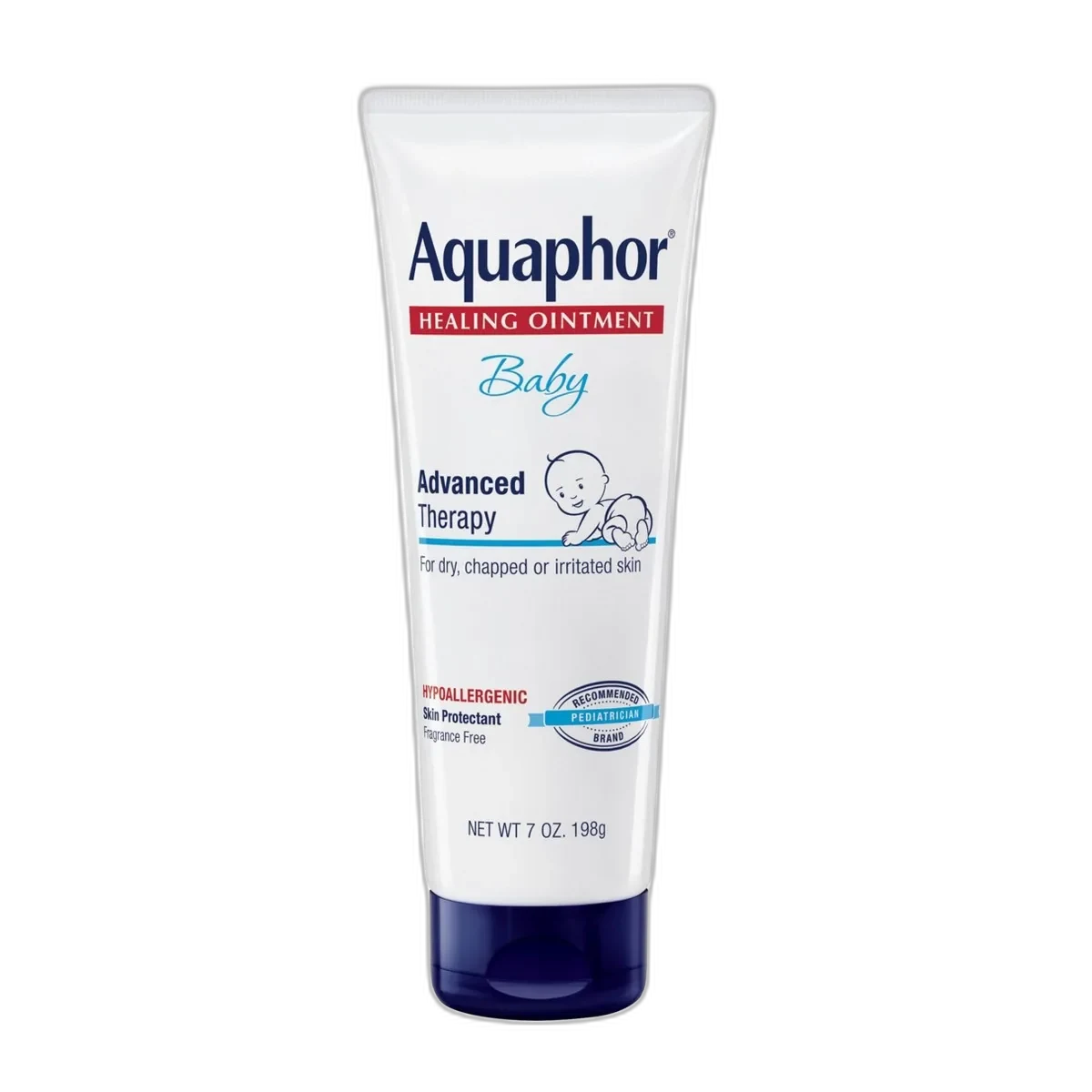
Healing Ointment Baby
Pediatrician's #1 Pick
 Verified reviewer
Pros & cons.
- +Identical formula to the hospital-trusted adult Aquaphor Healing Ointment
- +Number-one pediatrician-recommended brand for baby skin care
- +Seven-ingredient, fragrance-free, preservative-free formula safe for newborns
- +Clears mild to moderate diaper rash within 24-48 hours of consistent use
- +Versatile for diaper rash, chapped cheeks, drool rash, cradle cap, and eczema
- +Excellent value at thirteen dollars for a tube lasting two to four months
- +HSA/FSA eligible as an FDA-registered OTC skin protectant
- −Greasy, messy texture is inherent to the ointment format — unavoidable trade-off
- −Contains lanolin alcohol, a recognized allergen that may worsen eczema in sensitive babies
- −Not vegan (lanolin) and not cruelty-free certified (Beiersdorf)
- −Jar format is impractical for diaper changes — squeeze tube is the better option
- −Can stain clothing, bedding, and changing pad covers
The full review.
The most important fact about Aquaphor Baby Healing Ointment: it is the same product as regular Aquaphor Healing Ointment. It has the same seven ingredients and the same 41% petrolatum concentration. The blue and yellow baby packaging helps retail navigation; it is not a reformulation. A dermatologist, pediatrician, or mass spectrometer would find no difference if you swapped the labels.
This is not a criticism. It is the point. When Beiersdorf launched the Aquaphor Baby line in 2003, they did the responsible thing for a pharmaceutical company: they kept the formula. The ointment already spent nearly eight decades in hospitals, burn units, and dermatology offices. NICU nurses used it on premature infants with skin barely thick enough to hold together. It just needed packaging parents could find in the baby aisle.
The formula is minimal. 41% petrolatum creates the occlusive seal. Mineral oil and ceresin provide texture and spreadability. Lanolin alcohol emulsifies and adds emollient properties. Panthenol (provitamin B5) draws moisture into the skin and supports cellular repair. Glycerin provides humectant hydration. Bisabolol, derived from chamomile, soothes inflammation. No fragrance. No preservatives. No dyes. Seven ingredients, each with a specific job.
For diaper rash—the main reason parents use this product—the formula is nearly ideal. The petrolatum barrier physically separates baby’s skin from the moisture, friction, and enzymatic irritants in urine and stool that cause contact diaper dermatitis. Meanwhile, panthenol and bisabolol support healing and reduce inflammation beneath the seal. Most parents report visible improvement within 24 hours and resolution within two to three days. This matches dermatological literature for mild to moderate irritant contact dermatitis under occlusive protection.
Beyond the diaper area, this ointment handles almost every minor skin concern a baby encounters. Chapped cheeks from winter wind. Drool rash from teething. Cradle cap when softened with the ointment before gentle washing. Minor scrapes and scratches. Dry patches from eczema. The versatility that makes the adult version a medicine cabinet staple applies to the nursery too.
Texture
The texture is thick and greasy—this is not a lotion. It sits on the skin as a visible, glossy barrier. During diaper changes, this means slick hands and greasy smears on the changing pad cover. The squeeze tube format is more practical than the jar for one-handed diaper-change application. The jar is more economical but less convenient.
Best Season
Parents of eczema-prone babies must consider lanolin. Lanolin alcohol comes from sheep’s wool and is a recognized contact allergen. The American Contact Dermatitis Society named it Contact Allergen of the Year in 2023. A Dutch study found that approximately 66% of children with eczema reacted to lanolin in patch testing. Aquaphor uses a highly purified form; a clinical study of 499 subjects showed zero allergic reactions. However, the risk remains for eczema babies. If your child’s skin worsens after application, discuss lanolin sensitivity with your pediatrician.
Aquaphor is neither cruelty-free nor vegan. The lanolin is animal-derived, and Beiersdorf does not hold Leaping Bunny or PETA certification. Lanolin-free alternatives exist for families who prioritize these factors.
At roughly thirteen dollars for a seven-ounce tube that lasts two to four months, the value is excellent. The fourteen-ounce jar is even more economical. The product is HSA/FSA eligible.
A product trusted in neonatal intensive care units for decades, recommended by pediatricians more than any other baby skincare brand, and containing fewer ingredients than most breakfast smoothies is remarkable. In an era of thirty-ingredient baby lotions with lavender essential oil, Aquaphor Baby offers a simple solution—one developed for fragile patients in demanding clinical settings—for your nursery.
Ingredient analysis.
Full INCI list
Active Ingredient: Petrolatum 41% (Skin Protectant). Inactive Ingredients: Mineral Oil, Ceresin, Lanolin Alcohol, Panthenol, Glycerin, Bisabolol
Skin match.
The science.
The Science
Aquaphor Baby uses the same formula as the adult version. Petrolatum works as an occlusive skin protectant; it reduces transepidermal water loss by up to 99%. Research by Ghadially et al. shows petrolatum-based formulations repair the barrier by permeating the stratum corneum's intercellular lipid domains.
The occlusive mechanism matters for diaper dermatitis. A 2014 study by Stamatas et al. in Pediatric Dermatology found infant stratum corneum is thinner and more permeable than adult skin, with higher water content and lower lipid levels. This makes infants more vulnerable to irritant contact dermatitis from moisture and occlusion. The petrolatum barrier in Aquaphor physically separates compromised skin from irritants, while panthenol and glycerin support hydration and repair.
Multiple studies show panthenol's wound-healing properties. Proksch et al. in the Journal of Dermatological Treatment (2017) confirmed topical dexpanthenol (panthenol) improves stratum corneum hydration, reduces TEWL, and accelerates re-epithelialization. In diaper rash cases where the barrier breaks down repeatedly, panthenol provides active repair support that pure petroleum jelly lacks.
Clinical data supports lanolin allergenicity concerns. Wakelin et al. in Contact Dermatitis (2001) found lanolin alcohol is a common contact allergen, though modern purification reduces reaction rates. A manufacturer-sponsored study of 499 subjects on Aquaphor found zero allergic reactions, suggesting their purified lanolin alcohol has lower sensitization potential than less refined forms.
References
- Effects of petrolatum on stratum corneum structure and function — Journal of the American Academy of Dermatology (1992)
- Topical use of dexpanthenol in skin disorders — Journal of Dermatological Treatment (2017)
Dermatologist Perspective
Pediatric dermatologists often recommend Aquaphor as a first-line infant skin care option. Board-certified dermatologists note the seven-ingredient formula provides effective barrier protection and minimizes sensitization risk—vital for infant skin, which is more reactive and permeable than adult skin. Dermatologists frequently suggest applying Aquaphor to the diaper area at every change to prevent rash, rather than just treating it. The main caution is lanolin sensitivity; dermatologists advise patch testing on a small area for babies with known eczema or a family history of contact allergies.
Where it fits in your routine.
For diaper rash prevention: Apply a thin layer to clean, dry diaper area at every diaper change. For active diaper rash: Apply generously to affected area after gentle cleansing and thorough drying. For chapped skin: Apply to cheeks, chin, hands, or any dry patches as needed. For after-bath moisture seal: Apply to slightly damp skin immediately after bathing to lock in hydration. For cradle cap: Apply a small amount to scaly areas, leave for 15-20 minutes, then gently brush with a soft bristle brush before washing.
At $12.99 for the 7 oz tube (the most practical format for baby care), Aquaphor Baby is one of the most economical baby skin products. The 14 oz jar at $18.39 has even better per-ounce value for home use. Because the formula is identical to the adult version, parents can buy whichever size or format is cheapest — no baby premium is required for a different product. HSA/FSA eligibility is a practical bonus. For a product with a century of medical heritage and the number-one pediatrician recommendation, the value is outstanding.
Parents of newborns and infants who want the most pediatrician-trusted, hospital-validated ointment for diaper rash prevention, eczema management, and general baby skin protection. Also appropriate for adults who want the adult Aquaphor formula in baby-aisle-accessible packaging.
Parents of babies with known lanolin sensitivity or wool allergy must use a lanolin-free alternative. Families prioritizing vegan and cruelty-free products will need to look elsewhere. The identical adult version is the same product and costs less per ounce in larger sizes.
Product details.
Identical to the adult Aquaphor Healing Ointment — a thick, semi-solid, translucent ointment that melts on warm skin. Mineral oil and lanolin alcohol make it slightly more spreadable than pure petroleum jelly.
Unscented. It has no detectable odor. It contains no fragrance or essential oils.
White and blue jar (14 oz) or squeeze tube (3 oz, 7 oz) with yellow baby-themed accents. The tube with a flip-top cap works better for one-handed diaper changes. 0.35 oz travel tubes also exist. All packaging shows pediatrician-recommended messaging.
Applies as a thick, greasy ointment that creates a visible protective barrier on baby's skin. It does not absorb — this is intentional. The diaper area and treated patches will feel glossy and slick. The ointment works best on slightly damp skin after bathing. Diaper rash results show by the next diaper change.
2-4 months with daily use on diaper area and dry patches (7 oz tube)
24 months
All Year
The backstory.
Aquaphor spent its first seven decades as a medical professional product — stocked in hospitals, prescribed by dermatologists, but unavailable to consumers. When the brand expanded to baby care in 2003, it was a natural extension: the same ointment NICU nurses used on premature infants was finally packaged for parents to use at home. The formula hasn't changed because it didn't need to. A century of use in the most demanding clinical settings is its own validation.
About Aquaphor
Legacy Brand (20+ years)Beiersdorf Inc. developed Aquaphor in 1925. It has been a staple in dermatology offices and hospitals for a century. The Baby line launched in 2003, bringing the brand's medical-grade reputation to infant skincare. IQVIA ProVoice survey data shows Aquaphor is the number-one pediatrician-recommended brand for baby skin care.
Common myths.
Baby Aquaphor has a gentler or different formula than regular Aquaphor.
The formula is identical — same seven ingredients, same 41% petrolatum concentration, same everything. Only the packaging and shelf placement differ. You can use either version interchangeably.
Thick ointments like Aquaphor suffocate baby's skin.
Petrolatum forms a semi-occlusive barrier. This reduces water loss but allows oxygen to reach the skin. Doctors have used it safely on newborns, including premature infants in NICUs, for decades.
FAQ.
Is Aquaphor Baby different from regular Aquaphor Healing Ointment?
No. The formula is identical — the same seven ingredients at the same concentrations. The baby version uses different packaging so parents find it in baby aisles and can read baby-specific usage guidance on the label. You can use either version interchangeably.
Can I use Aquaphor Baby for diaper rash?
Yes, and it is the number-one pediatrician-recommended product for this purpose. Apply a thin layer to the diaper area at every change. This creates a protective barrier against moisture, friction, and irritants. Most diaper rashes show visible improvement within 24-48 hours of consistent application.
Is Aquaphor Baby safe for newborns?
Yes. This seven-ingredient, fragrance-free, preservative-free formula has treated newborns—including premature infants in hospital NICUs—for decades. Pediatricians recommend it from day one.
Does Aquaphor Baby contain lanolin? My baby has eczema.
Yes, it contains lanolin alcohol (derived from sheep's wool). Aquaphor uses a highly purified form with minimal allergenicity, but some babies with eczema may react to lanolin. If redness or irritation worsens after application, stop use and consult your pediatrician. A lanolin-free alternative may work better.
Can I use Aquaphor Baby on my baby's face?
Yes. People use it on chapped cheeks, drool rash around the mouth, wind-irritated skin, and dry patches on the face. Apply a thin layer to affected areas. The fragrance-free, preservative-free formula is gentle enough for infant facial use.
Is Aquaphor Baby vegan and cruelty-free?
It fails both tests. It contains lanolin alcohol (animal-derived from sheep's wool), and the parent company Beiersdorf lacks cruelty-free certification. Parents wanting vegan alternatives should choose lanolin-free, petroleum-based options or plant-based barrier creams.
Community
What the community says.
"Clears diaper rash visibly overnight with consistent application"
"Versatile for diaper rash, chapped cheeks, drool rash, and cradle cap"
"Gentle enough for newborn skin from day one"
"Fragrance-free and preservative-free with only seven ingredients"
"A little goes a very long way, making it extremely economical"
"Greasy, sticky texture can be messy during diaper changes"
"Contains lanolin alcohol — can worsen skin for lanolin-sensitive babies"
"Difficult to wash off hands, clothing, and changing pad covers"
"Jar packaging is less convenient for diaper changes than the squeeze tube"
"Not vegan and not cruelty-free certified"