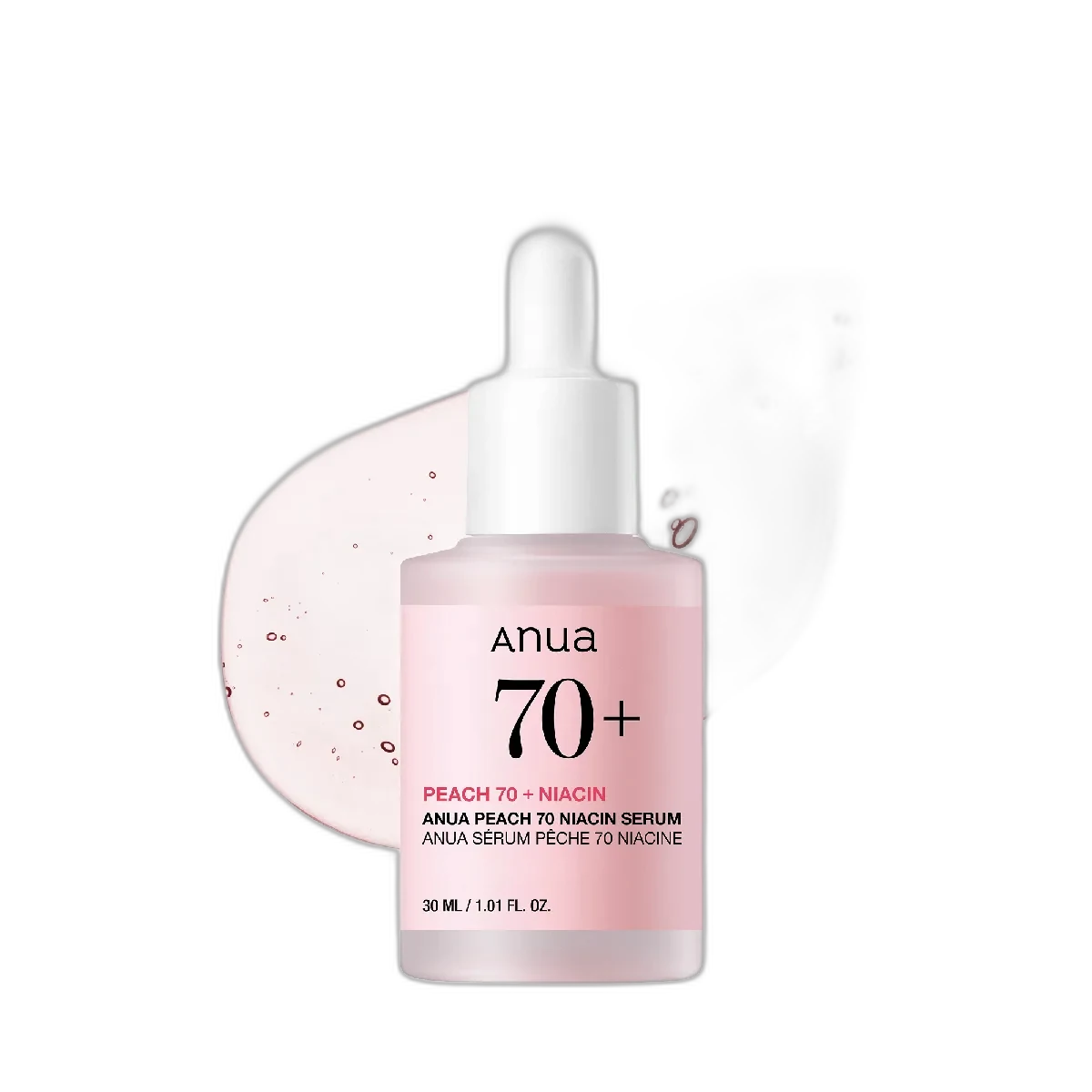
Peach 70 Niacin Serum
K-Beauty Glow Essential
 Verified reviewer
Pros & cons.
- +Triple-brightener system targets hyperpigmentation through three distinct biological pathways
- +70% peach extract base provides antioxidant-rich delivery beyond plain water
- +Immediate glass-skin glow visible from the first application
- +Purified centella triterpenes offer precise anti-inflammatory support
- +Triple-humectant system with polyglutamic acid, HA, and hydrolyzed HA
- +Strong value at $19 for this level of formulation sophistication
- +Over 4,000 reviews confirm consistent real-world brightening results
- −Contains added fragrance which may irritate sensitive or reactive skin
- −Small 30ml bottle requires frequent repurchasing with twice-daily use
- −Can feel slightly sticky if over-applied — 2-3 drops is sufficient
- −Peach extract concentration, while generous, is mostly decorative hydration
- −Fragrance-sensitive users must choose between this and the fragrance-free Heartleaf line
The full review.
The K-beauty brightening serum market is absurdly crowded. Every brand has one, most of them feature niacinamide, and the vast majority deliver roughly the same experience: a watery texture, vague promises about radiance, and results that range from subtle to nonexistent. So when a serum accumulates over four thousand reviews with an average north of 4.4 stars, it is worth investigating what it does differently.
About Anua’s Peach 70 Niacin Serum
Anua’s Peach 70 Niacin Serum launched in 2022 and quickly became one of the brand’s anchor products alongside their Heartleaf toner. The formula’s distinguishing move is its triple-brightener stack: 5% niacinamide handles melanosome transfer inhibition, alpha-arbutin tackles tyrosinase activity upstream, and 3-O-ethyl ascorbic acid adds antioxidant protection and additional melanin suppression from a third angle. Most brightening serums rely on one of these pathways. Using all three simultaneously means the formula addresses hyperpigmentation at multiple biological checkpoints — which is exactly how dermatologists approach stubborn pigmentation in clinical settings.
Reality
The 70.2% peach fruit extract concentration sounds like marketing, and to some extent it is — peach extract is mostly water with some vitamins and polyphenols. But it serves a genuine purpose as the serum’s delivery vehicle. Rather than using plain purified water as the base, Anua built the formula on a naturally antioxidant-rich substrate that contributes its own modest brightening and hydrating properties. Think of it as starting with a better canvas rather than painting over a blank one.
Texture
The texture is where this serum wins hearts. It has a lightweight, slightly viscous consistency with the faintest peachy tint — somewhere between water and gel, absorbing into skin within thirty seconds on a damp face. The immediate effect is a dewy, glass-skin glow that makes your skin look like it has been professionally lit. This is not just hydration; the peach extract and the light-reflecting properties of the serum create an optical luminosity that is visible from the first application. It is the kind of product that makes you understand why K-beauty devotees are loyal to the glass-skin aesthetic.
Formula
Beneath the sensory pleasure, the formulation has genuine depth. Purified centella asiatica triterpenes — asiaticoside, madecassic acid, and asiatic acid — are included as isolated compounds rather than a crude extract, which means more precise anti-inflammatory and collagen-stimulating activity. Polyglutamic acid joins sodium hyaluronate and hydrolyzed hyaluronic acid in a triple-humectant system that keeps the actives in sustained contact with the skin while maintaining all-day hydration. Three ferment extracts — lactobacillus, sphingomonas, and yeast — contribute to microbiome support and additional brightening through fermentation-derived metabolites.
Ceramide NP makes a supporting appearance, reinforcing the barrier while brightening actives do their work. Panthenol adds soothing insurance. Cyanocobalamin — vitamin B12, responsible for the serum’s subtle pink-peach tint — provides antioxidant benefits. The ingredient list reads like someone assembled an all-star team and then asked each player to do something specific rather than just showing up.
Scent
Now, the fragrance. It has to be addressed because it is the one genuine weakness in an otherwise thoughtful formulation. The serum contains added fragrance, which means it includes undisclosed aromatic compounds. The resulting scent is a pleasant, light peach — most users find it delightful — but fragrance remains one of the most common causes of skin sensitization. For a product marketed partly on its brightening claims, this is a contradiction: you want people with hyperpigmentation (who often have post-inflammatory sensitivity) to use this daily, but the fragrance may irritate the very skin you are trying to treat. It is not a dealbreaker for the majority of users, but it is a missed opportunity.
Results
The results, however, are difficult to argue with. Consistent users report visible brightening within four to six weeks — dark spots fading, overall tone evening out, a general luminosity that persists even after washing the serum off. The niacinamide-arbutin-vitamin C triad is well-supported by research, and at the concentrations present here, the effects are pharmacologically plausible rather than just marketing hope.
Price
At nineteen dollars for 30ml, this is competitively priced for what it delivers. The ingredient quality-to-price ratio is genuinely strong — you would typically need to spend significantly more to get a triple-brightener formulation with ferment extracts and purified centella triterpenes. The small bottle means frequent repurchases, which is the norm in K-beauty but can add up over time.
Conclusion
Anua’s peach line demonstrates the brand’s ability to formulate beyond their heartleaf comfort zone. This is not a one-ingredient wonder dressed up in pretty packaging. It is a legitimately sophisticated brightening serum that happens to smell like a peach and deliver an immediate glass-skin effect while working on longer-term pigmentation goals underneath. The fragrance keeps it from perfection, but for the vast majority of skin types, it earns its bestseller status through formulation substance rather than hype alone.
Ingredient analysis.
Full INCI list
Prunus Persica (Peach) Fruit Extract, Glycerin, Niacinamide, Butylene Glycol, Diethoxyethyl Succinate, Water, 1,2-Hexanediol, Lactobacillus Ferment, Sodium Hyaluronate, Sphingomonas Ferment Extract, Alpha-Arbutin, Melia Azadirachta Flower Extract, Ocimum Sanctum Leaf Extract, Melia Azadirachta Leaf Extract, Carthamus Tinctorius (Safflower) Seed Oil, Salvia Hispanica Seed Oil, Curcuma Longa (Turmeric) Root Extract, Corallina Officinalis Extract, Hydrolyzed Hyaluronic Acid, Chamaecyparis Obtusa Leaf Extract, Prunus Persica (Peach) Flower Extract, Camellia Sinensis Seed Oil, Yeast Ferment Extract, Centella Asiatica Extract, Artemisia Princeps Leaf Extract, Candida Bombicola/Glucose/Methyl Rapeseedate Ferment, Pentylene Glycol, Polyglyceryl-10 Laurate, Betaine Salicylate, Sodium Phytate, Cellulose, Caprylic/Capric Triglyceride, Hydrogenated Lecithin, Panthenol, Polyglutamic Acid, Linoleic Acid, Linolenic Acid, Polyglyceryl-10 Oleate, Sucrose Palmitate, Cyanocobalamin, 3-O-Ethyl Ascorbic Acid, Ceramide NP, Asiaticoside, Madecassic Acid, Asiatic Acid, Xanthan Gum, Fragrance
Skin match.
The science.
The Science
This serum brightens using a documented triple-active approach. Multiple randomized controlled trials validate 5% niacinamide for reducing hyperpigmentation. A landmark 2003 study in the British Journal of Dermatology (Hakozaki et al.) shows significant reduction in hyperpigmented spots and improved skin lightness over 12 weeks versus vehicle control. Alpha-arbutin uses a complementary mechanism: it inhibits tyrosinase activity directly at the enzymatic level to stop melanin synthesis. A 2004 study in the Journal of Bioscience and Bioengineering confirms alpha-arbutin has superior tyrosinase-inhibiting potency compared to beta-arbutin.
3-O-Ethyl ascorbic acid adds a third pathway. This amphiphilic vitamin C derivative has better stability and skin penetration than pure L-ascorbic acid. Research in Chemical and Pharmaceutical Bulletin shows it inhibits melanogenesis and provides antioxidant protection without the oxidation instability of pure ascorbic acid formulations.
The formula uses purified centella asiatica triterpenes (asiaticoside, madecassic acid, asiatic acid) instead of crude extract. A 2013 study in the International Journal of Molecular Sciences documented how these triterpenes stimulate type I collagen synthesis and provide anti-inflammatory effects through multiple signaling pathways. Polyglutamic acid, produced by Bacillus subtilis fermentation, inhibits hyaluronidase activity and retains more moisture than hyaluronic acid alone.
References
- The effect of niacinamide on reducing cutaneous pigmentation and suppression of melanosome transfer — British Journal of Dermatology (2003)
- Pharmacological Activity and Clinical Use of PDRN — International Journal of Molecular Sciences (2017)
Dermatologist Perspective
Dermatologists endorse combining niacinamide and alpha-arbutin as a first-line topical approach for hyperpigmentation management, especially for patients who cannot tolerate hydroquinone. Board-certified dermatologists note the 5% niacinamide concentration matches clinical study dosages, and the stable vitamin C derivative strengthens depigmenting efficacy. Dermatologists likely recommend this as a well-formulated over-the-counter option for mild-to-moderate hyperpigmentation and general brightening, though the fragrance may concern patients with rosacea or contact dermatitis. For stubborn melasma or significant sun damage, dermatologists typically advise using this serum with prescription-strength actives and rigorous sun protection.
Where it fits in your routine.
Apply 2-3 drops to clean, damp skin after toner. Pat it into your face and neck; do not rub. Wait 30-60 seconds for absorption before applying moisturizer. Use morning and evening. Always use broad-spectrum SPF 30+ in the morning, because niacinamide, alpha-arbutin, and vitamin C increase photosensitivity. For better absorption, apply to skin still damp from toner.
At $19 for 30ml, this serum offers high ingredient value. A triple-brightener formulation with purified centella triterpenes, multiple ferment extracts, polyglutamic acid, ceramide NP, and a 70% botanical base usually costs $30-45 from Western brands. K-beauty pricing keeps this accessible while maintaining formulation quality. The small bottle size is the main value factor — using it twice daily means repurchasing every six to eight weeks, totaling roughly $120-150 annually. This remains competitive for a brightening serum of this caliber.
Anyone dealing with post-inflammatory hyperpigmentation, dark spots, or general dullness who wants a multi-active approach in a single product. K-beauty enthusiasts seeking a glass-skin finish with clinical substance underneath. Combination and normal skin types looking for a lightweight brightening serum that hydrates without heaviness.
People with fragrance sensitivities or diagnosed contact dermatitis may react to the added fragrance. Those with active rosacea flares should be cautious. If medical reasons require fragrance-free formulations, use the Anua Heartleaf line or other fragrance-free alternatives.
Product details.
This lightweight, slightly viscous serum has a watery-gel consistency and a faint peachy tint. It absorbs quickly without residue. It leaves a dewy, glass-skin finish that feels hydrated but not heavy.
Light natural peach fragrance — pleasant and fruity, but not overwhelming. It dissipates within a minute of application. Note: it contains added fragrance ingredient.
Anua's signature peach-toned branding covers this frosted glass bottle with a dropper dispenser. The dropper controls the amount dispensed well. The 30ml size is standard for a K-beauty serum.
The first application gives an immediate dewy glow. The peach extract base provides visible, subtle luminosity right away. The serum absorbs on damp skin within 30 seconds. Most users feel no tingling, stinging, or irritation. The peach scent is noticeable but pleasant.
6-8 weeks with twice-daily application of 2-3 drops
12 months
All Year
The backstory.
This serum helped establish Anua's Peach line as a credible brightening collection alongside their original Heartleaf soothing range. The 70% peach extract concentration was a deliberate statement — proving that a fruit-extract-based serum could be more than just scented water by loading it with clinical-grade actives.
About Anua
Emerging Brand (2–5 years)Anua launched in 2019 as a K-beauty brand centered on heartleaf (Houttuynia cordata) extract. It gained global traction via social media and Olive Young bestseller rankings. Anua uses well-studied botanical ingredients, but its specific formulations lack independent clinical validation and the brand has a short track record.
Common myths.
70% peach extract makes this mostly fruit juice on your face.
Peach extract forms the base, but niacinamide, alpha-arbutin, and ethyl ascorbic acid provide the brightening power. The peach extract adds vitamins and acts as an antioxidant-rich delivery vehicle, but the targeted actives drive the clinical results.
Niacinamide and vitamin C cannot be used together.
This is a persistent skincare myth. The 3-O-ethyl ascorbic acid in this formula is stable and works with niacinamide. Modern formulation chemistry solved the pH compatibility issues from a 1960s study using pure ascorbic acid at high heat.
FAQ.
Does the Anua Peach 70 Niacin Serum actually brighten skin?
Yes — 5% niacinamide, alpha-arbutin, and 3-O-ethyl ascorbic acid target hyperpigmentation using three different mechanisms. Most users see visible brightening within 4-6 weeks of consistent use with daily sunscreen. The peach extract base adds antioxidant support to enhance the brightening effect.
Is this serum good for sensitive skin?
The active ingredients are well-tolerated, but this formula has added fragrance, a common irritant for sensitive skin. The centella triterpenes and panthenol offset potential irritation, but those with fragrance sensitivities should patch test first or use the fragrance-free Heartleaf line instead.
Can I use this serum with retinol?
Yes — niacinamide complements retinol by managing irritation and supporting barrier function. Apply this serum first, let it absorb, then apply your retinol product. The ceramide NP and centella in this formula buffer against retinol sensitivity.
What does 70% peach extract actually do for skin?
Peach fruit extract contains natural vitamins A and C, polyphenol antioxidants, and gentle fruit acids. At 70.2% concentration, it is the serum's hydrating base and creates an immediate glow. However, niacinamide, alpha-arbutin, and vitamin C derivative work together to drive the clinical brightening results.
How long does a bottle of Anua Peach 70 Niacin Serum last?
The 30ml bottle lasts 6-8 weeks if you apply 2-3 drops twice daily. This is standard for K-beauty serums of this size, but users who apply more will finish it faster.
What the community says.
"Noticeable brightening within weeks"
"Lightweight watery texture absorbs instantly"
"Pleasant natural peach scent"
"Visible glow after first application"
"Fades dark spots with consistent use"
"Contains fragrance which some sensitive users react to"
"Small 30ml bottle runs out quickly"
"Sticky if too much is applied"
"Results take several weeks of consistent use"
Featured in.
People also looked at.