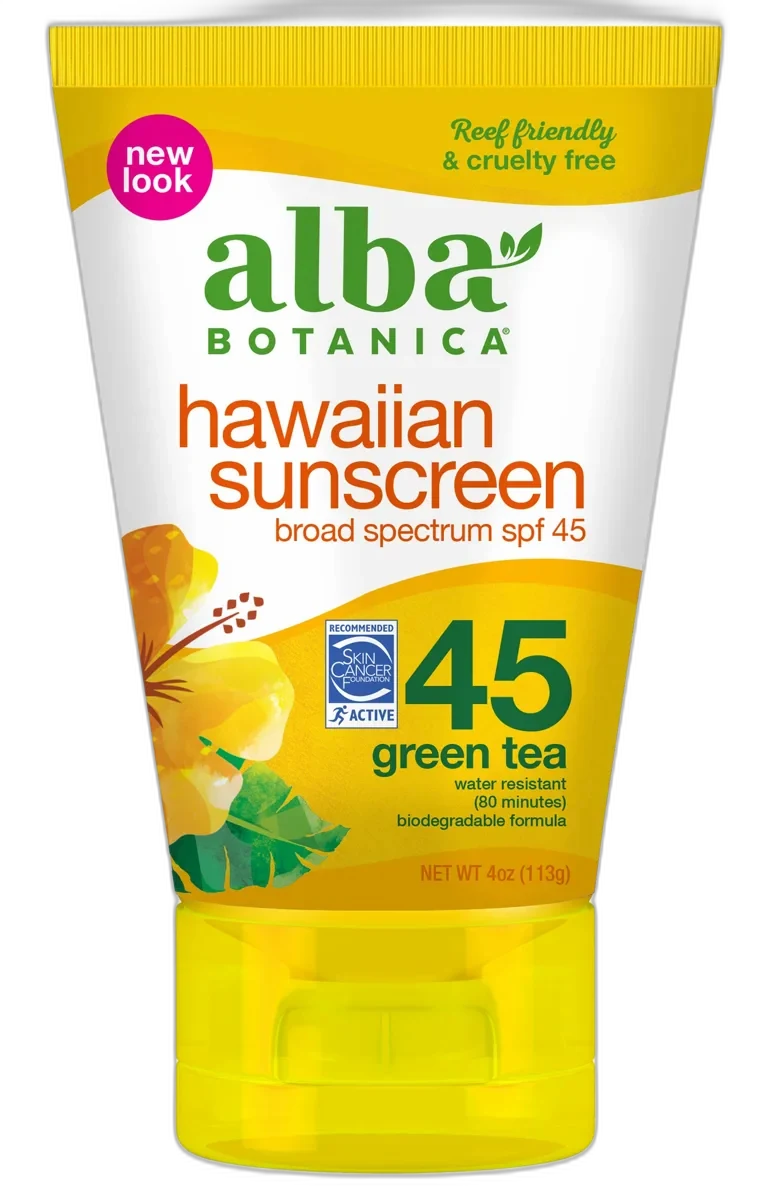
Hawaiian Sunscreen SPF 45
Vacation Drugstore Sunscreen
 Verified reviewer
Pros & cons.
- +Reliable broad-spectrum SPF 45 with a photostable filter system
- +Affordable drugstore price per ounce
- +Spreads easily without heavy white cast
- +Water-resistant for up to 80 minutes
- +Distinctive tropical coconut-vanilla scent
- +Long-running brand track record
- −Contains parabens inconsistent with natural branding
- −Octocrylene raises environmental concerns despite 'Hawaiian' marketing
- −Coconut oil and cetyl alcohol make it non-face-friendly
- −Strong fragrance limits use for sensitive users
- −Formulation has not been meaningfully updated in over a decade
The full review.
Every American drugstore beach-bag aisle has a specific kind of sunscreen. It has tropical labels, smells like coconut and vanilla, and comes in a squeeze bottle that gets gummy at the nozzle by day three. It evokes road trips, swim days, and sand in your sunglasses. Alba Botanica’s Hawaiian Sunscreen SPF 45 is a long-running example of this category. To review it fairly, you must acknowledge its intent.
It is not a clinical daily facial sunscreen. It does not compete with Korean or Japanese UV innovations in texture or finish. It is not a barrier-supportive, serum-like, under-makeup SPF for morning routines. It is a body sunscreen for beach days, pool days, and outdoor events. It uses a fragrance profile to mimic a vacation and a chemical filter load designed for water resistance. It meets that brief.
Filter System
The filter system uses a standard US chemical combination: avobenzone for UVA, plus homosalate, octisalate, and octocrylene for UVB and UVA stabilization. Octocrylene performs two tasks: it provides UV absorption and stabilizes avobenzone against sunlight-driven breakdown. This allows the product to maintain its SPF rating during a day at the beach. The filter load nears the US regulatory limit for each ingredient, reaching SPF 45 without mineral assistance. Photostability is reasonable. Water resistance meets the US-label ‘80 minute’ standard—it is not waterproof, but works for swims if you reapply after toweling off.
Texture
The inactive base reflects its vacation positioning. Coconut oil, passion fruit seed oil, and glycerin create a smooth emollient feel that spreads easier than most chemical body sunscreens.
Scent
The scent is distinctive—a coconut-vanilla tropical profile that some users love and others find overbearing. For those who love it, the scent triggers memories of beach trips and becomes part of the summer sensory experience. For those who dislike it, the scent lasts for hours and makes layering with other products difficult.
Common Complaints
The limitations are clear. First, the preservation system uses methylparaben and propylparaben; this is safe but contradicts the brand’s natural-positioning marketing. Second, the fragrance and essential oil load makes this a risky choice for facial application, sensitive skin, or anyone with a history of fragrance-related contact dermatitis. Third, and most substantively: the marketing uses heavy ‘Hawaiian’ imagery. While the formula avoids the oxybenzone and octinoxate targeted by Hawaii’s 2021 sunscreen ban, it still uses octocrylene, which has documented environmental and marine toxicity concerns. Using brand names or tropical imagery to assume reef safety is a mistake this product encourages; users concerned about ocean impact should choose mineral alternatives.
Fourth, regarding face use: coconut oil and cetyl alcohol create a comedogenic risk. Body skin tolerates more than facial skin; these ingredients work on arms and legs, but on the face, they cause breakouts in acne-prone users. The formula is not fungal-acne safe. This is a body sunscreen and should be used as such.
Finally, the formulation has not changed meaningfully in a decade. The category has moved toward fragrance-free, reef-conscious, and modern-filter alternatives. Blue Lizard, Sun Bum’s reformulated lines, and Supergoop’s body options have raised the bar for drugstore or mid-priced body sunscreens. Alba Botanica’s Hawaiian sits where it always has, for better or worse.
Best for
This delivers for users wanting a specific sensory experience—the coconut-vanilla beach sunscreen that smells like a vacation and costs under fifteen dollars. For users wanting clean formulation, reef-conscious choices, or a facial-compatible sunscreen, this is not the right product, and better options exist on the same shelf.
Ingredient analysis.
Full INCI list
Active Ingredients: Avobenzone 3%, Homosalate 10%, Octisalate 5%, Octocrylene 10%. Inactive Ingredients: Water, Butyloctyl Salicylate, Polyester-7, Glycerin, Cetyl Alcohol, Glyceryl Stearate, PEG-100 Stearate, Caprylic/Capric Triglyceride, Cocos Nucifera (Coconut) Oil, Aloe Barbadensis Leaf Juice, Passiflora Edulis (Passion Fruit) Seed Oil, Tocopheryl Acetate, Carbomer, Triethanolamine, Fragrance, Disodium EDTA, Phenoxyethanol, Methylparaben, Propylparaben
Skin match.
The science.
The Science
Chemical sunscreens using avobenzone, homosalate, octisalate, and octocrylene have decades of peer-reviewed clinical evidence for UV protection efficacy, photostability when properly combined, and preventing UV-induced DNA damage.
This product's specific combination is standard for US-market SPF 45+ formulations. Avobenzone is one of the few US-approved filters with meaningful UVA coverage, but it photodegrades alone; octocrylene acts as a stabilizer. Research in journals like Photochemistry and Photobiology shows that octocrylene-stabilized avobenzone keeps more than 90% of its absorbance after several hours of sun exposure, making the product's SPF claim work through a beach day. The environmental impact is more complex. Studies like a 2021 paper in Chemical Research in Toxicology investigated octocrylene for marine toxicity, identifying it as a source of benzophenone contamination in coral-reef-adjacent waters. Hawaii's 2021 ban targeted oxybenzone and octinoxate, which this product does not contain, so it is technically legal in Hawaii. However, users prioritizing reef safety should know octocrylene has issues and zinc oxide based mineral sunscreens remain the more conservative environmental choice. The inactive ingredients are simple emollients and preservatives; coconut oil and passion fruit seed oil affect the sensory profile more than UV protection. The FDA, the European SCCS, and dermatology organizations consider parabens at cosmetic concentrations safe. The presence of methylparaben and propylparaben is a regulatory non-issue, even if it mismatches the brand's natural-positioning marketing.
Dermatologist Perspective
Dermatologists recommend daily broad-spectrum sunscreen use as the most effective anti-aging and skin cancer prevention tool.
Board-certified dermatologists generally consider chemical sunscreens with avobenzone, homosalate, octisalate, and octocrylene safe and effective when used as directed. This product's filter combination matches standard dermatology recommendations for beach and outdoor use. Coconut oil and fragrance make this product less suitable for the face; dermatologists typically recommend dedicated non-comedogenic facial options for acne-prone patients. For body use on the beach, this sunscreen is a reasonable affordable choice, though dermatologists note that generous application and reapplication matter more than the specific brand.
Where it fits in your routine.
Shake before use. Apply a thick, even layer to all sun-exposed skin 15 minutes before going outdoors. Use enough product; US SPF testing assumes 2 mg/cm², or about one shot glass for the average adult body. Reapply every 2 hours during sun exposure, and immediately after swimming or heavy sweating. Use a hat, sunglasses, and UV-protective clothing to increase sun protection. Avoid heavy facial application because of the fragrance and comedogenic content. Wash off at the end of the day with a thorough cleanse, especially around the neck and hairline.
At about $12 for a 4 fl oz bottle, Alba Botanica Hawaiian Sunscreen SPF 45 costs the same as drugstore body sunscreens like Sun Bum Original, Banana Boat, and Coppertone. The per-ounce price is slightly above budget store-brand options and below premium brands like Supergoop Play or Blue Lizard. It offers reasonable value for beach or vacation use. For daily body use at the volume most dermatologists recommend (roughly 1 oz, or one shot glass per application), a 4 fl oz bottle lasts only a few beach days. This makes the per-use cost similar to mid-tier products.
This SPF 45 body sunscreen has a nostalgic tropical scent. It works for vacationers, beach-goers, and outdoor event users on a budget. It is a reasonable choice for normal and dry body skin that dislikes mineral sunscreens and needs an easy-spreading chemical alternative.
This works for sensitive skin, fragrance allergies, and acne-prone users needing non-comedogenic options. Reef-safety-conscious buyers should choose a mineral alternative instead. This is body-optimized, not for facial sunscreen seekers. Anyone who dislikes strong tropical fragrances will find this scent persistent and hard to tolerate.
Product details.
Smooth white lotion that spreads easily and absorbs into skin
Tropical coconut-vanilla scent
Squeeze bottle with flip cap
Spreads easily and absorbs faster than most chemical body sunscreens. The tropical scent is noticeable and lasts all day. It leaves no visible white cast. Some users feel mild warmth or tingling when first applying it.
4-6 beach days or 2-3 weeks of daily body use
12 months
spring summer
The backstory.
Alba Botanica has been producing Hawaiian-themed body products since the 1980s, riding the brand's California-lifestyle positioning. The Hawaiian Sunscreen SPF 45 became a long-running drugstore staple alongside the brand's Hawaiian body lotions and after-sun aloe gels. Worth noting: the product's marketing leans on Hawaii imagery, but the formula is not compliant with Hawaii's 2021 ban on oxybenzone and octinoxate sunscreens on the islands (the formula uses other filters, but the 'reef safe' claims in marketing are controversial).
About Alba Botanica
Legacy Brand (20+ years)Alba Botanica has been producing Hawaiian-themed body care and sunscreens since the 1980s, and the Hawaiian Sunscreen SPF 45 has been a drugstore staple for well over a decade. The formula is a chemical sunscreen with a tropical fragrance signature rather than a derm-clinical UV product.
Common myths.
'Hawaiian' in the name means it's reef-safe.
Hawaii's 2021 sunscreen law banned oxybenzone and octinoxate sales on the islands, but it did not set a broader reef-safe standard. This sunscreen uses octocrylene, which has documented environmental concerns. Brand names and tropical imagery do not replace checking the actual filter list.
FAQ.
Is this sunscreen reef-safe?
Not strictly. Hawaii's 2021 sunscreen ban targets oxybenzone and octinoxate, but this sunscreen contains neither. The formula does include octocrylene, which has documented marine toxicity concerns. Users who prioritize reef-safe sunscreens should use mineral (zinc oxide / titanium dioxide) alternatives instead.
Can I use it on my face?
You can, but you probably shouldn't use this daily. The coconut oil, cetyl alcohol, and fragrance make this body-optimized instead of face-optimized. Combination and oily users will find it too heavy, and acne-prone users should use dedicated facial sunscreens.
How long does it last?
Standard chemical sunscreen reapplication rules apply: every 2 hours during sun exposure, immediately after swimming or heavy sweating. The 'water resistant' label on US sunscreens means up to 40 or 80 minutes in the water — not 'waterproof.'
Is it acne-safe?
No. The formula has coconut oil and cetyl alcohol, which can be comedogenic on acne-prone skin. Users with facial acne-prone skin should use a dedicated non-comedogenic sunscreen instead.
Is it pregnancy safe?
Dermatologists generally consider chemical sunscreens with avobenzone, homosalate, octisalate, and octocrylene pregnancy-safe, despite FDA questions about filter absorption. Pregnant users seeking maximum caution can use a mineral sunscreen instead.
Does it leave a white cast?
No. This is a fully chemical sunscreen. It lacks zinc oxide or titanium dioxide, so it does not cause whitening. It absorbs clear on all skin tones.
What the community says.
"Beachy coconut scent"
"Affordable for the size"
"Goes on smoothly"
"Non-greasy for a chemical sunscreen"
"Water resistant"
"Contains oxybenzone-era chemical filters"
"Fragrance is strong"
"Not reef-safe by Hawaii's 2021 law"
"Parabens in the preservative"
"Not ideal for facial use"
People also looked at.