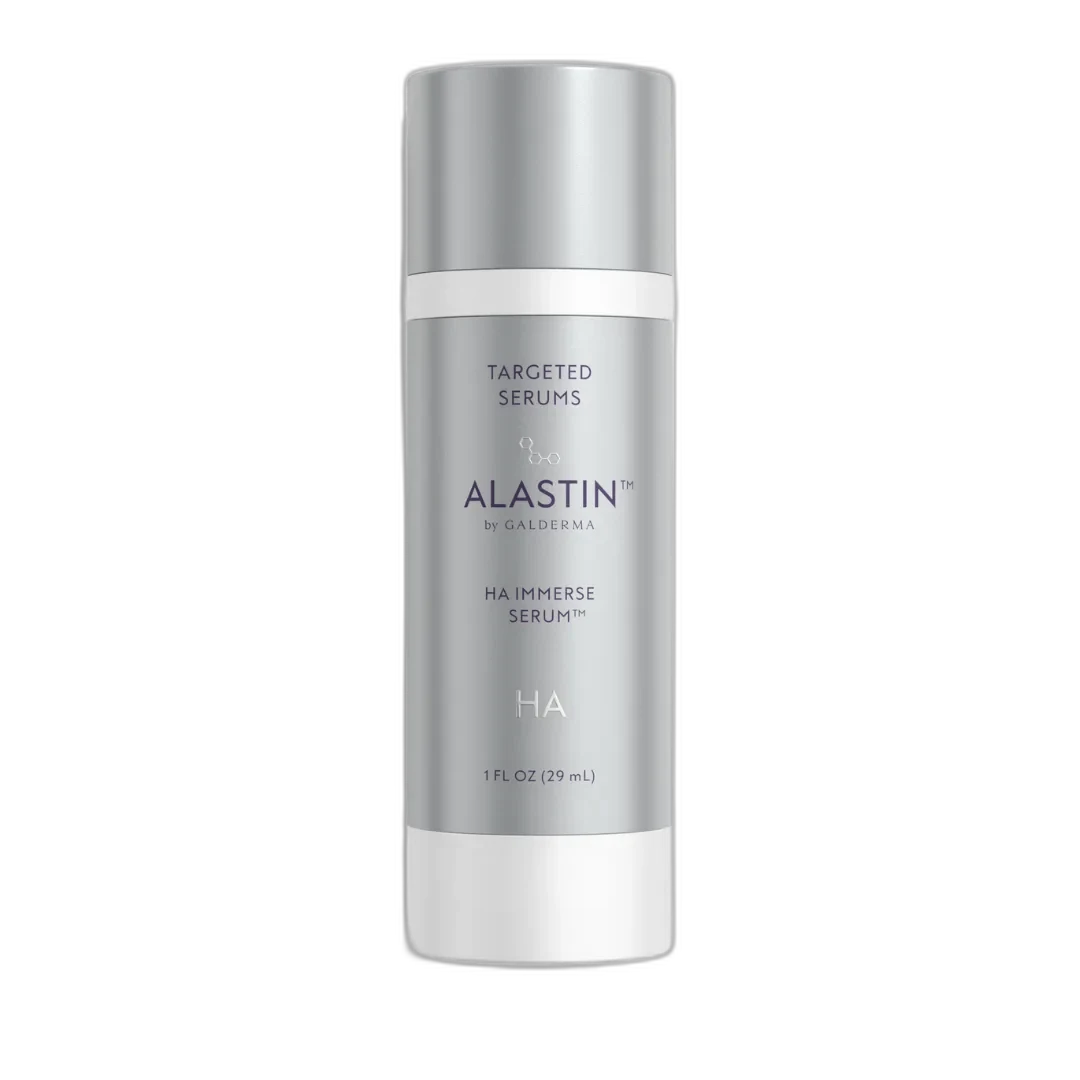
HA Immerse Serum
Post-Procedure Hydration Specialist
 Verified reviewer
Pros & cons.
- +Dual HA system combines standard and crosslinked forms for multi-depth hydration
- +HA-boosting peptides stimulate endogenous hyaluronic acid production via HAS2 enzyme activation
- +Completely fragrance-free and alcohol-free — ideal for sensitive and post-procedure skin
- +Elegant silicone-based texture absorbs instantly without sticky residue or pilling
- +Prebiotic sugar complex supports skin microbiome alongside hydration delivery
- +Layers beautifully under every product type without interference
- +Immediate smoothing and plumping sensation on first application
- +Backed by a physician-dispensed brand acquired by Galderma for its clinical credibility
- −At $68 for 1 oz, it is significantly more expensive than many effective HA serums
- −Small bottle size means 6-8 week lifespan at twice-daily use — annual cost adds up quickly
- −Peptide-driven HA boost is difficult to perceive as a distinct benefit beyond topical HA application
- −Limited independent review data makes it harder to validate real-world performance claims
- −Contains ascorbyl palmitate, a vitamin C form with questions about UV stability
The full review.
Alastin Skincare has a unique origin. The company launched in 2015 to help skin recover faster after dermatologic procedures. Lasers, chemical peels, and microneedling leave skin raw and needing intelligent repair. Because the development philosophy starts with compromised skin, it changes how the brand approaches hyaluronic acid.
The HA Immerse Serum uses that logic. Most HA serums simply dissolve hyaluronic acid in water and add a humectant. Alastin engineers hydration from multiple angles. The dual HA system uses both standard sodium hyaluronate and a crosslinked polymer form. The standard version penetrates the skin for deeper plumping. The crosslinked version sits near the surface, forming a moisture-retaining mesh that binds more water per molecule than the uncrosslinked version. One application provides both immediate surface smoothing and sustained deeper hydration.
The most interesting part of this formula is octapeptide-45. This cell-communicating peptide stimulates HAS2 — hyaluronidase synthase 2, the enzyme fibroblasts use to produce hyaluronic acid naturally. In-vitro studies show up to a 300% increase in endogenous HA production when this peptide reaches fibroblasts. The real-world effect is more modest, but the approach differs from standard HA serums. You are not just depositing moisture; you are asking your skin to make more. It is the difference between filling a leaking bucket and fixing the faucet.
Hexapeptide-11, a yeast-derived peptide, supports this by bolstering the structural matrix that holds moisture. Tremella fuciformis extract — silver ear mushroom, a staple in traditional Chinese skincare and modern cosmetic science — provides another humectant pathway. Its polysaccharides are structurally analogous to hyaluronic acid but bind water through different molecular interactions, adding redundancy to the moisture-retention system. The prebiotic complex of xylitylglucoside, xylitol, and anhydroxylitol feeds the skin’s beneficial microbiome and adds humectant activity.
Texture
The texture shows its clinical pedigree. This is not a sticky, sluggish HA serum that feels like glue. The silicone base — dimethicone and caprylyl methicone — gives it slip and elegance despite the active-dense formula. It absorbs in seconds, leaves skin immediately smoother, and layers under everything from retinol to sunscreen without pilling. If an HA serum has ever balled up under your moisturizer, this one solves that problem.
Scent
The fragrance-free, alcohol-free formulation fits a brand built for post-procedure skin. It contains no essential oils, no botanical fragrance compounds, and no ethanol. Lactoferrin provides gentle antimicrobial support. The preservative system is modern and minimal. This formula is invisible to reactive skin and succeeds at that goal.
What do you pay $68 for? The technology. This includes the peptide-driven HA stimulation, the crosslinked polymer system, and the physician-grade formulation philosophy. Is that technology visible? Within the first two weeks, most users report softer, smoother skin and improved hydration retention. Fine dehydration lines — shallow creases from parched skin, not deep creases from collagen loss — tend to soften. The plumping effect is real but subtle, providing healthy fullness rather than a dramatic transformation.
The limitation is that a well-formulated HA serum at one-third the price may produce similar results for many users. The peptide technology is innovative, but the endogenous HA boost is hard to perceive as a benefit separate from the topical HA. You pay for a more sophisticated mechanism of action — whether that sophistication yields better outcomes for your skin is the gamble.
The 1 oz bottle runs out quickly with twice-daily use on the face and neck. At six to eight weeks per bottle, this step costs approximately $500 annually. That is a significant commitment for a hydrating serum, a category where diminishing returns set in quickly.
Galderma’s acquisition of Alastin in 2022 confirms the brand’s scientific credibility. This pharmaceutical company makes Cetaphil and Restylane; they invested in Alastin’s technology and distribution, not hype. The clinical validation is real. Whether it is worth $68-per-ounce depends on your budget and if you value the peptide-driven approach over straightforward HA application.
For post-procedure skin, I recommend this serum. It was designed for that context, and the gentle, intelligent formulation excels when skin needs hydration without stress. For daily use on healthy skin, it is an excellent serum that may be more engineered than your hydration needs require.
Ingredient analysis.
Full INCI list
Water/Aqua/Eau, Glycerin, Polyacrylate-13, Sodium Hyaluronate, Sodium Hyaluronate Crosspolymer, Octapeptide-45, Hexapeptide-11, Tremella Fuciformis Sporocarp (Silver Ear Mushroom) Extract, Lactoferrin, Tetradecyl Aminobutyroylvalylaminobutyric Urea Trifluoroacetate, Xylitol, Propanediol, Anhydroxylitol, Phospholipids, Xylitylglucoside, Phosphatidylserine, Glucose, Hydroxymethoxyphenyl Decanone, Tocopherol, Ascorbyl Palmitate, Dimethicone, Caprylyl Methicone, Caprylic/Capric Triglyceride, Polyisobutene, Caprylyl Glycol, Disodium EDTA, Betaine, Polysorbate 20, Ethylhexylglycerin, Caprylhydroxamic Acid, Sorbitan Isostearate, Helianthus Annuus (Sunflower) Seed Oil, Lecithin, Pentylene Glycol, Magnesium Chloride, Phenoxyethanol, Potassium Sorbate, Sodium Hydroxide
Skin match.
The science.
The Science
This formulation stimulates endogenous hyaluronic acid production instead of relying only on topical application. Octapeptide-45 activates hyaluronidase synthase 2 (HAS2), the main enzyme that makes HA in dermal fibroblasts. Skin HA production drops with age; studies in the Journal of Investigative Dermatology show dermal HA content decreases by roughly 50% between ages 20 and 50, causing the volume loss and moisture loss seen in aging skin.
The crosslinked sodium hyaluronate polymer improves topical HA delivery. Standard sodium hyaluronate works as a humectant but skin hyaluronidases degrade it easily. Crosslinking the HA chains creates a resistant molecular mesh that stays on the skin surface longer to maintain hydration. Research in the International Journal of Biological Macromolecules shows crosslinked HA derivatives have better water-binding capacity and enzymatic degradation resistance than linear forms.
Tremella fuciformis polysaccharides retain moisture; research in the International Journal of Cosmetic Science suggests their water-holding capacity matches hyaluronic acid. Studies show the prebiotic complex (xylitylglucoside, xylitol, anhydroxylitol) supports skin microbiome diversity and balance, which regulates barrier function and transepidermal water loss.
Lactoferrin adds antimicrobial and anti-inflammatory benefits. Research in Biochemistry and Cell Biology shows lactoferrin modulates inflammatory cytokines and supports innate immune function at the skin surface—useful for post-procedure skin with a compromised barrier.
Dermatologist Perspective
Dermatologists often use hyaluronic acid serums in post-procedure recovery protocols, so Alastin's clinical history makes the HA Immerse Serum a fit for this use. Board-certified dermatologists note that peptide-driven HA stimulation is an interesting advancement over standard topical HA, though research continues into boosting endogenous HA via topical peptides. The fragrance-free, alcohol-free formulation works well for patients with sensitive or barrier-compromised skin. Dermatologists usually recommend applying HA serums to damp skin to capture hydration; this product's light texture improves compliance compared to thicker, stickier HA alternatives.
Where it fits in your routine.
Apply 1-2 pumps to clean, slightly damp skin morning and evening. Damp skin gives the hyaluronic acid something to bind to immediately, which improves absorption. Gently press into face and neck; do not rub aggressively. Follow immediately with a moisturizer to create an occlusive seal that locks in hydration. In the morning, finish with SPF. Apply before or after treatment serums based on your routine preference.
At $68 for 1 oz, this costs more than the $10-20 hyaluronic acid serum options that work. The price covers the peptide HA-boosting technology, crosslinked polymer system, and clinical-grade formulation. These are genuine innovations, but their visible impact beyond basic HA hydration is subtle. A 0.5 oz travel size exists for those who want to trial it first. The price makes sense for post-procedure use where formulation quality impacts recovery. For daily hydration on healthy skin, the cost-to-visible-benefit ratio is lower. Budget roughly $500 annually if using twice daily.
This serum works for persistent dehydration, post-procedure recovery, or barrier compromise without irritation risk. It suits retinol users with dryness, patients in active dermatological treatment, and sensitive skin needing a reliable hydrator.
Budget-conscious shoppers seeking effective hydration without the premium price can find well-formulated HA serums at one-third the cost that deliver comparable visible results. This is not the best choice for those preferring oil-free or silicone-free formulations, as the texture uses dimethicone to feel smooth.
Product details.
This lightweight, silky serum has a slight dimethicone slip and absorbs quickly without tackiness. It feels more elegant than many HA serums that leave a sticky film.
Unscented — no detectable fragrance.
An opaque pump bottle protects the formula from light degradation. The hygienic pump dispenser prevents contamination.
Immediate smoothing and plumping occurs on first use. There is no adjustment period; this gentle hydrator works from day one. Skin feels softer and more supple within minutes of application.
6-8 weeks with twice-daily use on face and neck
12 months
All Year
The backstory.
Alastin built its reputation on post-procedure skincare — products designed to help skin recover from lasers, peels, and injections. The HA Immerse Serum applies that recovery-oriented philosophy to everyday hydration, treating dehydrated skin with the same clinical seriousness the brand brings to post-laser healing. Its acquisition by Galderma in 2022 gave the brand pharmaceutical-grade distribution and validation.
About Alastin
Established Brand (5–20 years)Alastin Skincare launched in 2015 and grew fast as a physician-dispensed brand. The brand started by optimizing healing after dermatologic procedures. Galderma acquired Alastin Skincare in 2022, confirming its clinical position. Its patented TriHex Technology drives the product line.
Common myths.
Hyaluronic acid serums can dry out skin by pulling moisture from deeper layers.
HA draws moisture from the air in humid environments. In very dry climates, HA can pull water from lower skin layers. This formula uses a crosslinked HA polymer to retain moisture on the surface and a dimethicone base to create an occlusive layer that prevents transepidermal water loss.
All hyaluronic acid serums are basically the same.
HA molecular weight and form matter. This serum uses standard sodium hyaluronate, a crosslinked polymer form, and peptides that boost endogenous HA production. This approach differs from basic HA serums containing only one form of the ingredient.
What the community says.
"Immediate smoothing and plumping effect"
"Absorbs quickly without sticky residue"
"Layers well under other products"
"Keeps skin hydrated throughout the day"
"High price for a hyaluronic acid serum"
"Small 1 oz bottle runs out quickly"
"Some users report limited visible difference beyond basic hydration"
Featured in.
People also looked at.