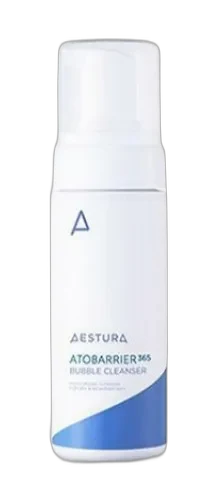
Atobarrier 365 Bubble Cleanser
Korean Derm Gentle Cleanser
 Verified reviewer
Pros & cons.
- +Gentle non-sulfate surfactant trio cleans without stripping
- +Glycerin positioned second on the INCI list cushions the surfactant action
- +Panthenol and allantoin add genuine barrier support during cleansing
- +Pre-whipped foam delivery is satisfying and easy to use
- +Derm-developed Korean brand with clinical credibility
- +Fungal-acne safe and suitable for most skin types
- −Contains added fragrance and declared EU allergens
- −Pricier than comparable drugstore foam cleansers
- −Foaming pump can occasionally clog
- −Not sufficient as standalone second cleanse for heavy makeup or waterproof SPF
- −Fragrance inclusion is at odds with the sensitive-skin positioning
The full review.
For most of skincare’s modern history, foam cleansers have been the compromised option. They feel great during use — that cloud-like lather is satisfying in a way gels and creams can’t match — but the surfactants that produce all that foam have historically been the same ones that strip skin, damage the barrier, and leave the stratum corneum gasping for water. Dermatologists have spent years telling patients with dry or sensitive skin to avoid foam cleansers entirely for exactly that reason. What Aestura is doing with its Atobarrier 365 Bubble Cleanser is the narrow but genuinely interesting work of proving that the compromise isn’t structural — you can build a foam cleanser that doesn’t wreck the barrier, if you care enough about the surfactant chemistry and the supporting ingredients.
The surfactant trio here is the starting point. Coco-glucoside, disodium cocoamphodiacetate, and sodium cocoyl isethionate are three of the gentler foam-generating cleansing agents available to formulators, and none of them are sulfates. Together they produce a cloud-like mousse that dispenses pre-whipped from the airless pump — the foam arrives already formed, which is part of the sensorial hook — while cleaning skin effectively without the stripping action that more aggressive surfactants deliver. The result is a formula that actually removes sebum, sunscreen, and daily grime at a similar level to typical foam cleansers, just without leaving your face feeling like it’s been sanded smooth.
The second critical formulation choice is what’s around the surfactants. Glycerin sits in the second position on the INCI list — unusually high for a foam cleanser, where glycerin is typically a token inclusion far down the list. Here it’s doing real work, cushioning the surfactant action and leaving a humectant residue on the skin after rinsing. Panthenol adds barrier support that most cleansers simply don’t bother with, and allantoin handles a quiet soothing role. Green tea extract shows up later on the INCI list as an antioxidant gesture — in a rinse-off product its functional role is limited, but it fits the sensitive-skin identity Aestura is building.
On the face, the product behaves exactly as it’s supposed to. You dispense one or two pumps of the already-whipped foam onto damp skin, massage gently for about thirty seconds, and rinse with lukewarm water. The post-cleanse feeling is the critical test here, and this is where the formula earns its reputation: your skin feels clean but not tight, moisturized rather than stripped, and ready to accept the next step of your routine without the uncomfortable delay while your skin recovers from being over-cleansed. For anyone used to a traditional foam cleanser, the absence of the post-rinse squeaky feel is the most obvious and immediate proof that the formulation logic worked.
Where this product has to be honest about its one real compromise is the fragrance question. The INCI list includes parfum alongside declared EU allergens limonene and linalool — an unusual inclusion in a product otherwise built for reactive, sensitive, and barrier-compromised skin. It’s the one place where Aestura’s sensorial instincts (Korean skincare is historically unafraid of light fragrance in cleansers) bump into the dermatological positioning, and the result is a cleanser that’s 90% appropriate for eczema-prone users but gets docked on that final 10% by the fragrance inclusion. For users without fragrance sensitivity, the scent is subtle and pleasant — a light, fresh note that disappears immediately on rinse. For users with known reactivity or active atopic flares, this is a flag worth taking seriously.
Beyond the fragrance issue, the limitations are relatively minor. The pump dispenser can occasionally clog if the product dries in the nozzle — a common issue with foaming pumps — and a quick rinse under hot water usually fixes it. At around $22 for 200ml, the price is reasonable but not cheap; comparable drugstore gentle foam cleansers exist at lower prices, though few with the same glycerin-forward formulation or the same dermatological pedigree. As part of a full Atobarrier 365 routine, the cleanser plays the role it’s supposed to play: it doesn’t undo the barrier work the rest of your products are doing, and for some users that alone is worth the price bump.
The right customer here is someone with dry, normal, or combination skin who wants the sensorial experience of a foam cleanser but has struggled with the tight, stripped feel that most foams produce. It’s also a reasonable pick for sensitive or atopic-prone users who can tolerate the fragrance inclusion — and for those who can’t, Aestura’s broader line includes alternatives. For oily skin that wants deep cleansing, this formula is mild enough that it may feel insufficient without an oil cleanser as the first step. And for anyone fully committed to fragrance-free skincare, the small but meaningful compromise on that front will keep this cleanser off the shortlist.
Formula
Ingredient analysis.
Full INCI list · pH 5.5
Water, Glycerin, Coco-Glucoside, Disodium Cocoamphodiacetate, Sodium Methyl Cocoyl Taurate, Butylene Glycol, Sodium Chloride, Acrylates Copolymer, 1,2-Hexanediol, Sodium Cocoyl Isethionate, Panthenol, Allantoin, Camellia Sinensis Leaf Extract, Tocopherol, Glyceryl Caprylate, Ethylhexylglycerin, Citric Acid, Parfum, Limonene, Linalool
Skin match.
The science.
The Science
Cleansing science supports glycerin-forward, gentle-surfactant foam cleansers as barrier-compatible options. Research on surfactant-induced skin damage shows sulfate-based cleansers and high-foaming anionic surfactants cause stratum corneum protein denaturation and lipid disruption. This mechanism causes the tight, stripped feel users get from traditional foam cleansers. Comparative studies show milder surfactants, like the coco-glucoside and amphoteric combinations used in this formula, cause significantly less barrier disruption while still cleansing well. Glycerin is a documented humectant and soothing agent; its second INCI spot means the concentration is meaningful. Multiple dermatological studies characterize Panthenol's barrier-recovery properties, and its inclusion in a rinse-off product leaves residual benefit on the skin surface. Green tea extract's role in a rinse-off format is modest because antioxidant activity requires contact time, which cleansing lacks, but it fits the gentle-skin positioning. The added fragrance is the only formulation choice not supported by sensitive-skin science, as it remains a common sensitizer in leave-on and rinse-off products.
Dermatologist Perspective
Dermatologists often recommend gentle non-sulfate cleansers for patients with dry, sensitive, or atopic-prone skin. Glycerin-forward formulations like this one fit that clinical advice. Board-certified dermatologists note that patients historically avoided foam cleansers due to surfactant aggression, but modern coco-glucoside-based systems change that for some patients. The added fragrance is the one element that would typically give dermatologists pause when recommending this for reactive patients. For patients with active eczema flares, fragrance-free alternatives are generally preferred.
Where it fits in your routine.
Apply 1-2 pumps of the pre-whipped foam to damp skin. Massage in circular motions for 30 seconds, then rinse with lukewarm water. Use morning and night, or as the second cleanse after an oil cleanser in PM routines with makeup or heavy sunscreen. Follow immediately with a hydrating toner or essence to lock in water before it evaporates from the skin surface.
At around $22 for 200ml, this cleanser costs more than drugstore foam cleansers but much less than prestige sensitive-skin options. You pay for the formulation sophistication, the dermatologist-developed pedigree, and the Korean clinical track record — a premium that justifies the cost for most users seeking barrier-safe cleansing. The catch is that the added fragrance reduces the sensitive-skin value; customers with known fragrance reactivity pay a premium for a product that isn't fully appropriate for them. For everyone else, the per-ounce math is reasonable.
Dry, normal, and combination skin types want a foam cleanser that lacks the tight, stripped feel of traditional foam formulations. It works well for users already using the Aestura line who want a cleanser that matches the barrier-repair philosophy of their routine.
Users with known fragrance reactivity or active atopic flares need a fully fragrance-free cleanser. Oily-skin users seeking a deep-cleaning experience may find this too gentle for a standalone evening cleanse. Budget-conscious shoppers can find acceptable gentle foam cleansers at drugstore prices.
Product details.
Pre-foamed cloud-like mousse dispensed from an airless pump
Subtle light fresh fragrance with citrus notes
200ml foaming pump bottle
The foam dispenses pre-whipped straight from the pump, spreading over the skin as a cloud-like mousse. After massaging for about 30 seconds and rinsing, skin feels clean but not tight — the absence of the squeaky post-cleanse feel is the single most obvious benefit of the glycerin-forward formulation.
2-3 months with twice-daily full-face use
12 months
All Year
The backstory.
The Bubble Cleanser was added to Aestura's Atobarrier 365 lineup to give customers a cleanser that matched the line's barrier-repair positioning. Korean dermatology clinics had been recommending Aestura's moisturizers for atopic-prone patients for years, and the cleanser was designed to complete a full routine without introducing a cleansing step that would undo the barrier work downstream.
About Aestura
Aestura is a Korean brand owned by Amorepacific. Founded in 2004, dermatologists developed the brand to create clinically backed barrier-repair formulations. Korean dermatology clinics routinely use the Atobarrier line for sensitive and atopic-prone skin. *Established Brand (5–20 years)*
Common myths.
Foam cleansers are always drying.
Older foam cleansers caused dryness because they used harsh sulfates. Modern formulas use gentle surfactants like coco-glucoside and high levels of glycerin — like this one — to stay non-stripping.
Gentle cleansers don't clean as well.
Surfactant gentleness and cleansing efficacy are different. This formula removes sebum, sunscreen residue, and daily dirt effectively without disrupting the stratum corneum like aggressive surfactants do.
FAQ.
Is this cleanser strong enough to remove sunscreen?
For most mineral and lightweight chemical sunscreens, yes. For heavy water-resistant SPF or makeup, use it as the second cleanse in a double-cleansing routine after an oil cleanser.
Why does a sensitive-skin cleanser contain fragrance?
The criticism is valid — the added fragrance and declared allergens (limonene, linalool) conflict with the formula's sensitive-skin positioning. Users with known fragrance reactivity should patch test or use a fragrance-free alternative.
Is it okay to use morning and night?
Yes. The surfactant system is mild enough for twice-daily use, and the glycerin content prevents the over-cleansing dryness that strips skin when using stronger foams.
Does it remove all makeup?
It removes light makeup like tinted moisturizer and concealer. Use an oil cleanser first for full coverage foundation, eye makeup, or waterproof products.
Is it safe for eczema?
This barrier-support formulation works for eczema-prone skin, but the fragrance concerns patients with active flares. Switch to a fully fragrance-free cleanser during a flare.
How long does the bottle last?
Use twice daily for roughly 2-3 months. The foaming pump dispenses a controlled amount to prevent over-use.
What the community says.
"non-stripping"
"foams well without sulfates"
"skin feels soft after rinsing"
"contains fragrance despite sensitive-skin positioning"
"pump dispenser can clog"
"pricier than comparable foam cleansers"