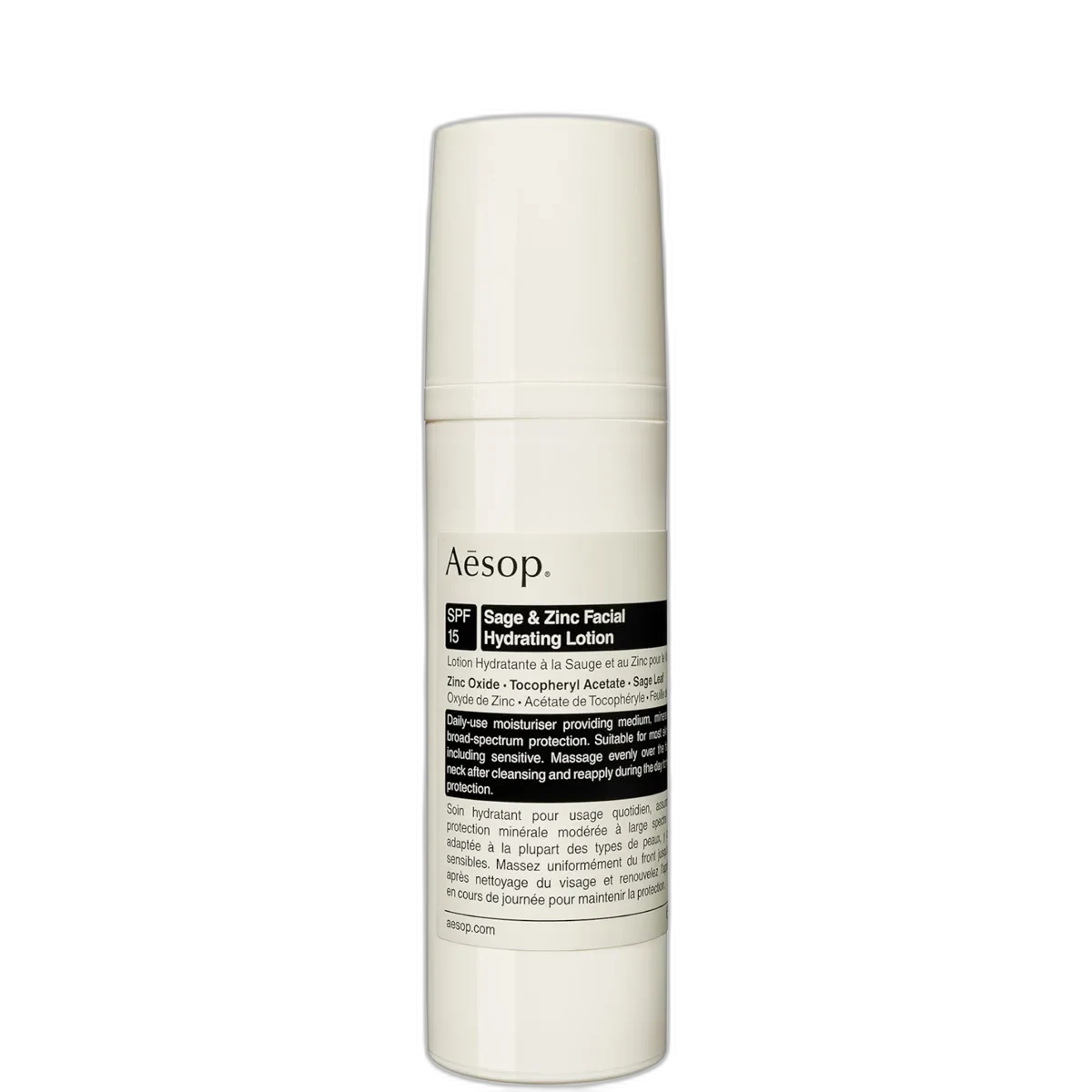
Sage & Zinc Facial Hydrating Cream SPF 15
The Aesop SPF Hybrid
 Verified reviewer
Pros & cons.
- +Fully mineral SPF with nano zinc oxide as the sole filter
- +Less white cast than traditional zinc sunscreens
- +Genuinely hydrating in addition to providing UV protection
- +Squalane and macadamia oil lipid base feels clean and modern
- +Vitamin E antioxidant inclusion supports photoprotection
- +Pregnancy-friendly mineral filter profile
- +Pleasant satin finish that layers under makeup
- −SPF 15 falls below modern dermatological recommendations
- −Premium price for sub-optimal sun protection
- −Sage and lavender oils irritate sensitive skin
- −Faint cast on darker skin tones
- −Small 50 ml bottle disappears quickly at correct application amounts
- −Newer mineral SPF moisturizers offer better protection at lower prices
Ingredient analysis.
Full INCI list
Water (Aqua), Zinc Oxide (Nano), Caprylic/Capric Triglyceride, PEG-100 Stearate, Glycerin, Cetearyl Alcohol, Potassium Cetyl Phosphate, Macadamia Ternifolia Seed Oil, Squalane, Hydrogenated Palm Glycerides, Phenoxyethanol, Tocopheryl Acetate, Citric Acid, Lauryl Pyrrolidone, Oenothera Biennis (Evening Primrose) Oil, Silica, Lavandula Angustifolia (Lavender) Oil, 1,2-Hexanediol, Salvia Officinalis (Sage) Oil, Glycine Soja (Soybean) Oil, Disodium EDTA, Xanthan Gum, Fusanus Spicatus Wood Oil, Tocopherol, Caprylyl Glycol, Ethylhexylglycerin, Magnesium Aluminum Silicate, Sodium Citrate, Glycine Soja (Soybean) Seed Extract, Daucus Carota Sativa (Carrot) Root Extract, Beta-Carotene, Linalool, Farnesol, D-Limonene, Geraniol.
Skin match.
The science.
The Science
The sole sunscreen filter in this formula is nano-particle zinc oxide, a physical (mineral) UV filter that provides broad-spectrum UVA and UVB protection by reflecting and scattering UV radiation. Nano zinc oxide differs from traditional non-nano zinc primarily in particle size, which affects both the cosmetic finish (less white cast) and the optical properties. Published reviews by regulatory bodies including the EU Scientific Committee on Consumer Safety have concluded that intact nano zinc oxide in topical sunscreen formulations does not penetrate beyond the stratum corneum and is considered safe for cosmetic use. The SPF 15 rating reflects the concentration of zinc oxide in the formula and represents the level at which the product was tested under standardized conditions. SPF 15 is the legal minimum for sunscreen labeling and blocks approximately 93 percent of UVB rays under correct application conditions; SPF 30 blocks approximately 97 percent. The four-percentage-point difference sounds modest but represents roughly double the UVB transmission, which matters cumulatively for long-term photoaging and pigmentation outcomes. Modern dermatological consensus, supported by the American Academy of Dermatology and most equivalent international bodies, recommends SPF 30 as the daily minimum for face protection, particularly for users concerned with hyperpigmentation, melasma, or accelerated photoaging. The hydration and lipid components of the formula are well-supported. Glycerin is the most-studied small-molecule humectant in cosmetic chemistry, with decades of evidence for surface hydration and barrier function support. Squalane is a skin-identical lipid that absorbs cleanly without the heaviness of plant butters and has documented emollient and barrier-supporting effects. Macadamia seed oil contributes a balanced fatty acid profile rich in oleic and palmitoleic acids. Tocopheryl acetate and tocopherol provide vitamin E antioxidant activity, which is particularly relevant in a sunscreen formula where the goal is to defend against UV-induced free radical damage. The essential oil components — sage, lavender, sandalwood, and the disclosed allergens — contribute aromatic identity and minor traditional-use anti-inflammatory claims, but they are also the formula's main contact-sensitization risk for fragrance-reactive users. Sage oil in particular is worth noting as a less common but documented contact sensitizer.
Dermatologist Perspective
Dermatologists generally view SPF 15 daily moisturizers as insufficient for primary sun protection by current standards. Board-certified dermatologists frequently recommend SPF 30 as the minimum daily protection level, particularly for patients concerned with photoaging, hyperpigmentation, melasma, or long-term skin cancer risk reduction. The mineral zinc oxide filter in this product is otherwise viewed favorably — dermatologists often recommend mineral sunscreens for patients with sensitive skin, rosacea, or pregnancy considerations, and nano zinc is considered safe by regulatory consensus. The standard dermatological caveats with this specific product are the SPF rating and the essential oil profile, with sage oil and the disclosed fragrance allergens flagged as suboptimal for patients with reactive or rosacea-prone skin. For patients seeking a luxury mineral SPF moisturizer with adequate protection levels, dermatologists would more typically recommend an EltaMD UV Clear Tinted (SPF 46), La Roche-Posay Anthelios mineral options, or similar products at lower prices and higher SPF levels.
Where it fits in your routine.
Apply this as your final morning step after cleansing, treatment serums, and any other moisturizer (if needed). Use at least a quarter-teaspoon — about two pumps from the dispenser — for the face and neck; using less reduces the SPF protection. Press the cream into your skin instead of rubbing, and let it absorb before applying makeup. Reapply every two hours when outdoors or after sweating or swimming. Use only in the morning. If you have a history of fragrance sensitivity, patch test on your inner forearm for 48 hours before first full use. Finish the product within twelve months of opening.
At approximately $80 for 50 ml, the only available size, the cream costs as much as upper-mid range luxury SPF moisturizers. The SPF 15 sun protection provides less value than competing brands, which offer SPF 30 mineral moisturizers at lower prices. The lipid and humectant base is well-formulated, but the SPF 15 sun protection fails modern recommendations. If a buyer wants the Aesop herbal scent profile and accepts SPF 15 for daily protection, the math works as a luxury experience purchase. For someone optimizing sun defense per dollar, this is one of the hardest products in the catalog to defend.
This product suits people with normal-to-combination skin, no fragrance sensitivity, no major pigmentation concerns, and a mostly indoor lifestyle who want a hydrating mineral SPF moisturizer hybrid and value the Aesop sensorial experience. The narrow target includes buyers who accept SPF 15 for their daily exposure and want a single-step morning product.
Choose an SPF 30+ mineral moisturizer if you worry about photoaging, hyperpigmentation, melasma, or heavy sun exposure. Skip it if you have rosacea, fragrance-reactive skin (the sage and lavender oils cause irritation), or if you want a primary sunscreen instead of a hybrid moisturizer. Budget-minded buyers get better SPF protection from EltaMD, La Roche-Posay, or similar dermatologist-developed brands for less.
Product details.
This thick cream thins on application and absorbs to a satin finish.
Distinctly herbal — sage and lavender over a faint sandalwood warmth.
Aesop uses a signature amber glass bottle with a pump dispenser. The pump is hygienic and gives a controlled dose, but the 50 ml volume runs out fast when applying enough for full SPF protection.
The first application feels cool and smells herbal. The thick cream presses into the skin and absorbs to a satin finish. Most users see a faint cast for one or two minutes before the formula settles. There is no purging or adjustment period.
One bottle lasts about 1.5-2 months if you use the correct sun-safe amount (roughly a quarter-teaspoon for the face). Using less stretches the bottle but lowers the actual SPF protection.
12 months
All Year
The backstory.
Sage & Zinc has been part of Aesop's catalog for over a decade as one of the brand's only SPF-containing daily moisturizers. It reflects an earlier era when SPF 15 was still considered an acceptable daily protection level — a standard that has since shifted upward to SPF 30 minimum across most dermatological guidance, leaving this product slightly behind contemporary best practice.
About Aesop
Legacy Brand (20+ years)Aesop launched in Melbourne in 1987 and has nearly four decades of formulation experience. Sage & Zinc has distributed continuously for over a decade as one of the brand's only SPF-containing daily moisturizers, with consistent global distribution supporting its prestige category credibility.
Common myths.
SPF 15 is enough for daily wear if you're not at the beach.
Modern dermatological guidance recommends at least SPF 30 for daily face protection, especially for skin with photoaging, hyperpigmentation, or melasma. SPF 15 blocks about 93% of UVB and SPF 30 blocks 97% — this difference matters more than the math suggests for people with pigmentation concerns.
Zinc oxide always leaves a white cast.
Nano-particle zinc oxide formulations reduce the white cast seen in older mineral sunscreens. This product leaves a faint cast on deeper skin tones, but it shows less than traditional micronized or non-nano zinc options.
FAQ.
Is SPF 15 enough for daily sun protection?
Not by modern dermatological standards—SPF 30 is the daily face protection minimum. SPF 15 blocks about 93% of UVB, while SPF 30 blocks 97%. This difference matters more for preventing long-term photoaging and pigmentation than the math shows. Use this product as a hydrating layer with minor bonus protection, not your only sunscreen.
Does it leave a white cast?
The nano particle size leaves less residue than traditional zinc oxide sunscreens, but a faint cast remains on darker skin tones. Light to medium skin tones generally see nothing; deeper tones may layer it under foundation or use a tinted alternative.
Can I use it instead of a separate sunscreen?
Only use this if you accept SPF 15 as full protection, which most dermatologists do not recommend. For daily sun defense, use this as a moisturizer with a dedicated SPF 30+ sunscreen on top, or use a higher-SPF mineral moisturizer instead.
Is it suitable for sensitive skin?
Caution is warranted. The formula contains sage oil, lavender oil, and the standard fragrance-allergen trio, all of which can irritate reactive skin. Sensitive types should choose a fragrance-free mineral sunscreen instead.
Is the nano zinc safe?
Yes. Regulatory bodies like the EU SCCS have extensively studied and reviewed nano-particle zinc oxide. The EU SCCS concluded that intact (non-degraded) nano zinc in topical sunscreens does not penetrate past the stratum corneum and is safe for cosmetic products.
Is it pregnancy-safe?
Yes. Mineral sunscreens with zinc oxide are the most pregnancy-friendly option. The active profile contains nothing typically restricted during pregnancy. Essential oils mean you should patch test if your pregnancy skin is more reactive.
How often should I reapply?
Reapply every two hours when outdoors, and after sweating or swimming. This rule applies to any sunscreen, including this one. One morning application works for indoor desk days, but reapply if you go into prolonged outdoor sun.
What the community says.
"Lightweight texture for a mineral SPF"
"Less white cast than typical zinc sunscreens"
"Layers cleanly under makeup"
"Pleasant herbal scent"
"Genuinely hydrating in addition to SPF"
"SPF 15 is too low for primary daily sun protection"
"Sage and lavender oils irritate sensitive skin"
"Premium price for a low-SPF formula"
"Still leaves a faint cast on darker skin tones"
People also looked at.