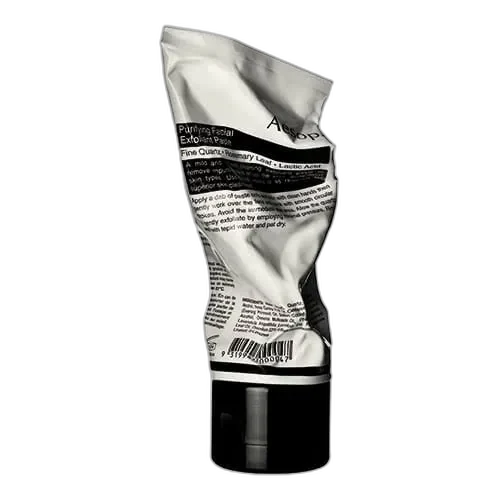
Purifying Facial Exfoliant Paste
Hybrid Scrub Upgrade
 Verified reviewer
Pros & cons.
- +Ultra-fine quartz particles provide controlled non-abrasive physical exfoliation
- +Added lactic acid creates a true physical-chemical hybrid approach
- +Rosehip and evening primrose emollient base buffers the exfoliation
- +Glycerin humectant support prevents post-rinse tightness
- +Long-serving formulation with 20+ years of consumer track record
- +Vegan and cruelty-free Aesop positioning
- −$52 price is high for a twice-weekly exfoliant
- −Essential oil content makes it unsuitable for reactive or barrier-compromised skin
- −Multiple declared EU allergens on the ingredient list
- −Overkill if you already use a good chemical exfoliant toner
- −Physical exfoliation is generally not recommended for active acne
The full review.
Skincare in the early 2000s featured harsh physical exfoliants. Apricot-kernel scrubs and walnut-shell exfoliants dominated, and standard advice suggested grinding grit into the face. Dermatologists have spent the last two decades discouraging these products because jagged particles cause micro-tears, especially on thin or reactive skin. Aesop’s Purifying Facial Exfoliant Paste launched as a reaction against coarse-scrub orthodoxy. The fact that it sells in essentially the same form twenty-plus years later endorses the original formulation logic.
The mechanism is specific. Quartz is second on the ingredient list—an unusual position for a physical exfoliant—meaning it performs real work rather than acting as marketing garnish. The particles are finely milled and more uniform than the shell and kernel materials in early-aughts scrubs, so the physical exfoliation is controlled rather than abrasive. Aesop added lactic acid—the gentlest AHA—which works while the paste sits on the skin during the massage step before rinsing. This dual mechanism makes the product a hybrid rather than a pure scrub or pure acid exfoliant, and this part of the formulation still competes with modern options.
Rosehip seed oil and evening primrose oil—Aesop’s house pairing—form a cushioning emollient base with glycerin for humectant support. These ingredients prevent the paste from stripping the skin after one minute of manual exfoliation. The essential oil layer is predictable: rosemary oil, clove oil, and chamomile appear alongside declared allergens (linalool, limonene, eugenol, geraniol, benzyl benzoate) at the bottom of the INCI list. This is standard Aesop; it will either be why you love the product or why you cannot use it.
The paste feels different from most scrubs. It squeezes out as a thick, opaque cream with visible fine grit. When massaged into damp skin, the quartz works without the scratchy feeling of coarser scrubs. The aromatic blend is intense—a warm, medicinal, herbal scent that feels like a spa-ritual or is overwhelming. After rinsing, skin feels smoother, slightly tingly from the lactic acid, and bright for a few hours. After two to three weeks of consistent weekly or twice-weekly use, texture improves and dullness lifts.
This is not for sensitive skin. The combination of physical exfoliation, lactic acid, and heavy essential oils is too much for a reactive barrier; users with rosacea, perioral dermatitis, or active acne will likely find it too intense. It is also overkill if you already use a well-tolerated chemical exfoliant toner. The hybrid approach suits people who prefer the tactile experience of a physical scrub or want to combine two exfoliation types into one step. At $52 for 75ml, the price is a barrier. You pay for the Aesop experience as much as the formulation. A well-formulated $15 scrub and a $20 lactic acid toner used on alternate nights can approximate this performance.
Who should buy this? People with healthy, non-reactive skin who enjoy the tactile ritual of a physical exfoliant, want the lactic acid assist, and want the Aesop sensorial experience. Use it once or twice a week on damp skin with light pressure and short contact time, followed by a hydrating serum and moisturizer. Used more aggressively, or by anyone who needs a gentle chemical exfoliant, it is an expensive way to irritate the face.
Who Should Buy
People with healthy, non-reactive skin who enjoy the tactile ritual of a physical exfoliant, want the lactic acid assist, and want the Aesop sensorial experience. Use it once or twice a week on damp skin with light pressure and short contact time, followed by a hydrating serum and moisturizer. Used more aggressively, or by anyone who needs a gentle chemical exfoliant, it is an expensive way to irritate the face.
Ingredient analysis.
Full INCI list
Water (Aqua), Quartz, Glyceryl Stearate SE, Rosa Canina (Rosehip) Fruit Oil, Oenothera Biennis (Evening Primrose) Oil, Glycerin, C12-16 Alcohols, Lactic Acid, Sodium Cocoyl Isethionate, Phenoxyethanol, Xanthan Gum, Ormenis Multicaulis Oil, Rosmarinus Officinalis (Rosemary) Leaf Oil, Eugenia Caryophyllus (Clove) Leaf Oil, Tocopherol, Sodium Hydroxide, Linalool, D-Limonene, Eugenol, Benzyl Benzoate, Geraniol
Skin match.
The science.
The Science
Physical-plus-chemical exfoliation works well if the physical component is finely milled and the chemical component is a gentle AHA. Lactic acid is a well-studied alpha hydroxy acid. At the low concentrations used in leave-off cleansers, it consistently improves stratum corneum cohesion, surface smoothness, and mild hyperpigmentation. Because this paste rinses off after 30-60 seconds, the lactic acid exposure is brief and surface-level. It assists the physical exfoliation rather than delivering the deeper cellular turnover a leave-on lactic serum provides. Quartz is a physical exfoliant with a solid mechanistic case, though it has less study than chemical acids. The particles are chemically inert, smooth, and have controllable particle size, which avoids the main dermatological concern with physical scrubs (irregular particles causing micro-tears). Rosehip seed oil and evening primrose oil both show emerging evidence for barrier support via essential fatty acids. The essential oil content — rosemary, clove, chamomile — does not add efficacy to the exfoliation and increases the irritation risk profile.
Dermatologist Perspective
Dermatologists generally prefer chemical exfoliants over physical scrubs, but fine-particle physical exfoliants like the quartz in this paste are acceptable for patients with healthy, non-reactive skin when used sparingly. Board-certified dermatologists note that this hybrid approach — a gentle physical component plus a brief lactic acid assist — is a reasonable format compared to aggressive single-mechanism scrubs. Dermatologists typically caution against using this product on patients with rosacea, active acne, or compromised barriers, and advise using it once or twice weekly even on tolerant skin. The essential oil content is a standard concern for reactive patients.
Where it fits in your routine.
Massage a dime-size amount onto clean, damp skin in small gentle circles for 30-60 seconds, avoiding the immediate eye area. Rinse thoroughly with lukewarm water and follow immediately with a hydrating serum and moisturizer. Use once or twice a week at most, and avoid combining with other exfoliating actives (retinoids, BHA, AHA serums) in the same routine. Always apply SPF the following morning after evening use.
At $52 for 75ml, this is a luxury exfoliant. Part of that price reflects the quartz particle quality, the lactic acid inclusion, and the rosehip-and-evening-primrose emollient base, which outperform average physical scrubs. The rest of the premium pays for brand experience, aromatic identity, and packaging aesthetics, not clinical superiority. If you value those factors and use the product twice weekly, one tube lasts several months, reducing the cost impact. For pure clinical outcomes, a sub-$20 gentle scrub plus a low-pH lactic acid toner provides comparable or better exfoliation.
Normal, combination, and non-reactive oily skin types who want a sophisticated hybrid exfoliant with physical texture. It suits Aesop fans who tolerate the brand's essential oil approach and need an exfoliating complement for their routine.
Avoid this paste if you have sensitive, rosacea-prone, eczema-prone, or breakout-prone skin. If you use an effective chemical exfoliant toner, you do not need it. Budget-conscious buyers find comparable results in cheaper alternatives.
Product details.
Thick creamy paste with fine gritty quartz particles suspended throughout
Pronounced herbal-woody-medicinal aroma of rosemary, clove, and chamomile
75ml white tube with Aesop's signature typographic label
The paste feels cushiony and grainy; the quartz is present but not harsh. Essential oils provide a warm, medicinal aroma that lasts through the massage step. Skin feels smoother and tingles slightly for a few minutes after rinsing.
4-6 months with twice-weekly use
12 months
All Year
The backstory.
This has been one of Aesop's longest-running cleansing products since the early 2000s, developed as an alternative to the often-harsh physical scrubs dominant at the time. The paste format and ultra-fine quartz were chosen specifically to provide a more controlled exfoliation experience than the apricot-kernel scrubs that were everywhere when it launched.
About Aesop
Established Brand (5–20 years)Aesop has made this exfoliant paste for nearly two decades. It is one of the brand's longest-running SKUs. Independent consumer reviews are plentiful, but Aesop formulations have limited formal clinical validation.
Common myths.
Physical scrubs are always worse than chemical exfoliants.
Coarse physical scrubs with irregular particles (apricot shell, walnut) can cause micro-tears, but fine, regularly shaped particles like the quartz in this paste provide gentle controlled exfoliation that many dermatologists consider perfectly acceptable for normal skin.
You need to scrub hard to see results.
Use this paste with light pressure and short contact time. Scrubbing hard with any physical exfoliant causes irritation and damages the barrier without improving outcomes.
FAQ.
How often should I use this exfoliant?
Most skin types only need this once or twice a week. Daily use of a physical-plus-chemical hybrid is too much and compromises your barrier over time.
***
Is it too abrasive for sensitive skin?
Likely. The quartz particles are finer than typical scrubs, but they still provide physical exfoliation. The lactic acid and essential oils increase irritation risk for reactive users. Sensitive skin works better with a gentle chemical exfoliant.
***
Can I use it with retinol?
Do not use in the same routine. Use on non-retinol nights and wait at least 24 hours before applying retinoids. Combining physical exfoliation with retinoids causes irritation and flaking.
Why is there fragrance in an exfoliant?
Aesop uses essential oils to define its brand identity. The rosemary, clove, and chamomile blend provides aroma but lacks function; people with fragrance reactivity should patch test before use.
Is it worth $52 for a face scrub?
Buy this only if you love the Aesop aesthetic and want the hybrid quartz-plus-lactic-acid format. Other gentle physical exfoliants cost much less, and a well-formulated chemical exfoliant toner works better for less money.
Do I need a moisturizer after using it?
Yes, always. Physical and chemical exfoliation temporarily compromises the barrier. Use a hydrating serum and moisturizer after to maintain skin health between uses.
***
Community
What the community says.
"finer grit than typical scrubs"
"leaves skin smooth and glowing"
"works on combination skin without stripping"
"heavy essential oil scent"
"expensive"
"too abrasive for sensitive skin"
Featured in.
People also looked at.