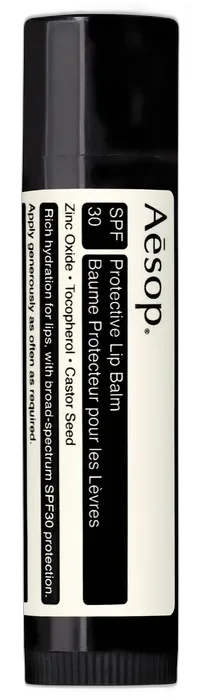
Protective Lip Balm SPF 30
Luxury Lip Sunscreen Upgrade
 Verified reviewer
Pros & cons.
- +Three-filter system including zinc oxide and modern non-US UV filters
- +Genuine broad-spectrum UVA coverage rare in lip products
- +Glossy non-waxy finish with no white cast from the nano zinc
- +Vegan formulation without beeswax or animal-derived lanolin
- +Smooth application and comfortable on-lip feel
- +Long-serving product with consistent global availability
- −Expensive at $25 for only 5.5 grams
- −Essential oil content not ideal for reactive lip skin
- −Contains multiple declared EU allergens
- −Small size means frequent repurchase for daily users
- −Overbuilt for low-UV daily office use
The full review.
Walk into any drugstore and look at the lip balms labeled SPF 30. Pick any of them up, read the active ingredients, and you’ll almost always find a single chemical filter — typically octinoxate or avobenzone — doing all the work. The rest of the ingredient list is wax and petrolatum. This has been the standard for decades, even as face sunscreens have evolved through multiple generations of filter technology, incorporated encapsulated antioxidants, and finally started addressing the full UVA spectrum. The lip category has mostly just watched it happen. Aesop’s Protective Lip Balm SPF 30 is one of a very small number of products that bothered to catch up.
The technical story is worth taking seriously. The filter stack here includes nano zinc oxide — rare enough in a lip product that it’s notable on its own — plus Tinosorb S and Uvinul A Plus, two modern UV filters widely available in Australia and Europe but still unavailable in the US sunscreen market. Tinosorb S is a photostable broad-spectrum filter that genuinely covers both UVA and UVB, while Uvinul A Plus handles the long-UVA portion that most sunscreens historically under-serve. Put all three together and you get something that actually earns the ‘broad-spectrum’ designation in a meaningful way, not just the technical box-checking that lets a product print SPF 30 on the front of the tube. For a surface as thin, pigment-light, and sun-exposed as the lips, that matters more than most people think about.
Underneath the filters, the balm base is built on castor seed oil, jojoba esters, pentaerythrityl tetraisostearate, and two vegetable waxes (candelilla and carnauba) in place of the beeswax most competing products use. That’s a deliberate choice — it keeps the formula vegan, and it also avoids one of the more common lip balm allergens. Tocopherol adds antioxidant support, and sunflower and jojoba oils round out the emollient layer. Application is exactly what you’d expect from a well-built balm: it glides on smoothly, dissolves into a glossy rather than waxy finish, and leaves no white cast despite the zinc content. The nano particle size does its job.
Where this product runs into its honest limitations is the essential oil question. Aesop added tangerine peel, lavender, and ylang ylang oils to the formula, and the INCI list declares limonene, linalool, geraniol, citral, citronellol, benzyl salicylate, and benzyl benzoate as allergens at the end. That’s a significant fragrance load for a product going on a mucous membrane, and anyone with a history of perioral dermatitis, lip dermatitis, or essential oil contact reactions should think twice. For users with tolerant skin, the scent is subtle and pleasant — a soft citrus-floral note that fades quickly — but the category of people for whom a premium lip SPF makes sense overlaps substantially with the category of people who should be cautious about essential oils, and that’s a tension worth naming honestly.
The price is the other obvious hurdle. At $25 for 5.5 grams, this is several times the cost of drugstore SPF lip balms. The technical superiority is real, but so is the fact that $25 buys a very small product. A typical daily user will finish it in four to six months, which means committing to this balm is committing to roughly $50-75 per year in lip sunscreen alone. For customers who already buy into Aesop’s broader line, or who specifically care about broad-spectrum UVA protection for the lips, the math works. For everyone else, a $10 zinc-based alternative from a brand like Sun Bum or Supergoop will get the general idea of lip SPF across without the filter sophistication.
Who should actually buy this? People who take skin cancer prevention seriously and want the best filter system they can get on their lips, particularly Aesop fans who already tolerate the brand’s essential oil approach. It’s also a reasonable pick for anyone in high-UV environments — skiers, sailors, people at altitude or near reflective surfaces — where the difference between a single-filter SPF and a three-filter broad-spectrum system genuinely matters. For daily office use by someone who rarely spends time in direct sun, this is overbuilt for the task. The formulation is genuinely impressive; the question is whether your lips need the upgrade.
Who Should Buy
People who take skin cancer prevention seriously and want the best filter system they can get on their lips, particularly Aesop fans who already tolerate the brand’s essential oil approach. It’s also a reasonable pick for anyone in high-UV environments — skiers, sailors, people at altitude or near reflective surfaces — where the difference between a single-filter SPF and a three-filter broad-spectrum system genuinely matters. For daily office use by someone who rarely spends time in direct sun, this is overbuilt for the task. The formulation is genuinely impressive; the question is whether your lips need the upgrade.
Ingredient analysis.
Full INCI list
Ricinus Communis (Castor) Seed Oil, Jojoba Esters, Pentaerythrityl Tetraisostearate, Euphorbia Cerifera (Candelilla) Wax, Zinc Oxide (Nano), Helianthus Annuus (Sunflower) Seed Oil, Tocopherol, Simmondsia Chinensis (Jojoba) Seed Oil, Glyceryl Behenate, Copernicia Cerifera (Carnauba) Wax, Diethylamino Hydroxybenzoyl Hexyl Benzoate, Bis-Ethylhexyloxyphenol Methoxyphenyl Triazine, Citrus Tangerina (Tangerine) Peel Oil, Hydrogenated Castor Oil, Glyceryl Isostearate, Polyhydroxystearic Acid, Lavandula Angustifolia (Lavender) Oil, Cananga Odorata Flower Oil, D-Limonene, Linalool, Benzyl Benzoate, Geraniol, Benzyl Salicylate, Citral, Citronellol
Skin match.
The science.
The Science
The case for UVA protection on the lips is stronger than the lip balm market usually acknowledges. Lip skin lacks the melanin-rich protection of other facial surfaces and is disproportionately exposed to overhead UV throughout the day, which is why actinic cheilitis and lip squamous cell carcinoma are documented clinical concerns, particularly in fair-skinned populations. Zinc oxide is one of the best-characterized broad-spectrum UV filters in sunscreen chemistry, with extensive evidence supporting both UVA and UVB coverage. Tinosorb S (Bis-Ethylhexyloxyphenol Methoxyphenyl Triazine) is a photostable broad-spectrum filter that has been widely studied in European and Australian sunscreen formulations and shown to deliver strong UVA protection without the photodegradation issues of older filters like avobenzone. Uvinul A Plus (Diethylamino Hydroxybenzoyl Hexyl Benzoate) specifically targets the long-UVA range that's associated with pigmentation and photoaging effects, and its safety profile is well-established in the scientific literature. The three-filter approach used here is supported by the principle that combining complementary filters delivers better real-world protection than any single filter alone. Where the formulation is less distinguished is in its essential oil content, which adds known sensitizers to a product being applied to a thin mucous-membrane surface — that choice is cosmetically driven rather than scientifically motivated.
Dermatologist Perspective
Dermatologists frequently recommend daily SPF lip protection as part of skin cancer prevention, particularly for patients with fair skin, outdoor occupations, or a history of actinic damage. Board-certified dermatologists note that most commercially available SPF lip balms offer primarily UVB protection, and products with genuine broad-spectrum UVA coverage — especially those incorporating modern filters like Tinosorb S or Uvinul A Plus — are meaningfully better suited to long-term photoprotection goals. Dermatologists typically caution patients with a history of perioral dermatitis, lip dermatitis, or fragrance allergies against essential-oil-heavy lip products, regardless of the filter sophistication.
Where it fits in your routine.
Apply a thick layer to clean, dry lips after morning skincare but before lipstick. Reapply every two hours during sun exposure, or after eating, drinking, or wiping the lips. One morning application and one midday refresh usually suffice for daily office use. People with lip sensitivity should patch test on the inner wrist for several days before lip application.
At $25 for 5.5 grams, this balm costs more than most lip balms. The value depends on the filter sophistication and the brand experience. If you need broad-spectrum UVA protection on the lips and lack access to modern filters locally, the premium makes sense. For general sun-awareness, the technical advantage over a $10 zinc-based alternative is real but may not justify 2.5x the price. Aesop built a better lip sunscreen than most competitors, and they charge for that quality — whether it is worth it depends on how seriously you take lip photoprotection.
This is for people who take lip sun protection seriously—outdoor workers, athletes, skiers, and fair-skinned users with a history of lip sun damage—who want a genuine broad-spectrum filter system instead of a token SPF claim. Aesop loyalists who already tolerate the brand's aromatic profile will find this one of the line's more technically impressive products.
People with perioral dermatitis, lip dermatitis, essential oil contact reactions, or significant fragrance sensitivity need unscented alternatives. Budget-conscious buyers can find adequate daily lip SPF in a $10 zinc-based balm instead of paying Aesop's premium.
Product details.
Firm stick softens on contact with lips and glides into a glossy, non-waxy finish
Subtle citrus-floral from tangerine peel, lavender, and ylang ylang oils
5.5g twist-up aluminum-look stick with Aesop's signature minimal typography
The essential oil blend gives a smooth, glossy application and a soft aroma. Nano zinc and modern filters dissolve into the base without tingling, chalkiness, or a visible white cast. Lips feel soft and protected immediately.
4-6 months with daily application and occasional midday reapplication
12 months
All Year
The backstory.
Aesop introduced this lip balm as part of its expansion into sun care, leveraging access to modern UV filters approved in Australia and Europe but not in the US market. The three-filter approach was a deliberate decision to offer a genuinely effective broad-spectrum lip product, rather than the SPF-as-afterthought approach most lip balms take.
About Aesop
Established Brand (5–20 years)Aesop is a global luxury skincare brand founded in Melbourne in 1987. It uses botanical formulations designed for sensory appeal. Aesop products have wide distribution and good reviews, but independent dermatological research on specific SKUs is limited.
Common myths.
SPF 30 lip balms are all basically the same.
Most SPF lip balms use one chemical filter for UVB protection and little UVA coverage. This product uses three filters from the zinc-Tinosorb-Uvinul spectrum, providing the broad-spectrum coverage rare in this category.
You don't need SPF on your lips.
Lip skin is thin, has low pigment, and faces high sun exposure. Lip melanoma and actinic cheilitis are documented risks. Regular SPF use is a well-supported prevention strategy for these conditions.
FAQ.
Is the SPF 30 genuinely broad-spectrum?
Yes. The three-filter system (zinc oxide, Tinosorb S, Uvinul A Plus) provides UVA coverage alongside UVB burn protection. This gives it a technical advantage over single-filter lip balms.
Does it leave a white cast?
No. The zinc oxide is nano-sized. It blends into the castor-oil-based balm and leaves no visible residue on the lips.
Why does it contain essential oils if it's for sensitive areas?
Aesop uses its signature botanical and essential oil profile in most products to define its brand identity. People with known fragrance or essential oil reactivity should patch test on the inner wrist before applying to the lips.
How often should I reapply?
Reapply every two hours during sun exposure, and after eating, drinking, or wiping the lips. For daily non-beach use, one morning application and one midday refresh works.
Can I wear lipstick over it?
Yes, but the glossy finish changes how matte lipsticks look. Let the balm absorb for 30-60 seconds before you layer color.
Is it safe for pregnancy?
Yes — the UV filters (zinc oxide, Tinosorb S, Uvinul A Plus) have strong safety profiles and are not linked to pregnancy concerns. The essential oil content is topical and minimal.
What the community says.
"genuinely broad-spectrum SPF"
"non-sticky finish"
"makes a great daily lip product"
"very expensive"
"small size"
"distinctive scent"