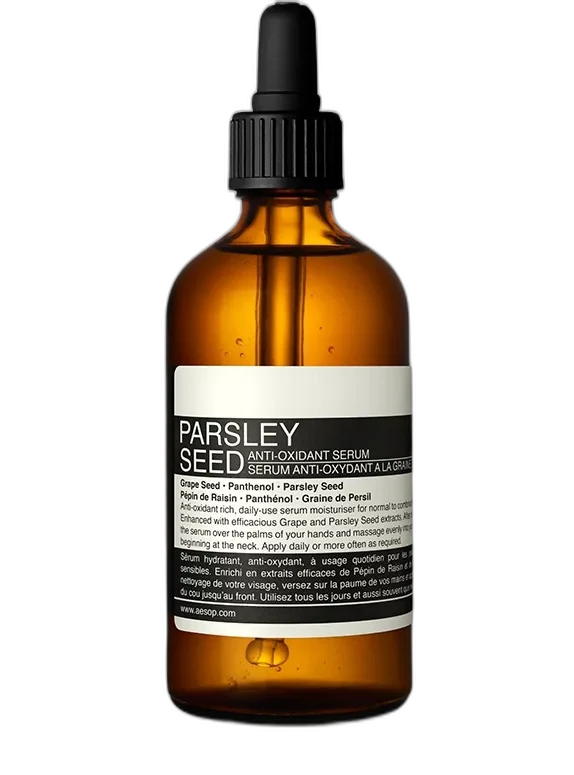
Parsley Seed Anti-Oxidant Serum
The Botanical Antioxidant
 Verified reviewer
Pros & cons.
- +Lightweight, fast-absorbing watery texture
- +Aloe-forward base feels gentle and non-stripping
- +Polyphenol antioxidants from green tea and grape seed have real evidence
- +Pleasant, distinctive herbal scent
- +Layers cleanly under moisturizer and sunscreen
- +Non-greasy daily wear suits combination and oily skin
- +Long-running formula with consistent reformulation discipline
- +Pregnancy-friendly active profile
- −Lavender oil and allergens make it risky for sensitive skin
- −Premium price for what is fundamentally a botanical hydration step
- −No headline active concentration to drive dramatic visible results
- −Functionally similar to much cheaper aloe-and-panthenol serums
- −Easily confused with the newer Parsley Seed Intense Serum
The full review.
How to Use
Cleanse and tone first, then press two to three pumps into damp face and neck skin. Damp skin helps humectant ingredients pull water more effectively. Wait thirty seconds for the serum to absorb, then apply moisturizer and, in the morning, sunscreen. Use morning and evening; consistency beats aggressive layering. The 100 ml bottle lasts three to four months with twice-daily use. Finish within twelve months of opening to keep the herbal extracts fresh.
Who Should Buy
If you have combination or oily skin, tolerate fragrance, and have the budget and temperament for the Aesop experience, this is a defensible purchase. For others, better-targeted options exist at every price point.
Texture
What it is: a watery, aloe-based daily hydrating layer with a polyphenol antioxidant cast and a strong botanical identity. The herbal scent hits as soon as you open the bottle. It feels like a thicker water in your palm—slightly slick from the aloe and the polysorbate emulsifiers, completely clear, with no oil sheen or residue after absorption.
Scent
Fragrance creates the same Aesop tension found throughout the line. Lavender oil, ormenis oil, and the disclosed allergens—linalool, limonene, geraniol—sit at the bottom of the formula.
Common Praise
The texture and feel satisfy. It applies as a watery liquid, sinks in within seconds, and leaves a finish that works with any routine. It is not tacky, shiny, or difficult to layer. Combination and oily skin types especially like it because the formula does not feel heavy or interfere with subsequent steps. The aloe and panthenol provide noticeable surface plumpness that softens mild dehydration without adding weight.
Not ideal for
Avoid this serum if your face skin flushes easily, has a history of perioral dermatitis, or reacts to lavender.
Ingredient analysis.
Full INCI list
Aloe Barbadensis Leaf Juice, Water (Aqua), Polysorbate 80, Sorbitol, PEG-150 Distearate, Polysorbate 20, Benzyl Alcohol, Phenoxyethanol, Lavandula Angustifolia (Lavender) Oil, Panthenol, Disodium EDTA, Citric Acid, Sodium Citrate, Camellia Sinensis Leaf Extract, Dehydroacetic Acid, Ormenis Multicaulis Oil, Vitis Vinifera (Grape) Seed Extract, Carum Petroselinum (Parsley) Seed Oil, Linalool, Limonene, Geraniol.
Skin match.
The science.
The Science
Two well-studied plant polyphenols form this serum's antioxidant backbone: green tea extract and grape seed extract. Green tea contains catechin polyphenols, specifically epigallocatechin gallate (EGCG). Published work shows topical green tea extract reduces UV-induced free radical generation and provides photoprotective effects when used with sunscreen, benefiting both acute UV-induced erythema and long-term photoaging markers. Topical EGCG also has anti-inflammatory activity, which calms and protects the skin. Grape seed extract provides oligomeric proanthocyanidins (OPCs), a polyphenol antioxidant class with documented free-radical scavenging activity. Cosmetic chemistry literature establishes both ingredients as topical antioxidants. They work synergistically; combining different antioxidant mechanisms provides broader-spectrum protection than a single antioxidant alone. Aloe vera leaf juice (the primary base ingredient), sorbitol (a humectant), and panthenol (provitamin B5) provide hydration. Aloe vera provides polysaccharide-driven humectant activity and mild anti-inflammatory traditional-use claims; published work supports modest improvements in surface hydration and barrier comfort. Sorbitol is a small-molecule humectant that works like glycerin to draw water into the upper stratum corneum. Panthenol has evidence as a humectant and barrier support agent at concentrations between 1 and 5 percent, showing documented improvements in skin hydration and a soothing effect that offsets the witch hazel and surfactant load in some companion products. The parsley seed oil — the namesake ingredient — has limited published research as a topical active and exists mainly for botanical identity and scent. The essential oil components (lavender, ormenis, and the disclosed fragrance allergens) provide aromatic identity and minor anti-inflammatory traditional-use claims, but they are the primary contact-sensitization risk for fragrance-reactive users. This formulation is a gentle daily hydration layer with a credible but modest polyphenol antioxidant contribution — a thoughtful botanical defense layer rather than a modern treatment serum.
Dermatologist Perspective
Dermatologists view polyphenol-based antioxidant serums as a reasonable supplementary layer, especially when paired with daily sunscreen. Board-certified dermatologists note that topical antioxidants like green tea and grape seed extracts have published evidence for photoprotective benefits and complement broad-spectrum SPF, but they do not replace sun protection. The standard dermatologic caveat for this specific product is the essential oil profile: dermatologists flag formulas with lavender oil and the disclosed fragrance allergens as suboptimal for patients with rosacea, eczema, or known fragrance reactivity. For sensitive patients, dermatologists typically recommend a fragrance-free antioxidant serum — vitamin C-based or polyphenol-based — instead. As a non-active, non-exfoliating product, this serum is compatible with most prescription routines and does not interfere with retinoid or AHA therapy applied subsequently.
Where it fits in your routine.
Cleanse and tone first. Dispense a small amount (roughly two to three pumps' worth, or a hazelnut-sized amount) into clean palms. Press it into damp face and neck skin. Wait 30 seconds for the serum to absorb before applying moisturizer and, in the morning, a broad-spectrum SPF 30 or higher. Use morning and evening. If you have a history of fragrance sensitivity, patch test on the inner forearm for 48 hours before first full use. Finish within twelve months of opening to minimize oxidation of the herbal extracts and essential oils.
At approximately $100 for 100 ml, the only available size, the original Parsley Seed Serum sits in the luxury price bracket. The actives — green tea extract, grape seed extract, panthenol, and aloe — are common, inexpensive ingredients. Functionally similar daily antioxidant serums exist at every lower price point, including pharmacy and mid-range options. You pay for the Aesop sensorial experience, the herbal scent, the amber bottle, and nearly two decades of texture refinement. If you treat morning skincare as a daily pleasure and tolerate fragrance, that premium works. If you optimize for dollars per active or want a treatment serum with stronger directional efficacy, the math is harder. Better options exist, including the newer Parsley Seed Intense Serum within Aesop's own catalog.
This works for people with combination, oily, or normal skin who want a gentle daily hydrating-antioxidant layer that fits into their routine. It suits those who tolerate fragrance and value the Aesop sensorial experience. The formula fits buyers who use skincare for long-term maintenance and want a botanical-first formula for daily preventive use.
Choose a fragrance-free alternative if you react to lavender or fragrance allergens. Skip this if you want a high-percentage vitamin C serum, a treatment-level antioxidant, or the niacinamide-driven Intense version. Budget shoppers can find functionally similar polyphenol serums for much less.
Product details.
All Year Certifications VeganCruelty-Free
The backstory.
The original Parsley Seed Anti-Oxidant Serum has been part of Aesop's catalog for nearly two decades and represents the brand's earlier philosophy of botanical-led formulation. It predates the more recent Parsley Seed Anti-Oxidant Intense Serum, which uses a different, more modern formula with niacinamide and additional actives. The original lives on as the gentler, more traditional sibling of the line.
About Aesop
Legacy Brand (20+ years)Aesop launched in Melbourne in 1987, and the Parsley Seed line is one of its longest-running anchor ranges. The original Parsley Seed Anti-Oxidant Serum has been in continuous distribution for nearly two decades and shows the brand's earlier, more botanically-driven formulation philosophy.
Common myths.
An antioxidant serum needs vitamin C to be effective.
Vitamin C is a well-studied topical antioxidant. Plant polyphenols, such as green tea catechins and grape seed proanthocyanidins, also show published topical antioxidant activity. This contribution is real but more diffuse.
A serum without a percentage callout isn't doing much.
Botanical extracts do not translate into percentage marketing like isolated actives. A well-formulated polyphenol serum provides meaningful antioxidant activity even without a number on the label.
FAQ.
What's the difference between the original Parsley Seed Serum and the Intense Serum?
The original uses a lighter, botanical-first formula with aloe vera, green tea, and grape seed extracts. The Intense Serum is a newer reformulation that adds niacinamide, more humectants, and a thicker texture. The two are not the same product.
Does this serum have vitamin C?
No. Green tea polyphenols (EGCG) and grape seed proanthocyanidins drive the antioxidant claim. For vitamin C, the Aesop Lucent Facial Concentrate is the better choice in the brand's range.
Is it a treatment serum?
It is not a modern treatment. It is a hydrating and antioxidant layer that supports daily skin defense instead of actively addressing pigmentation, texture, or aging. It is a daily protective layer, not a corrective treatment.
Can I use it with retinol?
Yes. The formula is gentle and has no actives that conflict with a retinoid. Most users layer the serum in the morning and a retinol product in the evening, but you can use both in one routine with a moisturizer in between.
Is it suitable for sensitive skin?
Use caution. The formula contains lavender oil, ormenis oil, and the standard fragrance-allergen trio. People with rosacea, eczema, or known fragrance sensitivity should use a fragrance-free antioxidant serum instead.
How much should I use?
Use a small amount — about the size of a hazelnut, or two to three pumps from a Cap-and-pour. Press it into clean, slightly damp skin after toner and before moisturizer. The 100 ml bottle lasts three to four months with twice-daily use.
Is it pregnancy-safe?
Yes. The active profile contains no ingredients typically restricted during pregnancy. You can use it during pregnancy and breastfeeding.
What the community says.
"Lightweight, fast-absorbing texture"
"Gentle enough for daily use"
"Pleasant herbal scent"
"Non-stripping and non-greasy"
"Layers well under moisturizer"
"Functionally similar to much cheaper aloe-and-panthenol serums"
"Lavender oil and allergens limit sensitive-skin use"
"Premium price for a non-treatment formula"
"Antioxidant claim feels modest compared to vitamin C serums at similar prices"
People also looked at.