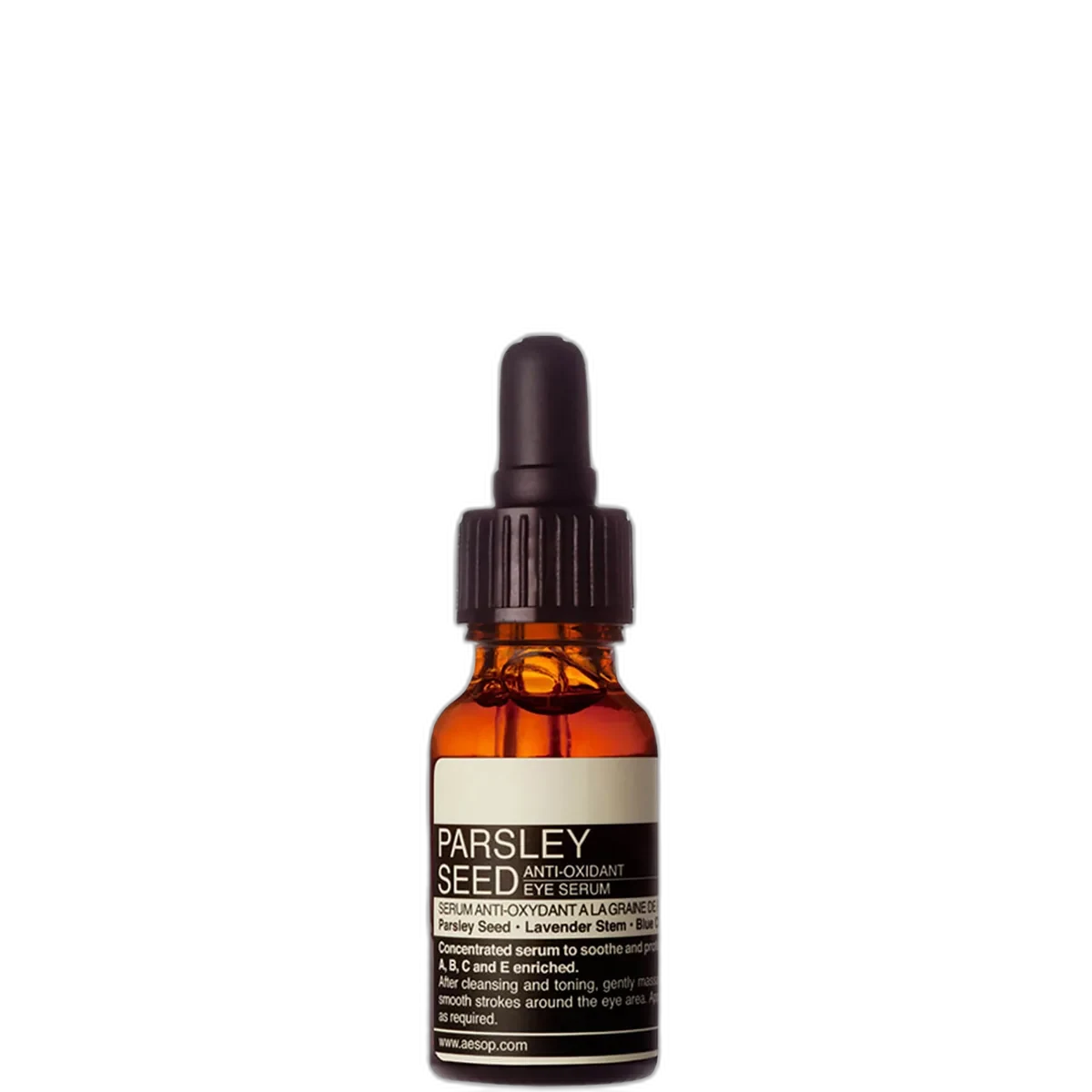
Parsley Seed Anti-Oxidant Eye Serum
The Lightweight Eye Antioxidant
 Verified reviewer
Pros & cons.
- +Genuinely lightweight, fast-absorbing texture suits combination and oily skin
- +Stable vitamin C derivative provides gentle gradual brightening
- +Layered antioxidant complex from green tea, vitamin E, and carotenoids
- +Doesn't pill under concealer or eye cream
- +Panthenol supports barrier comfort in the thin under-eye zone
- +Stable, well-protected amber dropper packaging
- +Pregnancy-friendly active profile
- −Lavender and chamomile essential oils make it risky for sensitive eyes
- −Modest, slow brightening compared to higher-percentage L-ascorbic acid serums
- −Premium price for the small 15 ml format
- −Will not address structural or vascular dark circles
- −Open dropper bottle exposes the formula to air with each use
The full review.
About Aesop
Aesop is a luxury skincare brand.
Texture
Pull a single drop from the dropper and it sits on the fingertip like a thicker water — almost watery, faintly glossy, and almost perfectly weightless. Applied along the orbital bone, it absorbs within seconds and leaves behind nothing — no residue, no tackiness, no shine.
Scent
The formula contains lavender oil, ormenis (chamomile-related) oil, chamomilla flower oil, and the standard fragrance-allergen trio of linalool, limonene, and geraniol.
Best for
For the right user, this is a quietly excellent product that does something almost no other luxury eye treatment does.
Not ideal for
For the wrong user, it’s an expensive bottle of lavender-scented disappointment. The line between those two outcomes runs straight through how your skin responds to fragrance, and you should be honest with yourself about which side of it you sit on before reaching for the dropper.
How to Use
One drop is enough for both eyes — Aesop’s instructions are accurate on that front, and overusing the product wastes it without improving results. Pat gently along the orbital bone with a clean ring finger, avoid the lash line itself, and let it absorb fully before layering eye cream or moisturizer on top.
Pairs Well With
The serum plays well underneath richer products, which makes it a useful addition to a routine that already has a heavier eye cream — you can let this layer handle the antioxidant and lightweight hydration work while a separate occlusive cream handles whatever overnight moisture barrier you need. That layered approach actually makes the serum’s lightweight format a feature rather than a limitation.
Common Complaints
A meaningful subset of users — those with rosacea, eczema, contact dermatitis history, or simply unusually sensitive eyes — will find that the serum stings on application or causes a faint tightness that doesn’t quite go away.
Common Praise
For people who have spent years dodging eye creams that pill under concealer or settle into fine lines instead of softening them, the absorption profile alone is reason enough to consider this. It’s a featherweight finish in a category that almost nobody else is serving, and that’s the genuine differentiation.
Works for
Pigmentation-driven dark circles — the kind caused by post-inflammatory melanin from years of allergic eye-rubbing or from genetic hyperpigmentation around the orbital area — will gradually soften with daily use over four to six weeks, especially when paired with diligent sunscreen on the face.
Conflicts With
Dark circles caused by structural shadowing, thin skin showing the underlying vasculature, or fat-pad displacement will not change at all, no matter how long you use this or any other topical.
AM routine
Not explicitly mentioned, but implied to be used in the morning.
PM routine
Not explicitly mentioned, but implied to be used in the evening.
Ingredient analysis.
Full INCI list
Aloe Barbadensis Leaf Juice, Water (Aqua), PEG-40 Hydrogenated Castor Oil, Hamamelis Virginiana (Witch Hazel) Water, Magnesium Ascorbyl Phosphate, PEG-150 Distearate, Polysorbate 20, Phenoxyethanol, Benzyl Alcohol, Ethylhexylglycerin, Glycine Soja (Soybean) Oil, Lavandula Angustifolia (Lavender) Oil, Sorbitol, Panthenol, Disodium EDTA, Camellia Sinensis Leaf Extract, Ormenis Multicaulis Oil, Sodium Citrate, Chamomilla Recutita (Matricaria) Flower Oil, Tropolone, Carum Petroselinum (Parsley) Seed Oil, Daucus Carota Sativa (Carrot) Root Extract, Citric Acid, Benzoic Acid, Beta-Carotene, Tocopherol, Linalool, D-Limonene, Geraniol.
Skin match.
The science.
The Science
Magnesium ascorbyl phosphate (MAP) drives this serum's brightening and antioxidant effects. This phosphorylated, water-soluble ascorbic acid derivative stays stable at near-neutral pH. On the skin, enzymes convert MAP to active vitamin C, which supports collagen synthesis and inhibits tyrosinase to gradually depigment skin. A small clinical study in the Journal of Dermatological Science showed visible melasma improvement after several weeks of consistent use. In-vitro studies also show MAP has antioxidant capacity comparable to ascorbic acid at higher concentrations. The under-eye area suits a derivative-based vitamin C because this region cannot tolerate the low pH and stinging caused by pure ascorbic acid. Green tea polyphenols, tocopherol, beta-carotene, and carrot root extract provide a redundant antioxidant defense. Studies show green tea catechins, specifically EGCG, scavenge UV-induced free radicals and work synergistically with vitamin C in topical formulations. Tocopherol regenerates oxidized vitamin C and adds lipid-soluble antioxidant activity to this water-dominant formula. Panthenol, the provitamin B5 found halfway down the INCI, acts as a humectant and barrier support agent at 1 to 5 percent concentrations; it improves skin hydration and soothes the witch hazel and surfactant load. Lavender, chamomile, and ormenis essential oils provide aroma and minor anti-inflammatory traditional-use claims, but they also cause the formula's allergen disclosures. Limonene and linalool have documented contact sensitization potential when oxidized, so eye-area products with these components require caution in patients with fragrance-reactive histories.
Dermatologist Perspective
Dermatologists view magnesium ascorbyl phosphate as a good vitamin C choice for the periorbital area, where the harshness of L-ascorbic acid is rarely tolerated. Board-certified dermatologists often recommend stable C derivatives to patients wanting gradual brightening of mild post-inflammatory pigmentation around the eyes. The main caveat for this specific product is the essential oil profile. Dermatologists flag formulas with lavender oil, limonene, and linalool as suboptimal for patients with periocular dermatitis, rosacea, or known fragrance allergies, as the under-eye area is unforgiving of cumulative irritation. Dermatologists typically suggest a fragrance-free vitamin C eye treatment for sensitive patients. Daily facial sunscreen is essential for any vitamin C derivative to show pigmentation benefits. Dermatologic guidance also notes that no topical treatment addresses structural or vascular dark circles; those require in-office interventions or acceptance.
Where it fits in your routine.
Apply 1 drop morning and evening after cleansing and treatment serums. Pat gently along the orbital bone with a clean ring finger; do not rub or drag the skin. Keep the application a few millimeters from the lash line to reduce irritation from the essential oils. Let the serum absorb fully (about 30-60 seconds) before applying eye cream, moisturizer, or makeup. If you have fragrance sensitivity or periocular dermatitis, patch test on the inner forearm or jawline for 48 hours before first full use. Use within twelve months of opening.
At approximately $66 for 15 ml, the only available size, the serum costs as much as luxury eye treatments. The actives — magnesium ascorbyl phosphate, panthenol, green tea extract, tocopherol — are common and inexpensive. Pharmacy alternatives with similar functional profiles cost under $25. You pay for the texture refinement, the lightweight format that almost no other prestige eye treatment matches, and the Aesop ritual. For an oily or combination skin user frustrated by every rich eye cream, this premium makes sense. For someone optimizing ingredient dollars or seeking a fragrance-free option, the math is harder to justify.
People with combination, oily, or normal skin want a featherweight eye treatment that does not pill, feel heavy, or disrupt concealer in the morning. It also works as a strong supplementary layer for anyone using an existing eye cream that is rich enough to require a separate antioxidant step underneath.
Choose a fragrance-free alternative if you have rosacea, eczema, periocular dermatitis, or confirmed fragrance allergies. Skip it if your dark circles are structural or vascular instead of pigmentation-driven, or if you need a thick, occlusive eye cream for genuinely dry under-eye skin.
Product details.
Fluid, almost watery serum with a faint herbal cast.
The essential oil blend has light parsley and chamomile herbal notes and warm lavender.
Small amber glass bottle with dropper and signature Aesop typography. The dropper allows precise dosing for the eye area but exposes the formula to air during use.
First application is cool and almost weightless — the watery texture sinks in within seconds. Most users feel an immediate light hydration but no dramatic plumping. Some report a brief tingle near the lash line from the essential oils, which usually settles within a minute.
Approximately 4-5 months with twice-daily use on the under-eye area.
12 months
All Year
The backstory.
The Parsley Seed Anti-Oxidant Eye Serum sits within Aesop's longest-running treatment line, which has been part of the brand's identity for nearly two decades. It was developed at a time when antioxidant skincare was just becoming a mainstream conversation, and it has remained essentially unchanged because the format — a featherweight serum for the eye area — still has surprisingly few luxury competitors today.
About Aesop
Legacy Brand (20+ years)Aesop launched in Melbourne in 1987, and the Parsley Seed line is one of its longest-running anchors. The Anti-Oxidant Eye Serum has been in continuous distribution for nearly two decades. Its global retailer presence and stable formulation maintain its credibility in the prestige eye-care segment.
Common myths.
Eye serums need to feel rich to work.
The under-eye area needs consistent humectant and antioxidant delivery more than heavy occlusion. A well-formulated lightweight serum like this one outperforms thick creams for oily and combination skin types with adequate natural barriers.
Vitamin C in eye products causes irritation.
L-ascorbic acid often irritates the eye area. Stable derivatives like magnesium ascorbyl phosphate brighten skin without the low-pH sting.
FAQ.
What's the difference between Aesop's Parsley Seed Eye Serum and Eye Cream?
The serum is a lightweight, water-based formula using magnesium ascorbyl phosphate and antioxidants. The cream is thicker and more emollient to hydrate and comfort the barrier. Oily and combination skin types prefer the serum; drier eye areas use the cream.
Does this serum help with dark circles?
The magnesium ascorbyl phosphate and polyphenol antioxidants subtly brighten pigmentation-driven dark circles. It does not affect dark circles from structural shadowing or visible vasculature. Use daily for 4-6 weeks to see changes.
Is it safe to use under the eye?
The formula targets the orbital area, but includes lavender oil, chamomile oil, and standard fragrance allergens. Apply it along the orbital bone instead of directly on the lash line. Patch test for 48 hours if you have a history of contact sensitivity.
Can I use this with retinol?
Yes, with care. Use the serum in the morning and a retinoid eye cream at night to keep them in separate routines. The vitamin C derivative is gentle enough to avoid compounding retinoid irritation, but spacing them out reduces cumulative sensitivity.
How much should I use?
One drop covers both eyes. Pat gently with a clean ring finger along the orbital bone; do not rub or pull the skin. The 15 ml bottle lasts about four to five months using it twice daily.
Will it work under makeup?
Yes. The lightweight, fast-absorbing texture is a strength — it sinks in within a minute and does not pill under concealer or eye cream. Let it dry fully before applying anything on top.
Is it pregnancy-safe?
The active profile contains no ingredients typically restricted during pregnancy. You can use it during pregnancy and breastfeeding, but patch test if your skin is more reactive.
What the community says.
"Lightweight, fast-absorbing texture"
"Doesn't pill under concealer"
"Pleasant herbal scent"
"Subtle brightening over time"
"Works well for oily and combination skin"
"Lavender oil and other essentials can sting near the lash line"
"Pricey for the small 15 ml size"
"Brightening effects are gradual and modest"
"Not ideal for true sensitive skin around the eyes"
People also looked at.