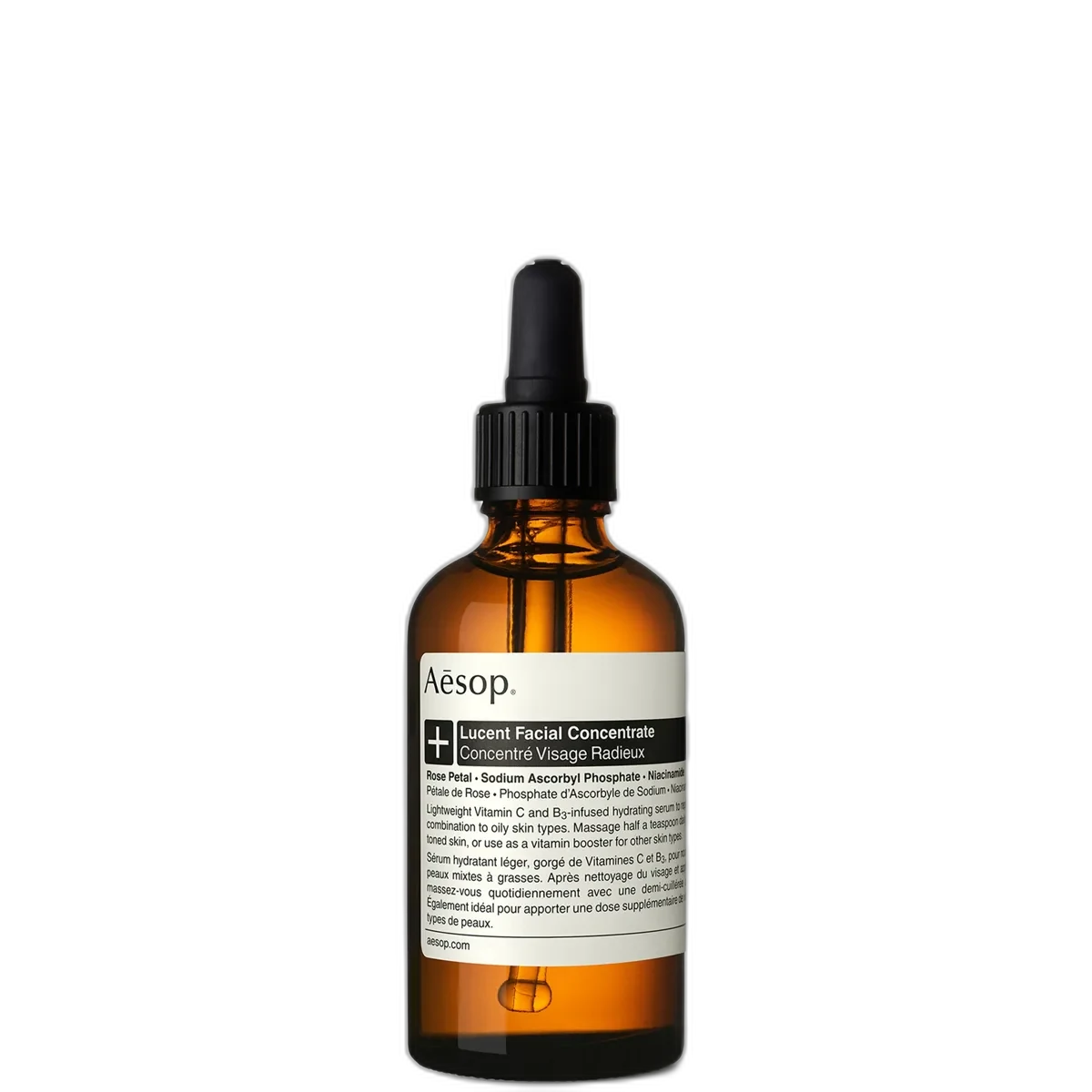
Lucent Facial Concentrate
The Polite Vitamin C
 Verified reviewer
Pros & cons.
- +Genuinely gentle vitamin C suitable for reactive skin types
- +Niacinamide and SAP combination supports tone and barrier
- +Watery, fast-absorbing texture layers cleanly under SPF
- +Calms visible redness without stinging or flushing
- +Iconic, mood-lifting rose and frankincense scent profile
- +Glycerin-rich vehicle adds noticeable surface hydration
- +Pregnancy-friendly active profile
- +Consistent decade-long track record across global retailers
- −Luxury price for a derivative-based vitamin C formula
- −Essential oils and allergens make it unsafe for fragrance-reactive users
- −Dropper bottle exposes formula to air with each use
- −Pigmentation results are slow compared to L-ascorbic acid
- −Not fungal-acne safe due to PEG and botanical oils
The full review.
Most luxury vitamin C serums announce themselves with a number — twenty percent ascorbic acid, fifteen percent, ten — as if the percentage alone were proof of seriousness. Aesop’s Lucent Facial Concentrate goes the other way. There is no headline percentage on the label, no mention of clinical strength, no race-to-the-top messaging. Instead, there is a watery serum in an amber glass bottle that smells like a Melbourne florist, and a quiet little ingredient list that suggests the brand spent more time worrying about who was going to use this than about how to win an INCI shootout.
That restraint turns out to be the most interesting thing about Lucent. The vitamin C here is sodium ascorbyl phosphate, the friendlier, water-soluble cousin of L-ascorbic acid. It is less potent on paper, slower to act, and far better tolerated by skin that throws a tantrum at the first sign of a low pH. Aesop pairs it with niacinamide — yes, the very combination that internet myth said you couldn’t use together, and yes, that myth has been thoroughly debunked. In Lucent’s formulation the two work in tandem: the niacinamide handles tone, redness, and barrier reinforcement, and the C derivative gradually contributes its own brightening and antioxidant support. It’s an unfashionable approach in a category that loves a percentage, and it works precisely because it doesn’t try to do too much.
The texture is the next pleasant surprise. Despite the name suggesting something dense, Lucent is essentially a slightly-thickened water. It goes on cool, absorbs in seconds, and leaves behind a finish so flat that you can layer it under a mineral sunscreen without any of the usual pilling drama. Glycerin sits second on the ingredient list, which is unusually generous for a treatment serum, and you feel its presence in the soft, slightly plumped surface that emerges within a minute of application. There is no tackiness, no shine, no waiting around for it to settle in. For oily and combination skin types who have spent years dodging vitamin C serums that left them either greasy or stripped, this is almost suspiciously easy to wear.
And then there is the smell, which is half the reason anyone owns an Aesop product in the first place. Rose damascena leads, frankincense warms the back of it, and a thread of Australian sandalwood ties the whole thing together. It is unmistakable, occasionally polarizing, and entirely intentional. If you are scent-reactive, this serum is not for you, and the pile of essential-oil-derived allergens at the bottom of the INCI — limonene, citronellol, geraniol, farnesol — should make you cautious. If you are not scent-reactive, applying Lucent feels less like a chore and more like the small, slightly indulgent moment in your morning that keeps you doing your routine. There’s a real argument that the smell of a product is a feature, not a bug, when it makes you reach for it daily.
Performance lands roughly where the formulation predicts. Within the first week, most people notice a gentle radiance and a softening of the kind of dehydration lines that show up after a long flight or a cold week. By the second or third week, redness around the nose calms down a touch, and the skin looks more even when you compare a bare-faced selfie now to one from before. The serious pigmentation work — true dark spots, post-acne marks, the stubborn melasma shadow on the upper cheek — moves on its own slower clock. Expect eight to twelve weeks of consistent daily use, with religious sunscreen, before you can confidently say it has done anything for those.
Which brings us to the price, and the part where any honest review has to slow down. One hundred and twenty-five dollars for sixty milliliters of a sodium ascorbyl phosphate serum is a lot of money. It is, frankly, several times more than what the actives alone command in less perfumed packaging. You can find competent niacinamide-and-C-derivative serums for under thirty dollars at any pharmacy. What you are paying for, then, is a combination of three things: a meaningfully gentle formulation that the brand has tuned over years, a sensorial experience that very few mass-market serums attempt, and the design language of Aesop itself. Whether those add up to a hundred-dollar difference depends entirely on how you treat your morning routine. If you want maximum percent for minimum dollar, this isn’t the play. If you want the serum that you’ll actually use every day for two years because the bottle on your sink makes you happy to look at, the math shifts.
Where Lucent does deserve unambiguous credit is in tolerability. This is one of the few brightening serums you can recommend to someone with rosacea-prone or genuinely reactive skin without a long list of caveats — provided they can tolerate fragrance, which is the one non-negotiable. The bisabolol inclusion is a small detail that signals Aesop knew exactly who would be drawn to a luxury vitamin C, and built the formula to behave for them. There is no sting, no flush, no morning-after irritation, even on consecutive days. For a category that often demands a pain tolerance from its users, that is a quietly significant achievement.
The limitations are real and worth naming. The dropper-bottle format exposes the formula to air every time you use it, and although the amber glass protects against light, oxidation will eventually creep in if you keep the bottle for longer than four months. The pigmentation results are gentle by design and will frustrate anyone hoping for the dramatic clearing that a 15 percent L-ascorbic acid serum can sometimes deliver. And the price will always be a barrier for anyone who doesn’t already buy into the broader Aesop universe. None of these are dealbreakers — they are simply the trade-offs you accept when you choose this particular bottle over a dozen cheaper, less interesting ones.
What Lucent ultimately is, ten years into its life, is an unusually mature product in a category obsessed with novelty. It does the same thing it did in 2016, in roughly the same bottle, for roughly the same kind of person — and that consistency is its quiet argument for itself.
Ingredient analysis.
Full INCI list
Water (Aqua), Glycerin, Sodium Ascorbyl Phosphate, Niacinamide, PEG-40 Hydrogenated Castor Oil, Citric Acid, Xanthan Gum, Sodium Gluconate, 1,2-Hexanediol, Caprylyl Glycol, Sodium Dehydroacetate, Maltodextrin, Bisabolol, Polysorbate 20, Boswellia Carterii Oil, Fusanus Spicatus Wood Oil, Rosa Damascena Flower Oil, Biosaccharide Gum-1, Phenoxyethanol, Sodium Carrageenan, Sea Salt (Maris Sal), Limonene, Citronellol, Geraniol, Farnesol.
Skin match.
The science.
The Science
Lucent pairs sodium ascorbyl phosphate (SAP) with niacinamide. This combination serves as a gentler alternative to traditional L-ascorbic acid serums. SAP is a phosphorylated, water-soluble vitamin C precursor. It stays stable at near-neutral pH, so formulas like this one avoid the burning or oxidation issues common with pure ascorbic acid. Once on the skin, enzymes convert SAP to active ascorbic acid to support collagen synthesis and antioxidant defense. This conversion is slower and less complete than applying L-ascorbic acid directly, meaning SAP-based serums work more gradually but cause less irritation. Research on SAP specifically examines acne and pigmentation: a Journal of Cosmetic Dermatology study on a 5 percent SAP lotion showed fewer inflammatory acne lesions after twelve weeks. In-vitro work also shows SAP brightens skin by interfering with melanin production. Niacinamide has more evidence; randomized trials show concentrations between 2 and 5 percent reduce hyperpigmentation, support ceramide synthesis, and improve barrier function. Lucent explicitly combines these two ingredients. Old skincare folklore claimed vitamin C and niacinamide cancel each other out, but that claim stems from outdated experiments with unstable ingredients and fails under modern scrutiny of stabilized formulations. Combining a gentle C derivative with a well-tolerated dose of niacinamide is a low-risk way to provide antioxidant and tone-evening support without harsh side effects. The rest of the formula uses glycerin for surface hydration, bisabolol for calming, and three botanical oils for scent and minor anti-inflammatory effects. This matches Aesop's philosophy of using small, supportive doses of well-tolerated ingredients instead of high-intensity single actives.
Dermatologist Perspective
Dermatologists see sodium ascorbyl phosphate as a good choice for patients who cannot tolerate the low pH of L-ascorbic acid serums, especially those with rosacea, sensitive skin, or flushing tendencies. Board-certified dermatologists often note that the best vitamin C serum is the one a patient uses consistently; Lucent's tolerability makes this easier than many higher-percentage options. Pairing it with niacinamide is a common recommendation for patients with post-inflammatory hyperpigmentation because both ingredients target different stages of the pigmentation pathway. Dermatologists note that essential oils, even at low concentrations, can cause contact sensitization in some patients. Lucent's fragrance-allergen profile makes it unsuitable for those with confirmed fragrance allergies. As with all brightening serums, dermatologic guidance states that daily sunscreen is required to see any pigmentation benefit.
Where it fits in your routine.
Apply 3 to 5 drops to clean, slightly damp skin in the morning and evening. Press into the face and neck rather than rubbing, then follow with moisturizer and, in the morning, a broad-spectrum SPF 30 or higher. The serum can be used twice daily from the start; no acclimation period is needed for most users. Store the bottle away from direct light and, ideally, finish it within four to five months of opening to minimize oxidation. It can be layered with hyaluronic acid serums underneath and ceramide moisturizers over the top, and is compatible with a separate retinoid step in the evening when buffered with a moisturizer.
At $125 for 60 ml, Lucent is a luxury product. The math is harder than for many derm-developed competitors. You can find the actives — sodium ascorbyl phosphate and niacinamide — in well-formulated drugstore serums for a tenth of the price. People optimizing strictly for ingredient cost should look elsewhere. Beyond the formulation, you pay for the sensorial experience and Aesop's decades of refining how a serum feels and smells on the skin. That premium works for someone who treats their morning routine as a small ritual. It does not work for someone who wants the strongest possible brightening result per dollar. Lucent earns its price on tolerability and experience, not on raw potency.
This serum works for normal, combination, or oily skin types seeking daily brightening without stinging, flushing, or pilling under sunscreen. It suits those who value the Aesop sensorial experience. It is a strong choice for sensitive skin types who want a gentler entry point into vitamin C after reacting to L-ascorbic acid serums.
Skip this if you react to fragrance or essential oils, manage fungal acne or seborrheic dermatitis, or prefer derivative-based formulas under thirty dollars over hundred-dollar serums. Skip it if you want fast, dramatic dark-spot fading — a higher-percentage L-ascorbic acid serum works faster.
Product details.
All Year
The backstory.
Lucent launched in September 2016 as Aesop's answer to the brightening serum boom, and it has remained one of the brand's top-ranked skin products ever since. The formula reflects Aesop's house philosophy: borrow the actives that have earned their evidence, dress them in the brand's botanical signature, and resist the temptation to chase the highest possible percentages.
About Aesop
Legacy Brand (20+ years)Aesop launched in Melbourne in 1987. It has nearly four decades of formulation experience and a botanically-leaning portfolio that major dermatology-adjacent retailers stock and independently review. Aesop is not a clinical or derm-developed brand, but its longevity and consistent formulation standards give it credibility in the prestige skincare segment.
Common myths.
Sodium ascorbyl phosphate doesn't really work as vitamin C.
It has less potency than pure L-ascorbic acid but converts to active ascorbic acid on the skin. Published evidence shows modest brightening and antioxidant effects, especially when used with niacinamide like in this formula.
You can't use vitamin C and niacinamide together.
That myth stems from old research using non-stabilized ingredients in unrealistic conditions. Modern formulas like Lucent combine both without losing efficacy.
FAQ.
Is Aesop Lucent Facial Concentrate worth the price?
Value depends on your priorities. The formula uses niacinamide and a stabilized vitamin C derivative, and you pay for the sensorial experience. If you only care about active percentages and efficacy, similar derivative-based serums cost under $30.
Can I use Lucent with retinol?
Yes. Sodium ascorbyl phosphate is gentler than L-ascorbic acid, so pH conflicts are not a concern. Most users layer Lucent in the morning and a retinoid at night, but you can use both in one routine if you use a moisturizer in between.
Does Aesop Lucent help with dark spots?
The niacinamide and vitamin C derivative combination gradually softens pigmentation, but it is not a fast-acting brightener. Use it daily with SPF for 8-12 weeks to see visible change.
Is this serum suitable for sensitive skin?
It is gentler than most vitamin C serums, but it contains rose, frankincense, and sandalwood essential oils plus limonene, citronellol, geraniol, and farnesol. Fragrance-reactive skin should look elsewhere.
***
How many drops should I use?
Aesop recommends massaging 3-5 drops into clean, slightly damp skin. The 60 ml bottle lasts roughly three to four months if used twice daily.
Is Aesop Lucent fungal acne safe?
No. The formula contains PEG-40 hydrogenated castor oil, polysorbate 20, and several botanical oils that feed Malassezia. Do not use this if you manage fungal acne or seborrheic dermatitis.
***
Does Lucent contain any sunscreen?
No. This treatment serum requires a daily broad-spectrum sunscreen. Its vitamin C derivative needs sun protection to provide pigmentation benefits.
***
Community
What the community says.
"Lightweight, non-tacky finish that layers under makeup"
"Calms redness without stinging"
"Iconic rose-frankincense scent"
"Visible glow within the first week"
"Gentle enough for daily use"
"Eye-watering price for a derivative-based vitamin C"
"Glass dropper bottle is heavy and prone to oxidation if left in light"
"Scent is polarizing for fragrance-sensitive users"
"Modest pigmentation results compared to L-ascorbic acid serums"
People also looked at.