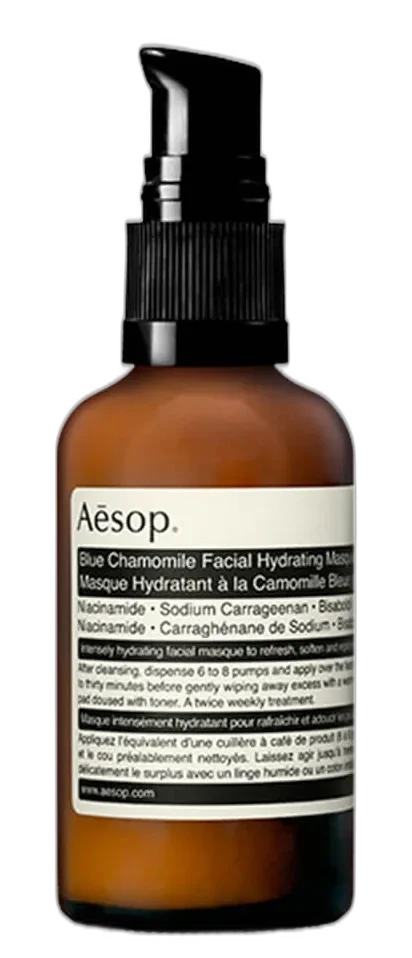
Blue Chamomile Facial Hydrating Masque
Luxury Hydrating Clay Mask
 Verified reviewer
Pros & cons.
- +Blue chamomile delivers genuine chamazulene-based soothing effect
- +Balanced formulation hydrates while the clays absorb
- +Creamy texture and distinctive blue color elevate the ritual
- +Panthenol and allantoin reinforce the calming profile
- +Aesop's signature scent creates a spa-like experience at home
- +Vegan and Leaping Bunny certified
- +Non-stripping finish suits combination and dry skin
- −$70 for 60ml significantly pricier than functional equivalents
- −Essential oil blend excludes sensitive and rosacea-prone users
- −Not fungal-acne safe due to esters and botanical oils
- −Jar packaging less hygienic than a tube or pump
- −Small size runs out quickly with weekly use
The full review.
Twist open the jar of Aesop’s Blue Chamomile Masque and the first thing you notice isn’t the smell — it’s the color. A pale, dusky blue-gray that looks more like an artist’s pigment than a skincare product. That color is not dye, not marketing, not Aesop being aesthetic for aesthetic’s sake. It’s chamazulene, a compound formed during the steam distillation of German chamomile flowers, and it’s the natural blue pigment of Matricaria recutita essential oil. Chamazulene also happens to have documented anti-inflammatory properties, which is why this masque has built its cult following: the visual cue and the functional ingredient are the same thing. It’s the rare case where the color of a skincare product actually means something.
The rest of the formula is built to support and not undermine that chamomile foundation. Where most clay masks make the mistake of leading with pure bentonite and kaolin and calling it a day — producing that squeaky-tight, almost-painful post-rinse feel that belongs in a 1990s skincare ad — this one puts glycerin and butylene glycol high on the ingredient list alongside the clays, then adds panthenol, allantoin, and hydrolyzed wheat protein to cushion the experience. The result is a clay mask that actually hydrates while it absorbs, a genuinely useful concept for combination skin that wants the cleansing effect without the barrier stripping. Dry skin users tend to find it comfortable rather than drying; oily skin users get the oil-balancing benefit without the rebound production that comes from over-stripping.
The sensory experience is where Aesop really earns its price. The texture is creamy and medium-thick, spreads smoothly, and settles into a satin finish rather than a chalky crack. The scent is the distinctive Aesop aromatic blend pushed in a spa-like direction — blue chamomile, lavender, cedar, sandalwood, and fragrance components combine into something that smells like a very expensive wellness retreat. For the 10-15 minutes you’re wearing it, your bathroom becomes a small, quiet, smells-like-herbs ritual. Skin comes off the mask visibly calmer, softer, and noticeably less red if you started the session with any reactivity or flushing. This is the kind of immediate visual payoff that justifies why people keep buying luxury masks despite the markup.
The limits of the formula are the essential oils themselves. Lavender, cedar, and sandalwood oils all contain known fragrance allergens — linalool, limonene, and geraniol are disclosed openly on the ingredient list because EU labeling requires it — and for users with reactive skin, rosacea, eczema, or compromised barrier, these are the exact ingredients to avoid. Blue chamomile itself is among the gentler essential oils and has genuine anti-inflammatory credentials, but the supporting cast is more complicated. Anyone who’s reacted to an aromatherapy product before should patch test on the jawline for 48 hours before committing to a full-face application. And fungal-acne-prone users should skip it entirely, since essential oils plus fatty esters are not a Malassezia-friendly combination.
Performance over repeated use is predictable. Used once or twice a week, skin looks gradually smoother, more even-toned, and less congested without the barrier fatigue that aggressive weekly clay masks can cause. Used too frequently, even this gentler formula can start to disrupt the barrier, so resist the temptation to use it as a daily habit. Results peak in the 10-15 minute wear window — there’s no benefit to leaving the masque on longer than that, and in fact leaving it until it’s fully dry defeats the hydration-friendly formulation logic. Rinse it off while it still has some softness to it, and skin will feel conditioned rather than stripped.
The price is the usual Aesop conversation. $70 for 60ml of clay masque is a lot of money in absolute terms. The same functional profile — a hydration-forward clay mask with botanical soothing — exists at brands like Origins, Kiehl’s, and Herbivore for $30-50, and at drugstore brands like The Body Shop for under $20. What Aesop offers that those don’t is the total sensory package: the amber glass jar, the botanical aroma, the spa-like ritual, the specific chamazulene credential that ties the color to the function. If that package is why you bought it, the price is reasonable in context. If you’re evaluating on pure ingredient-to-dollar efficiency, you’ll find better options elsewhere.
For combination, normal, and slightly oily skin that enjoys a weekly ritual and doesn’t react to essential oils, this is a sensory upgrade that delivers real calming benefits alongside the aesthetics. For reactive, sensitive, or barrier-compromised skin, the essential oil content is too much of a risk regardless of how lovely the chamomile story is. As with most Aesop products, you’re buying a complete experience more than a maximally optimized formula — which is fine as long as you go in knowing exactly what that trade looks like.
Ingredient analysis.
Full INCI list
Water (Aqua), Glycerin, Butylene Glycol, Bentonite, Kaolin, Panthenol, Allantoin, Hydrolyzed Wheat Protein, Sodium PCA, Aloe Barbadensis Leaf Juice, Chamomilla Recutita (Matricaria) Flower Oil, Chamomilla Recutita (Matricaria) Flower Extract, Lavandula Angustifolia (Lavender) Oil, Cedrus Atlantica Bark Oil, Santalum Album (Sandalwood) Oil, Tocopherol, Xanthan Gum, Sodium Hydroxide, Fragrance (Parfum), Linalool, Limonene, Geraniol, Phenoxyethanol, Ethylhexylglycerin.
Skin match.
The science.
The Science
Chamazulene is the formulation's strongest technical credential. This deep blue sesquiterpene compound forms during steam distillation of Matricaria recutita flowers. Research in journals like Phytomedicine and Phytotherapy Research shows chamazulene has anti-inflammatory effects in topical applications, mainly by inhibiting cyclooxygenase and leukotriene pathways. This is not marketing: blue chamomile oil has a real, modest anti-inflammatory mechanism, making its inclusion in a masque for calming reactive skin technically sound.
The clay-humectant balance is the second interesting element. Bentonite and kaolin are naturally absorbent clays that bind surface oil and impurities through ion exchange and physical adhesion. Alone, they can over-dry the skin by pulling moisture and oil from the stratum corneum. The inclusion of glycerin (second on the ingredient list), butylene glycol, panthenol, aloe, and sodium PCA — all high-quality humectants — counteracts this drying effect by drawing water into the skin during the 10-15 minute contact window. This dual-action approach is well-established in modern mask formulation but remains rare in the luxury category, where many brands use old-school clay-heavy formulas.
The essential oil supporting cast makes the science more complicated. Lavender oil contains linalool and linalyl acetate, both known fragrance allergens with documented sensitization potential in repeated-exposure studies. Cedarwood and sandalwood oils contribute terpenes that can be photosensitizing at higher concentrations. Together, these oils create the masque's sensory and aromatic profile but increase the irritation risk for reactive users. The concentration of each essential oil is likely low enough for most users to tolerate, but the cumulative effect can be significant for those with pre-existing sensitivity.
Dermatologist Perspective
Dermatologists generally view hydrating clay masks as a reasonable occasional treatment for combination and oily skin, though most recommend fragrance-free options for patients with reactive conditions. Board-certified dermatologists note that blue chamomile oil has genuine anti-inflammatory properties, but they caution that the benefit is meaningful only if the formula lacks other irritants. For patients with rosacea, eczema, or sensitive skin, dermatologists usually suggest clay masks without essential oils — brands like Avène or La Roche-Posay often replace Aesop in those recommendations. This masque is not a standard clinical protocol; it is a patient-chosen aesthetic product that dermatologists may approve for non-reactive skin types.
Where it fits in your routine.
Apply an even layer to clean, dry skin with clean fingers or a masque brush. Avoid the eye and lip areas. Leave on for 10-15 minutes. Do not let it fully dry, or the hydration-forward formulation loses effectiveness. Rinse with warm water using gentle circular motions, pat dry, and use a hydrating toner and moisturizer next. Use 1-2 times per week. Do not use on the same day as retinol, acids, or other active treatments. If you have a history of fragrance sensitivity, patch test on the jawline first.
At $70 for 60ml, this is priced firmly in the luxury mask tier, where the value proposition depends almost entirely on how much you enjoy the sensory ritual. Functionally similar hydrating clay masks from brands like Origins, Kiehl's, or Herbivore Botanicals deliver comparable soothing and balancing effects for $30-50, and drugstore options from The Body Shop or L'Oréal hit $15-25. What Aesop specifically offers is the chamazulene-forward formulation (which has real scientific basis), the signature scent profile, and the branded ritual experience. For Aesop devotees who value the sensory side, the price is defensible. For users evaluating on ingredient-to-dollar efficiency, it's a tough sell.
Normal, combination, and mildly oily skin types who enjoy a weekly sensory ritual and want a hydrating alternative to traditional clay masks. Ideal for Aesop devotees building a complete branded routine and users who respond well to blue chamomile's calming effect.
The essential oil blend makes this unsuitable for sensitive, rosacea-prone, eczema-prone, or fragrance-reactive skin. Fungal-acne-prone users should also avoid it. Shoppers seeking value can find comparable hydrating clay masks elsewhere for one-third the price.
Product details.
Blue chamomile, lavender, cedar, and sandalwood create a botanical, aromatic profile. The scent is strong on application and fades to mild after rinse-off.
Aesop's signature amber glass jar with a screw-top lid and beige label. Jar format is less hygienic than a tube but fits the brand aesthetic.
The first application feels cool and slightly tingly because of the lavender and chamomile essential oils. The masque dries to a slightly matte finish but does not feel uncomfortably tight. It rinses off easily with warm water and leaves skin soft and visibly calmer.
2-3 months with weekly use (2-3 tablespoons worth per application).
12 months
All Year
The backstory.
Aesop added the Blue Chamomile Masque to its treatment lineup as a gentler alternative to traditional purifying clay masks. The use of matricaria recutita oil for its chamazulene content and visual signature (the blue hue) reflects Aesop's preference for botanically distinctive formulations.
About Aesop
Legacy Brand (20+ years)Aesop launched in 1987 and has spent nearly four decades building a globally recognized botanical skincare brand. Its credibility comes from sensory consistency and a loyal following, not clinical trials or peer-reviewed evidence.
Common myths.
Clay masks leave skin feeling tight and squeaky-clean.
Clay mask views are outdated. Modern formulations balance absorbent clays with humectants to clean without stripping. Tight, squeaky skin shows over-drying, not effective cleansing.
Essential oils in skincare are always beneficial.
Essential oils are concentrated plant compounds. They soothe some users but irritate others. Blue chamomile is gentler than most, but lavender, cedar, and sandalwood oils contain known sensitizers.
FAQ.
Is this mask good for sensitive skin?
The answer is mixed. Blue chamomile oil and panthenol soothe skin, but the formula also contains lavender, cedar, and sandalwood essential oils plus fragrance. These ingredients can trigger reactions in sensitive or rosacea-prone skin. Patch test on the jawline before full face use.
How often should I use this masque?
Most skin types work best with one to two uses per week. Using it more often can disrupt the barrier because of the essential oil content. If your skin feels dry or irritated the next day, use it once weekly or skip a week.
Why is the masque blue?
Chamazulene, a compound in blue chamomile essential oil, creates the blue color. This is not dye; steam distillation of Matricaria recutita flowers produces this natural pigment. Chamazulene has documented anti-inflammatory effects in topical applications.
Does it actually hydrate or does it dry out the skin?
The glycerin, aloe, and panthenol high in the ingredient list hydrate more than a traditional clay mask. Skin feels softer and more supple after rinsing, not tight or stripped.
Can I use it alongside retinol or AHAs?
Yes, but not on the same day. Use the masque on days you skip active treatments to avoid cumulative irritation. This matters because the essential oil content increases sensitivity when layered with retinoids.
How does it compare to Aesop's Parsley Seed Anti-Oxidant Facial Treatment Masque?
Blue Chamomile calms and hydrates. Parsley Seed has more antioxidants and a lighter texture. Choose Blue Chamomile for soothing sensitive or combination skin; choose Parsley Seed for dullness and oxidative stress.
Community
What the community says.
"Beautiful blue color and scent experience"
"Soothes redness visibly"
"Doesn't over-dry like traditional clay masks"
"Feels luxurious and spa-like"
"Expensive for the size"
"Essential oils can bother sensitive users"
"60ml runs out quickly with regular use"
"Scent is strong for some"
People also looked at.