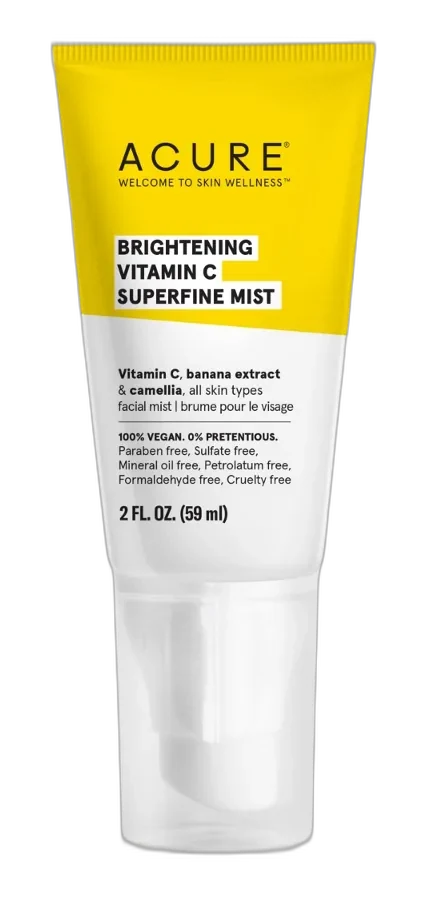
Brightening Vitamin C Superfine Mist
Daytime Refresh
 Verified reviewer
Pros & cons.
- +Glycerin at meaningful concentration provides real humectant action
- +Stable sodium ascorbyl phosphate avoids oxidation issues
- +Fine-mist nozzle delivers an even refreshing spray
- +Works well as a daytime refresh over makeup
- +Pregnancy-safe and fungal-acne-safe formulation
- +Affordable price point at $15 for 100ml
- +EWG Verified, vegan, and cruelty-free
- −Brightening contribution is essentially marketing — the format limits dose
- −Doesn't replace a real vitamin C serum for actual brightening goals
- −Plastic packaging feels less premium than glass alternatives
- −Banana scent is divisive even though it's faint
The full review.
Facial mists occupy a strange niche. Brands sell them as brightening, hydrating, or anti-aging treatments, but the format limits delivery. A mist sprays a thin, watery layer across the skin. The product volume per use is low, the active concentration stays low to prevent nozzle clogging and ensure stability, and most of the liquid evaporates quickly. For real treatment, use a serum or a moisturizer. Mists provide refresh and hydration, period.
Acure’s Brightening Vitamin C Superfine Mist accepts this reality, despite the marketing. The vitamin C is sodium ascorbyl phosphate, a water-soluble derivative that stays stable in a watery base and converts to active ascorbic acid in the skin. SAP has published evidence for mild brightening and antioxidant activity, but most studies use leave-on serum formulations at higher concentrations, not mists. In this product, SAP is a marketing layer; it justifies the “brightening” name but isn’t the reason to buy the mist.
The reason to buy the mist is the glycerin. Glycerin is second on the INCI, meaning it is at a high enough concentration to function as a humectant. Glycerin draws water into the stratum corneum and adds a slight tackiness so the mist clings to the skin instead of evaporating instantly. This distinguishes a useful hydrating mist from a spray of plain water, which can leave skin drier by accelerating evaporation. The licorice extract adds a small brightening signal via glabridin, which has modest tyrosinase-inhibiting activity, while the banana extract supports the brand’s plant-based image.
In practice, this mist works like a decent budget hydrating mist. The nozzle produces a fine, even spray rather than a harsh stream. The spray feels cooling, especially in warm weather or dry indoor air. It absorbs without visible residue or stickiness. It works as a midday refresh over makeup—spritz, press lightly, and the face looks dewier and feels less tight. As a layer between steps in a morning or evening routine, it provides a reasonable hydration boost before a serum and moisturizer.
This mist is not a substitute for a real vitamin C serum. It will not fade dark spots. For hyperpigmentation, dullness, or brightening goals, use a leave-on serum at a high concentration—such as the Acure Brightening Vitamin C & Ferulic Acid Serum from this same line, which uses THD ascorbate in a serum format. The mist and the serum are not interchangeable, even if the marketing suggests otherwise.
Other limitations exist. The plastic spray bottle is functional but unremarkable, the fine-mist nozzle can clog if the spray hole gets dirty, and the faint banana scent is subjective. The price is $15 for 100ml—fair, but not an aggressive value. The bottle lasts about two months with daily use. For an established budget brand, this is an “adequate” product rather than an “essential” one in the Acure lineup.
Who should buy it?
People who know a mist is a refresh tool, not a treatment, and want a budget option with enough humectant content to hydrate. Anyone with dry or dehydrated skin in air-conditioned offices or low-humidity climates, or those who enjoy the ritual of a midday spritz. People who already use a vitamin C serum for brightening and want a small extra dose. Casual Acure fans using the full Brightening line.
Who should skip it?
Anyone expecting a mist to replace a serum. Anyone with a routine already optimized for hydration and brightening. Skincare minimalists who find mists unnecessary. The product is not bad; it is just optional. A basic glycerin-and-water hydrating mist could make the same claims for less money.
The broader question is whether the brightening mist category exists for marketing differentiation rather than meaningful vitamin C delivery. The answer is yes. This Acure mist is a reasonable example, but the category relies on aesthetics and ritual rather than dermatological function. Buy accordingly.
Formula
Ingredient analysis.
Full INCI list
Water (Aqua), Glycerin, Musa Sapientum (Banana) Fruit Extract, Sodium Benzoate, Potassium Sorbate, Glycyrrhiza Glabra (Licorice) Root Extract, Sodium Ascorbyl Phosphate (Vitamin C), Sodium Hydroxide, Camellia Oleifera (Camellia) Leaf Extract
Skin match.
The science.
The Science
Sodium ascorbyl phosphate (SAP) is a water-soluble vitamin C derivative. Published evidence shows it is stable and converts to active ascorbic acid in the skin. Studies examine SAP for acne management and mild brightening at leave-on serum concentrations (1-5%). Mists face a dose-on-skin challenge: a mist deposits a thin, low-concentration layer that mostly evaporates before active conversion occurs. Published evidence for SAP brightening uses serum-format applications, not mist applications, and no clinical data shows misting SAP delivers comparable benefits.
Glycerin is one of the most effective topical humectants, with decades of established evidence. Its molecular structure binds water and draws moisture from the dermis to the stratum corneum, improving barrier hydration and skin elasticity. The 2008 Loden review in the International Journal of Cosmetic Science documented glycerin's role in moisturizer formulations and its broad tolerability across skin types. In this mist, glycerin is the most clinically defensible active.
Licorice root extract contains glabridin, a documented tyrosinase inhibitor with mild brightening evidence in vitro and in some clinical studies. A mist application provides modest contribution due to contact time and concentration, but the inclusion fits a brightening narrative rather than just a hydrating one. Banana extract has very limited published clinical data and works as a botanical signature rather than a functional active.
Dermatologist Perspective
Dermatologists generally view facial mists as supportive products for hydration and skin comfort, not primary treatments for brightening or pigmentation. Board-certified dermatologists note that vitamin C works best when delivered via a leave-on serum at appropriate concentrations—typically 10-20% L-ascorbic acid or stable derivatives at comparable strength. Mists serve as refresh tools for dry environments, midday makeup touch-ups, or a light hydration step, but rarely as the source of active treatment. For patients with hyperpigmentation, dermatologists almost universally recommend serums, retinoids, or in-office treatments over mists.
Where it fits in your routine.
Hold the bottle 6-8 inches from the face, close your eyes, and mist evenly across the skin. Press the liquid into the skin with clean fingertips to help the humectants absorb instead of letting it air-dry. Use after cleansing, as a midday refresh over makeup, or whenever the skin feels dry or tight. Do not spray directly into the eyes. Store the bottle at room temperature away from direct sunlight.
At $15 for 100ml, this mist has a fair price for its category. The bottle lasts about 2 months with daily use, making the cost-per-use pennies. The price is honest for an established brand with broad distribution, but value depends on your perspective. As a hydrating mist with a small vitamin C bonus, it delivers what it should. As a brightening treatment, it doesn't justify any price because the format cannot deliver brightening at any cost. Set your expectations correctly and the math works.
Users who enjoy hydrating facial mist rituals and want budget-friendly humectants. People in dry climates or air-conditioned offices needing a midday refresh. Acure fans wanting to complete the Brightening line. Pregnant or nursing users seeking a gentle hydrating spray.
A mist does not replace a vitamin C serum for brightening. This format suits skincare minimalists who use serums and moisturizers for hydration. It also works for anyone who dislikes banana scent.
Product details.
Watery clear liquid that mists into a fine even spray
Light banana-citrus note from the fruit extract; no added fragrance
Plastic spray bottle with fine-mist nozzle
Refreshing, cooling spray that absorbs without residue. Skin feels lightly hydrated and slightly dewy. There's no immediate brightening visible — that's not what a mist of this kind delivers, even though the marketing implies otherwise.
About 2 months with daily use, longer if used as an occasional refresh
12 months
spring summer
The backstory.
Acure launched the Brightening Vitamin C Superfine Mist in 2020 as part of its expanded Brightening line, which already included the cleansing gel, scrub, and serum. The mist filled the budget facial-spray niche at Target and Ulta, where mid-day refresh sprays became a popular category during the pandemic-era work-from-home boom. The product became a casual everyday addition for Acure fans rather than a marquee item.
About Acure
Established Brand (5–20 years)Acure launched in 2010 as a budget clean beauty brand at Target, Whole Foods, and Ulta. Its products are EWG Verified and use plant-based actives, but specific products have limited independent clinical validation.
Common myths.
Vitamin C mists provide the same benefits as vitamin C serums.
They don't. A mist applies a thin, low-concentration layer that mostly evaporates. Even with a stable derivative like SAP, a mist delivers a lower dose to the skin than a serum. Mists provide hydration and refresh; serums provide active brightening.
Spritzing water on your face hydrates it.
Plain water on the skin accelerates evaporation and can leave skin drier. A facial mist's hydrating benefit comes from humectants like glycerin, not the water. The glycerin content in this mist makes it moisturizing instead of counterproductive.
FAQ.
Is this mist a real vitamin C product?
It contains sodium ascorbyl phosphate, a stable vitamin C derivative, at a low concentration for a leave-on mist. This is a hydrating mist with a small vitamin C bonus, not a brightening treatment. Use a serum for meaningful vitamin C action.
Can I spray this over makeup?
Yes — that is one of its best uses. The fine mist nozzle sprays evenly to add dewiness without moving makeup. Press it lightly into the skin or let it absorb naturally.
Does the vitamin C in this mist actually brighten skin?
Only slightly. A mist applies a thin layer of low-concentration product, and much of it evaporates. SAP converts to active vitamin C in the skin, but a mist delivers a dose far below a serum. Use this for hydration and refresh, not as your primary brightening step.
Is the mist safe during pregnancy?
Yes. It lacks salicylic acid, retinoids, or other ingredients flagged for pregnancy. Vitamin C derivatives, glycerin, licorice, and banana extract are pregnancy-safe.
How does this compare to the Acure Vitamin C Serum?
The serum uses tetrahexyldecyl ascorbate (THD) and ferulic acid in a concentrated leave-on format to brighten skin over weeks. The mist uses sodium ascorbyl phosphate at a lower concentration in a sprayable format to hydrate and refresh. They have different purposes — use both together for a complete routine.
What the community says.
"Fine even mist application"
"Refreshing throughout the day"
"Adds dewiness to a routine without stickiness"
"Affordable hydrating mist"
"Vitamin C contribution is minimal"
"Doesn't replace a real serum"
"Plastic spray bottle feels less premium"