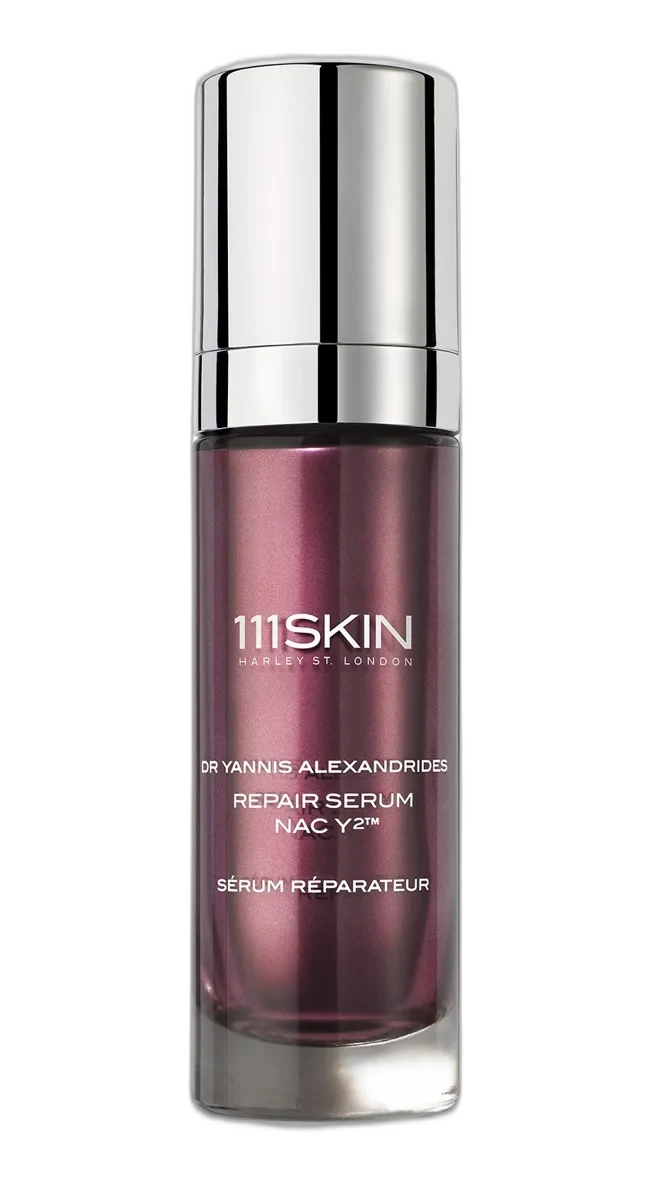
Repair Serum NAC Y2
Post-Procedure Antioxidant
 Verified reviewer
Pros & cons.
- +Layered antioxidant formula with NAC, SAP, niacinamide, escin
- +Genuine clinical origin from a Harley Street plastic surgeon
- +Well-suited to post-procedure recovery and reactive skin
- +Near-neutral pH eliminates stinging and flushing
- +Lightweight texture with quick absorption
- +Centella, calendula, and aloe add soothing support
- +Strong real-world track record over a decade on market
- −$188 for 30ml is steep against equivalent alternatives
- −Contains alcohol and fragrance — not for highly reactive skin
- −Isopropyl myristate may be comedogenic for some
- −NAC topical evidence base is thinner than vitamin C or retinoids
- −Less potent for raw brightening than L-ascorbic acid serums
The full review.
Most luxury skincare brands invent origin stories backward. They create a product, build a marketing narrative, and add vague clinical references to a founder’s bio. 111Skin is a rare exception. Dr. Yannis Alexandrides, a Harley Street plastic surgeon, founded the brand in 2012. He developed the NAC Y2 formula for a clinical purpose: helping post-procedure patients heal faster with less inflammation, redness, and oxidative stress on traumatized skin. The serum existed before the brand. The brand grew around it. This starting point differs from most luxury skincare and shapes how to evaluate this product.
The NAC Y2 acronym refers to N-acetyl cysteine—a small molecule that acts as a precursor to glutathione, the skin’s main endogenous antioxidant. Glutathione neutralizes free radicals from UV exposure, pollution, surgical trauma, laser treatments, and general oxidative load. Topical NAC supports glutathione synthesis where needed. While the clinical literature is thinner than research for vitamin C or vitamin E, the mechanism is well-characterized and the use case for post-procedure recovery is biologically coherent. For a surgeon providing a serum after laser resurfacing or rhinoplasty, NAC was a functional choice, not an exotic marketing inclusion.
The rest of the formula layers around the NAC for the same use case. Sodium ascorbyl phosphate provides a stable, near-neutral-pH vitamin C derivative that pairs with the NAC for antioxidant defense. Niacinamide supports the barrier and brightening. Escin—a saponin from horse chestnut seeds—has documented anti-inflammatory and microcirculation-supporting effects to address vascular fragility after surgery. Centella asiatica adds soothing and wound-healing support. Calendula and cistus extracts provide anti-inflammatory backup. Aloe vera adds hydration and calming. The formula works as a recovery cocktail, which is its design.
A few ingredient choices merit flagging. Alcohol sits high on the list, likely acting as a solubilizer and penetration enhancer for the actives. This may bother rosacea-prone users or those with sensitive skin despite the calming formula. Isopropyl myristate is comedogenic for some, a concern for post-procedure skin. Soy isoflavones are present at low levels; these are generally safe but relevant for soy allergies. Added fragrance is the hardest inclusion to justify in a product for compromised skin. Luxury skincare often includes scent even in clinical products, which is a real compromise here.
Application is simple. The lightweight gel-serum texture absorbs in seconds without residue or tackiness. There is no stinging, warmth, or flushing. The near-neutral pH and lack of L-ascorbic acid make this serum more comfortable than traditional vitamin C products. The light floral fragrance is noticeable but not overwhelming. Three to four drops cover the full face and neck.
Results match the formulation. Reduced redness and a calmer baseline appear within one to two weeks for users with reactive skin or those recovering from procedures. Subtle radiance improves at three to four weeks. Consistent use over months builds skin resilience and texture changes. There is no dramatic transformation; the formulation provides quiet, cumulative support rather than active correction. This is not a product for pigmentation-fading or wrinkle-smoothing in six weeks. It is a gentle antioxidant cocktail for skin recovery and long-term resilience.
The value is harder to defend. At $188 for 30ml, this is one of the most expensive antioxidant serums on the market. It costs significantly more than SkinCeuticals C E Ferulic, which uses pure L-ascorbic acid in a stabilized base and remains the gold standard for antioxidant potency. The 111Skin serum is gentler, more layered, and has a clinical origin, but you pay a substantial premium for the brand and the surgical founder’s credibility. The Inkey List, The Ordinary, and several mid-tier brands offer NAC, vitamin C derivatives, niacinamide, and centella in similar or cleaner formulations for much less.
The price is more defensible in specific clinical contexts. If an aesthetic clinic recommends this serum for post-procedure use, if simpler alternatives fail to calm your skin, or if you value a product that originated in an operating room, the price is legitimate. Outside those cases, you are mostly paying for the brand.
The limitations are clear. Alcohol and fragrance disqualify this from being a true sensitive-skin product despite its calming claims. The price-to-active ratio is difficult to justify against cheaper options. The N-acetyl cysteine evidence base for topical use is suggestive but less deep than the literature for vitamin C or retinoids. Additionally, the brand’s move into lifestyle luxury has somewhat diluted the clinical credibility this specific serum retains.
If you value brand heritage, layered formulations, and a genuine clinical origin story—and can afford the price—this is a thoughtful luxury option. For everyone else, the same actives exist in cleaner, simpler, and much cheaper forms.
Formula
Ingredient analysis.
Full INCI list · pH 5.5
Aqua/Water, Glycerin, Sorbitol, Isopropyl Myristate, Alcohol, Polyacrylate Crosspolymer-6, Sodium Ascorbyl Phosphate, Acetyl Cysteine, Escin, Niacinamide, Calendula Officinalis Flower Extract, Cistus Incanus Flower/Leaf/Stem Extract, Aloe Barbadensis Leaf Extract, Centella Asiatica Extract, Aesculus Hippocastanum Seed Extract, Lecithin, Beta-Sitosterol, Soy Isoflavones, Glycosphingolipids, Polyglyceryl-6 Laurate, Polyglyceryl-10 Oleate, Carbomer, Hydroxyacetophenone, 1,2-Hexanediol, Caprylyl Glycol, Sorbitan Palmitate, Sodium Hydroxide, Phenylpropanol, Parfum/Fragrance
Skin match.
The science.
The Science
N-acetyl cysteine (NAC) acts as a precursor to glutathione, the body's master endogenous antioxidant, and oral studies show it supports systemic antioxidant levels. Topical NAC has less evidence. A 2009 study in the Archives of Dermatological Research by Bernstein et al. shows topical N-acetyl cysteine improves skin barrier function and reduces oxidative damage in stressed skin models. The mechanism—supporting endogenous glutathione synthesis and scavenging reactive oxygen species—is biologically well-characterized, even if clinical trials for cosmetic NAC are limited. Sodium ascorbyl phosphate is a stable vitamin C derivative that converts to L-ascorbic acid in the skin. It has documented antioxidant and brightening effects and, unlike most vitamin C forms, has published data for treating acne. Extensive research supports niacinamide's role in barrier support, melanosome transfer reduction, and tone improvement. Escin, a saponin from horse chestnut seeds, has documented anti-inflammatory and microvascular-stabilizing effects in topical and oral uses and appears in European pharmaceutical preparations for vascular fragility. Dermatology literature supports Centella asiatica's wound-healing and barrier-supporting effects. This combination of actives matches a post-procedure recovery formula, though no independent clinical trials exist for this exact proprietary complex.
References
- Sodium ascorbyl phosphate shows in vitro and in vivo efficacy in the prevention and treatment of acne vulgaris — International Journal of Cosmetic Science (2008)
Dermatologist Perspective
Dermatologists view 111Skin's NAC Y2 Repair Serum with more credibility than most luxury skincare because of its clinical origins under Dr. Yannis Alexandrides. Board-certified dermatologists note the layered antioxidant approach—combining NAC, vitamin C derivatives, niacinamide, and anti-inflammatory botanicals—matches typical post-procedure recovery serum formulations. Aesthetic clinics often use the product after injectables, laser resurfacing, and chemical peels. Dermatologists note that these same active categories exist in cheaper products and that the price reflects luxury branding rather than ingredient cost. For patients with significant sensitivity or rosacea, the alcohol and fragrance content are considerations; simpler fragrance-free alternatives like Skinceuticals Phyto Corrective may be recommended instead.
Where it fits in your routine.
Apply morning and night to clean skin. Press three to four drops into the face and neck after cleansing and any toner step. Follow with moisturizer and SPF 50 in the morning. It pairs well with hyaluronic acid serums, ceramide moisturizers, and most other actives. It was originally developed for post-procedure use, so you can add it to recovery routines after consulting your aesthetic provider.
At $188 for 30ml, this serum leads the luxury antioxidant category and costs much more than gold-standard alternatives like SkinCeuticals C E Ferulic. Using three to four drops twice daily lasts roughly two to three months — about $60-80 per month for the serum alone. The price reflects luxury brand positioning and its clinical origin rather than ingredient cost. Cheaper serums from The Ordinary, The Inkey List, and Paula's Choice provide many of the same actives in equally clean formulations for much less. This product has value in specific contexts: post-procedure clinical use, users who value the surgeon-founder story, and users who find this layered formulation calms their skin better than simpler products.
Mature skin with healing concerns, post-procedure aesthetic clinic clients, and anyone seeking clinical credibility from a surgeon-founded brand. It works for users who find layered antioxidant formulations better than single-active alternatives. This suits those building a luxury routine around brand heritage instead of maximum value-per-dollar.
Skip this if you have fragrance sensitivity, want the best ingredient quality per dollar, or need a potent L-ascorbic acid serum for pigmentation. Also skip if your routine has a comprehensive antioxidant approach — adding this serum won't add meaningful benefit.
Product details.
Lightweight gel-serum that absorbs quickly with no tackiness.
Light floral fragrance — present and noticeable.
Frosted glass dropper bottle in 111Skin's signature minimalist clinical aesthetic.
The first application causes no stinging or warmth. Redness reduces and the baseline calms within one to two weeks — especially for users with rosacea-adjacent reactivity or those coming off recent procedures.
About 2-3 months with twice-daily use of 3-4 drops.
12 months
All Year
The backstory.
Dr. Yannis Alexandrides, a Harley Street plastic surgeon, developed the original NAC Y2 formula to help his post-procedure patients heal faster and with less inflammation. The serum was launched commercially in 2012 as the founding product of 111Skin and remains the brand's most clinically credible offering. Its ongoing use in aesthetic clinics worldwide is part of why it has retained credibility despite the brand's expansion into more lifestyle-oriented luxury products.
About 111Skin
Established Brand (5–20 years)Dr. Yannis Alexandrides, a Harley Street plastic surgeon, founded 111Skin in 2012. He created the NAC Y2 formula to speed up healing for his post-procedure patients. The brand has clinical credibility from its surgical origins, but independent peer-reviewed validation of the proprietary NAC Y2 complex is limited.
Common myths.
Higher prices in skincare always mean better results.
Often, you pay for packaging, marketing, and brand positioning instead of ingredient quality. The actives in this serum work, but cheaper products with similar formulations exist.
NAC is just a niche ingredient with no real evidence.
N-acetyl cysteine is extensively studied as an oral supplement to increase glutathione. Topical NAC has less research but shows growing evidence for antioxidant support and post-procedure recovery.
FAQ.
What does NAC actually do for skin?
N-acetyl cysteine is a precursor to glutathione, the skin's master antioxidant. Topical NAC has been studied for neutralizing free radicals, supporting post-inflammatory recovery, and reducing oxidative stress on the skin barrier. It's most useful as part of a layered antioxidant routine.
Is the 111Skin NAC Y2 Serum worth the price?
Value depends on your priorities. The clinical origin and post-procedure positioning are real. The actives are well-formulated. However, cheaper serums with equally clean formulations offer similar antioxidant benefits. Most users get better value from leave-on alternatives.
Can I use it after a cosmetic procedure?
Yes — this is its original purpose. Aesthetic clinics use it after injectables, laser treatments, and chemical peels to support healing. Always check with your provider before using any product post-procedure.
Is it safe during pregnancy?
No actives here are clearly contraindicated. However, soy isoflavones and the lack of pregnancy data on the proprietary complex mean most dermatologists recommend simpler alternatives while pregnant. Consult your OB-GYN.
Does it contain retinol?
No. This serum uses antioxidants (NAC, SAP, niacinamide) instead of retinol. You can layer it with a retinoid if you tolerate one.
Will it sting on application?
Most users report no stinging. The formula has a near-neutral pH and uses a stable vitamin C derivative instead of L-ascorbic acid. The alcohol content may bother reactive skin.
How does it compare to SkinCeuticals C E Ferulic?
C E Ferulic provides more potent antioxidant brightening because it uses 15% L-ascorbic acid in a stabilized base. The 111Skin serum is gentler, contains multiple actives including NAC, and targets post-procedure and barrier-supporting use. Different products suit different priorities.
Community
What the community says.
"Calms post-procedure redness"
"Builds skin resilience over time"
"Pleasant lightweight texture"
"Strong brand credibility from surgical origins"
"Eye-watering price for 30ml"
"Contains alcohol and fragrance"
"Less potent than dedicated L-ascorbic acid serums"
People also looked at.