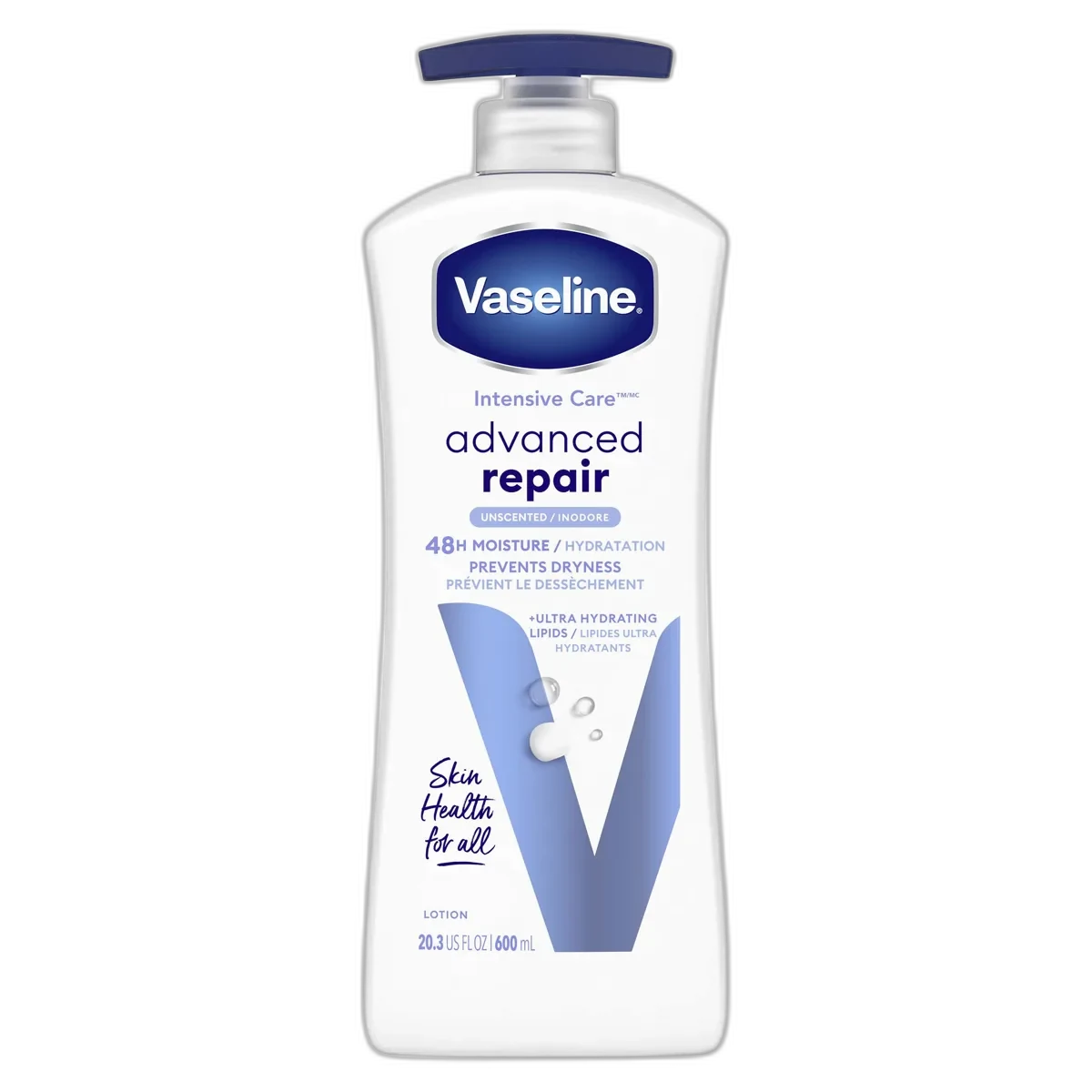
Intensive Care Advanced Repair Lotion
Everyday Dry Skin Essential
 Verified reviewer
Pros & cons.
- +National Eczema Association Seal of Acceptance validates its eczema suitability
- +Under $8 for 20 ounces — exceptional per-ounce value for clinical-grade care
- +Genuinely fragrance-free unscented formula with no masking scents
- +Proven glycerin-petrolatum-shea butter combination for effective barrier repair
- +Absorbs into a non-greasy satin finish practical for daily use
- +Available in four sizes from travel (2 oz) to family pump (32 oz)
- +Made with 50% recycled plastic packaging
- −Contains methylparaben and propylparaben — a dealbreaker for paraben-avoiders
- −Thinner consistency may disappoint those expecting a rich body cream
- −Initial tackiness takes 1-2 minutes to fully absorb
- −Contains isopropyl myristate and palmitate — comedogenic concerns for body acne
- −Not cruelty-free — Unilever permits testing where legally required
The full review.
The Vaseline Intensive Care line has been on American bathroom shelves since 1968 — the same year that saw the first Moon landing, the debut of 2001: A Space Odyssey, and the founding of the American Academy of Dermatology’s annual meeting format. While culture has changed almost beyond recognition since then, the basic chemistry of human skin has not, and Vaseline’s fundamental approach to moisturizing it has proven remarkably durable.
The Advanced Repair formulation, which modernized the lineup around 2015, represents the intersection of that five-decade heritage with contemporary delivery technology. The concept is simple but well-executed: combine the three most validated moisturizing mechanisms — humectant (glycerin), occlusive (petrolatum), and emollient (shea butter and dimethicone) — in a formula that absorbs well enough to use every day without feeling like you have coated yourself in cooking grease.
The glycerin sits second in the ingredient list, signaling a meaningful concentration that provides genuine moisture-pulling power. Petrolatum follows, but rather than delivering it as the heavy, visible layer people associate with the Vaseline name, the formula uses micro-droplet technology to distribute tiny petrolatum particles throughout the lotion base. This matters because research has shown petrolatum does far more than simply seal the skin surface — it permeates the stratum corneum, integrates into the depleted intercellular lipid structure, and upregulates the skin’s own barrier repair proteins. The micro-droplet approach lets this happen without the cosmetic penalty of a greasy finish.
Dimethicone layers in as a secondary occlusive, and shea butter adds fatty acid richness that conditions the skin’s surface. Sunflower seed oil contributes linoleic acid support at a modest concentration near the bottom of the INCI list. The overall formula reads like a textbook approach to dry skin management — not because it is unimaginative, but because the textbook was partly written by research on these exact ingredients.
What elevates this from commodity body lotion to something worth noting is the National Eczema Association Seal of Acceptance. The NEA evaluates products based on ingredient safety, absence of common irritants, and suitability for sensitive, eczema-prone skin. Earning this seal means the formula was specifically assessed for its compatibility with compromised skin barriers — a validation that most luxury moisturizers costing five times as much cannot claim.
The unscented version deserves particular credit. Fragrance is the most common cosmetic contact allergen, and too many products labeled “unscented” still contain masking fragrances. This formula has no parfum in the INCI list — cedrol appears as a trace ingredient, likely from the shea butter processing, but there is no added fragrance of any kind. On the skin, it smells like nothing, which is exactly what people with reactive skin need.
Texturally, this is a medium-weight lotion that pours from the bottle more fluidly than you might expect from something marketed as clinical-grade. It spreads easily with moderate slip and absorbs within about two minutes. The initial feel can be slightly tacky — that is the petrolatum doing its job — but it settles into a comfortable satin finish that does not transfer to clothing or feel heavy. It is not as instantly luxurious as a whipped body butter, but it is significantly more practical for getting dressed and going about your day.
The paraben presence (methylparaben and propylparaben) is the formula’s most polarizing element. These remain among the most effective cosmetic preservatives available and are FDA-approved at the concentrations used here. But consumer sentiment has shifted, and for a meaningful segment of shoppers, parabens are a firm no-go regardless of the safety data. Vaseline has not yet released a paraben-free version of this formula, which is a missed opportunity given its otherwise strong profile.
The product also contains isopropyl myristate and isopropyl palmitate — both rated high on comedogenicity scales. For a body lotion this is largely academic since body skin is far less prone to comedonal acne than facial skin, but anyone with back acne or chest breakouts should be aware.
At $7.49 for 20.3 ounces, the value proposition borders on absurd. This is roughly $0.37 per ounce for a dermatologist-tested, NEA-accepted, clinically validated body lotion that delivers genuine barrier repair. The 32-ounce pump bottle drops the per-ounce cost even further. Available in four sizes from 2-ounce travel to 32-ounce pump, it scales to any lifestyle.
Vaseline does not need to be exciting. It does not need to trend on social media or land on a celebrity’s vanity shelf. It needs to repair dry skin effectively, at a price that does not penalize people for having bodies that need moisturizing. On those terms, the Advanced Repair Lotion quietly excels.
Ingredient analysis.
Full INCI list
Water (Eau), Glycerin, Stearic Acid, Petrolatum, Glycol Stearate, Isopropyl Palmitate, PEG-100 Stearate, Dimethicone, Mineral Oil (Huile Minerale), Dicaprylyl Ether, Cetyl Alcohol, Butyrospermum Parkii (Shea) Butter, Phenoxyethanol, Glyceryl Stearate, Triethanolamine, Methylparaben, Acrylates/C10-30 Alkyl Acrylate Crosspolymer, Propylparaben, Stearamide AMP, Disodium EDTA, Isopropyl Myristate, Helianthus Annuus (Sunflower) Seed Oil, Cedrol
Skin match.
The science.
The Science
The glycerin-petrolatum foundation of this formula rests on some of the most robust evidence in dermatology. A 2020 randomized, double-blind crossover study by Vaillant et al. in the Journal of Cosmetic Dermatology demonstrated that the combination of glycerol and petrolatum in an emollient significantly reduced transepidermal water loss (TEWL) and increased stratum corneum hydration compared to vehicle alone, confirming a synergistic effect between these two ingredients.
Petrolatum's mechanism of action has been extensively characterized. Ghadially et al. showed in a 1992 study in the Journal of the American Academy of Dermatology that petrolatum permeates throughout the stratum corneum, replacing depleted intercellular lipids rather than merely forming a surface barrier. This allows normal barrier recovery processes to proceed while maintaining hydration. Czarnowicki et al. expanded on this in 2016 in the Journal of Allergy and Clinical Immunology, demonstrating that petrolatum application upregulates antimicrobial peptides, barrier differentiation markers (filaggrin and loricrin), and increases stratum corneum thickness while reducing inflammatory T-cell infiltration — findings particularly relevant for this product's eczema-prone target user.
Dimethicone's role as a skin protectant is recognized in the FDA OTC monograph, where it is classified as an active ingredient at concentrations of 1-30%. As an occlusive, it complements petrolatum by providing a lighter-weight protective barrier on the skin surface.
The National Eczema Association's validation of this formula reflects an independent assessment that the ingredient profile meets safety standards for compromised skin barriers — a meaningful endorsement backed by dermatological review.
References
- Combined effects of glycerol and petrolatum in an emollient cream: A randomized, double-blind, crossover study in healthy volunteers with dry skin — Journal of Cosmetic Dermatology (2020)
- Effects of petrolatum on stratum corneum structure and function — Journal of the American Academy of Dermatology (1992)
- Petrolatum: Barrier repair and antimicrobial responses underlying this 'inert' moisturizer — Journal of Allergy and Clinical Immunology (2016)
Dermatologist Perspective
Dermatologists frequently recommend petrolatum-based moisturizers as first-line maintenance therapy for dry and eczema-prone skin, and this product's NEA Seal of Acceptance reflects that clinical alignment. Board-certified dermatologists note that the triple-mechanism approach — humectant, occlusive, and emollient — addresses all three components of effective moisturization simultaneously. The fragrance-free formulation is particularly important from a dermatological standpoint, as fragrance remains the most common cause of cosmetic contact dermatitis. For patients managing eczema, dermatologists typically recommend applying this type of moisturizer within three minutes of bathing to trap moisture in the skin.
Where it fits in your routine.
Apply a thick layer to damp skin within three minutes of showering or bathing to trap moisture. Focus on dry areas like shins, elbows, knees, and forearms. For severely dry patches, apply more product and layer pure Vaseline Jelly on top. Reapply as needed, especially after hand washing or in dry environments.
At $7.49 for 20.3 ounces ($0.37/oz), this is one of the cheapest clinically validated body lotions in the US market. The 32 oz pump at $9.99 lowers the cost to $0.31/oz. This pricing is low for a product with the NEA Seal of Acceptance that repairs the skin barrier, thanks to Vaseline's scale as a Unilever brand and inexpensive core ingredients. Daily full-body use costs roughly $50-60 annually, which is less than one jar of many prestige body creams.
People with dry to very dry body skin who want reliable, clinically validated hydration at a budget price. It works well for eczema-prone individuals needing a fragrance-free daily moisturizer that won't irritate compromised skin. It is ideal for families needing a go-to body lotion for multiple skin types.
Avoid this if you skip parabens or want cruelty-free products. People with body acne may want to avoid the comedogenic emollients in this formula. This lotion has a thin consistency and may not satisfy those who prefer a thick body cream.
Product details.
Medium-weight lotion that pours easily. It is thinner than a body cream but thicker than a lightweight body milk. It spreads smoothly with moderate slip.
The Unscented version has almost no detectable odor. It smells faintly like petroleum jelly if you smell closely, but it is effectively odorless on the skin.
Plastic squeeze bottles (10 oz, 20.3 oz) use flip-top caps, or a pump bottle (32 oz) is available. These use 50% recycled plastic. The white bottle is simple and utilitarian with blue and teal Vaseline branding. A 2 oz travel size exists.
Applies smoothly without stinging or irritation. It feels slightly tacky for one to two minutes before it absorbs into a comfortable, non-greasy finish. Skin feels softer and more comfortable immediately. No adjustment period is required.
6-8 weeks using the 20.3 oz bottle daily on the full body; 2-3 months using the 32 oz pump.
12 months
All Year
The backstory.
The Vaseline Intensive Care line has been a body care mainstay since 1968, making it one of the longest-running moisturizer product lines in the US market. The Advanced Repair formulation modernized the lineup around 2015, incorporating Vaseline's micro-droplet petrolatum delivery system and earning the NEA Seal of Acceptance — a validation that positioned it as more than just a commodity body lotion.
About Vaseline
Legacy Brand (20+ years)Robert Chesebrough founded Vaseline in 1870. It has anchored skincare for over 150 years. The Intensive Care line launched in 1968, and the Advanced Repair formulation updates the brand's barrier repair philosophy. Unilever owns the brand, and this product has a National Eczema Association Seal of Acceptance.
FAQ.
Is Vaseline Intensive Care Advanced Repair good for eczema?
Yes — this product holds a National Eczema Association Seal of Acceptance, meaning it meets the NEA's ingredient safety and suitability criteria for eczema-prone skin. The unscented formula avoids fragrance, a common eczema trigger, while the glycerin-petrolatum combination provides the barrier repair that dermatologists recommend as eczema management. For flare-ups, it may need to be supplemented with prescribed treatments.
Does Vaseline Advanced Repair contain fragrance?
The unscented version has no parfum or fragrance ingredients. It contains trace levels of cedrol, a naturally derived terpenoid, but this is not a fragrance additive. A separate lightly fragranced version exists — check the label carefully if you avoid all fragrance.
How long does Vaseline Advanced Repair moisturize?
The brand claims 48-hour moisture retention. Clinical testing shows 90% more moisture versus untreated skin. Most users find one application after showering provides comfortable hydration for a full day, though very dry environments or frequent handwashing may require reapplication.
Is Vaseline Advanced Repair lotion greasy?
This formula contains petrolatum and mineral oil but absorbs into a non-greasy, satin finish within about two minutes. The micro-droplet technology distributes petrolatum in small particles throughout the lotion instead of leaving a heavy surface layer. Some users note slight initial stickiness that fades quickly.
Does this product contain parabens?
Yes — it contains methylparaben and propylparaben. These preservatives work well, are well-studied, and the FDA approves them at cosmetic concentrations. Consumers who prefer paraben-free formulations must choose alternatives. The parabens ensure the product's stability and long shelf life.
What the community says.
"Absorbs well without feeling overly greasy on the body"
"Genuinely effective for very dry and cracked skin"
"Extremely affordable — under $8 for 20 ounces"
"Unscented version is truly fragrance-free with no detectable odor"
"NEA-accepted for eczema-prone skin adds credibility"
"Good everyday body moisturizer for consistent hydration"
"Thinner consistency than expected — some find it too runny"
"Can feel slightly sticky on initial application before absorbing"
"Contains parabens which are a dealbreaker for some consumers"
"Some users report the formula has changed over the years"
"Pump mechanism on larger bottles can malfunction"
"Not rich enough for severely cracked winter skin without layering"