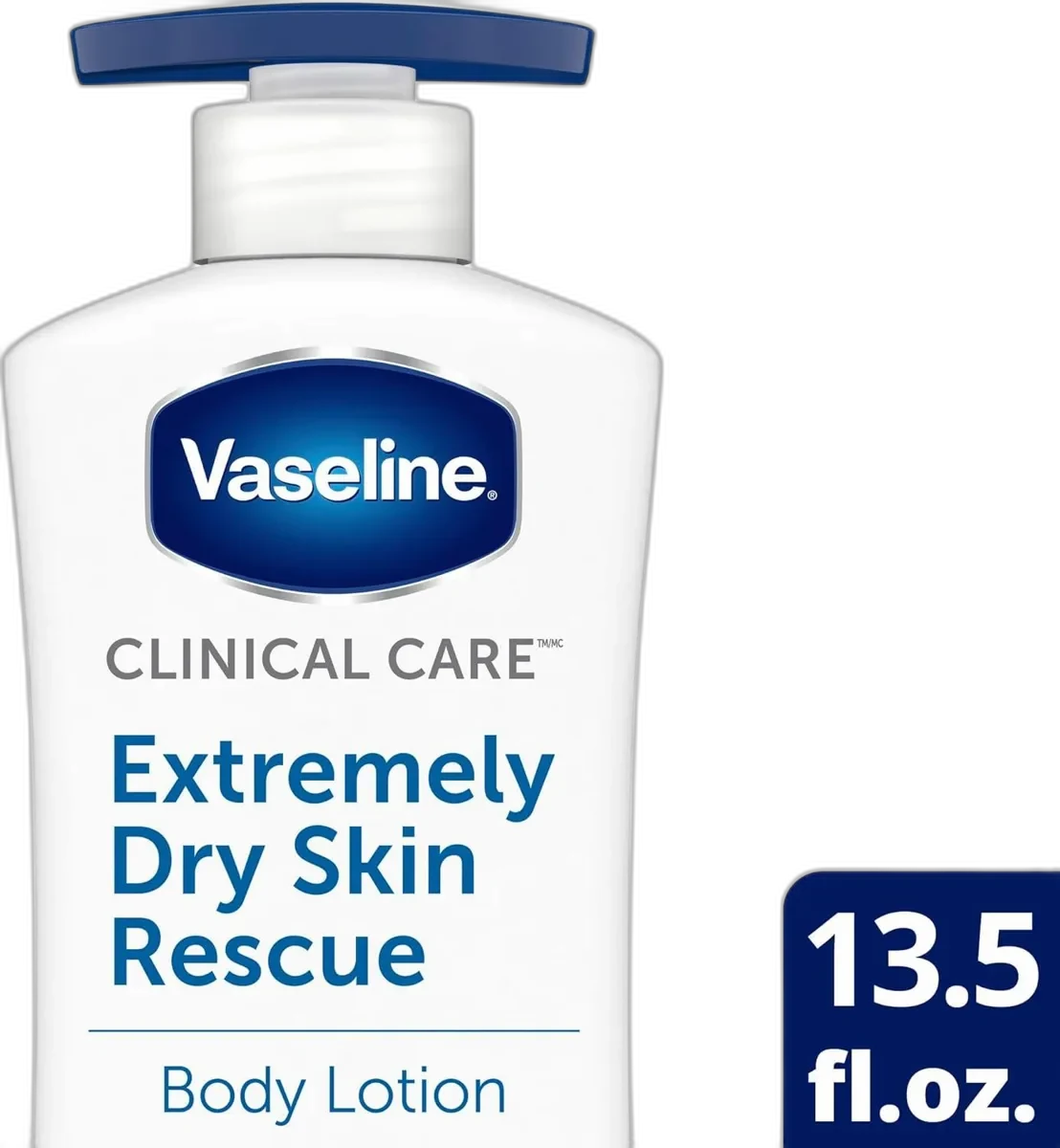
Clinical Care Extremely Dry Skin Rescue Healing Moisture Lotion
Dry Skin Emergency Room
 Verified reviewer
Pros & cons.
- +Glycerin-petrolatum formula backed by over a century of dermatological research
- +Under $9 for 13.5 ounces — exceptional value for clinical-grade hydration
- +Completely fragrance-free, suitable for eczema-prone and sensitive skin
- +Noticeable improvement in cracked, flaking skin within 2-3 days of use
- +Petrolatum actively repairs the barrier rather than merely sealing moisture
- +Absorbs better than expected for a clinical-strength body lotion
- +Hypoallergenic and dermatologist-tested formulation
- +Available in multiple sizes including a travel-friendly 1 oz option
- −Pump bottle design can misdirect product and frustrate regular use
- −Contains methylparaben and propylparaben which some consumers avoid
- −Too heavy for humid weather or oily body skin types
- −Not suitable for facial use due to occlusive weight
- −Not cruelty-free — Unilever permits animal testing where legally required
The full review.
There is something almost poetic about a brand founded in 1870 still being relevant enough to launch a clinical skincare line in 2018. Robert Chesebrough discovered petroleum jelly on oil rigs in Pennsylvania and spent years convincing the world it could heal skin. A century and a half later, his company is still making the case — and the science has only gotten stronger.
Vaseline’s Clinical Care Extremely Dry Skin Rescue represents the modern evolution of that original insight. It takes petrolatum — the ingredient most people still think of as a simple skin sealant — and positions it within a formula designed to actually repair compromised skin barriers rather than merely protecting them. The product launched in 2018 as part of Vaseline’s push into clinical-grade skincare at drugstore prices, and it has quietly become one of the more effective options in the extremely-dry-skin category.
The formula is anchored by a glycerin-petrolatum one-two punch. Glycerin sits second in the ingredient list, pulling moisture into dehydrated skin through its well-documented humectant action. Petrolatum follows in third position, but here is where things get interesting. Most people assume petrolatum just sits on the surface and blocks water loss. A groundbreaking 1992 study published in the Journal of the American Academy of Dermatology demonstrated that it actually permeates throughout the stratum corneum, integrating into the intercellular lipid structure and accelerating barrier recovery. Then in 2016, a study in the Journal of Allergy and Clinical Immunology revealed that petrolatum upregulates antimicrobial peptides and barrier differentiation markers like filaggrin and loricrin — proteins essential for healthy skin barrier function. In other words, petrolatum is biologically active, helping your skin rebuild rather than just shielding it from further damage.
Vaseline supplements this core with what they call a Barrier Repair Complex, incorporating hydroxystearic acid as a pro-lipid alongside caprylic and capric triglycerides. Dimethicone adds a lighter occlusive layer on top, giving the formula a more cosmetically elegant finish than pure petrolatum would achieve. The overall effect is a lotion that feels rich but not suffocating — heavier than a standard body lotion, certainly, but far more wearable than slathering on straight jelly.
Texture
Texturally, it applies smoothly with good spread. There is a noticeable protective film after application — this is the petrolatum and dimethicone doing their job, creating that occlusive seal. In dry climates and winter weather, this film feels like a warm blanket for your skin. In humid summer weather, it can feel a touch heavy, which is why this product really earns its keep during the colder months.
Scent
The fragrance-free formulation is a genuine relief in a body care category that often equates strong scent with effectiveness. There is no detectable fragrance whatsoever, which makes this suitable for eczema-prone skin, post-shower sensitivity, and anyone who has learned the hard way that fragranced lotions on cracked skin is an act of self-betrayal.
Works for
Performance is where this lotion genuinely impresses. The immediate effect is softening — within minutes, rough patches feel smoother and the tight, uncomfortable sensation of extremely dry skin subsides. By day two or three of consistent twice-daily use, flaking reduces noticeably. Vaseline claims a transformation from extremely dry to healed within five days, and based on user feedback, that timeline is realistic for moderate dryness. Severely compromised barriers — the kind with visible cracking and raw patches — may take a full one to two weeks.
Common Complaints
The preservation system relies on parabens (methylparaben and propylparaben), which will be a dealbreaker for some consumers. It is worth noting that parabens remain among the most effective and well-studied preservatives available, and the concentrations used in cosmetics are well within safety guidelines established by both the FDA and the European Commission’s Scientific Committee on Consumer Safety. That said, consumer preference is consumer preference, and this product does not offer a paraben-free alternative.
Packaging
The pump bottle packaging is functional but not without criticism — multiple users report the pump misdirecting product and being somewhat finicky. It is a minor frustration for an otherwise well-executed product. The 13.5-ounce bottle offers genuine value, lasting two to three months with regular full-body application.
Vaseline may not generate the excitement of a new indie brand or a celebrity launch, but there is something to be said for a company that has been studying one ingredient for over a century and keeps finding new ways to deploy it effectively. This lotion does not need to be exciting. It needs to rescue extremely dry skin. And at $9, it does exactly that.
Ingredient analysis.
Full INCI list
Aqua (Water), Glycerin, Petrolatum, Stearic Acid, Caprylic/Capric Triglyceride, Butylene Glycol, Glycol Stearate, Stearamide AMP, PEG-100 Stearate, Dimethicone, Glyceryl Stearate, Cetyl Alcohol, Phenoxyethanol, Magnesium Aluminum Silicate, Methylparaben, Xanthan Gum, Hydroxyethylcellulose, Propylparaben, Potassium Hydroxide, Disodium EDTA, Hydroxystearic Acid
Skin match.
The science.
The Science
Glycerin and petrolatum form one of the most validated combinations in dermatological literature. A 2020 study by Vaillant et al. in the Journal of Cosmetic Dermatology tested glycerol and petrolatum in an emollient cream. The combination reduced transepidermal water loss (TEWL) and increased corneometry scores more than a vehicle alone, showing synergistic effects beyond what either ingredient does alone.
Petrolatum does more than just occlude. Ghadially et al. showed in a 1992 study in the Journal of the American Academy of Dermatology that petrolatum permeates the stratum corneum and integrates into intercellular lipid bilayers. This replaces depleted lipids while allowing normal barrier recovery processes to occur underneath.
A 2016 study by Czarnowicki et al. in the Journal of Allergy and Clinical Immunology showed that petrolatum application upregulates barrier proteins like filaggrin and loricrin, increases antimicrobial peptide expression, reduces inflammatory T-cell infiltrates, and increases stratum corneum thickness in atopic dermatitis skin. This matters for the target user with dry, potentially eczema-prone skin, as petrolatum actively promotes the skin's own repair mechanisms instead of just preventing moisture loss.
A 2008 review in the British Journal of Dermatology supports glycerin's role as a humectant. It documented how glycerin improves stratum corneum hydration, enhances skin barrier function, accelerates wound healing, and inhibits lipid phase transitions that compromise barrier integrity in dry conditions.
References
- Combined effects of glycerol and petrolatum in an emollient cream: A randomized, double-blind, crossover study in healthy volunteers with dry skin — Journal of Cosmetic Dermatology (2020)
- Effects of petrolatum on stratum corneum structure and function — Journal of the American Academy of Dermatology (1992)
- Petrolatum: Barrier repair and antimicrobial responses underlying this 'inert' moisturizer — Journal of Allergy and Clinical Immunology (2016)
- Glycerol and the skin: holistic approach to its origin and functions — British Journal of Dermatology (2008)
Dermatologist Perspective
Dermatologists often recommend petrolatum-based moisturizers to manage dry skin and eczema, and this product follows American Academy of Dermatology clinical guidelines. Board-certified dermatologists note the glycerin-petrolatum combination provides immediate humectant hydration and long-term barrier repair, which works well for patients with chronically dry or atopic skin. Dermatologists commonly suggest this fragrance-free, hypoallergenic formulation for patients with sensitive or reactive skin who need reliable hydration without the risk of contact dermatitis from fragrance allergens.
Where it fits in your routine.
Apply a generous amount to damp skin right after bathing to maximize moisture absorption. Target dry areas like elbows, knees, shins, hands, and feet. For cracked hands, apply a thick layer at night and wear cotton gloves. Use twice daily, or more often during winter and in dry climates. Let the lotion absorb fully in the morning before applying sunscreen to exposed areas.
At $8.99 for 13.5 ounces, this product offers high value for clinical-grade body care. The cost per ounce is about $0.67 — much lower than most specialty dry skin treatments and prescription emollients. Vaseline has over 150 years of petrolatum expertise; the price reflects Vaseline's scale and ingredient simplicity, not lower efficacy. Multiple sizes exist, including a 6.8 oz tube for portability and a 1 oz travel size. The larger bottle lasts 2-3 months with regular use, keeping the annual cost of daily dry skin management low.
This is for anyone with chronically dry, cracked, or winter-ravaged skin seeking clinical-level barrier repair without the clinical price tag. It works well for eczema-prone individuals, people in dry or cold climates, and anyone using body lotions that absorb quickly but leave skin dry again within hours.
Avoid this if you skip parabens. Oily skin and people in humid climates may find this formula too heavy for daily use. This lotion's occlusive profile suits the body better than a facial moisturizer.
Product details.
This thick lotion is heavier than standard body lotions but lighter than a balm or cream. It spreads smoothly and leaves a protective, non-sticky layer on the skin.
Unscented. Base ingredients have a faint, neutral scent that dissipates immediately.
13.5 oz white pump bottle with blue and clinical-style design. A 6.8 oz squeeze tube is also available. Some users criticize the pump bottle design for misdirecting product.
Applies smoothly and softens skin immediately. It causes no tingling or irritation. The lotion forms a visible protective layer that seals in moisture; this is intentional, not a flaw. Extremely dry and cracked areas show visible improvement within two to three applications.
Apply twice daily to the full body for 2-3 months, or use on hands and dry patches for 3-4 months.
12 months
fall winter
The backstory.
Vaseline launched the Clinical Care line in October 2018 as an evolution beyond their classic jelly, targeting consumers with severely dry skin who needed clinical-grade hydration at a drugstore price. The line was built on the insight that petroleum jelly's barrier repair properties could be enhanced with additional lipids and humectants in a more cosmetically elegant lotion format.
About Vaseline
Legacy Brand (20+ years)Robert Chesebrough founded Vaseline in 1870, making it one of the world's oldest continuously sold skincare brands. Over a century of dermatological research covers its core ingredient, petroleum jelly. The Clinical Care line launched in 2018 and uses an advanced formulation approach based on the brand's petrolatum expertise.
Common myths.
Petrolatum clogs pores and suffocates the skin.
A 1992 study in the Journal of the American Academy of Dermatology shows petrolatum permeates the stratum corneum and accelerates barrier recovery instead of impeding it. A 2016 study in the Journal of Allergy and Clinical Immunology shows petrolatum upregulates antimicrobial peptides and barrier proteins; it is biologically active, not inert.
Clinical-grade lotions do not need high prices to work.
The glycerin-petrolatum core of this product is one of the most validated hydration combinations in dermatology. These ingredients are cheap to source, so Vaseline offers clinical-level barrier repair for under $9 — the price reflects the ingredients, not the efficacy.
FAQ.
Is Vaseline Clinical Care good for eczema?
This fragrance-free, glycerin-and-petrolatum formula works for eczema-prone skin. Research shows petrolatum upregulates barrier repair proteins and antimicrobial peptides in atopic skin. This is not a medicated eczema treatment, but it provides the intensive barrier repair dermatologists recommend for eczema management.
Does Vaseline Clinical Care contain parabens?
This formula uses methylparaben and propylparaben as preservatives. The FDA approves parabens and considers them safe at cosmetic concentrations, but consumers seeking paraben-free products should choose other options. These parabens extend shelf life and ensure reliable preservation.
Can I use Vaseline Clinical Care on my face?
This fragrance-free, gentle formula targets body use. The petrolatum and heavier emollients can occlude facial skin, especially for oily or acne-prone types. Use a lighter moisturizer formulated specifically for the face on your face.
How quickly does Vaseline Clinical Care work on dry skin?
Most users report immediate softening after the first application. Flaking and roughness improve visibly within 2-3 days. The brand claims skin goes from extremely dry to healed within 5 days. Severely compromised skin barriers require 1-2 weeks of consistent use for full recovery.
Is Vaseline Clinical Care fragrance-free?
This product is fragrance-free. It has no added fragrance, essential oils, or masking scents. This makes it suitable for sensitive and eczema-prone skin, where fragrance often triggers irritation.
Community
What the community says.
"Transforms extremely dry, flaky skin within days"
"Absorbs faster than expected for a clinical-strength lotion"
"Fragrance-free with no detectable scent"
"Effectively heals cracked hands and rough patches"
"Excellent for winter skin and eczema-prone areas"
"Soft, smooth skin that lasts through the day"
"Pump design misdirects product and can be frustrating to use"
"Contains parabens which some consumers prefer to avoid"
"Can feel heavy or sit on skin surface in humid weather"
"Not as widely available in all retail locations"
"May be too rich for areas beyond hands and body"