Vitamin C Serum
Gentle Daily Vitamin C
 Verified reviewer
Pros & cons.
- +Two complementary vitamin C derivatives plus vitamin E
- +Stable formulation that doesn't oxidize in the bottle
- +No tingling, stinging, or flushing on application
- +Suitable for sensitive and reactive skin
- +Fragrance-free with a clean preservative system
- +Pregnancy and breastfeeding safe
- +Works for daily antioxidant defense rather than just brightening
- −Less potent than L-ascorbic acid for stubborn pigmentation
- −Slower visible brightening timeline (6-12 weeks)
- −Not the best pick for melasma or deep hyperpigmentation
- −Slightly higher price than budget vitamin C alternatives
The full review.
Skincare consumers want Vitamin C most, but brands struggle to formulate it. L-ascorbic acid is the most studied and potent form, but it is also temperamental. It requires a low pH around 3 to stay biologically active, oxidizes in air or light, and turns brown as it degrades into useless byproducts. A correct formulation provides one of dermatology’s most effective brightening and antioxidant ingredients. An incorrect one results in an expensive bottle of vinegar that stings and stops working weeks after opening. The famous SkinCeuticals C E Ferulic serum is the gold standard L-ascorbic acid product; it costs $182 and uses airless dark glass for this reason. Most cheaper L-ascorbic acid serums oxidize before reaching the consumer.
Typology’s vitamin C serum uses the opposite approach. Instead of stabilizing the temperamental gold-standard form, it uses two derivatives — 3-O-ethyl ascorbic acid and ascorbyl glucoside — with vitamin E. This creates a stable, gentle, near-neutral pH formula that avoids airless packaging and the tingling L-ascorbic acid users associate with efficacy. This is a trade-off to understand before buying.
Derivatives convert to L-ascorbic acid once they reach the skin, where enzymes break the bonds that stabilize them in the bottle. Ethyl ascorbic acid is a more bioavailable derivative; research suggests it converts efficiently and provides relatively rapid antioxidant action. Ascorbyl glucoside is gentler and slower, releasing its L-AA payload over a longer window. By combining both, Typology achieves a layered antioxidant effect: the ethyl ester handles immediate free radical defense and brightening, while the glucoside extends coverage throughout the day. Vitamin E completes the network by quenching lipid-phase free radicals — a documented synergy where vitamin C and vitamin E regenerate each other in the skin.
The ingredient list is short and clean. Water and propanediol form the base. The two vitamin C derivatives are near the top. Polyglyceryl-10 esters provide gentle solubilization. Tocopheryl acetate adds the vitamin E. Chondrus crispus extract — Irish moss — adds mild humectancy. Xanthan gum stabilizes texture. The preservative system uses the same gentle 1,2-hexanediol, caprylyl glycol, and tropolone blend Typology uses across its line. It has no fragrance, no essential oils, no alcohol, and no glycerin. It is as clean as a vitamin C serum gets at this price point.
Application is uneventful. The serum is a thin water-gel that absorbs in seconds without residue. There is no tingling, warmth, or flushing — even on freshly cleansed, recently exfoliated, or previously reactive skin. For those who find L-ascorbic acid serums too aggressive, this is an alternative that feels good to use every morning.
Results match a derivative-based formulation. Subtle radiance and slight brightening appear within one or two weeks. Real changes in hyperpigmentation take longer than with L-ascorbic acid — expect six to eight weeks for noticeable fading on mild marks, and twelve weeks or more for deeper or older pigmentation. Stubborn melasma and post-inflammatory hyperpigmentation on darker skin tones may not respond as well as they would to a properly formulated L-AA serum. This is the central trade-off: the derivative formulation is gentler, more stable, and more pleasant, but it works slower and has a lower ceiling for pigmentation correction.
The formula excels at daily antioxidant defense. Vitamin C’s primary role is not pigmentation correction, but protecting skin from cumulative UV and pollution-generated free radical damage, complementing rather than replacing sunscreen. For this, the dose, derivative form, and vitamin E are sufficient. You do not get maximum brightening, but you get credible photoprotection, and the gentleness encourages consistent use.
The formula’s stability is an impressive feature. L-ascorbic acid serums in standard amber glass droppers typically oxidize visibly within months, turning from clear to yellow, amber, and brown. Typology’s derivative-based formula does not do this. The serum stays clear and effective through the full six-month period-after-opening, providing usable vitamin C through the entire bottle.
The limitations are honest. If you seek to actively reverse stubborn hyperpigmentation, melasma, or significant sun damage, this serum will underperform compared to a SkinCeuticals C E Ferulic, a Skinoren prescription, or a properly formulated 15% L-ascorbic acid serum. The derivative ceiling is real. If you already use vitamin C without irritation and see results, there is no reason to switch to a gentler version.
For everyone else — sensitive or dry skin, retinol users with overlapping irritation, those frustrated by L-AA stinging and oxidation, or beginners building a routine — this is one of the more thoughtfully formulated entry-level vitamin C serums available. It is not the most potent option, but it is one of the easiest to use consistently, and consistency is how vitamin C works.
Ingredient analysis.
Full INCI list · pH 5.5
Aqua/Water, Ascorbyl Glucoside, Propanediol, Polyglyceryl-10 Stearate, 3-O-Ethyl Ascorbic Acid, Polyglyceryl-10 Oleate, Sodium Hydroxide, Tocopheryl Acetate, Chondrus Crispus Extract, 1,2-Hexanediol, Caprylyl Glycol, Xanthan Gum, Tropolone
Skin match.
The science.
The Science
Skincare vitamin C falls into two categories: pure L-ascorbic acid (the gold-standard form in most clinical trials) and stabilized derivatives that convert to L-AA in the skin. Research on the pure form is extensive. A foundational 1996 paper by Pinnell and colleagues in the Journal of the American Academy of Dermatology shows that 15% L-ascorbic acid with vitamin E and ferulic acid increases photoprotection and reduces UV-induced skin damage. Formulation studies show derivatives like 3-O-ethyl ascorbic acid and ascorbyl glucoside convert to L-AA in the stratum corneum at different rates—3-O-ethyl ascorbic acid releases relatively fast, while ascorbyl glucoside provides slower, sustained delivery. Derivatives have less clinical evidence than L-ascorbic acid, but they offer better stability: they stay active in the bottle longer and do not require the low pH that L-AA needs. This avoids the stinging and irritation that often limits compliance. Vitamin E (tocopheryl acetate in this formulation) works synergistically—it regenerates oxidized vitamin C in the skin and quenches lipid-phase free radicals that water-soluble vitamin C cannot reach. This serum combines multiple vitamin C forms with vitamin E to build a layered antioxidant defense network. While not as potent as a properly formulated 15% L-AA + ferulic acid serum, it provides credible daily photoprotection without the stability and irritation problems of pure L-AA formulations.
References
- Topical L-ascorbic acid: percutaneous absorption studies — Dermatologic Surgery (2001)
Dermatologist Perspective
Dermatologists generally view L-ascorbic acid as the gold standard for topical vitamin C, but they increasingly recognize derivative formulations as a legitimate alternative for patients with sensitive skin or those who cannot tolerate the low pH of L-AA serums. Board-certified dermatologists often recommend derivative-based vitamin C serums for first-time users, sensitive skin, and patients using retinoid therapy where L-AA stinging would increase irritation. The dual-derivative approach in this formulation—combining a fast-acting and a slow-release form with vitamin E—matches how dermatologists advise patients to approach antioxidant layering. For patients with significant hyperpigmentation, melasma, or established photodamage, L-AA or prescription tyrosinase inhibitors remain the more potent options.
Where it fits in your routine.
Apply to clean skin in the morning. Press three to four drops into the face and neck after cleansing and any toner step. Use moisturizer and SPF 50 next — vitamin C works best with sunscreen as a layered photoprotection strategy. It is compatible with niacinamide, hyaluronic acid, and most other actives. Storage is easy — the derivative formulation does not need refrigeration or special handling.
At $33 for 30ml, this serum costs more than The Ordinary's vitamin C derivative formulations but less than most luxury department-store options. Using three to four drops every morning lasts about three to four months. This costs roughly $10 per month for a stable, fragrance-free, sensitive-skin-friendly daily antioxidant. A larger size offers better per-ml value. Value depends on your goal: as a daily antioxidant defense product, the price is fair; as a hyperpigmentation treatment, L-ascorbic acid alternatives use money more efficiently.
Sensitive skin, beginners, retinol users with overlapping irritation, and anyone frustrated by L-ascorbic acid serums that sting or turn brown. It works best for daily antioxidant defense instead of active hyperpigmentation correction.
If you target stubborn melasma, deep hyperpigmentation, or significant photodamage, use a properly formulated L-ascorbic acid serum or a prescription tyrosinase inhibitor instead. Skip this if you tolerate L-AA well and already see results.
Product details.
Lightweight water-gel that absorbs quickly without residue.
Completely fragrance-free.
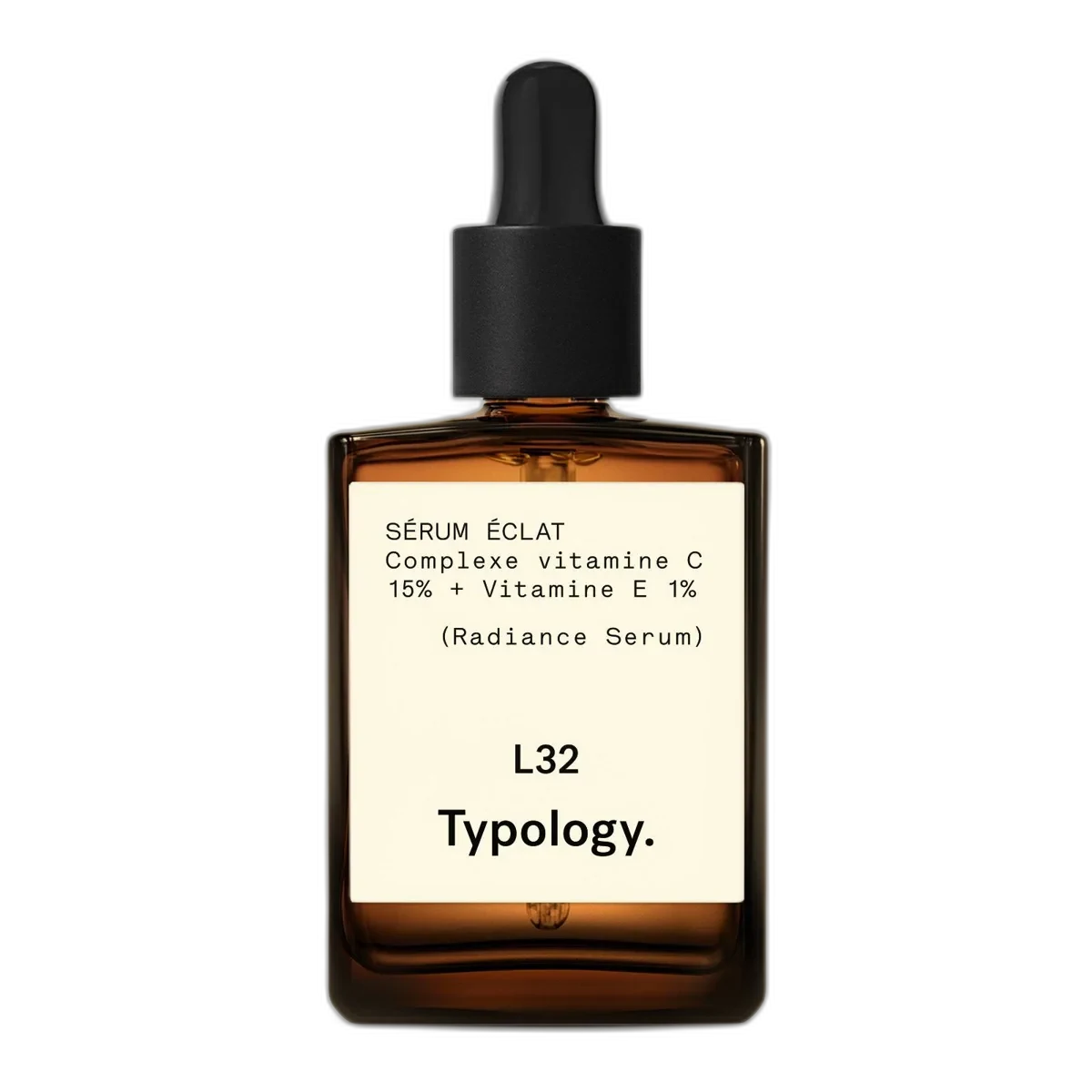
Amber glass dropper bottle in Typology's signature minimalist style.
The derivative-based formulation is gentler than pure L-ascorbic acid and causes no tingling or stinging on first application. Subtle radiance shows within the first week, and brightening increases over 6-8 weeks.
3-4 months with daily morning use.
6 months
All Year
The backstory.
Typology launched the radiance serum in 2021 to fill a gap in its lineup for sensitive-skin-friendly vitamin C. The brand chose a dual-derivative approach over the more common L-ascorbic acid route specifically because the derivative formulations don't require airless packaging or risk oxidation in the bottle, which suited the brand's straightforward amber glass aesthetic.
About Typology
Emerging Brand (2–5 years)Typology launched in 2019 using a French direct-to-consumer model and minimalist active formulas. Its vitamin C serum has thousands of reviews on the brand site, but independent clinical validation for this specific formulation is limited.
Common myths.
Only L-ascorbic acid "counts" as real vitamin C.
L-ascorbic acid is the most potent form. Both ethyl ascorbic acid and ascorbyl glucoside convert to L-AA in the skin. These derivatives are gentler, more stable, and effective, though they work on a slower timeline.
Vitamin C serums need to sting to work.
Low pH (~3) stabilizes L-ascorbic acid and usually causes stinging, not efficacy. Derivative-based formulas at near-neutral pH work without the burn.
FAQ.
Is Typology's Vitamin C Serum as strong as L-ascorbic acid serums?
This serum lacks raw potency. L-ascorbic acid is the most bioactive form. This serum uses two derivatives that convert to L-AA in the skin. These are gentler, slower-acting, and more stable, but visible results take longer.
Will this serum oxidize and turn brown?
These derivatives are more stable than L-ascorbic acid serums. This stability allows Typology to use a standard dropper bottle instead of an airless pump.
Can I use it with niacinamide?
Yes — modern formulations disprove the myth that vitamin C and niacinamide cancel each other out. Apply this serum before niacinamide, or use them in separate routines.
Is this serum safe during pregnancy?
Yes. All common topical forms of Vitamin C are safe during pregnancy and breastfeeding.
Does it help with dark spots?
Gradually. The dual-derivative approach fades mild to moderate hyperpigmentation over 8-12 weeks. For stubborn or deep pigmentation, a true L-ascorbic acid serum or prescription tyrosinase inhibitor will work faster.
How to Use
Morning is optimal — vitamin C provides daytime antioxidant defense against UV-generated free radicals, and it pairs naturally with sunscreen as a layered photoprotection strategy.
Best for
Can sensitive skin use this serum?
Yes — the derivative-based formula at near-neutral pH is one of the most sensitive-skin-friendly vitamin C options on the market. No tingling, no flushing, no stinging.
Community
What the community says.
"Gentle even on sensitive skin"
"No tingling or stinging"
"Stable formulation that doesn't oxidize quickly"
"Pleasant lightweight texture"
"Slower brightening than L-ascorbic acid serums"
"Not as potent for stubborn hyperpigmentation"
People also looked at.