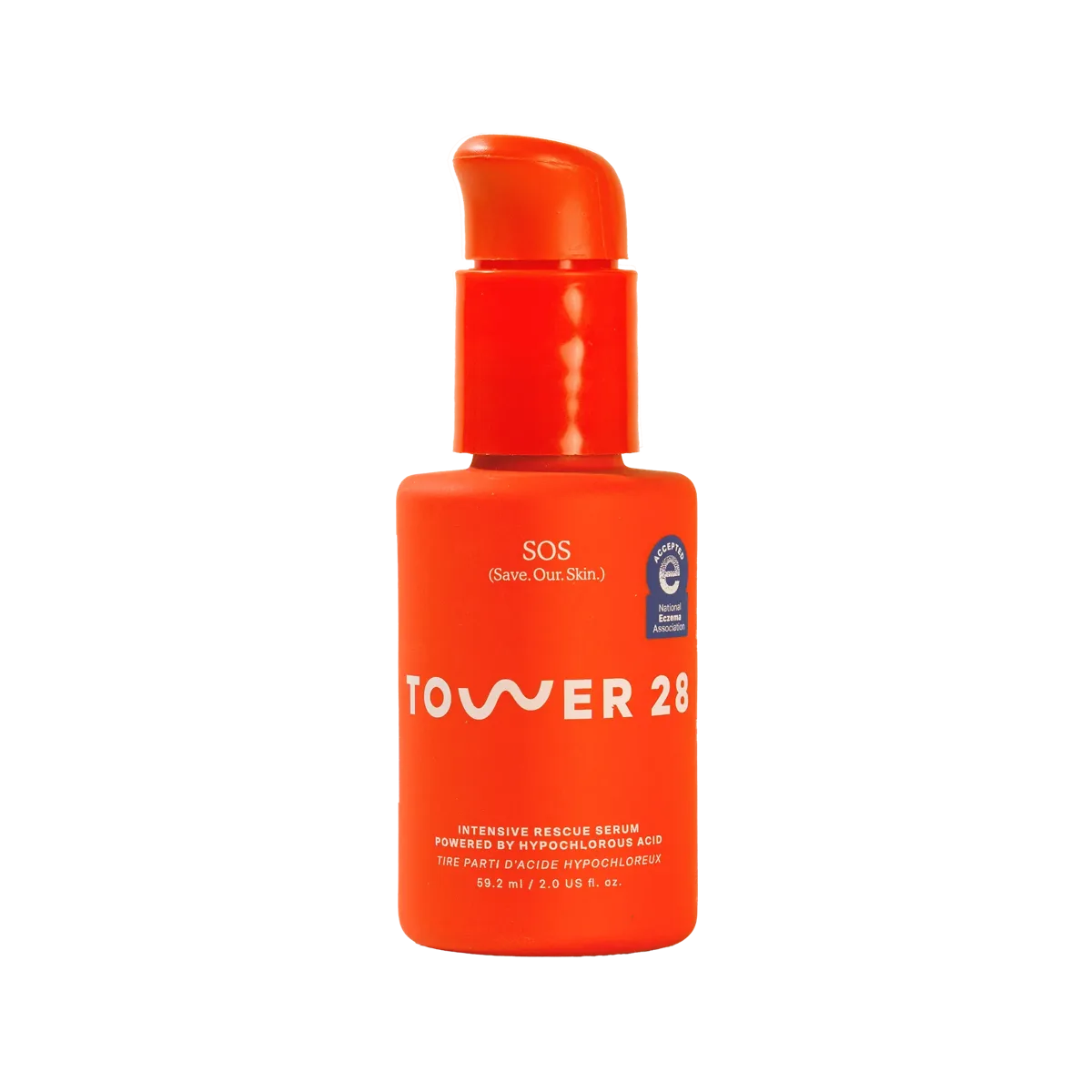
SOS Intensive Rescue Serum
Reactive Skin MVP
 Verified reviewer
Pros & cons.
- +Near-zero irritation profile on compromised, broken, or flaring skin
- +Triple-validated by the National Eczema, Psoriasis, and Rosacea organizations
- +Stabilized HOCl remains active for months unlike unstabilized alternatives
- +Fungal-acne safe, pregnancy-safe, and suitable for post-procedure recovery
- +Layers invisibly under any serum, moisturizer, or sunscreen without pilling
- +Calms flushing and inflammation within minutes of application
- +No fragrance, no essential oils, no sensitizing preservatives
- +Pump delivery allows targeted dosing on specific flare areas
- −Price feels steep for a five-ingredient, mostly-water formulation
- −Provides no hydration, barrier repair, or traditional serum benefits
- −Faint chlorine scent on application may put some users off
- −Must be used within six months of opening or potency declines
- −Easy to underestimate the dose because the texture feels like nothing
The full review.
Here is a fun exercise: turn the bottle around, read the ingredient list, and count. Water. A mineral stabilizer. A pH buffer. Salt. Hypochlorous acid. Five ingredients. No niacinamide, no ceramides, no centella extract, no fancy peptides. If you’re used to the twelve-syllable INCI lists of most modern serums, your first instinct is probably to suspect the bottle is a joke. It is not. It is the most deliberate five ingredients Tower 28 could have put in a bottle, and understanding why is the entire point of this product.
Hypochlorous acid is the same compound your own immune cells generate during wound healing. Hospitals have used it for decades in wound care, burn units, and ophthalmic irrigation because it is genuinely antimicrobial and genuinely non-cytotoxic — a combination that is almost impossible to find in any other antibacterial agent. The catch is that pure hypochlorous acid in water is wildly unstable. Give it a few weeks in a non-stabilized format and you are left holding a bottle of very expensive tap water. For years this meant HOCl was either a freshly-mixed medical product or a gimmick-y salon sanitizer, neither of which belonged in a skincare routine. What Tower 28 did — and what the sodium magnesium fluorosilicate in this bottle is doing — is hold the HOCl stable enough that you can keep it on your nightstand and trust that it still works six months from now.
The texture experience is almost anticlimactic. You dispense a pump onto your palm and it looks and feels exactly like water because that is essentially what it is. There is no slip, no residue, no cushion, nothing to rub in. The first time I used it I genuinely checked the bottle to confirm I hadn’t grabbed something by mistake. A few seconds after application there is a very faint chlorine note — not perfume-strong, not unpleasant, just the scent of the chemistry itself — and then it disappears. No tingle, no warmth, no stinging, even on the kind of cracked, weeping eczema patches where the gentlest ‘soothing’ serums usually cause you to inhale sharply.
Where the serum shows its hand is in what does not happen over the next few minutes. Flushed, reactive skin calms visibly within about a quarter of an hour. Inflammatory acne papules that were throbbing stop throbbing. Post-procedure redness after a peel or laser settles down faster than it would with plain moisturizer. None of this is dramatic in the Instagram-transformation sense. What it is is reliable. If you have rosacea, eczema, or perioral dermatitis, you already know that ‘reliable’ and ‘soothing serum’ do not usually belong in the same sentence.
The irritation profile is essentially zero, which is why this has become a fixture in dermatologists’ own toolkits for patients coming off a prescription topical or in the middle of an active flare. It also happens to be fungal-acne safe, which is worth mentioning in a category where roughly half of everything labeled ‘calming’ contains a Malassezia-feeding oil or ester. Pregnancy-safe, breastfeeding-safe, newborn-safe for diaper rash — the same core formula the brand sells for facial use has been used by parents on their infants without issue, which tells you something about the tolerability ceiling.
The honest limitations are all structural rather than performance-based. You are not getting hydration from this, because water with a trace of salt does not hydrate skin any more than tap water does. You are not getting barrier repair the way a ceramide or panthenol formula would. You are not getting visible plumping or glow. This serum is a calming and antimicrobial step, full stop, and it needs to be layered with a real hydrator and a real moisturizer to close the routine properly. Treating it as a standalone serum is the fastest way to feel disappointed.
Value is the part where opinions split. Thirty-four dollars for what is mostly water will read as absurd to anyone who priced out the raw materials, and they are not wrong on the math. But raw materials pricing ignores the engineering problem of keeping HOCl stable for a year in an opaque glass bottle, and it ignores the validation work the brand did with three separate dermatology nonprofits to earn the seals on the box. Those seals are not decorative — each requires ingredient review and patient testing on the condition in question. For the person with chronic rosacea who has tried eight other ‘soothing’ serums and flared on six of them, the price is a rounding error. For the person with generally healthy skin who wants a nice serum, this is not the bottle to buy, and the brand would probably agree.
The bottom line: if your skin reacts to things, if you are coming off a course of tretinoin or accutane, if you have a flare-prone inflammatory condition, or if you just want the one product in your cabinet that you know will never sting, this is an exceptionally good purchase. If you are hunting for hydration, brightening, or anti-aging, keep looking — this serum is not built for that job, and it has the courage of its convictions about it.
Ingredient analysis.
Full INCI list · pH 5.5
Water (Aqua), Sodium Magnesium Fluorosilicate, Sodium Phosphate, Sodium Chloride, Hypochlorous Acid
Skin match.
The science.
The Science
The active in this serum is hypochlorous acid, a weak acid (HOCl) that neutrophils generate endogenously during the innate immune response respiratory burst. It works as a potent broad-spectrum antimicrobial that is non-cytotoxic to human cells at physiological concentrations, making it a staple in wound care and ophthalmic irrigation for decades. A 2014 review in the Journal of Drugs in Dermatology examined stabilized HOCl for skin use and found a favorable profile for inflammatory dermatoses, including atopic dermatitis. Other research on hypochlorous acid preparations shows reduced S. aureus colonization on atopic skin; this matters because S. aureus overgrowth links to eczema flare severity. Stabilization chemistry is as vital as the active: unstabilized HOCl in water reverts to sodium chloride within weeks. The sodium magnesium fluorosilicate and sodium phosphate buffer in this formula are critical because they hold the equilibrium on the HOCl side of the reaction to stay bioactive across the product's shelf life. The near-neutral pH also matters; HOCl is most biologically active in its protonated form between pH 4 and 6, which this serum targets. The seals from the National Eczema Association, National Psoriasis Foundation, and National Rosacea Society provide patient-level tolerability evidence—each organization reviews ingredients and real-world testing on relevant patient populations before awarding their seal.
References
- Stabilized Hypochlorous Acid Cleanser and Gel in Skin Disorders — Journal of Drugs in Dermatology (2018)
Dermatologist Perspective
Dermatologists often use hypochlorous acid as a low-risk first step for patients with reactive or flaring skin, especially those with rosacea, atopic dermatitis, or post-procedure inflammation. Board-certified dermatologists note that stabilized HOCl preparations are clinical staples because they provide antimicrobial action without the barrier disruption caused by benzoyl peroxide, alcohol toners, or acid-based cleansers. Many dermatologists recommend this product because the stabilization chemistry works—a key difference from hypochlorous acid sprays that degrade before they leave the store shelf. Clinicians often suggest it as a layering step between cleansing and a prescription topical to reduce inflammation, or as an adjunct during isotretinoin courses when patient skin cannot tolerate most over-the-counter serums.
Guidance
Where it fits in your routine.
Apply to clean, dry skin as the first step after cleansing, morning and night. Dispense 2–3 pumps into your palm or onto the affected area, press gently into the skin, and wait 30 seconds for absorption before applying a hydrating serum, moisturizer, or SPF. For targeted flare management, apply an extra pump to the reactive patch up to 3–4 times per day. Use it before or after a prescription topical like metronidazole, azelaic acid, or tretinoin — many users layer this first to buffer irritation from those actives. Finish opened bottles within six months to keep the HOCl active.
At $34 for 2 oz, this costs as much as a boutique skincare serum, even though its formula is simpler than most drugstore saline sprays. The reality: you pay for the stabilization technology, the dermatology validation seals, and the clinical track record of a brand founded specifically for reactive-skin patients. For patients with chronic rosacea, eczema, or post-procedure skin who need a product that does not sting, the price makes sense because it replaces more expensive failed purchases. For those with resilient skin seeking an extra calming step, a generic hypochlorous acid spray from a medical supply retailer works the same way for less money. No larger size exists, so there is no per-ounce discount.
This works for rosacea, eczema, psoriasis, perioral dermatitis, inflammatory acne, or chronically reactive skin that stings from other products. It also helps post-procedure recovery (peels, lasers, microneedling) and buffers tretinoin or other prescription retinoids on nights you use them.
Anyone looking for visible hydration, brightening, or anti-aging benefits from a serum — this formula provides none of those things. Skip if your skin is generally tolerant and you want your serum budget to do more functional work, or if the $34 price for a five-ingredient formula bothers you on principle.
Product details.
All Year Certifications National Eczema Association SealNational Psoriasis Foundation SealNational Rosacea Society SealCruelty-FreeVegan
The backstory.
Founder Amy Liu built Tower 28 around products her daughter — who has severe eczema — could actually use. The SOS line grew out of the observation that hypochlorous acid, long used in hospital wound care, was nearly impossible to find in a stable, consumer-friendly format. The Intensive Rescue Serum was positioned as the more targeted sibling to the Daily Rescue Spray for flare-ups requiring a precise dose.
About Tower 28
Emerging Brand (2–5 years)Amy Liu founded Tower 28 in 2019. Her daughter has severe eczema. Tower 28 has seals from the National Eczema Association, National Psoriasis Foundation, and National Rosacea Society. This multi-organization validation is rare for a young indie brand.
Common myths.
Hypochlorous acid is identical to bleach and damages skin.
At these low concentrations and near-neutral pH, HOCl is the same compound your immune cells produce during wound healing. It differs from sodium hypochlorite (bleach) and has a strong safety record in wound care and ophthalmology.
A five-ingredient serum can't really do anything.
Simplicity is the goal — reactive skin reacts to actives, preservatives, and extracts. Reducing the formula to water, salt, buffer, and active makes it tolerable on broken or inflamed skin where most "soothing" serums still sting.
FAQ.
What's the difference between the SOS Intensive Rescue Serum and the Daily Rescue Facial Spray?
Both use stabilized hypochlorous acid as the active. The serum uses a pump bottle for controlled, targeted dosing on active flares. The spray is a full-face mister for daily calming. The serum works better for focused treatment of rosacea or eczema patches. The spray is more convenient for whole-face use or throughout the day over makeup.
Can I use this with tretinoin or other retinoids?
Yes — the pH-neutral, active-free base makes it an ideal buffer on nights you use tretinoin. Many users apply this first to calm the skin, wait 30 seconds, then layer their retinoid and moisturizer on top.
Is it safe to use during a rosacea or eczema flare?
This serum holds the National Rosacea Society, National Eczema Association, and National Psoriasis Foundation seals specifically because it was tested on compromised skin. The minimal ingredient list and near-neutral pH mean it generally doesn't sting even on broken or weeping skin.
Will it treat active acne?
Hypochlorous acid does not unclog pores or turn over skin cells like salicylic acid or a retinoid. Instead, its mild antimicrobial action reduces surface bacteria on inflamed papules and calms surrounding redness. Use it alongside a BHA or benzoyl peroxide routine, not as a replacement.
Why does it smell faintly like a swimming pool?
That is hypochlorous acid. Your immune system produces this same compound during wound healing, and it shares a molecular family with pool disinfectants. The scent vanishes within seconds and is not an added fragrance.
How long does a bottle last?
Apply twice daily to the full face. Most people use the 2 oz bottle in 2–3 months. Tower 28 recommends using it within 6 months of opening because hypochlorous acid loses potency when exposed to air and light.
Is it safe during pregnancy and while breastfeeding?
Yes — hypochlorous acid, saline, and mineral buffers have no known issues during pregnancy or lactation. The formula contains no retinoids, salicylic acid, or essential oils to raise concerns.
Community
What the community says.
"Calms redness almost immediately"
"No stinging on broken or irritated skin"
"Helps shorten eczema and rosacea flare duration"
"Works for fungal acne-prone skin"
"Expensive for a five-ingredient formula"
"Feels like water — some expect more from a serum"
"Short shelf life once opened"
Featured in.
People also looked at.