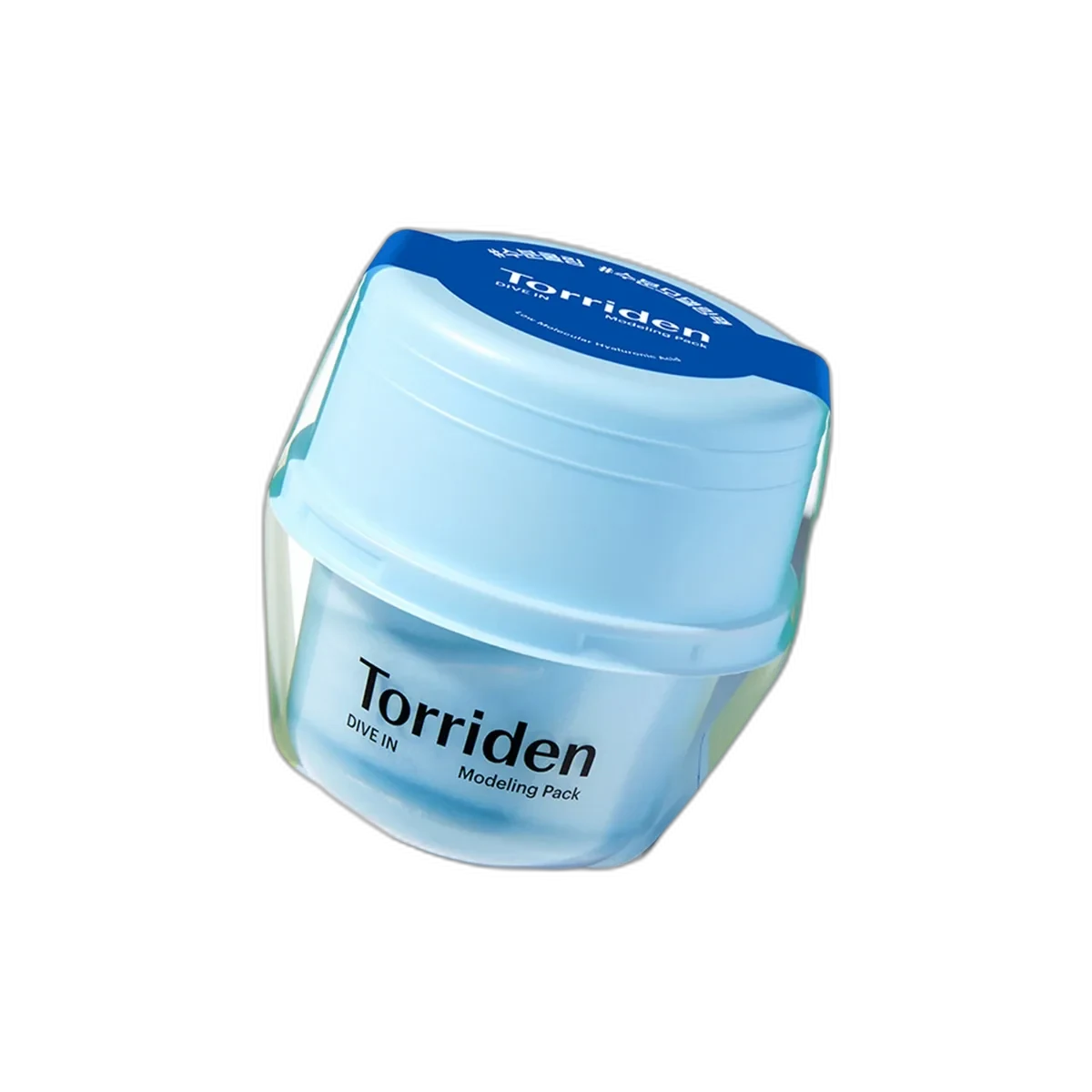
DIVE-IN Modeling Pack
K-Beauty Spa Ritual Mask
 Verified reviewer
Pros & cons.
- +Alginate occlusive film delivers substantive hydration during wear
- +Peel-off format is a satisfying spa-ritual experience
- +5-form HA stack ports the DIVE-IN hydration story into the format
- +Mild sebum absorption from kaolin benefits combination skin
- +Can be mixed with hydrating toner instead of water for stacked effect
- +Fragrance-free, alcohol-free, sensitive-skin tolerant
- +$3.74 per session in the 5-pack is reasonable value for the format
- −High-effort format requires mixing, spatula application, and cleanup
- −Learning curve on the powder-to-water ratio
- −Setting time is unforgiving — no save-for-later option
- −2025 launch means limited long-term real-world data
- −Not a great fit for users who want low-effort weekly treatments
The full review.
Modeling packs occupy a quiet niche in K-beauty. These peel-off rubber masks are the type you saw at Korean spas a decade ago. They have lost shelf space to sheet masks for years because sheet masks require less effort and are easier to market. Most new K-beauty brands skip modeling packs. Torriden launched one in 2025. This decision suggests users seeking a ritual skincare experience—mixing, applying, and peeling—prefer modeling packs over sheet masks. It also suggests the DIVE-IN line’s hyaluronic acid can provide more substantive hydration than the standard category mix of humectants and soothing extracts.
The learning curve begins when you open the packet. The 25 grams of loose powder looks like a mix of flour and fine sand. The INCI lists diatomaceous earth and glucose at the top, followed by algin, kaolin, calcium sulfate, xanthan gum, corn starch, cellulose gum, and the humectant layer. Mix it with water in a clean bowl at a 1:1 ratio by volume. Stir quickly with a spatula; you have 60-90 seconds before the alginate cross-links with the calcium sulfate and the paste sets. Apply it thickly to your face with the spatula and wear it for 15-20 minutes.
The application determines if modeling packs feel like a ritual or a chore. The alginate reaction creates an immediate, dramatic cooling sensation—more intense than a sheet mask, but not uncomfortable. The paste turns from a thick liquid to a flexible rubber within five minutes. Once set, the format holds the humectant layer against the skin for the full wear. Peel-off removal is more satisfying than sheet masks. The post-rinse finish is plumper, smoother, and more refined than 15 minutes of sheet mask exposure, likely due to the quality of the occlusive seal.
The formulation is thoughtful. The 5-form HA stack (positions 12 through 16 on the INCI) is the active payload; larger fractions contribute to the film-forming effect while smaller fractions deposit during the occlusive phase. Panthenol and allantoin at positions 17 and 18 provide active soothing to buffer the cooling sensation and any transient reactivity. The clay fraction (kaolin and diatomaceous earth near the top) adds mild sebum absorption, giving combination skin a gentle deep-cleaning effect that pure hydration masks lack. Trehalose, betaine, xylitol, and glycerin complete the humectant layer. The formula is fragrance-free, alcohol-free, essential-oil-free, and lacks ingredients likely to cause problems for reactive skin.
This format is not low-effort. You need a clean mixing bowl, a spatula, time to mix before the alginate sets, and time to peel and rinse. You also need patience to clean residue from your hairline and ears. The 25g packet is single-use; the reaction starts as soon as you add water. For users who like this ritual, the effort is the draw. For those wanting a 20-second apply-and-forget sheet mask, a modeling pack feels like homework.
The cost structure is interesting. At $6 for a single packet or $18.70 for a 5-pack ($3.74 per use), the per-session cost is lower than the DIVE-IN Sheet Mask at $3.30 per sheet when you buy the bundle. Most users will choose the sheet mask for convenience. However, the modeling pack lets you use your own hydrating toner instead of water, a common K-beauty hack that stacks the effect with existing products in a way sheet masks cannot.
Note a point of skepticism: this is a 2025 launch, so real-world data is thin. We have early reviews, ingredient analysis, and Torriden’s hydration track record, but we lack the three-plus years of feedback available for the DIVE-IN serum or sheet mask. Because the format is established and the ingredients are conventional, this low data confidence is a manageable risk. You are buying a conventional format with Torriden’s specific HA system. Buyers requiring deep track records should wait a year or two; those who enjoy new formulations can buy with reasonable confidence.
Who should buy it?
Users who enjoy ritual skincare and prefer the modeling pack format to sheet masks. Fans of the DIVE-IN line wanting to vary their weekly treatment. Anyone planning a spa-like pamper evening. Combination skin users who benefit from mild sebum absorption and hydration.
Who should skip it?
Anyone who finds mixing and peeling annoying. Anyone wanting a low-effort weekly treatment—the sheet mask is the obvious choice. Anyone with very dry skin who prefers a pure humectant format over the clay fraction.
Ingredient analysis.
Full INCI list
Diatomaceous Earth, Glucose, Algin, Kaolin, Calcium Sulfate, Xanthan Gum, Zea Mays (Corn) Starch, Cellulose Gum, Trehalose, Betaine, Xylitol, Hyaluronic Acid, Sodium Hyaluronate, Potassium Hyaluronate, Hydroxypropyltrimonium Hyaluronate, Hydrolyzed Sodium Hyaluronate, Panthenol, Allantoin, Potassium Alginate, Sodium Dehydroacetate, Dextrin, Tetrasodium Pyrophosphate, Water, Glycerin, 1,2-Hexanediol, Undaria Pinnatifida Extract, Gardenia Florida Fruit Extract
Skin match.
The science.
The Science
Modeling packs rely on a specific chemistry — the cross-linking of sodium alginate with divalent calcium ions (provided by calcium sulfate in this formula) to form a flexible polymer network that sets within minutes of mixing with water. This reaction has been studied extensively in food science and cosmetic applications, and produces a reliable, reproducible gel that provides genuine occlusive coverage for the duration of wear. The occlusion itself is the primary mechanism of hydration delivery in modeling masks — by preventing transepidermal water loss during the 15-20 minute wear, the mask raises the stratum corneum water content significantly above baseline, even before the humectant payload is factored in. The humectant layer in this formula is dominated by Torriden's 5-form hyaluronic acid system, which has the same supporting literature as the brand's other DIVE-IN products — multi-weight HA delivers hydration at multiple corneocyte depths, with the larger forms (like the crosspolymer implicit in the naming convention) creating substantive surface films and the smaller hydrolyzed fractions penetrating for deeper water binding. Kaolin and diatomaceous earth have well-documented sebum-absorbing properties, providing a mild deep-cleaning effect that complements the humectant delivery. The clay fraction can slightly reduce surface oil without the aggressive drying effect of bentonite or French green clay, which is why this formulation tolerates combination and oily skin without causing rebound sebum production. Panthenol and allantoin have established anti-inflammatory and barrier-supporting properties at the concentrations typically used in topical products. Overall, the scientific support for this modeling pack is solid on the occlusion mechanism, solid on the hyaluronic acid delivery, and reasonable on the clay absorption and panthenol soothing axes — the format is well-validated, and Torriden's specific active selection is consistent with the brand's hydration-focused philosophy.
Dermatologist Perspective
Dermatologists generally view modeling packs as acceptable supplementary products when formulated without fragrance, alcohol, or aggressive clay blends. Board-certified dermatologists note that the alginate-calcium reaction is chemically inert from a skin-tolerance perspective — the reaction occurs before application, so there's no ongoing chemical activity on the skin itself during wear. The main caution dermatologists flag is that peel-off masks can occasionally cause micro-trauma during removal for users with extremely fragile skin, rosacea, or active eczema flares, and those patients should either avoid the format or peel off the mask very gently. For the typical healthy-skinned user, dermatologists commonly accept modeling packs as a reasonable weekly ritual product, and this particular formulation's fragrance-free and acid-free design makes it broadly safe. As with all sheet-mask-adjacent formats, dermatologists emphasize that modeling packs are supplementary, not replacements for daily serums and moisturizers.
Where it fits in your routine.
Open the 25g packet and pour the powder into a clean, dry bowl. Add cool or room-temperature water (or hydrating toner) at the 1:1 volume ratio specified on the packet. Stir quickly with a spatula to make a smooth thick paste — you have 60-90 seconds before the alginate sets. Apply immediately to cleansed skin with the spatula, covering the entire face in a thick even layer (avoid the eye area and lips). Leave on for 15-20 minutes while the mask sets into a flexible rubber gel. Peel off from the edges, aiming to remove it in a single piece. Rinse residue with water. Follow with your normal toner, serum, and moisturizer routine. Use weekly or every 10 days.
Buy a single 25g packet for $6 or a 5-pack for $18.70 ($3.74 per packet in the bundle). The 5-pack offers better per-use value and suits regular users best. The cost per use matches sheet masks, but requires more effort—you trade convenience for the spa-ritual experience and more substantive occlusive delivery. The value is solid for users who enjoy the mixing-and-peeling ritual. Sheet masks win for pure efficiency. As an emerging brand launching in 2025, the premium pricing warrants a moderate mental discount, though the per-packet cost sits in the reasonable mid-tier for K-beauty modeling products.
Buy this if you enjoy ritual skincare and prefer the spa-like modeling pack format over low-effort sheet masks. It works for combination skin users who want mild sebum absorption and hydration, DIVE-IN line fans wanting to vary their weekly treatment, and pamper-night users wanting a more elaborate skincare moment.
Skip this if you want a low-effort weekly treatment — the DIVE-IN Sheet Mask provides similar hydration with less work. Skip this if you dislike mixing-and-peeling cosmetics, have very dry skin that lacks a need for clay, or want long-term data before trying a 2025 product launch.
Product details.
Loose powder mixes with water into a thick paste and sets into a flexible rubber-like gel during wear
Unscented
25g foil packet, sold individually or in 5-pack bundles
First use has a small learning curve — the powder-to-water ratio determines if the mask sets into a flexible rubber or stays runny. The alginate-calcium reaction feels cooling upon application. Within minutes, the paste sets into a peelable gel that lasts the full 15-20 minute wear. Peel-off removal is more satisfying than sheet masks, and the post-rinse finish looks plumper and more refined.
Each 25g packet is for single use — the format is one session per packet.
24 months
All Year
The backstory.
Torriden launched the DIVE-IN Modeling Pack in 2025 as an extension of the DIVE-IN hydration line into the traditional Korean spa-mask format. The decision to enter this category is interesting because modeling masks are an older K-beauty format that most new brands skip in favor of sheet masks. Torriden's reasoning appears to be that users who want a ritual skincare experience — mixing, applying, peeling — prefer modeling packs to sheet masks, and that the HA-layering story could deliver more substantive hydration in that format than the category norm.
About Torriden
Emerging Brand (2–5 years)Torriden launched in 2021, and the DIVE-IN line is the brand's flagship hydration range. The Modeling Pack enters the traditional Korean spa-format rubber mask category. This K-beauty format is well-established, even though this specific product is a recent release.
Common myths.
Modeling packs remove impurities from the skin via peel-off action.
The peel-off effect mechanically removes the alginate film rather than pulling impurities from the dermis. The 'deep cleaning' sensation results from sweat and sebum that accumulate on the skin surface during the 15-20 minute wear and then peel away. The product works by delivering humectants and soothing agents during the occlusive phase, not through the peel itself.
Modeling packs deliver more hydration than sheet masks because they're thicker.
Thickness doesn't matter—occlusion time and HA substantivity do. Modeling packs and sheet masks both provide 15-20 minutes of occlusion. Hydration depends on humectant selection, not format. This modeling pack uses the same HA system as the Torriden sheet mask, but uses a different delivery method.
FAQ.
How do I mix the Torriden DIVE-IN Modeling Pack?
Pour the powder into a clean bowl. Add water or hydrating toner at the ratio on the packet (usually 1:1 powder to water by volume). Stir quickly with a spatula to make a smooth thick paste. Apply to the face immediately before the alginate sets.
Can I use my hydrating toner instead of water?
Yes — this is a common K-beauty hack for enhancing the hydration payload. Torriden's own DIVE-IN Skin Booster works well for this. Just make sure the liquid is cool or room temperature; warm liquid can accelerate setting too quickly.
Is it messy to use?
Partially. Mixing and applying requires a learning curve. You need a clean bowl, a spatula, and time to rinse residue after peeling. It requires more effort than a sheet mask, which appeals to users seeking a spa-ritual experience.
How often should I use it?
Most people use modeling packs once a week or every 10 days. You can use them more often, but weekly use balances cost and effort for most routines.
Is it safe for sensitive skin?
Yes — it is fragrance-free, alcohol-free, and essential-oil-free. Panthenol and allantoin act as active soothers. Very reactive users occasionally note a cooling sensation during setting, but this is not an irritation signal.
How does it compare to the DIVE-IN Sheet Mask?
Both use Torriden's 5-form HA complex but use different delivery methods. The sheet mask is pre-measured and requires less effort. The modeling pack offers a spa ritual that peels off and absorbs clay-sebum. Choose based on preference — both work.
Can I use it before makeup?
Yes, but plan ahead — the 15-20 minute wear plus mixing and rinsing adds ~30 minutes to your pre-event routine. The plumping effect stays stable under foundation.
Community
What the community says.
"Satisfying spa-like ritual experience"
"Cooling sensation as the mask sets"
"Noticeable plumping after removal"
"Fragrance-free and gentle on sensitive skin"
"Mixing and peel-off process is messy"
"Learning curve on the water-to-powder ratio"
"Single-use format makes regular use impractical"
People also looked at.