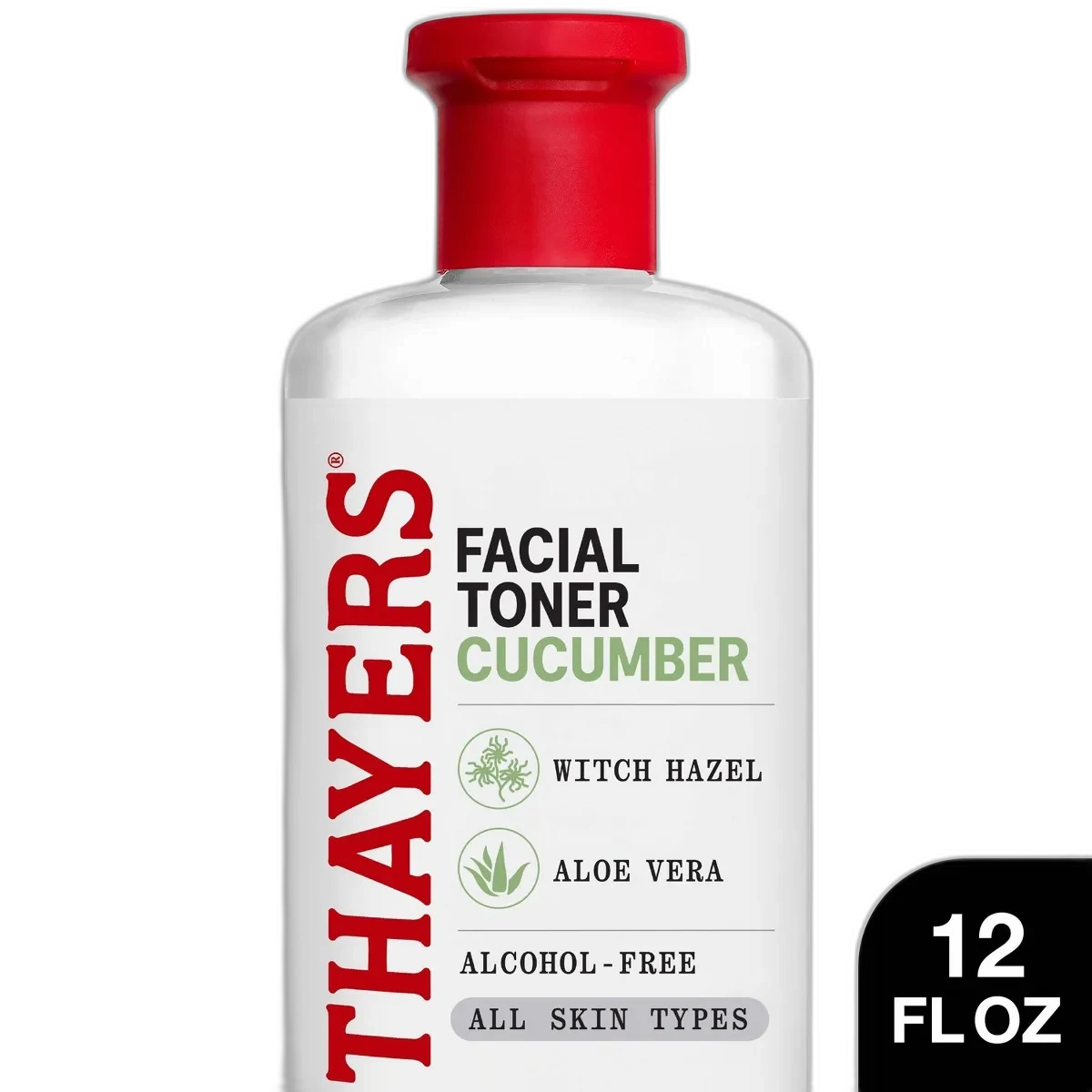
Cucumber Facial Toner
Drugstore Holy Grail
 Verified reviewer
Pros & cons.
- +Actually hydrating instead of drying despite containing witch hazel
- +Ten-ingredient short list with nothing irritating or controversial
- +Excellent value at roughly $1 per ounce
- +Gentle enough for sensitive, reactive, or pregnant users
- +Fragrance-free with only natural cucumber extract scent
- +Vegan, cruelty-free, and dermatologist-recommended
- +Versatile application — hands, cotton round, or layered K-beauty style
- +Generous 12 oz bottle that lasts months with daily use
- −No active ingredients to address pigmentation, acne, or aging
- −Plastic bottle replaced the original apothecary glass packaging
- −Cucumber scent is mild and fades within seconds of application
- −Functionally similar to other Thayers variants — different scent only
- −Toner step itself is genuinely optional in modern routines
The full review.
In 1847, Connecticut physician Henry Thayer sold a witch hazel preparation from his pharmacy as medicine. It treated cuts, bites, and minor skin irritations—a botanical first aid tool for any small-town apothecary. Thayer’s preparation differed because he refused to use alcohol to extract witch hazel tannins. While alcohol simplifies chemistry and extends shelf life, Thayer used only slowly distilled water. This made his version gentler than market competitors. This approach remains the reason Thayers toners exist 178 years later and why they sit on almost every skincare-curious teenager’s bathroom shelf in America.
The formula is short enough for a business card. Water, glycerin, witch hazel extract, aloe vera, cucumber extract, two preservatives, citric acid for pH adjustment, and potassium hydroxide. That is all. It has no actives in the modern sense—no acids, no peptides, no vitamin C, and no retinoids—and that is the intent. The cucumber variant is the most fragrance-free in the Thayers lineup (the brand also makes rose petal, lavender, and unscented versions of the same base). I would give this to anyone with reactive skin who cannot use witch hazel. They can use it, provided it is this kind.
The experience is pleasant. It pours as a clear, slightly slick liquid that smells faintly of fresh cucumber for thirty seconds before it absorbs. It does not tingle, tighten, or cause an astringent pucker. Glycerin and aloe provide hydration, while witch hazel provides mild tannins at sub-astringent concentrations. This offers a faint pore-refining feel without stripping the skin. If you avoided witch hazel due to a bad experience with a drugstore brown bottle containing 14% alcohol, this formula rehabilitates the ingredient.
This is not a treatment. Nothing in this bottle fades hyperpigmentation, smooths fine lines, clears breakouts, or builds collagen. It is a hydrating prep step—like an essence in a Korean routine—that helps the next serum absorb better and feel nicer. Using it as a treatment toner will disappoint you. Using it as a hydration layer at eleven dollars for a 12-ounce bottle provides clear value. At twice-daily use with a cotton round, this bottle lasts most users four to six months. You can budget under three dollars per month for a daily-use step with zero downside.
The brand’s drugstore positioning matters for value. L’Oréal acquired Thayers in 2023, which surprised the indie-skincare community, but the formula remains intact and the price is steady. The packaging shifted from the iconic apothecary glass bottle to plastic over the last decade. This is an aesthetic loss, as the original glass bottle was a piece of history, but it does not change the contents. If bottle aesthetic matters more than contents, that is a fair complaint. If contents matter more than the bottle, the contents remain the same.
I disagree with the idea that everyone needs a toner. They do not. Modern cleansers are pH-balanced, modern moisturizers contain glycerin and humectants, and a well-built routine can skip toner without loss. This product offers a low-stakes, low-cost extra hydration layer for people who enjoy the ritual of toning, want to slow their routine, like the cool feel of a watery liquid after cleansing, or want a gentle witch hazel option for mild oiliness. If you are one of those people, this is the right toner. If you want results for dark spots, breakouts, or fine lines, spend your toner budget on actives instead.
The cucumber extract is worth noting. Independent evidence for cucumber’s topical benefits is limited. In cosmetic chemistry, it acts as a soothing botanical with a refreshing scent. At this concentration, it affects the sensory experience more than skin outcomes. This is not a flaw, as sensory experience is why people use toners, but the cucumber version has no different functional outcomes than the rose or unscented versions. Pick the scent you like; the formula works the same in all three.
Who this is for: anyone wanting a reliable, gentle, hydrating toner with no surprises or ingredient-list anxiety, especially people with sensitive or reactive skin who struggle with traditional astringent toners. Who it isn’t for: shoppers looking for actives, results-oriented users wanting clinical work from a toner, and minimalists who see no point in an extra step that addresses nothing specific.
Who this is for
anyone who wants a reliable, gentle, hydrating toner with no surprises and no ingredient-list anxiety, particularly people with sensitive or reactive skin who’ve struggled with traditional astringent toners.
Who it isn’t for
shoppers looking for actives, results-oriented users who want their toner to do clinical work, and minimalists who don’t see the point of an extra step that doesn’t address anything specific.
Formula
Ingredient analysis.
Full INCI list · pH 5.5
Aqua/Water/Eau, Glycerin, Hamamelis Virginiana (Witch Hazel) Bark/Leaf/Twig Extract, Aloe Barbadensis Leaf Extract, Cucumis Sativus (Cucumber) Fruit Extract, Phenoxyethanol, Caprylyl Glycol, Ethylhexylglycerin, Citric Acid, Potassium Hydroxide
Skin match.
The science.
The Science
This formula's science focuses on what it excludes. Witch hazel (Hamamelis virginiana) contains tannins that show mild astringent and anti-inflammatory effects topically, though extraction method and concentration dictate strength. Alcohol-extracted witch hazel concentrates tannins but introduces ethanol's known barrier-disrupting effects; water-extracted witch hazel, like Thayers' proprietary preparation, has a milder tannin profile and avoids alcohol. Peer-reviewed dermatology research shows witch hazel's anti-inflammatory effects treat minor skin irritation, especially when paired with humectants—the exact way this formula is built.
Glycerin and aloe vera are the two real workhorses. Glycerin is a top-tier, well-studied humectant that draws water into the stratum corneum to improve short-term hydration. Aloe vera has more variable evidence but a long history of soothing and mild humectant effects, which helps compromised or post-cleanse skin. Together, they provide most of the measurable hydration in this toner; witch hazel and cucumber act as supporting characters in the humectant profile.
Cucumber fruit extract has the weakest evidence. Some in vitro data shows antioxidant activity in cucumber-derived compounds, but topical clinical evidence in cosmetics is limited. It serves as a brand differentiator and sensory note rather than a functional active. The pH of around 5.5 aligns with the skin's natural acid mantle and supports barrier integrity.
The formula's omissions are also evidence-relevant. Because it lacks alcohol, fragrance, essential oils, drying surfactants, and acids, the irritation risk is low—a fact supported by long-term real-world data from millions of users. The lack of actives is an intentional design, not an oversight.
Dermatologist Perspective
Dermatologists often recommend alcohol-free witch hazel formulations like this one for patients seeking a gentle hydrating toner without the irritation risk of acid-based or alcohol-based toners. Board-certified dermatologists note the toner step is optional in modern routines, but for patients who enjoy the ritual or want to address mild oiliness without overdoing it, the Thayers line is a consistently recommended drugstore option. Dermatologists treating sensitive skin, rosacea, or post-procedure recovery often suggest fragrance-free hydrating formulas—and while the cucumber variant contains trace botanical extracts, it stays within the tolerable range for most reactive skin types. The standard professional caveat is that this is not a treatment product and does not address acne, pigmentation, or aging concerns beyond gentle hydration support.
Where it fits in your routine.
Apply twice daily after cleansing and before serums. The easiest way is to pour a small amount onto a cotton round and sweep it across the face, neck, and decolletage. For more hydration, put a few drops into clean palms and pat directly onto damp skin like a Korean essence. Layer 2-3 passes if your skin is dehydrated. Follow with serum and moisturizer immediately while skin is still damp to lock in hydration.
At roughly $12 for 12 fl oz, the cost is about $1 per ounce—great value for a daily-use toner with a clean ingredient list. Most users use one bottle for 4-6 months applying twice daily with a cotton round, making the monthly cost under $3. No premium-tier toner offers comparable simplicity or meaningfully different results, which justifies staying in the drugstore tier for this category. The 8.5 oz and 3 oz sizes work for travel and trial, but the 12 oz size offers the best per-ounce value and is what most regular users will choose.
This alcohol-free hydrating toner works for anyone needing gentle hydration. It suits sensitive skin, users seeking witch-hazel without harsh astringents, and budget-conscious shoppers wanting clean ingredients without prestige prices.
If you want actives, hyperpigmentation, anti-aging, or acne treatment, skip this. This formula has no clinical actives and only provides hydration. Skip this if you don't use a toner; this product doesn't change that.
Product details.
Watery clear liquid
Fresh, mild cucumber — fragrance-free formula
12 oz plastic bottle with screw cap
The glycerin makes it feel cool and slightly slick. It has no tingling, no astringent burn, and no lingering scent. Skin feels comfortable and prepped within seconds without an adjustment period.
4-6 months with twice-daily face application using a cotton round
12 months
All Year
The backstory.
Henry Thayer, a Connecticut physician, started selling his witch hazel preparation in 1847 as a medicinal remedy. The brand survived 175+ years largely intact, was acquired by L'Oréal in 2023, and the modern facial toner line (cucumber, rose petal, unscented, lavender) was developed in the 1990s as the brand pivoted toward beauty retail.
About Thayers
Legacy Brand (20+ years)Thayers is one of the oldest continuous personal care brands in the United States. Connecticut physician Henry Thayer founded the brand in 1847. Thayers uses traditional witch hazel preparation methods refined for over 175 years.
Common myths.
All witch hazel is drying and harsh. Alcohol-extracted witch hazel creates this reputation. This formula uses Thayers' alcohol-free distillation with glycerin and aloe. This makes it one of the gentlest toner formats available — it is hydrating.
Most modern cleansers are pH-balanced and don't need a corrective toner. This product doesn't focus on pH correction; it provides hydration and a soothing post-cleanse step.
FAQ.
Can I use this on sensitive skin?
Yes. The ten-ingredient formula has no fragrance, no essential oils, no alcohol, and no acids. It is one of the most reliably gentle toners in the drugstore tier — the cucumber extract is at a low cosmetic level and rarely causes reactions.
What's the difference between the Cucumber, Rose Petal, and Unscented versions?
All three use the same witch hazel/glycerin/aloe base. Cucumber contains cucumber fruit extract for a fresh-skin feel, Rose Petal uses rose extract and a light floral note, and Unscented removes the botanical extras for the most reactive skin.
Is this safe to use during pregnancy?
Yes. The formula has no retinoids, no salicylic acid, no hydroquinone, and no essential oils — nothing on standard pregnancy-caution lists.
Will it help with acne?
Indirectly at best. This formula lacks active acne-fighting ingredients. It works as a non-drying alternative to harsh astringents, but active acne treatment requires a separate salicylic acid or benzoyl peroxide product.
Why did Thayers switch from glass to plastic bottles?
The brand switched from glass to reduce shipping weight and costs during mass retail expansion. Longtime users miss the apothecary-style glass bottle, but the formula is the same.
How should I apply Thayers toner?
Pat it on with clean hands, use a cotton round, or apply multiple layers Korean-skincare-style for extra hydration. Any method works — the formula is gentle enough for any application style.
What the community says.
"actually hydrating not drying"
"clean simple ingredient list"
"fresh cucumber scent"
"big 12 oz bottle"
"gentle enough for daily use"
"plastic bottle not premium"
"no active ingredients beyond hydration"
"cucumber scent fades quickly"
"glass bottle discontinued"