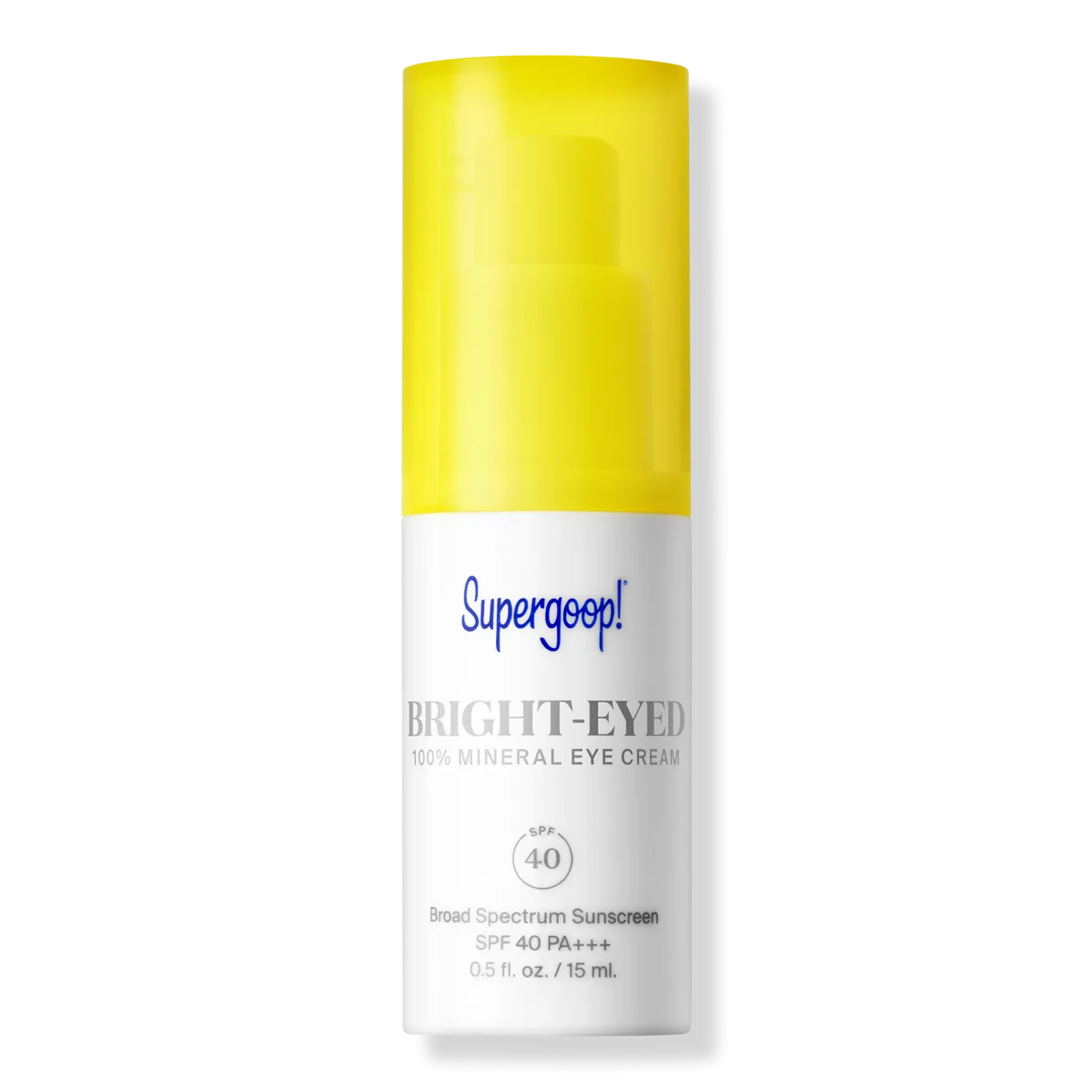
Bright-Eyed 100% Mineral Eye Cream SPF 40
Eye SPF Essential
 Verified reviewer
Pros & cons.
- +100% mineral formula with zinc oxide that does not sting or irritate the sensitive eye area
- +Iron oxide tint color-corrects dark circles while eliminating typical mineral white cast
- +Functions as eye cream, sunscreen, and concealer primer in one product
- +Fragrance-free with probiotic, caffeine, and antioxidant support for periorbital skin
- +Does not settle into fine lines or crease under makeup throughout the day
- +Pregnancy-safe, reef-safe, and cruelty-free with FSA/HSA eligibility
- −Single tint shade may not suit very fair or very deep skin tones equally
- −Small tube at 0.5 oz for $38 — requires repurchasing every 2-3 months
- −No anti-aging actives like retinol or peptides — protection only, not treatment
- −Can feel slightly heavy in very humid conditions
- −SPF claims assume adequate application thickness, which is hard to achieve around eyes
The full review.
Five to ten percent of all skin cancers occur in the periorbital area—the thin skin around the eyes. Most people skip sunscreen here or use face SPF and hope it does not migrate into the eyes and burn. It usually does. Chemical UV filters like avobenzone and oxybenzone often cause stinging and tearing, so many people leave a sunscreen-free border around their eyes. This creates an unprotected zone where the skin is thinnest and most vulnerable to UV damage.
Supergoop! built Bright-Eyed to close this gap, and Bright-Eyed does exactly what it promises. The formula uses 14.4% zinc oxide as its sole UV filter for two reasons. First, zinc oxide is a physical blocker that sits on the skin surface instead of being absorbed; it does not migrate into tear ducts like chemical filters. Second, zinc oxide provides broad-spectrum protection, blocking both UVA (aging and cancer-causing wavelengths) and UVB (burning wavelengths) without the instability issues of avobenzone.
Texture is the main challenge for mineral sunscreen around the eyes. Traditional zinc oxide formulas are thick, chalky, and leave a visible white residue on thin under-eye skin. Bright-Eyed uses a three-part strategy: coated zinc particles (triethoxycaprylylsilane treatment for better dispersion), iron oxide tinting (for color correction and to eliminate white cast), and a mousse-like cream base that blends without tugging the delicate periorbital skin.
Bright-Eyed goes on with a slight peach-pink tint and blends to a natural, skin-like finish. On most light to medium skin tones, the color correction brightens the under-eye area and makes dark circles appear softer immediately. This dual function—sunscreen plus color corrector—lets Bright-Eyed replace both an AM eye cream and an under-eye primer. For deeper skin tones, the tint may look slightly ashy or warm, a limitation of the single-shade approach.
Beyond UV protection, the formula includes ingredients that go beyond basic mineral sunscreen. Caffeine from griffonia simplicifolia seed extract provides temporary vasoconstriction to reduce puffiness. Lactobacillus ferment lysate offers probiotic-derived barrier support for the sensitive eye area. Pomegranate and green tea extracts add antioxidant protection to complement the physical UV blocking. Glycerin and propanediol provide hydration, and the formula is fragrance-free.
Bright-Eyed feels like a proper eye cream—hydrating, smooth, and comfortable—rather than a downsized sunscreen. It does not settle into fine lines, crease under concealer, or pill when layered. These are basic expectations, but mineral sunscreens around the eyes rarely achieve this combination.
Bright-Eyed is a sunscreen first and an eye treatment second. If you want retinol, peptides, or serious anti-aging actives, Bright-Eyed is not that product. It protects and hydrates well, but it will not address deep wrinkles or significant hyperpigmentation alone. Use it in your morning routine alongside any targeted eye treatment used at night.
At $38 for 0.5 ounces, the price is steep but reasonable in context. Few mineral eye SPF products exist, and none at this price point match Bright-Eyed’s texture, tinting, and skin-friendly ingredients. The value lies in what Bright-Eyed replaces: a mediocre eye cream, a stinging facial sunscreen, and an under-eye primer.
Bright-Eyed is not revolutionary in its ingredients or claims. It is revolutionary because it exists. The periorbital area has been a sunscreen dead zone for decades, and Supergoop! built a product that makes protection feel natural rather than punishing. This makes it worth considering for anyone who takes sun protection seriously.
Ingredient analysis.
Full INCI list
Active Ingredient: Zinc Oxide 14.4%. Inactive Ingredients: Water, Caprylic/Capric Triglyceride, Glycerin, Propanediol, Butyloctyl Salicylate, Glyceryl Stearate Citrate, Lauroyl Lysine, Cetyl Esters, Inulin Lauryl Carbamate, Polyhydroxystearic Acid, Cetearyl Alcohol, Potassium Cetyl Phosphate, Griffonia Simplicifolia Seed Extract, Titanium Dioxide, Olive Oil Polyglyceryl-6 Esters, Mica, Triethoxycaprylylsilane, Microcrystalline Cellulose, Glyceryl Glucoside, Hydroxyacetophenone, Polyurethane-79, Diethylhexyl Syringylidenemalonate, Sodium Stearoyl Lactylate, 1,2-Hexanediol, Caprylyl Glycol, Sodium Citrate, Trisodium Ethylenediamine Disuccinate, Camellia Sinensis Leaf Extract, Lactobacillus Ferment Lysate, Punica Granatum Extract, Sodium Stearoyl Glutamate, Xanthan Gum, Cellulose Gum, Iron Oxides, Hedychium Coronarium Root Extract
Skin match.
The science.
The Science
Zinc oxide at 14.4% provides broad-spectrum UV protection via a physical mechanism. The particles reflect and scatter UV radiation instead of absorbing and converting it like chemical filters. This makes zinc oxide photostable, unlike avobenzone, which degrades under UV exposure without stabilizers. Physical blocking works best for the periorbital area because the particles stay on the skin surface and do not enter tear ducts.
The iron oxides in this formula do more than color correct. Bernstein et al. (2021) published research in the Journal of the American Academy of Dermatology showing that iron oxides protect against visible light and high-energy visible (HEV) blue light—wavelengths zinc oxide alone does not block adequately. Visible light induces hyperpigmentation, especially in darker skin tones (Fitzpatrick IV-VI), and causes photoaging through reactive oxygen species generation. Zinc oxide plus iron oxides provides more complete photoprotection than zinc oxide alone.
Caffeine's topical effects around the eyes come from its vasoconstrictive properties. It constricts periorbital blood vessels, temporarily reducing the blood pooling that creates dark circles. A review in the Journal of Cosmetic Dermatology noted that caffeine also inhibits phosphodiesterase, which increases cAMP levels in adipocytes and promotes lipolysis; this may reduce periorbital puffiness from fluid retention.
Lactobacillus ferment lysate provides postbiotic support. It delivers metabolites that strengthen the skin's acid mantle and support the resident microbiome. Maintaining barrier integrity is vital in thin periorbital skin, as compromised barriers there increase transepidermal water loss, sensitivity, and visible aging.
Dermatologist Perspective
Dermatologists recommend sun protection for the periorbital area. Eyelid skin is roughly 0.5mm thick—among the thinnest on the body—and lacks the sebaceous glands that provide natural photoprotection elsewhere on the face. Board-certified dermatologists note that 5-10% of skin cancers occur around the eyes. They prefer mineral-only formulas like Bright-Eyed for this area because zinc oxide does not cause the stinging or irritation linked to chemical UV filters. Dermatologists also note the iron oxide tinting is not just cosmetic; it provides measurable visible light protection that zinc oxide alone cannot deliver.
Where it fits in your routine.
Apply a small amount (about the size of a grain of rice per eye) to the orbital bone area with your ring finger. Gently pat and blend. Do not rub aggressively; the periorbital skin is delicate. Apply after eye serums or treatments but before face sunscreen and makeup. Use it as a base for concealer. Reapply every two hours during extended outdoor sun exposure. One morning application works for daily indoor and commute use.
At $38 for 0.5 oz, Bright-Eyed costs more than most eye creams but stays competitive for a specialized mineral sunscreen. Few products fit this niche: mineral SPF for the periorbital area that has an elegant texture and no white cast. Supergoop! has 17+ years in the SPF category, which supports its UV protection claims. Daily use lasts the tube for about 2-3 months, making the annual cost $150-$230. Because Bright-Eyed replaces a separate AM eye cream and under-eye primer, the consolidated value is reasonable for users buying all three products.
This works for anyone wanting mineral SPF protection for the eye area without the stinging, white cast, or thick texture most sunscreens cause there. It helps people with dark circles, sensitive eyes, or those skipping sunscreen in the periorbital area.
Skip this if you want a treatment-focused eye cream with anti-aging actives like retinol or peptides, if the single tint shade misses your skin tone, or if you want to use your facial sunscreen on the eye area instead of a separate product.
Product details.
Mousse-like cream with a slight pinkish-peach tint. It is thicker than expected for an eye cream but blends smoothly without tugging. It absorbs into a natural, non-chalky finish.
No detectable fragrance — clean and neutral.
Small squeeze tube has a narrow applicator tip for precise dispensing. It fits easily in a travel kit or makeup bag.
The mineral tint and mica provide immediate brightening; dark circles look softer right after application. The formula causes no stinging, burning, or sensitivity around the eye area. The mousse texture feels hydrating but not heavy. It blends into a natural finish that works alone or under concealer.
2-3 months with daily AM use around both eyes
12 months
All Year
The backstory.
Supergoop! developed Bright-Eyed after learning from dermatologists that the eye area is one of the most UV-vulnerable zones on the face, yet most people either skip sunscreen there entirely or use formulas that sting and irritate. Launched in 2020, it addressed a genuine gap in the market — most eye creams lack SPF, and most sunscreens are too harsh for the delicate periorbital skin.
About Supergoop!
Established Brand (5–20 years)Holly Thaggard founded Supergoop! in 2007 to make sunscreen a daily habit. The brand is Leaping Bunny certified cruelty-free and reef-safe. Supergoop is not dermatologist-developed, but the brand consulted dermatologists during product development. Independent testing verifies the UV protection claims of its SPF products.
Common myths.
Regular facial sunscreen works around the eyes; you do not need a separate eye SPF.
Many facial sunscreens contain chemical UV filters (avobenzone, oxybenzone) that can cause stinging and tearing when applied near the eyes. Mineral formulations like Bright-Eyed use zinc oxide, which sits on the skin surface and does not migrate into the eyes. The eye area also has thinner skin that benefits from gentler formulations.
Mineral sunscreens always leave a white cast that looks bad under the eyes.
Modern mineral formulations like Bright-Eyed use coated zinc oxide particles and iron oxide tinting to stop white cast. The iron oxides correct color, while the surface-treated zinc disperses evenly without the chalky finish of older mineral formulas.
FAQ.
Does Supergoop Bright-Eyed leave a white cast?
No — the formula uses 100% zinc oxide mineral, but includes iron oxide tinting and coated zinc particles for a natural, non-chalky finish. The slight peach-pink tint color-corrects dark circles. However, the tint shade may not be neutral on all skin tones.
Can you wear makeup over Supergoop Bright-Eyed?
Yes — the formula works as an eye primer. It creates a smooth, hydrated base for concealer adhesion. Mineral particles set makeup and prevent creasing. Many users call it one of the best under-eye primers they have tried.
Is Supergoop Bright-Eyed pregnancy safe?
Yes — the formula uses only zinc oxide for mineral UV protection. It has no chemical filters, retinoids, or ingredients contraindicated in pregnancy. Dermatologists recommend zinc oxide as one of the safest sunscreen options during pregnancy and breastfeeding.
How often should I reapply Supergoop Bright-Eyed?
Apply once in the morning for daily indoor and commute activities. Reapply every two hours for extended outdoor exposure — beach, hiking, outdoor sports — as with any sunscreen. The formula layers well, but blot excess before reapplying to prevent buildup.
Can Supergoop Bright-Eyed replace my eye cream?
Use it in the AM. Glycerin and propanediol hydrate, caffeine depuffs, and SPF 40 provides antioxidant protection. It lacks anti-aging actives like retinol or peptides, so use a dedicated PM eye treatment if you target wrinkles or significant dark circles.
What the community says.
"No white cast despite being 100% mineral — the tint blends seamlessly"
"Hydrating formula does not settle into fine lines or crease under makeup"
"Works beautifully as a primer for under-eye concealer"
"Gentle enough for sensitive eye area without stinging or irritation"
"Fragrance-free and reef-safe with high SPF protection"
"Tint can be too warm or peachy for very fair or very deep skin tones"
"Pricey at $38 for just 0.5 oz — a small amount of product"
"SPF may not be sufficient as the sole under-eye sun protection for extended outdoor exposure"
"Some users feel it does not provide special eye care benefits beyond basic SPF"
"Can feel slightly thick or heavy in humid weather"
People also looked at.