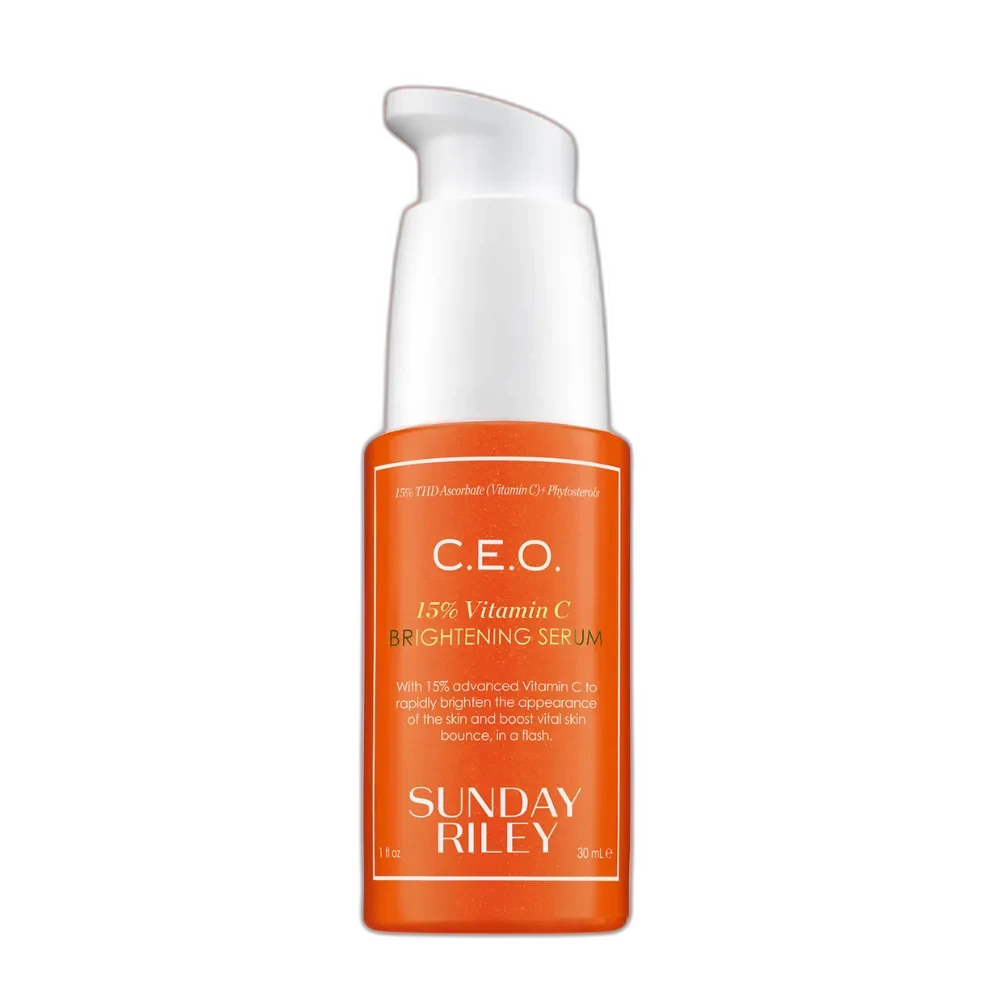
C.E.O. 15% Vitamin C Brightening Serum
Award-Winning Vitamin C
 Verified reviewer
Pros & cons.
- +15% THD ascorbate is significantly more stable than L-ascorbic acid serums
- +Delivers visible skin brightening within 1-2 weeks of daily use
- +No stinging or irritation from low pH — works at skin-neutral pH
- +Multiple beauty awards including Allure Best of Beauty
- +Squalane-based formula provides lightweight moisture alongside vitamin C
- +Three size options including a $50 trial size for testing before committing
- −Citrus essential oils (orange, tangerine) are photosensitizers in a morning serum
- −Premium $85 per ounce price when affordable THD alternatives exist
- −Research shows THD may degrade rapidly under oxidative stress without specific stabilizers
- −Contains beeswax derivatives — not vegan despite cruelty-free certification
- −Brand's FTC fake review settlement (2015-2017 period) affects early review trustworthiness
The full review.
About Sunday Riley
The vitamin C serum market has a dirty secret: most of the products people buy have already started degrading by the time they use them. L-ascorbic acid — the form with the most clinical evidence — is notoriously unstable, oxidizing when exposed to light, air, and warm temperatures. That $80 serum you ordered online and left on your doorstep for a few hours? There’s a decent chance it’s already less potent than the label claims. Sunday Riley’s C.E.O. serum was built around rejecting this problem entirely.
Tetrahexyldecyl Ascorbate — THD for short — is a vitamin C derivative that solves the stability problem by being lipid-soluble rather than water-soluble. While L-ascorbic acid degrades in weeks to months even in the best packaging, THD remains stable for far longer because it’s not reactive with water and oxygen in the same way. It also doesn’t require the aggressively low pH (below 3.5) that L-ascorbic acid needs for penetration, which means no stinging, no flushing, and no burning sensation on application. For the significant number of people who’ve tried vitamin C serums and given up because they couldn’t tolerate the irritation, THD offers a genuine alternative.
At 15%, the THD concentration in this serum is meaningful — it’s listed as the second ingredient after water, confirming it’s present in substantial amounts. The lipid-soluble nature allows THD to penetrate through the skin’s lipid barrier more efficiently than water-soluble vitamin C, which theoretically means better delivery to the cells where it needs to work. Once inside skin cells, THD is converted to ascorbic acid (the active form), where it can inhibit tyrosinase (the enzyme that drives melanin production) and support collagen synthesis.
The practical results are well-documented across thousands of reviews: visible brightening within one to two weeks, meaningful improvement in dark spots and post-inflammatory hyperpigmentation within four to six weeks, and a cumulative glow that builds with consistent morning use. Multiple beauty awards — including Allure Best of Beauty — validate that the product delivers on its brightening promise.
Myth
But here’s where intellectual honesty requires a harder look. A 2021 study published in the International Journal of Molecular Sciences by Swindell et al. found that THD ascorbate alone ‘degrades rapidly under oxidative stress’ — completely breaking down within six minutes in a controlled assay — and showed no significant collagen production enhancement in fibroblasts on its own. The researchers found it needed to be paired with acetyl zingerone to demonstrate meaningful antioxidant and collagen-boosting activity. This Sunday Riley formula does not contain acetyl zingerone. It does contain tocopherol (vitamin E), which is a different type of antioxidant stabilizer with some synergistic properties, but the specific finding that THD alone may not be an effective antioxidant is a piece of evidence that should temper expectations about the product’s anti-aging claims.
Reality
A more favorable 2024 study by Min et al. in the Journal of Cosmetic Dermatology showed that a THD-containing serum produced significant decreases in pigmentation and fine lines over twelve weeks in 35 subjects. And a 2023 multicenter study found a 145% increase in collagen content versus control. The evidence base is growing, and the clinical results for brightening specifically are encouraging, even if the antioxidant protection mechanism is less certain than with L-ascorbic acid.
Formula
The formula surrounding the THD is relatively simple. Squalane provides the lipid vehicle that helps THD penetrate and adds lightweight moisture. Tocopherol (vitamin E) offers antioxidant synergy. Glycolic acid provides mild exfoliation that enhances the brightening effect by clearing pigmented surface cells. Saccharide isomerate binds to skin for long-lasting hydration. Soybean sterols support the skin barrier. It’s not an overloaded formula — it’s focused on the vitamin C delivery, which is arguably the right approach.
Texture
The experience of using it is pleasant, if imperfect. The serum has a lightweight, slightly rich texture that absorbs within a minute or two.
Scent
The citrus-orange scent from the sweet orange and tangerine peel oils is bright and fresh — most users enjoy it, and it fades quickly. But those same citrus oils are documented photosensitizers and allergens (containing limonene and linalool), which is a genuine formulation concern in a product designed for morning use before sun exposure. A vitamin C serum should be protecting your skin from environmental damage, not adding its own sensitization risk.
Packaging
The packaging is a solid opaque pump that protects the formula from light and air — important even for a stable derivative like THD. The pump dispenses controlled amounts, though several reviewers note difficulty extracting the last portion of product. Available in three sizes: 0.5 oz for $50 (trial size), 1.0 oz for $85 (standard), and 1.7 oz for $122 (best per-ounce value at $71.76).
Value
The value conversation is straightforward: this is a premium vitamin C serum in a market where The Ordinary and Naturium offer stable vitamin C products for a fraction of the price. What Sunday Riley offers at this price point is a proven formula with multiple beauty awards, elegant cosmetics, and a concentration that’s clearly labeled and verified. Whether the Sunday Riley experience is worth three to four times the cost of a budget alternative depends on how much you value the specific formulation approach and brand trust — keeping in mind that brand trust carries an asterisk here due to the FTC fake review settlement.
Best for
The C.E.O. serum does what it promises most visibly: it brightens skin. For people who’ve been frustrated by unstable vitamin C serums that oxidize before the bottle is half empty, or who’ve given up on the stinging and flushing of L-ascorbic acid, THD at 15% in a stable formula represents a practical solution. Just understand that you’re trading the depth of L-ascorbic acid’s evidence base for the convenience of a derivative that’s gentler and stabler — and that the research on THD’s standalone antioxidant efficacy is less settled than the marketing suggests.
Ingredient analysis.
Full INCI list
Aqua, Tetrahexyldecyl Ascorbate, Squalane, Polyglyceryl-6 Distearate, PEG-8 Beeswax, Limonene, Citrus Sinensis (Sweet Orange) Oil, Citrus Tangerina Peel Oil, Glycine Soja (Soybean) Sterols, PPG-12/SMDI Copolymer, Sodium Phytate, Tocopherol, Phenoxyethanol, Acetamidoethoxyethanol, Hydroxyethyl Acrylate/Sodium Acryloyldimethyl Taurate Copolymer, Sodium Acrylate/Sodium Acryloyldimethyl Taurate Copolymer, Jojoba Esters, Glycolic Acid, Caprylyl Glycol, Cetyl Alcohol, Polyglyceryl-3 Beeswax, Chlorphenesin, Glycerin, Polysorbate 60, Sorbitan Isostearate, Saccharide Isomerate, Linalool
Skin match.
The science.
The Science
Tetrahexyldecyl Ascorbate (THD) is a lipid-soluble ester of ascorbic acid. It penetrates the skin barrier via the lipid pathway, unlike L-ascorbic acid which uses the aqueous pathway. This chemistry offers practical advantages: stability at neutral pH (avoiding irritating low-pH formulas), resistance to oxidative degradation in the bottle, and better penetration through the skin's lipid-rich intercellular matrix.
A 2024 clinical study by Min et al. in the Journal of Cosmetic Dermatology tested a THD-containing serum in 35 subjects over 12 weeks. It found statistically significant decreases in pigmentation (p<0.0001) and fine lines/wrinkles (p<0.0001). A 2023 multicenter study by Hooper et al. in the Journal of Clinical and Aesthetic Dermatology showed a 145% increase in collagen content versus control and 20% improvement in mottled hyperpigmentation by week 12 — but these studies used formulations with additional actives, so THD's specific contribution is hard to isolate.
However, a 2021 study by Swindell et al. in the International Journal of Molecular Sciences questioned THD's standalone efficacy. Researchers found THD alone 'degraded completely within 6 minutes under oxidative stress' and showed 'no significant collagen enhancement in fibroblasts' without acetyl zingerone as a stabilizer. This matters because the Sunday Riley formula lacks acetyl zingerone — though it includes tocopherol (vitamin E), which provides antioxidant stabilization through a different mechanism.
Literature well-documents the vitamin C + vitamin E synergy: tocopherol regenerates oxidized ascorbic acid derivatives, extending their lifespan in the skin. No direct studies exist to confirm if this synergy overcomes the rapid THD degradation documented by Swindell et al. in this specific formulation.
The glycolic acid in the formula works independently to promote keratinocyte turnover, shedding pigmented surface cells to enhance brightening. This dual mechanism targets hyperpigmentation alongside THD's tyrosinase inhibition activity.
References
- Open-label topical application of tetrahexyldecyl ascorbate and acetyl zingerone containing serum improves the appearance of photoaging and uneven pigmentation — Journal of Cosmetic Dermatology (2024)
- Tetrahexyldecyl Ascorbate (THDC) Degrades Rapidly under Oxidative Stress but Can Be Stabilized by Acetyl Zingerone to Enhance Collagen Production and Antioxidant Effects — International Journal of Molecular Sciences (2021)
- Antioxidant Skincare Treatment for Hyperpigmented and Photodamaged Skin: Multi-Center, Open-Label, Cross-Seasonal Case Study — Journal of Clinical and Aesthetic Dermatology (2023)
Dermatologist Perspective
Board-certified dermatologists see THD ascorbate as a reasonable alternative for patients who cannot tolerate L-ascorbic acid, though the evidence base is smaller. Dermatologists note practical advantages — stability, gentleness, lipid solubility — that help patient compliance, as the best antioxidant is the one patients use consistently. Most dermatologists flag the citrus essential oils as an unnecessary irritation and photosensitization risk in a morning product, and some worry about the gap between THD's marketing and clinical evidence. For patients seeking brightening and pigmentation correction, dermatologists find the clinical results encouraging; for patients seeking antioxidant photoprotection, L-ascorbic acid formulations remain the gold standard.
Where it fits in your routine.
Apply 4-5 drops to clean, dry skin every morning. Press the serum into the skin using fingertips, starting at the face center and moving outward. Wait 1-2 minutes for absorption before applying moisturizer. Always follow with broad-spectrum SPF 30+ sunscreen — vitamin C enhances photoprotection but does not replace sunscreen. Use at night if desired, but antioxidant benefits work best during daytime UV and pollution exposure.
At $85 for 1 ounce, the C.E.O. serum costs more than most vitamin C products. The 0.5 oz trial at $50 and the 1.7 oz at $122 ($71.76/oz) provide options. THD stability reduces waste from oxidation, a common issue when L-ascorbic acid serums degrade before use. However, brands like The Ordinary (Ascorbyl Tetraisopalmitate at $8.90) and Naturium sell stable vitamin C derivatives for much less. The Sunday Riley premium price buys a proven formulation, beauty award validation, smooth texture, and 15% concentration certainty — but other brands offer the core technology for a fraction of the price.
This serum works for people seeking stable, gentle vitamin C for brightening, dark spot correction, and antioxidant protection. It suits those who find L-ascorbic acid products too irritating or unstable. It is ideal for combination, dry, and normal skin types who want elegant texture, proven brightening results, and can pay a premium for the formulation.
Citrus essential oils and fragrance allergens may irritate sensitive skin. Budget-conscious consumers can find comparable THD ascorbate products for less. Those seeking the strongest evidence-backed antioxidant protection should use L-ascorbic acid + ferulic acid formulations instead.
Product details.
Sweet orange and tangerine peel essential oils create a light citrus-orange fragrance. Most reviewers call the scent pleasant and fresh, but some find it overpowering. The scent fades minutes after application.
An opaque pump bottle protects the vitamin C from light and air. It comes in 0.5 oz ($50), 1.0 oz ($85), and 1.7 oz ($122). The pump dispenses controlled amounts, but extracting the last portion of product is difficult.
The first application feels light and slightly cooling as the serum absorbs. The citrus scent is immediate. Skin looks subtly brighter and more luminous right away. Most users feel no tingling or irritation, unlike the stinging L-ascorbic acid serums can cause. Most users notice improved radiance within the first week.
2-3 months with daily use of 4-5 drops (1 oz size)
12 months
All Year
The backstory.
Originally launched in 2017 as 'C.E.O. Rapid Flash Brightening Serum,' this product quickly became Sunday Riley's bestselling serum and earned multiple beauty awards including Allure Best of Beauty. The C.E.O. name plays on the vitamin C connection and the brand's characteristically bold product naming. It was later renamed to emphasize the 15% concentration, reflecting the skincare market's increasing focus on ingredient transparency and potency numbers.
About Sunday Riley
Established Brand (5–20 years)Cosmetic chemist Sunday Riley founded Sunday Riley in 2009 in Houston, Texas. The C.E.O. serum won several beauty awards, including the Allure Best of Beauty and Cosmopolitan Beauty Award (both 2018). Sunday Riley settled with the FTC in 2020 regarding fake Sephora reviews posted from 2015-2017.
Common myths.
THD ascorbate has the same anti-aging evidence as L-ascorbic acid.
Decades of clinical research confirm L-ascorbic acid boosts collagen, fights free radicals, and fades hyperpigmentation. THD ascorbate is newer and has a smaller, growing evidence base. A 2021 study in the International Journal of Molecular Sciences shows THD ascorbate degrades rapidly under oxidative stress and lacks significant collagen enhancement without stabilizers. THD ascorbate offers practical advantages like stability and gentleness, but lacks the clinical validation of L-ascorbic acid.
You need a low-pH vitamin C serum for it to work.
L-ascorbic acid follows that rule; it needs a pH below 3.5 to penetrate skin. THD ascorbate is oil-soluble and works at skin-neutral pH. It uses the lipid pathway to enter cells instead of the water-based route L-ascorbic acid depends on. This formula is not acidic, so it is less irritating than traditional vitamin C serums.
FAQ.
What type of vitamin C is in the Sunday Riley C.E.O. serum?
This serum uses 15% Tetrahexyldecyl Ascorbate (THD), a lipid-soluble vitamin C derivative. THD is oil-soluble, stable at neutral pH, and penetrates the skin barrier via the lipid pathway, unlike L-ascorbic acid (the most commonly studied form). It is less irritating than L-ascorbic acid but has less clinical research supporting its efficacy.
Is the Sunday Riley C.E.O. serum good for sensitive skin?
THD ascorbate is gentler than L-ascorbic acid. However, this formula contains citrus essential oils (sweet orange and tangerine peel), limonene, and linalool — documented fragrance allergens and potential photosensitizers. For sensitive or reactive skin, these essential oils may cause irritation despite the gentle vitamin C form.
Can I use the C.E.O. serum with retinol?
Yes, but in separate routines. Use the C.E.O. vitamin C serum in the morning with sunscreen and your retinol product at night. This maximizes the antioxidant photoprotective benefits of vitamin C during the day and the cell-turnover benefits of retinol overnight. Using both at once is unnecessary and increases irritation risk.
How long does the Sunday Riley C.E.O. take to show results?
Most users see better skin brightness and radiance within 1-2 weeks of daily morning use. Dark spots and hyperpigmentation show more significant improvements after 4-6 weeks. Full brightening and anti-aging benefits build over 8-12 weeks of consistent use.
Is the Sunday Riley C.E.O. worth the price?
At $85 for 1 oz, this is a premium serum. The 15% THD ascorbate concentration is high. The formula's stability prevents potency loss before the bottle is empty, unlike L-ascorbic acid serums. The 1.7 oz size at $122 has better per-ounce value. However, The Ordinary and Naturium offer more affordable THD ascorbate and stable vitamin C options.
Does the vitamin C in the C.E.O. serum oxidize and turn orange?
THD ascorbate is more stable than L-ascorbic acid. This reduces the oxidation problem seen in many vitamin C serums, where the formula turns yellow or brown as it degrades. The yellow-orange color of this serum comes from citrus essential oils, not oxidation. The pump packaging also protects the formula from air.
What the community says.
"Visible skin brightening within days to two weeks of consistent use"
"Pleasant light citrus-orange scent that most users enjoy"
"Lightweight texture absorbs quickly without stickiness"
"Effective at fading dark spots and post-inflammatory hyperpigmentation"
"Gentler than L-ascorbic acid vitamin C serums with less irritation"
"Premium price of $85 per ounce for a daily-use serum"
"Citrus essential oils can irritate sensitive and reactive skin types"
"Some users report tacky or shiny residue that doesn't fully absorb"
"Pump design makes it difficult to extract the last product from the bottle"
"Research questions THD ascorbate's antioxidant stability without specific stabilizers"
Featured in.
People also looked at.