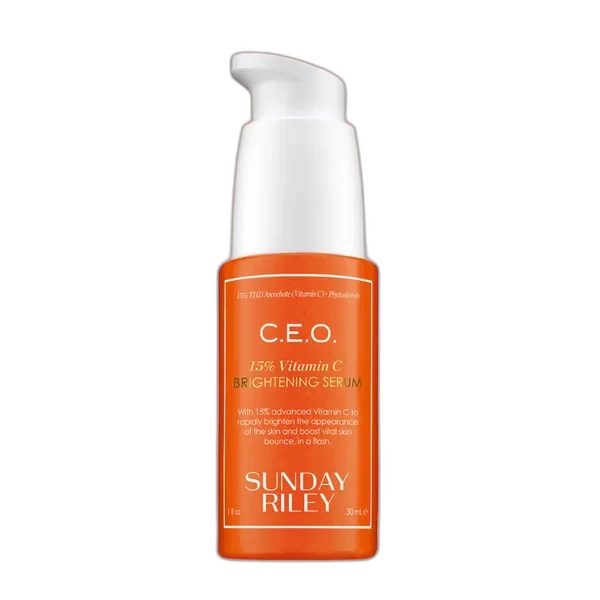
C.E.O. 15% Vitamin C Brightening Serum
Gentle Glow Powerhouse
 Verified reviewer
Pros & cons.
- +THD ascorbate at a disclosed 15% provides effective, stable brightening without L-ascorbic acid's sting
- +Squalane-based delivery system is specifically optimized for lipid-soluble vitamin C penetration
- +Vitamin C + E synergy creates a self-reinforcing antioxidant loop that enhances photoprotection
- +Creamy emulsion texture layers well under moisturizer and sunscreen without pilling
- +Formula remains stable for months without the rapid oxidation typical of L-ascorbic acid serums
- +Pregnancy-safe vitamin C option for those who want to maintain brightening routines
- +Multiple beauty awards and strong community validation with over 2,500 reviews
- −At $85 for 1 oz, the price is increasingly hard to justify as THD ascorbate has been democratized
- −Citrus essential oils and limonene are potential sensitizers that contradict the gentle positioning
- −Not vegan due to beeswax content — a surprising omission for a B Corp brand in 2026
- −Pump mechanism wastes the last 15-20% of product, adding to the effective cost per use
- −THD ascorbate requires intracellular conversion, so effective vitamin C levels are lower than the 15% label suggests
- −Emulsion base may clog pores or cause breakouts in acne-prone skin types
The full review.
For nearly a decade, the vitamin C serum debate has focused on one question: how much L-ascorbic acid can you tolerate? The industry raised concentrations from 10% to 15%, 20%, and higher. Each increase added potency but also the stinging sensation vitamin C users accept for a brighter complexion. Sunday Riley took a different path.
When C.E.O. launched in 2017 as the ‘Rapid Flash Brightening Serum,’ it used 15% tetrahexyldecyl ascorbate — THD ascorbate. This is not L-ascorbic acid. It is a lipid-soluble vitamin C ester with a different pharmacological profile. L-ascorbic acid dissolves in water, needs a pH below 3.5 to penetrate skin, and degrades weeks after opening. THD ascorbate dissolves in lipids, works across a wider pH range, and stays stable for months. The trade-off is that THD ascorbate must convert to ascorbic acid inside the cell to work, so the effective vitamin C concentration is lower than the 15% on the label. You trade immediate potency for consistency, tolerance, and daily use.
The formulation follows this logic. THD ascorbate is second on the INCI list, followed by squalane — a lightweight emollient that also acts as a solvent for fat-soluble actives. This is intentional. A lipid-soluble vitamin C in a lipid-rich base creates a delivery system where every part helps penetration through the stratum corneum’s lipid matrix. Water-based L-ascorbic acid serums fight the skin’s natural oil barrier; C.E.O. works with it.
The supporting ingredients are specific. Tocopherol (vitamin E) creates C+E synergy — vitamin C regenerates oxidized vitamin E, and vitamin E stabilizes vitamin C. This antioxidant loop enhances photoprotection more than either does alone. A small amount of glycolic acid provides gentle exfoliation to keep the skin surface smooth for the vitamin C, while saccharide isomerate offers sustained-release hydration that lasts after washing.
The texture distinguishes C.E.O. from watery, fast-drying vitamin C serums. This is a creamy emulsion — thick enough to feel substantial, but light enough to layer under moisturizer and sunscreen without pilling or heaviness. The initial application feels slightly tacky but resolves within a minute or two, leaving a soft, luminous finish. It feels more like a lightweight moisturizer than a treatment serum, which appeals to vitamin C newcomers.
Results build gradually. The squalane base provides immediate luminosity — skin looks healthier and more glowy from day one. Over the first two weeks, brightening emerges as the vitamin C’s antioxidant protection builds and glycolic acid encourages surface cell turnover. By four to eight weeks, dark spot fading becomes noticeable, especially on superficial sun spots and post-inflammatory marks. The brand’s clinical data shows visible brightening in seven days, which matches the immediate radiance boost rather than depigmentation — that takes longer.
Common Complaints
C.E.O. has contradictions. The most obvious is the fragrance. This serum contains citrus sinensis (sweet orange) oil, citrus tangerina (tangerine) peel oil, limonene, and linalool — many known sensitizers in a product marketed as gentle for sensitive skin. Limonene is sixth on the INCI list, suggesting a high concentration. These inclusions are puzzling or irritating for anyone with fragrance sensitivity or reactive skin. A serum that is gentler than L-ascorbic acid should not include sensitizers that L-ascorbic acid serums usually avoid.
The beeswax in the formula — as both PEG-8 beeswax and polyglyceryl-3 beeswax — acts as an emulsifier to create the creamy texture, but it is not vegan and may contribute to the clogged pores and breakouts some users report. For an $85 product from a B Corp-certified brand in 2026, the beeswax is an outdated formulation choice.
Value
C.E.O. faces scrutiny on value. At $85 for one ounce, it is a premium vitamin C serum. When it launched in 2017, high-quality THD ascorbate at this concentration in a good base was rare. In 2026, the market has changed. Many brands offer THD ascorbate serums for much less. The Allure and Cosmopolitan awards from 2018 show when C.E.O. was the best option; today, it is one of many.
Packaging
The pump packaging protects the formula from air and light, but it has a flaw: the pump cannot extract the last 15-20% of product, causing waste. For a product at this price, leaving seven to twelve dollars’ worth of serum in the bottle is frustrating.
C.E.O. remains a good vitamin C serum that solves a problem for many. If L-ascorbic acid was too irritating, unstable, or unpleasant, THD ascorbate is a validated alternative — and C.E.O. is a well-formulated example. The 15% concentration, the C+E synergy, and the lipid delivery system show formulation expertise. Whether that expertise is worth $85 when the core ingredient is now common is for the buyer to decide.
Formula
Ingredient analysis.
Full INCI list
Aqua/Water, Tetrahexyldecyl Ascorbate, Squalane, Polyglyceryl-6 Distearate, PEG-8 Beeswax, Limonene, Citrus Sinensis (Sweet Orange) Oil, Citrus Tangerina (Tangerine) Peel Oil, Glycine Soja (Soybean) Sterols, PPG-12/SMDI Copolymer, Sodium Phytate, Tocopherol, Phenoxyethanol, Acetamidoethoxyethanol, Hydroxyethyl Acrylate/Sodium Acryloyldimethyl Taurate Copolymer, Sodium Acrylate/Sodium Acryloyldimethyl Taurate Copolymer, Jojoba Esters, Glycolic Acid, Caprylyl Glycol, Cetyl Alcohol, Polyglyceryl-3 Beeswax, Chlorphenesin, Glycerin, Polysorbate 60, Sorbitan Isostearate, Saccharide Isomerate, Linalool
Skin match.
The science.
The Science
Tetrahexyldecyl ascorbate (THD ascorbate) is a lipid-soluble ester of ascorbic acid. It enters the skin differently than water-soluble L-ascorbic acid. Its eight branched alkyl chains let it partition into the lipid bilayer of cell membranes. There, intracellular esterases cleave it to release active ascorbic acid directly inside the cell. This avoids the pH-dependent absorption barrier that makes L-ascorbic acid formulations irritating.
A 2024 open-label study by Min et al. in the Journal of Cosmetic Dermatology tested a THD ascorbate-containing serum on 35 participants for 12 weeks. The study showed statistically significant improvements in skin pigmentation (p < 0.0001), fine lines and wrinkles (p < 0.0001), smoothness, firmness, and skin barrier function — proving clinical efficacy for the derivative across multiple aging parameters (Min et al., J Cosmet Dermatol, 2024).
THD ascorbate's antioxidant stability has nuances. A 2021 study by Swindell et al. in the International Journal of Molecular Sciences found that THD ascorbate alone degrades rapidly under oxidative stress — reaching complete degradation within six minutes in their model system. The study showed that combining THD ascorbate with acetyl zingerone prevented this degradation, which raises questions about the long-term stability of THD ascorbate formulations without such stabilizers. C.E.O.'s formula includes tocopherol (vitamin E) to provide some antioxidant protection for the vitamin C, but it does not include acetyl zingerone.
The vitamin C + vitamin E synergy in C.E.O. is well-supported. Landmark research shows the combination of ascorbic acid and tocopherol provides greater photoprotection than either alone — vitamin C regenerates vitamin E from its oxidized form (tocopheroxyl radical), recycling the antioxidant. This mechanism works regardless of the vitamin C derivative used, as the intracellularly released ascorbic acid performs the same regeneration function.
References
- Open-label topical application of tetrahexyldecyl ascorbate and acetyl zingerone containing serum improves the appearance of photoaging and uneven pigmentation — Journal of Cosmetic Dermatology (2024)
- Tetrahexyldecyl Ascorbate (THDC) Degrades Rapidly under Oxidative Stress but Can Be Stabilized by Acetyl Zingerone to Enhance Collagen Production and Antioxidant Effects — International Journal of Molecular Sciences (2021)
Dermatologist Perspective
Dermatologists generally view THD ascorbate as a viable alternative for patients who cannot tolerate L-ascorbic acid's low-pH formulations. Board-certified dermatologists note that while L-ascorbic acid has the deepest evidence base, THD ascorbate's lipid solubility allows better penetration through the stratum corneum's lipid matrix. Its pH independence also eliminates the irritation that causes many patients to stop using vitamin C. Dr. Joshua Zeichner, Director of Cosmetic and Clinical Research at Mount Sinai Hospital, has spoken favorably about the ingredient's brightening and anti-aging properties. Dermatologists typically recommend using any vitamin C serum in the morning with broad-spectrum sunscreen for synergistic photoprotection, noting that consistent use matters more than the specific derivative.
Where it fits in your routine.
Press 3-4 drops into clean, dry skin each morning using clean hands. Wait 1-2 minutes for absorption before you apply moisturizer and SPF 30+ sunscreen. This emulsion absorbs faster than water-based serums. You can use it at night, but morning use provides maximum antioxidant benefit against UV and environmental stress. Store in a cool, dark place to maintain stability.
At $85 for 1 oz ($50 for 0.5 oz mini; $122 for 1.7 oz large), C.E.O. is a high-tier vitamin C serum. The larger size has the best per-ounce value for regular users. At its 2017 launch, the formula was premium; THD ascorbate at a disclosed concentration with a purpose-built lipid delivery system was rare. By 2026, many brands use this ingredient at various prices. The 15% concentration, Allure-award-winning formulation, and C+E synergy differentiate it, but the citrus essential oils and beeswax are suboptimal formulation choices. For a brand founded in 2009 with prestige positioning, the price reflects brand equity and ingredient innovation.
C.E.O. works for anyone seeking vitamin C benefits who dislikes the stinging, instability, or rapid oxidation of L-ascorbic acid serums. It suits normal to dry skin types wanting brightening and anti-aging without irritation, and people who want a disclosed active concentration and a thick application.
Skip C.E.O. if you have citrus essential oil allergies or sensitivity, if you are vegan (beeswax is a dealbreaker), or if you want the cheapest THD ascorbate serum — other products use the same core ingredient for less. Users who prefer the proven potency of high-concentration L-ascorbic acid may find this derivative approach too weak.
Product details.
Sweet orange and tangerine peel essential oils provide a moderate citrus fragrance. Most users find the scent pleasant and fresh, but some find it too strong for daily use. Limonene is the sixth ingredient by concentration, which shows a notable fragrance load. The scent fades a few minutes after application.
The white opaque pump bottle protects the vitamin C from light. The pump mechanism works well for most of the product's life but fails to dispense the last 15-20%, causing product waste. The opaque design prevents seeing the remaining product level.
The squalane-rich base delivers immediate luminosity on the first application. This formula lacks the tingling, stinging, or burning typical of L-ascorbic acid serums, which helps users who struggle with harsher vitamin C formulations. The emulsion texture feels different than a watery serum. No purging is expected.
2-3 months with daily morning use of 3-4 pumps (1 oz size)
12 months
All Year
The backstory.
C.E.O. launched in 2017 as 'Rapid Flash Brightening Serum,' positioning itself as Sunday Riley's entry into the vitamin C serum market. The name was a playful nod — C.E.O. standing for the vitamin C focus. Rather than competing on L-ascorbic acid concentration (the prevailing arms race at the time), Sunday Riley chose THD ascorbate, betting on tolerance and stability over raw potency. The product won multiple beauty awards in 2018 and became one of Sunday Riley's top sellers alongside Good Genes and Luna.
About Sunday Riley
Established Brand (5–20 years)Cosmetic chemist Sunday Riley founded Sunday Riley in 2009 in Houston, Texas. The brand is Leaping Bunny and PETA certified cruelty-free, B Corp certified, and ranks #1 for brightening specialists in the US per NPD data. Sunday Riley settled with the FTC in 2020 regarding fake reviews posted from 2015 to 2017.
Common myths.
THD ascorbate is less potent than L-ascorbic acid and has lower efficacy.
THD ascorbate uses a different mechanism — it penetrates the cell membrane lipid bilayer and converts to active ascorbic acid inside the cell. A 2024 clinical study showed significant improvements in pigmentation and fine lines over 12 weeks. L-ascorbic acid has more published research, but THD ascorbate's stability and tolerability ensure more consistent delivery over the product's shelf life.
This serum contains 15% pure vitamin C (L-ascorbic acid).
The 15% refers to tetrahexyldecyl ascorbate, a lipid-soluble vitamin C ester, not L-ascorbic acid. This distinction matters because THD ascorbate has a different molecular weight, penetration profile, and irritation potential. Skin cells convert it to ascorbic acid. This means the effective concentration of active vitamin C is lower than 15%, but the delivery is more sustained and less irritating.
FAQ.
Can I use Sunday Riley CEO with retinol?
Yes — use C.E.O. in the morning for antioxidant protection and brightening, and use retinol at night. This AM/PM separation provides the benefits of both without increasing sensitivity from layering them. The vitamin C enhances your sunscreen's photoprotection during the day.
Is Sunday Riley CEO Vitamin C Serum pregnancy safe?
Sunday Riley markets this serum as pregnancy-safe. The formula uses THD ascorbate instead of retinol and lacks ingredients typically flagged during pregnancy. However, the low glycolic acid content warrants discussion with your OB-GYN or dermatologist, as some practitioners advise caution with any exfoliating acids during pregnancy.
Why doesn't Sunday Riley CEO sting like other vitamin C serums?
Most vitamin C serums that sting use L-ascorbic acid. This requires a pH below 3.5 to penetrate skin, and that acidity causes the burning. C.E.O. uses THD ascorbate, a lipid-soluble form that works at a wider pH range and does not need an acidic environment. This serum delivers vitamin C without the harsh, stinging sensation.
Is Sunday Riley CEO vegan?
No — C.E.O. contains PEG-8 Beeswax and Polyglyceryl-3 Beeswax, which come from bees. Sunday Riley is cruelty-free (Leaping Bunny and PETA certified), but this product is not vegan. The brand's Luna and Tidal products are vegan alternatives.
Does Sunday Riley CEO Vitamin C oxidize quickly?
THD ascorbate is more stable than L-ascorbic acid and oxidizes slower. The opaque pump bottle protects it from light. Users say the product keeps its color and efficacy for months. One study shows THD ascorbate degrades under prolonged oxidative stress, so store it away from heat and direct sunlight.
What the community says.
"Visible brightening and glow within the first two weeks of use"
"Non-irritating compared to L-ascorbic acid serums — no stinging or redness"
"Stable formula that does not oxidize or turn orange quickly"
"Lightweight emulsion absorbs well and works beautifully under makeup"
"Pleasant citrus scent that feels luxurious during application"
"Noticeable improvement in overall skin tone and texture over time"
"At $85 for 1 oz, the price is steep for a vitamin C derivative serum"
"Citrus essential oils and limonene are potential sensitizers — contradicts gentle positioning"
"Some users experience clogged pores or breakouts from the beeswax and emulsion base"
"Pump dispenser wastes product — difficult to extract the last 15-20% from the bottle"
"Dark spot fading results are inconsistent and require months of daily use"
"Not vegan due to beeswax content"
People also looked at.