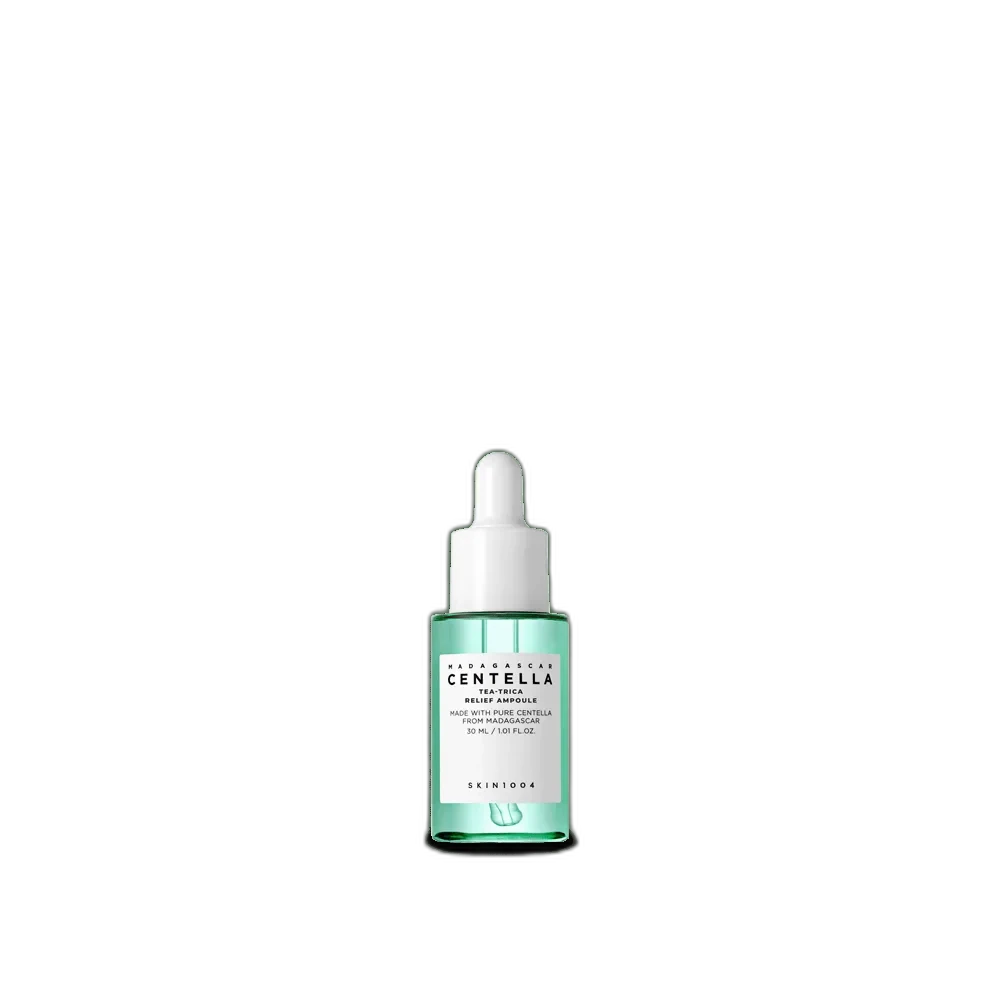
Tea-Trica Relief Ampoule
Acne Treatment Ampoule
 Verified reviewer
Pros & cons.
- +Tea tree leaf water as the base vehicle, not a trace additive
- +Treatment-grade betaine salicylate dose for real pore turnover
- +Niacinamide at meaningful concentration for sebum and marks
- +Full centella triterpene panel plus beta-glucan for buffering
- +Lightweight texture with no sting on application
- +Fragrance-free and suitable for twice-daily use
- −Not for dry, sensitive, or rosacea-prone skin
- −Not pregnancy safe due to BHA derivative
- −Not strictly fungal acne safe due to PEG ingredient
- −Not enough to replace prescription treatment for severe cystic acne
- −Glass dropper dispenses slowly for daily use
The full review.
Each SKIN1004 product line centers on one active; in the Tea-Trica range, this ampoule is that centerpiece. The Purifying Toner handles daily maintenance. The B5 Cream hydrates and buffers. The Relaxing Mask provides weekly intensive care. This ampoule performs the actual treatment work—the layer that targets active breakouts, reduces sebum output, and fades marks. This framing matters for evaluation. You aren’t asking “is this nice?”—you are asking “does it do the job?” For the right skin type, it does.
The INCI shows tea tree leaf water at the top, not water. SKIN1004 uses this pattern across the Tea-Trica line, much like their cica line uses a high-centella-water base. The product vehicle carries antimicrobial activity against Cutibacterium acnes before other actives even act. Published clinical research shows tea tree works on mild-to-moderate inflammatory acne. While most research uses higher-concentration essential oil gels, the water and leaf extract forms carry the same antimicrobial compounds without the sting. Using them as the base provides the benefit without the irritation.
Betaine salicylate is the second major active, which distinguishes this ampoule from the toner. A toner typically doses betaine salicylate for daily maintenance. This ampoule uses it as a treatment-grade step; the INCI placement suggests a concentration in the full 4% Korean formulation range. This is approximately equivalent to 0.5% traditional salicylic acid but has less surface sting due to slower release. It performs real pore-turnover work. Paired with the tea tree water base, the antimicrobial and keratolytic mechanisms hit different targets in one session.
Niacinamide sits higher on the INCI in this ampoule than in the rest of the line. It is likely in the 4-5% range, the sweet spot for sebum regulation via sebocytes, post-inflammatory hyperpigmentation support, and barrier maintenance. Research on niacinamide at these concentrations is extensive and well-replicated. Zinc PCA adds sebum-balance support and beta-glucan adds immunomodulatory soothing, making the supporting cast unusually complete for an acne serum. Beta-glucan is an under-recognized addition; its anti-inflammatory and wound-healing profile pairs naturally with the centella triterpene layer.
That centella layer prevents this ampoule from being a “works but hurts” acne product. All four triterpenes appear in the INCI. They dampen the inflammation BHA and tea tree might trigger and support barrier function during dehydrating treatment phases. SKIN1004 uses this same pattern across the Tea-Trica line, allowing this ampoule to work twice daily instead of every other day. Without the centella, it would require a more cautious application schedule.
Texture
The texture is a lightweight gel that absorbs in about thirty seconds without stickiness. Three to four drops cover the face; more will pill under follow-up moisturizer or sunscreen. There is no sting or adjustment period on application—the formulation is engineered for immediate comfort. Breakout reduction usually shows by the end of the first week, and post-inflammatory marks start fading by the third or fourth week.
Honest limitations
Honest limitations: this is not for dry, sensitive, or rosacea-prone skin. The tea tree and BHA combination is too much for reactive types. It is not pregnancy-safe due to the betaine salicylate, and it is not strictly fungal acne safe because of the PEG ingredient—though tea tree actives sometimes fit fungal acne routines depending on tolerance. For severe cystic acne, use this as an adjunct to prescription treatment, not a replacement. The glass dropper is slower than a pump, a minor ergonomic issue rather than a formulation one.
At around $28 for 50ml, the value is fair. It costs similarly to the Probio-Cica Intensive Ampoule from the same brand and is meaningfully cheaper than Western acne serums with comparable ingredient density. For oily or combination skin with mild-to-moderate inflammatory acne seeking a daily treatment serum that won’t sting, this is a strong K-beauty option—and it is the Tea-Trica product the rest of the line organizes around.
Ingredient analysis.
Full INCI list · pH 4.5
Melaleuca Alternifolia (Tea Tree) Leaf Water, Centella Asiatica Leaf Water, Propanediol, Glycerin, Niacinamide, 1,2-Hexanediol, Pentylene Glycol, Betaine Salicylate, Melaleuca Alternifolia (Tea Tree) Leaf Extract, Centella Asiatica Extract, Madecassoside, Asiaticoside, Asiatic Acid, Madecassic Acid, Panthenol, Sodium Hyaluronate, Hydrolyzed Hyaluronic Acid, Zinc PCA, Allantoin, Houttuynia Cordata Extract, Portulaca Oleracea Extract, Beta-Glucan, PEG-40 Hydrogenated Castor Oil, Arginine, Tromethamine, Carbomer, Ethylhexylglycerin, Disodium EDTA
Skin match.
The science.
The Science
Tea tree oil (Melaleuca alternifolia) has extensive published evidence for antimicrobial activity against Cutibacterium acnes. Clinical trials show it works for mild-to-moderate inflammatory acne similarly to low-dose benzoyl peroxide, but with a slower onset. Using tea tree leaf water as the ampoule base delivers antimicrobial terpenes at lower concentrations and with less irritation than essential oil formulations. Betaine salicylate is a salicylic acid ester that slowly releases free salicylic acid on skin. Korean dermatology research supports its use as a gentler BHA alternative at concentrations up to 4%, showing comedolytic and anti-inflammatory activity comparable to lower-strength salicylic acid with reduced sensory irritation. Salicylic acid has decades of published evidence for acne efficacy. Niacinamide at 4-5% has well-documented effects on sebum production, post-inflammatory hyperpigmentation, and barrier function in multiple published studies. The centella triterpene panel provides anti-inflammatory activity supported by peer-reviewed research on madecassoside and asiaticoside. Beta-glucan has documented immunomodulatory and wound-healing activity. Zinc PCA shows evidence for sebum regulation. This multi-mechanism approach — antimicrobial, keratolytic, sebum-regulating, anti-inflammatory, and barrier-supportive — is a coherent strategy for managing mild-to-moderate inflammatory acne in a daily leave-on format.
Dermatologist Perspective
Dermatologists often recommend multi-mechanism acne serums that combine low-concentration leave-on BHAs with niacinamide for mild-to-moderate inflammatory acne patients. Board-certified dermatologists note tea tree derivatives can provide useful antimicrobial adjunct action, especially for patients who prefer plant-based actives or cannot tolerate benzoyl peroxide. This type of ampoule is a frequent suggestion for a daily supportive step alongside prescription topical retinoids or oral treatments, not as a primary treatment for moderate-to-severe acne. Dermatologists typically advise patients with sensitive skin or rosacea to avoid tea tree and BHA combinations.
Where it fits in your routine.
Press 3-4 drops into clean skin after toner, covering the face and neck. Use moisturizer and sunscreen in the morning, or a thicker cream at night. Use it twice daily. If you use retinoids or other exfoliants, start once daily to prevent dryness. Always use sunscreen in the morning — BHAs can increase sun sensitivity.
At about $28 for 50ml, this ampoule has a competitive price in the K-beauty acne category. Western tea tree and BHA serums often cost $40-60 for similar sizes and have less complete ingredient lists. The cost-per-benefit is reasonable for oily or acne-prone skin using it as a daily treatment serum. One bottle lasts about two months with twice-daily full-face use. As a standalone use, it offers better value than most clinical-brand equivalents.
Oily or combination skin with mild-to-moderate inflammatory acne, active breakouts, and post-inflammatory marks. It also fits users of the Tea-Trica toner and cream who want a treatment-tier serum to complete the routine.
Dry, sensitive, or rosacea-prone skin. Anyone pregnant. If your acne is severe or cystic, this is a supportive product, not a treatment — you need prescription care as the primary.
Product details.
Lightweight gel-serum with a slight slip
Fragrance-free with faint tea tree note from the water base
Glass dropper bottle
Feels cool on application. No immediate tingle. Skin feels clearer by day 5-7 and less reactive by week 2.
About 2 months with twice-daily full-face use
12 months
All Year
The backstory.
The Tea-Trica Relief Ampoule was developed as the treatment centerpiece of SKIN1004's acne line, sitting between the Purifying Toner and the B5 Cream. It's designed to be the active step in the routine rather than a supporting one.
About SKIN1004
Emerging Brand (2–5 years)SKIN1004 launched in 2016 using Madagascar centella. The Tea-Trica Relief Ampoule is the core treatment in the acne-focused Tea-Trica line, combining tea tree and BHA with the centella triterpene panel.
Common myths.
Tea tree serums work for active breakouts, but not for maintenance
Tea tree antimicrobial activity works on active breakouts. However, niacinamide, BHA, and zinc PCA in this formula also target excess sebum, clogged pores, and post-inflammatory marks. This is a maintenance product, not just a rescue product.
FAQ.
How does this compare to the Purifying Toner?
The toner is a daily maintenance step with a lower BHA concentration. The Relief Ampoule is the treatment step — higher actives, more concentrated niacinamide, and beta-glucan added for soothing. You can use both in the same routine with the toner first.
Is the Tea-Trica Relief Ampoule pregnancy safe?
No — it has betaine salicylate, a salicylic acid derivative. Most dermatologists recommend avoiding leave-on BHAs during pregnancy. Use the Probio-Cica Intensive Ampoule instead.
Can I use it with retinol?
Yes, but build slowly. Use retinol every third night and the ampoule on non-retinol nights. Both dry the skin during the first few weeks; using them together too aggressively compromises your barrier.
Is it fungal acne safe?
Not strictly. It contains PEG-40 hydrogenated castor oil. Tea tree and BHA actives often help malassezia, but the formula is not on standard safe lists.
How many drops should I use?
Three to four drops covers the full face. Using more causes pilling under sunscreen or moisturizer. One bottle lasts about two months with twice-daily use.
What the community says.
"Reduces active breakouts within weeks"
"Doesn't sting like traditional BHA serums"
"Lightweight texture"
"Fades marks alongside clearing"
"Can be drying when layered with the toner"
"Not enough for severe cystic acne"
"Dropper delivery is slow"
People also looked at.