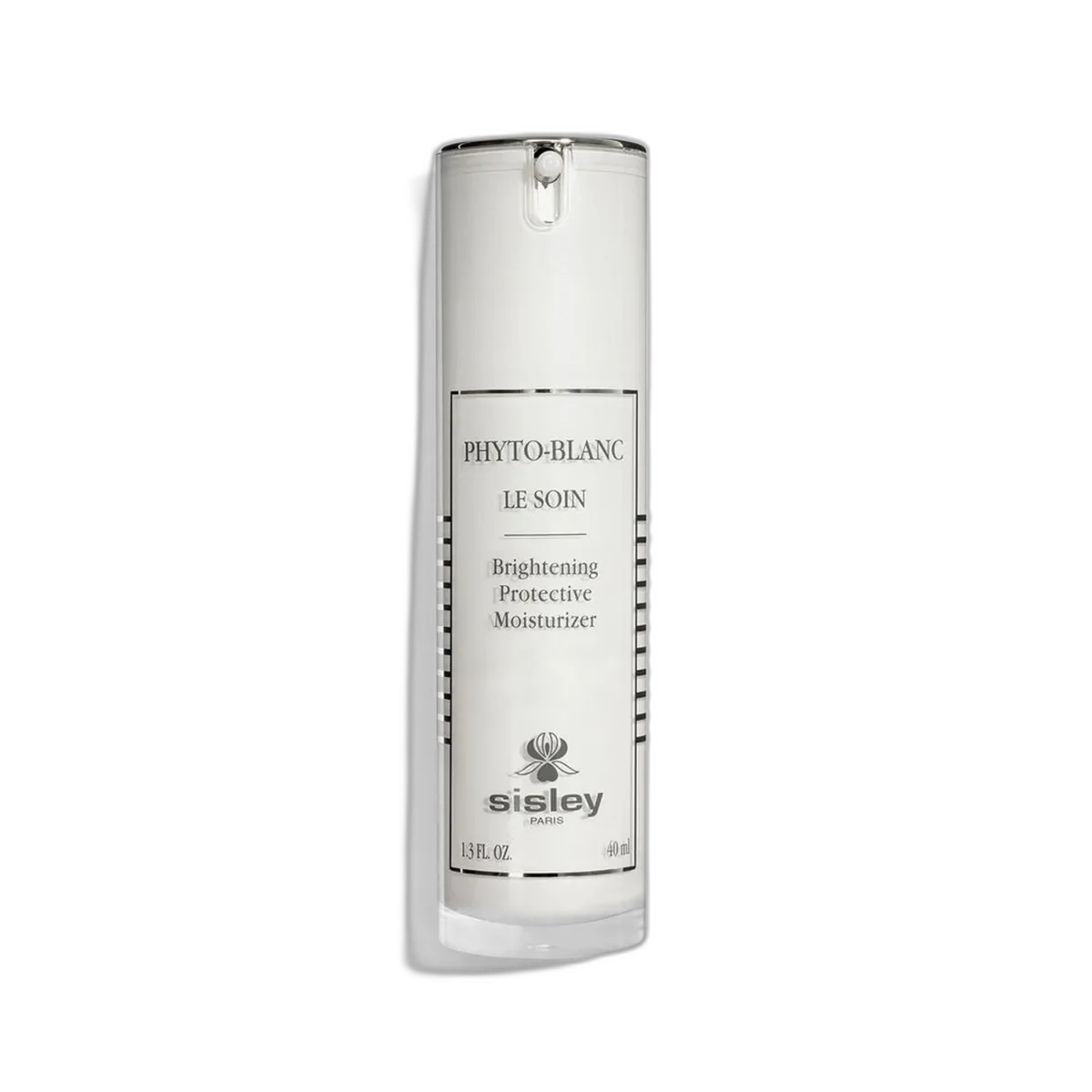
Phyto-Blanc Le Soin Brightening Protective Cream
Luxury Brightening SPF
 Verified reviewer
Pros & cons.
- +Combines niacinamide and hexylresorcinol at functional levels for real brightening
- +Broad-spectrum SPF 50+ PA+++ with nano titanium dioxide
- +Elegant satin finish with minimal white cast on most tones
- +Plays beautifully under makeup without pilling or dragging
- +Addresses prevention, reduction, and correction of pigmentation in one step
- +Paraben-free formulation, unusually modern for Sisley
- +Functional brightening backed by actual evidence, not just marketing
- −Eye-watering $460 price for only 40ml of product
- −Essential oils create real allergen risk for sensitive skin
- −Jar packaging is not ideal for photosensitive active ingredients
- −Deeper skin tones may still see some gray cast
- −Value is essentially impossible to defend versus pharmacy-brand alternatives
- −Monthly replacement cost if used at correct SPF application density
The full review.
This Sisley review starts with something unusual: the formulation is good. Phyto-Blanc Le Soin is not a luxury moisturizer with brightening vibes and token extracts. It is a functional brightening SPF using three top evidence-based brightening actives: niacinamide at a functional position on the INCI, hexylresorcinol as a studied tyrosinase inhibitor, and broad-spectrum UV protection from nano titanium dioxide rated SPF 50+ PA+++. The science is serious. The Asian luxury market, where this product was primarily developed, treats pigmentation correction as a mature category. Sisley built the Phyto-Blanc collection around actives dermatologists in Tokyo and Seoul would recommend. This puts Phyto-Blanc Le Soin in a different category from luxury ‘brightening moisturizers’ that are just antioxidant creams with aspirational names.
The niacinamide-plus-hexylresorcinol combination works through different mechanisms. Niacinamide reduces melanosome transfer from melanocytes to keratinocytes—the last step before pigment reaches the skin surface—while hexylresorcinol inhibits tyrosinase, the enzyme that synthesizes melanin. Published clinical work shows hexylresorcinol can produce pigmentation reduction comparable to hydroquinone in some studies, without hydroquinone’s regulatory baggage. Combined with broad-spectrum SPF 50, which prevents new UV-triggered pigmentation, this creates a ‘pincer move’ covering prevention, reduction, and correction in one step. This is a functional brightening SPF.
The texture also earns credit. Most mineral SPFs are chalky, draggy, or white-casting. Phyto-Blanc Le Soin uses a dimethicone-forward base with caprylyl methicone and macadamia oil to neutralize titanium dioxide drawbacks. On light to medium skin tones, the cast is minimal or nonexistent. On deeper skin tones, a slight gray pull remains; patch test if your tone is below medium-warm. The soft satin finish works well under makeup and leaves skin looking lit-from-within rather than powdered flat. It feels like an entirely different category from drugstore mineral SPFs.
There is a complication. The formula includes lavender, sage, and marjoram essential oils, plus parfum. These are real allergens present at levels that affect sensitive or reactive skin. If you have rosacea or a compromised barrier during a pigmentation episode, do not use this—the essential oil load fights the formula’s soothing mission. For healthy, tolerant skin, the essential oils are usually a non-issue, but they make the formulation feel less ‘clinical’ than the actives suggest.
The price is an issue. Four hundred and sixty dollars for 40 milliliters is an extraordinary ask. Correct sunscreen application requires about 1/4 teaspoon for the full face, or roughly 1.25ml. At 40ml, that lasts about 32 applications—one month if you use it daily with midday reapplication. One month costs four hundred and sixty dollars. The math is difficult. A well-formulated equivalent—niacinamide 5%, hexylresorcinol, and mineral SPF 50+—costs $30 to $80 from Asian beauty brands and pharmacy lines. The performance difference is real but small, while the price difference is 10x. No value calculation favors Sisley unless you decide the sensory and heritage experience of a Sisley counter product is worth the delta. It will be for many, but not for most.
Sisley deserves credit and criticism here. Credit for building a functional, evidence-based brightening SPF that isn’t just marketing. Criticism for pricing it at a level that ignores value. You can admire the formulation and still think the price is absurd. Both are true.
Who should buy this?
Sisley clients with visible pigmentation who already use the brand and want a single-step daytime product for protection, correction, and a beautiful finish. Buyers for whom price is not a consideration and who want the best luxury brightening SPF available. Gift buyers for someone interested in the Phyto-Blanc collection.
Who should skip?
Anyone evaluating value—the alternatives are real and good. Sensitive skin—the essential oils are a problem. Deeper skin tones that avoid cast—patch test first. Anyone wanting a dedicated brightening active as a primary serum should buy Phyto-Blanc Pure Bright Activating Serum or a third-party high-concentration tranexamic acid or cysteamine treatment and pair it with a $30 mineral SPF.
The formulation earns respect. The price tag earns a raised eyebrow. Decide which side you are buying on.
Formula
Ingredient analysis.
Full INCI list
Aqua/Water/Eau, Dimethicone, Titanium Dioxide (Nano), Glycerin, Caprylyl Methicone, Polyglyceryl-3 Polydimethylsiloxyethyl Dimethicone, Niacinamide, Dimethicone/Vinyl Dimethicone Crosspolymer, Aluminum Hydroxide, Stearic Acid, Pentylene Glycol, Dicaprylyl Carbonate, Macadamia Integrifolia Seed Oil, Panthenol, Tocopheryl Acetate, Hexylresorcinol, Lens Esculenta (Lentil) Fruit Extract, Polygonum Fagopyrum (Buckwheat) Seed Extract, Bisabolol, Sucrose Dilaurate, Rosa Canina Fruit Extract, Pisum Sativum (Pea) Extract, Thymus Serpyllum Extract, Lavandula Angustifolia (Lavender) Oil, Thymus Mastichina Flower Oil, Salvia Officinalis (Sage) Oil, Butylene Glycol, Polyglyceryl-4 Isostearate, Cetyl PEG/PPG-10/1 Dimethicone, Hexyl Laurate, Sodium Chloride, Ethylhexylglycerin, Stearalkonium Hectorite, Silica, Disodium EDTA, Citric Acid, Propylene Carbonate, Isoceteth-10, Polysorbate 20, Glycine Soja (Soybean) Oil, Caprylyl Glycol, Sodium Hydroxide, p-Anisic Acid, Parfum/Fragrance, Sorbic Acid
Skin match.
The science.
The Science
This formulation has more evidence than most luxury brightening products. Niacinamide has extensive clinical literature for pigmentation reduction; studies in the British Journal of Dermatology show topical niacinamide at 2-5% concentrations reduce hyperpigmentation by inhibiting melanosome transfer from melanocytes to keratinocytes. Hexylresorcinol is a newer evidence-based brightening ingredient. A 2014 Journal of Clinical and Aesthetic Dermatology paper shows it compares favorably to hydroquinone for pigmentation reduction with better tolerability. These two actives use complementary mechanisms: hexylresorcinol inhibits tyrosinase (the rate-limiting enzyme in melanin synthesis) and niacinamide blocks the later transfer of formed melanosomes, creating a "dual-path approach." Nano titanium dioxide at SPF 50+ provides broad-spectrum UVA/UVB coverage. Preventing new UV-induced pigmentation is the most important step in any brightening routine—no active fades spots faster than the sun makes new ones. The botanical additions (lentil, buckwheat, rosehip) provide trace antioxidant and polyphenol support but do not drive performance; the three main actives do the heavy lifting. The formulation's weakness is the jar packaging stability—hexylresorcinol and niacinamide both need airtight, opaque packaging, which a screw-top jar lacks compared to a pump or airless container.
Dermatologist Perspective
Dermatologists approve of this active profile. Board-certified dermatologists recommend broad-spectrum SPF 50+ as the foundation of any hyperpigmentation protocol. Clinical dermatology increasingly cites the combination of niacinamide and hexylresorcinol as an evidence-based alternative to hydroquinone for patients who cannot tolerate or access it. However, dermatologists note patients can get equivalent results with a $20 pharmacy-brand mineral SPF and a $30 niacinamide-plus-hexylresorcinol serum; the price difference does not change clinical outcomes. For patients treating melasma or post-inflammatory hyperpigmentation, dermatologists typically recommend pairing a daytime brightening product with a prescription-strength active at night—tretinoin, azelaic acid, or hydroquinone short courses—instead of relying on one daytime product alone.
Where it fits in your routine.
Apply this as the final step of your morning skincare routine. Use a pea-sized amount — roughly 1/4 teaspoon covers the full face at the correct SPF density, which exceeds most users' typical application. Warm the product between fingertips and press it into your face, neck, and upper chest. Reapply every 2-3 hours if you stay outside for extended periods. Layer a dedicated brightening serum (like Sisley's Pure Bright Activating Serum, or a third-party tranexamic acid treatment) underneath to fade pigmentation faster. Avoid the immediate eye area.
Phyto-Blanc Le Soin is hard to defend here. Forty milliliters at $460 costs $11.50 per milliliter. Applying sunscreen at the correct density empties the jar in about a month. This monthly cost exceeds what most people spend on their entire skincare routine. Pharmacy-brand mineral SPF 50 with niacinamide costs $15-40 for similar quantities. Brightening serums with hexylresorcinol cost under $80. Choosing equivalent-actives alternatives saves several thousand dollars a year with minimal performance trade-off. The math works for buyers who want the luxury-counter experience. It fails for anyone evaluating evidence-per-dollar.
Sisley clients treating hyperpigmentation want one daytime step for functional brightening and broad-spectrum mineral SPF. This works for normal to dry skin with medium or lighter tones. It leaves no white cast and contains no irritating essential oils.
The price-to-performance math fails for value shoppers. Sensitive and rosacea-prone skin should avoid the essential oils. Buyers with deeper skin tones should patch test for cast before spending $460 on a jar.
Product details.
Rich, silky cream that spreads thinly and dries to a soft-satin finish
Herbal floral from the essential oils and parfum — noticeable but not overwhelming
A frosted jar with a screw-top lid is elegant, but lacks hygiene for an active formula with photosensitive ingredients.
The pump dispenses a cushioned texture that warms during massage. The dimethicone-heavy base neutralizes most of the chalky white cast typical of titanium dioxide to leave a satin finish. Some users feel mild warmth from the essential oils on first use.
About 2-3 months of daily face application at the correct 2mg/cm² SPF dose
12 months
All Year
The backstory.
The Phyto-Blanc collection was developed primarily for the Asian luxury market, where brightening skincare has decades of consumer sophistication and SPF is considered essential to any pigmentation-correcting routine. Sisley built the line around hexylresorcinol and niacinamide rather than the hydroquinone and arbutin standards used in earlier generations — a more modern active choice driven by dermatologist input from Tokyo, Seoul, and Hong Kong markets.
About Sisley
Legacy Brand (20+ years)Sisley has nearly five decades of experience formulating luxury botanical skincare. The Phyto-Blanc line is their modern brightening platform, created first for the Asian luxury market where brightening skincare has the most mature consumer base.
Common myths.
It's just another expensive moisturizer with SPF
This formula stacks three evidence-based brightening actives on broad-spectrum mineral UV filters, a combination most brightening moisturizers lack. The science works; the price is the issue. Myth Mineral SPF always leaves a white cast Reality The nano titanium dioxide, dimethicone, and silicone carriers in this formula neutralize most white cast, even on medium skin tones. Deeper skin tones may still see a slight pull.
FAQ.
Is Phyto-Blanc Le Soin actually an SPF product?
Yes — it has an SPF 50+ PA+++ rating and uses nano titanium dioxide as the only UV filter. Most 'brightening moisturizers' lack functional sun protection, but this one has it, which is essential for real pigmentation correction.
Does it replace my sunscreen?
Yes, if you apply a quarter teaspoon to the full face and reapply throughout the day. If you use less or skip reapplication, use it as a tinted moisturizer and layer a dedicated SPF.
Can it fade existing dark spots?
Yes, slowly. Niacinamide and hexylresorcinol are both evidence-based tyrosinase-modulating actives. Together, they fade superficial pigmentation in 4-12 weeks. For faster results, use a brightening serum like Phyto-Blanc Pure Bright.
Is it safe during pregnancy?
It lacks retinoids, hydroquinone, or salicylic acid, making it generally pregnancy-compatible. Both niacinamide and hexylresorcinol are typically cleared for pregnancy; consult your OB if you have specific concerns.
Will it leave a white cast on deeper skin tones?
nano titanium dioxide minimizes the white cast. Most light-to-medium tones won't notice it. Deeper skin tones may see a slight gray pull — patch test before committing.
Can sensitive skin use it?
With caution. The brightening actives and mineral SPF base are tolerable, but the essential oils (lavender, sage, marjoram) and added fragrance add allergen risk. If your skin is truly reactive, this is not the brightening SPF to start with.
How does it compare to the rest of the Phyto-Blanc collection?
Le Soin is the daytime step — it carries the SPF. The Overnight Brightening Cream handles nighttime repair with different actives, and the Pure Bright Activating Serum layers underneath both. Together they make a full brightening system.
Community
What the community says.
"Elegant finish under makeup"
"Visible brightening over time"
"No white cast despite mineral SPF"
"Comfortable on dry skin"
"Wildly expensive"
"Essential oils not ideal for sensitive skin"
"40ml runs out quickly"
"Similar results possible at 10% of the price"
People also looked at.