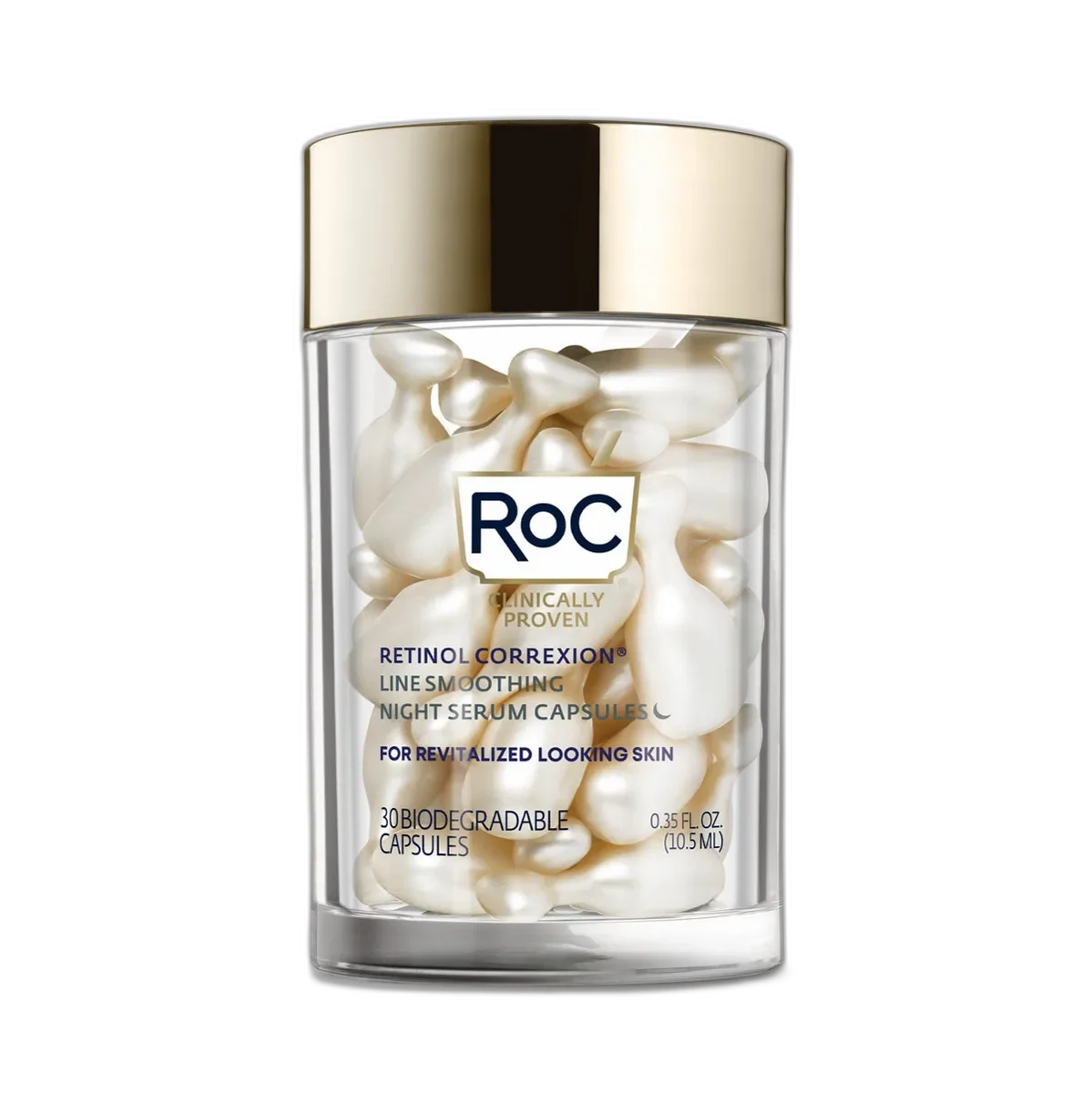
Retinol Correxion Capsules Night Serum
Drugstore Retinol Gold Standard
 Verified reviewer
Pros & cons.
- +Capsule format preserves retinol potency from first use to last — no degradation over time
- +Anhydrous silicone base delivers retinol with superior stability compared to water-based formulas
- +Ceramide NP addresses retinol-induced barrier disruption directly within the formula
- +Only eight ingredients — minimalist formulation reduces the risk of sensitization reactions
- +Completely fragrance-free, honoring the brand's founding pharmaceutical principle since 1957
- +Under $25 for a full month of nightly retinol treatment with patent-backed delivery
- +Biodegradable capsules eliminate the guesswork of dosing — one capsule, one application
- +Lightweight, non-greasy finish layers well under nighttime moisturizers without pilling
- −Soybean oil carries moderate comedogenicity risk for acne-prone and oily skin types
- −Retinol concentration is proprietary — impossible to compare strength against other products
- −Single-use capsule format generates more packaging waste than a traditional bottle
- −Fixed capsule dose dispenses slightly more product than some users need for face alone
- −Retinization period of dryness and flaking is unavoidable during the first few weeks
- −Not suitable during pregnancy or breastfeeding due to retinol content
The full review.
In 1957, French pharmacist Dr. Jean-Charles Lissarrague decided skincare ingredients must meet pharmaceutical standards. This led to RoC — a brand that patented a way to keep retinol stable without water, solving a decades-old cosmetics industry problem. The Retinol Correxion Capsules Night Serum embodies this: retinol sits in a biodegradable capsule, suspended in an anhydrous silicone base, protected from the air, light, and water that degrade most retinol products weekly.
The ingredient list is short. Only eight ingredients. While many serums list thirty or forty components, RoC’s capsule serum is minimal. Cyclopentasiloxane and dimethiconol form the silicone carrier. Ethylhexyl cocoate and soybean oil provide slip and emolliency. Retinol does the work. Ceramide NP supports the barrier that retinol can disrupt. Dimethylmethoxy chromanol — a synthetic antioxidant — protects the retinol from oxidative degradation. Phenoxyethanol preserves the formula. Every ingredient has a purpose.
The format is the key. Each capsule is a sealed environment; air cannot touch the retinol until you twist it open. This is critical because retinol is unstable. When you open a retinol serum bottle, oxygen begins degrading the active. By the time you finish a dropper bottle three months later, the retinol concentration is lower. Research shows silicone-encapsulated retinol has up to a ninefold increase in stability compared to unencapsulated forms, providing a direct skin benefit.
Using it feels ritualistic. You twist open the gold capsule, squeeze the contents onto your fingertips, and press it onto your face. The texture is thin and slippery — not watery or oily, but a silky middle ground created by the silicone base. It absorbs within two minutes and leaves a velvety, almost powdery finish. It has no scent, fitting for a company that made fragrance-free formulation a founding principle decades ago.
Performance follows the standard retinol path but with a gentler learning curve than many category competitors. The first two weeks may cause mild dryness or occasional flaking as cell turnover accelerates. By week four, retinization subsides and results appear: smoother texture, subtle brightness, and early softening of fine lines that deepens over following months. Users report visible improvement in crow’s feet and forehead lines by the eight-week mark; 4,000+ reviews on Walmart with a 4.4-star average confirm this.
The ceramide NP is important. The formula addresses retinol’s main side effect — barrier disruption — directly, rather than relying on your moisturizer. This reflects pharmaceutical-level formulation. The dimethylmethoxy chromanol is also strategic: this antioxidant protects the retinol in the capsule and defends your skin from free radical damage during overnight repair.
There are limitations. Soybean oil has a moderate comedogenicity rating, making this less ideal for oily or acne-prone skin. The capsule format creates more packaging waste than a single bottle, though RoC made the capsules biodegradable. The retinol concentration is proprietary, so you must trust RoC’s expertise instead of comparing percentages with other products. This opacity can frustrate some consumers.
Each capsule dispenses a fixed amount, slightly more than some need for the face alone. You can use the extra on your neck and décolleté, where many people skip retinol.
At under twenty-five dollars for a month’s supply, the value is high. You get patent-backed retinol stability, ceramide barrier support, and a proprietary antioxidant in a system that stops the potency loss seen in dropper bottles. This product does not use luxurious textures or Instagram-ready packaging. It delivers results, as expected from a brand founded by a pharmacist who treated beauty products like medicine.
Formula
### PM routineIngredient analysis.
Full INCI list
Cyclopentasiloxane, Ethylhexyl Cocoate, Dimethiconol, Glycine Soja (Soybean) Oil, Retinol, Dimethylmethoxy Chromanol, Ceramide NP, Phenoxyethanol
Skin match.
The science.
The Science
This product uses RoC's patent (US6015568A) for anhydrous retinol stabilization. This method removes water, the main cause of retinol degradation. Research in the Journal of Controlled Release (Shields et al., 2018) shows silicone-encapsulated retinol has a half-life nine times longer than unencapsulated retinol. Human studies also show it is 12-23% less irritating, confirming the delivery method RoC uses for this product.
Dermatological literature establishes retinol's efficacy as an anti-aging active. A landmark study in Archives of Dermatology (Kafi et al., 2007) found that 0.4% topical retinol on naturally aged skin increased procollagen type I expression and glycosaminoglycan content over 24 weeks. Histological analysis and physician assessment confirmed clinical improvement in fine wrinkles. A 2025 Bayesian network meta-analysis in Scientific Reports, covering 23 randomized controlled trials and 3,905 participants, ranks retinol as a significantly effective topical intervention for facial photoaging.
However, a systematic review by Spierings (2021) in the Journal of Clinical and Aesthetic Dermatology found only 'weak evidence' for OTC retinol's anti-aging benefits under rigorous standards, noting many positive trials had methodological limitations. This does not invalidate retinol—the mechanistic evidence for collagen stimulation and cellular turnover acceleration is robust—but it suggests OTC concentrations produce results gradually over months rather than weeks.
The ceramide NP in this formula supports the barrier, which is vital during retinol use. Ceramides make up about 50% of the stratum corneum lipid matrix; their depletion during retinol-accelerated turnover drives the dryness and irritation linked to retinoids. The dimethylmethoxy chromanol provides broad-spectrum antioxidant protection by scavenging reactive oxygen and nitrogen species. This helps during the overnight window when retinol-stimulated cellular repair increases oxidative activity.
References
- Improvement of Naturally Aged Skin with Vitamin A (Retinol) — Archives of Dermatology (2007)
- Encapsulation and controlled release of retinol from silicone particles for topical delivery — Journal of Controlled Release (2018)
- Evidence for the Efficacy of Over-the-counter Vitamin A Cosmetic Products in the Improvement of Facial Skin Aging: A Systematic Review — Journal of Clinical and Aesthetic Dermatology (2021)
Dermatologist Perspective
Dermatologists often recommend RoC's Retinol Correxion line to patients new to retinoids. The capsule format earns praise in clinical settings for its stability. Board-certified dermatologists note that retinol's efficacy depends on dose and stability. A higher-concentration retinol exposed to air for months may deliver less active ingredient than a lower-concentration formula sealed until use. The anhydrous delivery system and single-dose packaging solve this. Dermatologists typically advise starting with every-other-night application, increasing to nightly use, and always using broad-spectrum SPF during the day because retinol increases photosensitivity.
Where it fits in your routine.
Cleanse and dry your face well — retinol absorbs best on dry skin. Twist or snap open one capsule and squeeze the contents onto your fingertips. Press and spread it evenly across your face, neck, and décolleté if desired. Follow with a ceramide-rich or barrier-supporting moisturizer. Use at night only. Start with every other night for 2-3 weeks, then use nightly as tolerated. Apply SPF 30+ every morning because retinol increases sun sensitivity.
At $24.99 for 30 capsules — exactly one month of nightly use — this is one of the most cost-effective retinol treatments available. The value increases because the sealed capsule format delivers full-potency retinol in every dose, whereas bottled serums lose efficacy over time. RoC also offers 10-count and 50-count options; the larger jar has better per-unit value for committed users. As a legacy pharmacy brand with nearly seven decades of retinol formulation expertise and an actual patent on anhydrous retinol delivery, RoC's pricing reflects earned confidence rather than marketing markup — a rare thing in skincare.
This is for anyone seeking a stable, no-nonsense retinol treatment at a drugstore price. It works well for retinol beginners needing a gentle start and for users disappointed by retinol serums that lose effectiveness over time.
Soybean oil makes this risky for oily, acne-prone skin. Pregnant or breastfeeding individuals must avoid this entirely. Stabilize active rosacea flares or a severely compromised skin barrier before using retinol.
Product details.
The oil-serum is thin and slippery with a silky silicone feel. It is neither watery nor thick; it glides on easily and absorbs fully within about two minutes.
Unscented. There is no detectable fragrance — only a faint neutral note from the silicone base that dissipates immediately.
A compact tub holds individual biodegradable twist-open capsules. Each capsule contains one full dose of serum. This single-use format protects retinol from air and light degradation between uses, preserving potency better than a pump or dropper bottle. It is travel-friendly and hygienic.
The first application feels smooth and silky. Expect mild dryness, slight flaking, or tingling during the first 1-3 weeks as skin undergoes retinization — this is normal and typically resolves. Use it every other night, then build to nightly use. Skin looks noticeably smoother and more radiant by week 4.
30 capsules last one month if used nightly, or 2 months if used every-other-night during the adjustment period
12 months
All Year
The backstory.
RoC pioneered shelf-stable retinol in the drugstore market and holds foundational patents on anhydrous retinol formulation. The capsule format emerged from their research into eliminating the air and light exposure that degrades retinol in traditional packaging — each capsule is essentially a single-use stability vault. It's become one of the most awarded drugstore retinol products since its 2020 launch.
About RoC
Legacy Brand (20+ years)Dr. Jean-Charles Lissarrague, a French pharmacist, founded RoC in 1957. The brand uses strict dermatologist testing and fragrance-free formulation. RoC introduced the first shelf-stable retinol and owns foundational patents on anhydrous retinol delivery systems.
Common myths.
The capsules contain less retinol than pump serums, making the dose ineffective.
Each capsule delivers a controlled, full-face dose of an anhydrous retinol formula. Since air and water do not touch the retinol until application, the potency at use is higher than many pump-dispensed retinol serums open for weeks.
Retinol in capsules is a marketing gimmick; it works the same as any retinol serum.
RoC patents anhydrous retinol stabilization. Research shows silicone-encapsulated retinol has up to 9x greater stability than unencapsulated forms and reduces irritation potential by 12-23%.
FAQ.
How often should I use RoC Retinol Correxion Capsules?
Use every other night for the first 2-3 weeks so your skin adjusts to the retinol. Move to nightly use once your skin tolerates it without excessive dryness or flaking. Each capsule contains exactly one dose — apply to clean, dry skin and follow with moisturizer.
Can I use RoC Retinol Capsules with vitamin C or niacinamide?
Yes to niacinamide — it works well with retinol and helps soothe irritation. Use vitamin C in the morning and the retinol capsules at night to avoid instability from combining them in one routine step.
Are the RoC Retinol Capsules better than a regular retinol serum?
The capsule format provides real stability. Each sealed capsule protects the retinol from air and light degradation, so the retinol stays at full potency every time you open one. Traditional pump or dropper retinol serums start degrading the moment the bottle opens and continue degrading with each use.
What percentage of retinol is in RoC Retinol Correxion Capsules?
RoC keeps the retinol concentration proprietary and does not disclose it. User reviews document the formula's effectiveness, and the retinol's stability in the anhydrous, air-sealed capsule format ensures maximal potency at application, regardless of the starting concentration.
Is the RoC Retinol Capsules Night Serum safe during pregnancy?
No. This product contains retinol, a vitamin A derivative. Dermatologists advise avoiding retinol during pregnancy and breastfeeding because of the theoretical risk of teratogenicity. Use bakuchiol-based alternatives during pregnancy.
Will the RoC Retinol Capsules cause purging?
Retinol speeds up cell turnover. Some users see brief purging (small breakouts, mostly in congestion-prone areas) during the first 2-4 weeks. This usually resolves as skin adjusts. If irritation lasts over 6 weeks or worsens, stop use and consult a dermatologist.
How long do the RoC Retinol Capsules last once opened?
Individual seals keep the retinol stable until you open each capsule. The jar has a 12-month period after opening (PAO). Because each capsule is a sealed unit, the potency issues seen in bottled serums do not occur here — the last capsule in the jar is as fresh as the first.
What the community says.
"Visible improvement in fine lines within 4-8 weeks of consistent use"
"Lightweight, non-greasy texture absorbs quickly without residue"
"Capsule format keeps retinol fresh and makes dosing foolproof"
"Less irritating than many retinol serums thanks to the anhydrous delivery"
"Exceptional value for a well-formulated retinol treatment"
"Noticeable glow and more even skin tone with continued use"
"Initial dryness and flaking during the retinization adjustment period"
"Single-use capsules generate packaging waste despite being biodegradable"
"Soybean oil may cause breakouts in acne-prone skin"
"Each capsule dispenses slightly more product than some users need for face alone"
"Retinol concentration is proprietary, making comparison to other products difficult"
People also looked at.