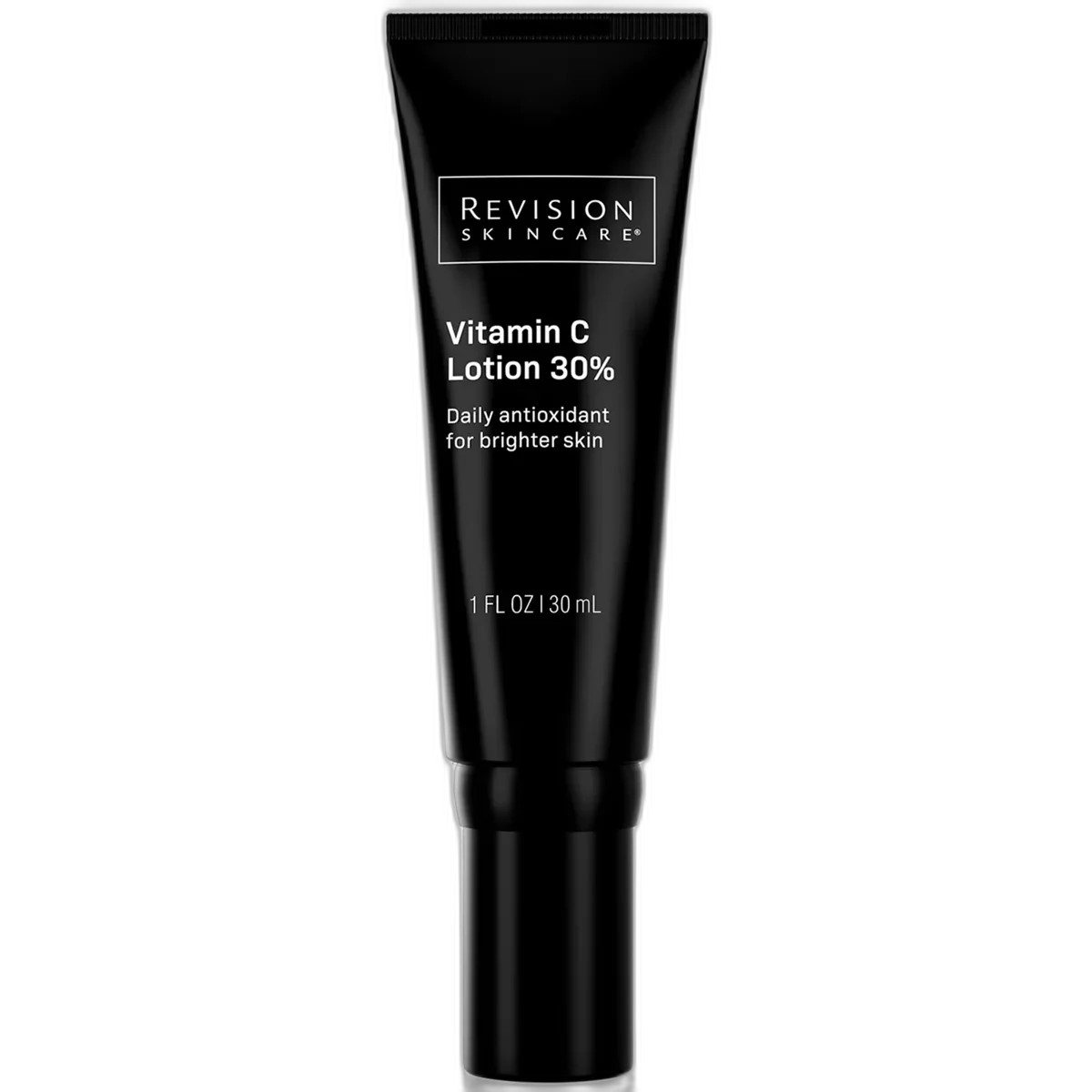
Vitamin C Lotion 30%
Maximum-Strength Stable Vitamin C
 Verified reviewer
Pros & cons.
- +30% THD ascorbate — one of the highest stable vitamin C concentrations available in skincare
- +Clinical study showing 100% participant improvement in fine lines and radiance at 12 weeks
- +Remarkably gentle despite the high concentration — no low-pH irritation like L-ascorbic acid
- +Superior stability means no oxidation or color change throughout the product's lifespan
- +Triple antioxidant system (C + E + CoQ10) for comprehensive cellular protection
- +Fragrance-free, minimal formula with no unnecessary filler ingredients
- −Premium $149 price for 1 oz — among the most expensive vitamin C products available
- −Some sensitive skin types may need a brief adjustment period at this concentration
- −Only available in 1 oz size at most retailers
- −THD ascorbate requires metabolic conversion, technically reducing immediate bioavailability versus L-ascorbic acid
- −The high price makes the 15% version a more practical everyday choice for many budgets
The full review.
The vitamin C market lacks credibility. Most serums claim to brighten, firm, and protect, but few provide clinical data where every participant improves. Revision Skincare’s Vitamin C Lotion 30% does. In a 12-week study, 100% of participants improved in fine lines and radiance, 90% improved in overall photodamage, and 93% reported more even, brighter skin tone. Poorly formulated or unstable products cannot produce these numbers.
The engineering decision is simple: 30% Tetrahexyldecyl Ascorbate. This is double the concentration of Revision’s 15% version and higher than almost any other vitamin C product on the market. Most brands cap L-ascorbic acid at 15-20% because higher concentrations cause intolerable irritation and rapid instability. THD ascorbate changes this. It is oil-soluble, works at neutral pH, stays stable in the bottle and on the skin, and avoids the stinging and redness that make high-concentration L-ascorbic acid impractical for daily use.
The formula is minimal. It contains water, THD ascorbate (second ingredient), glycerin, and supportive ingredients including tocopherol (vitamin E), ubiquinone (CoQ10), squalane, and stabilizers. It has no fragrance, no unnecessary botanicals, and no marketing-driven padding. The triple antioxidant system—vitamin C, vitamin E, and CoQ10—provides cellular protection: vitamin C works in the aqueous cellular environment, vitamin E protects lipid membranes, and CoQ10 guards the mitochondria. At 30% vitamin C, this triple system has more antioxidant substrate, extending the duration and depth of protection.
The texture matches the 15% version—a lightweight lotion that absorbs quickly and layers well under sunscreen and moisturizer. Doubling the vitamin C concentration could have made the product heavier, greasier, or harder to apply. The 30% formula keeps the same application because the THD ascorbate is stable in this emulsion base.
Brightening results arrive faster and more dramatically than with the 15%. Users report visible luminosity within the first week and meaningful improvement in dark spots and uneven tone by week four. The clinical study timeline aligns—significant improvements in multiple parameters were measurable at 12 weeks, though many users see changes sooner. This is an effective brightening treatment for hyperpigmentation, sun damage, or age-related dullness.
The gentle profile at this concentration is a key benefit. Most users report zero irritation—no tingling, redness, or dryness. Some sensitive skin types may feel mild initial warmth that subsides quickly and diminishes with use. Compared to a 20% L-ascorbic acid serum, which causes stinging and potential redness in many users, the difference is stark. Revision offers more vitamin C with less irritation.
Price is the main barrier. At $149 for one ounce, this is among the most expensive vitamin C products available. The concentration justifies part of the premium—you get double the vitamin C of the 15% formula—but the per-ounce cost is high. Some retailers offer a 0.5 oz size for testing. The stability adds value: unlike L-ascorbic acid serums that oxidize weeks after opening, the THD ascorbate formula maintains potency for the full duration of use. You pay for usable vitamin C, not for a formula that degrades before the bottle is empty.
If L-ascorbic acid serums were irritating, unstable, or underwhelming, this formula offers a different approach. It is not cheap. But when 100% of clinical trial participants improve and users report this product outperforms their other vitamin C, the price reflects the cost of getting it right.
Ingredient analysis.
Full INCI list
Water, Tetrahexyldecyl Ascorbate, Glycerin, PPG-12/SMDI Copolymer, Corn Starch Modified, Cyclopentasiloxane, Cetearyl Glucoside, Tocopherol, Ubiquinone, Glyceryl Caprylate, Hydrogenated Lecithin, Squalane, Xanthan Gum, Chlorphenesin, Acrylates/C10-30 Alkyl Acrylate Crosspolymer, Phenoxyethanol, Benzoic Acid, Leuconostoc/Radish Root Ferment Filtrate, Triethanolamine, Butylene Glycol, Sorbic Acid, Cetyl Alcohol, Stearyl Alcohol, Tocopheryl Acetate
Skin match.
The science.
The Science
Tetrahexyldecyl ascorbate at 30% is a concentration rare in stable vitamin C formulations. Research in the Journal of Cosmetic Dermatology shows THD ascorbate penetrates the skin's lipid barrier better than L-ascorbic acid. Studies show THD ascorbate has superior skin retention and sustained release of active ascorbic acid over time. Because THD ascorbate is oil-soluble, it bypasses the stratum corneum's aqueous resistance—the main barrier to L-ascorbic acid penetration.
Revision's 12-week clinical study showed 100% improvement in fine lines and radiance, 90% improvement in photodamage and smoothness, and 93% reported more even skin tone. While brand-sponsored studies require context, the 100% response rate is notable; L-ascorbic acid vitamin C studies typically show improvement in 60-80% of participants at similar timeframes.
The vitamin C + E synergy at this concentration follows the Pinnell research model (Journal of the American Academy of Dermatology, 2003). These two antioxidants regenerate each other in a cycle that extends overall protective capacity. At 30% vitamin C, the regeneration cycle has more substrate, which theoretically extends effective antioxidant protection throughout the day.
Coenzyme Q10 (ubiquinone) provides mitochondria-targeted antioxidant defense. High-concentration vitamin C drives enhanced collagen synthesis, which increases metabolic demand on fibroblasts. CoQ10 supports the electron transport chain that powers this protein synthesis, helping cells follow the collagen-stimulating signals from vitamin C.
Dermatologist Perspective
Dermatologists recommend the 30% concentration for patients who tolerate the 15% version and want more aggressive brightening and anti-aging results. Board-certified dermatologists use the clinical study data to recommend this to patients with significant hyperpigmentation, photodamage, or dullness. The gentle profile at this concentration differentiates it from L-ascorbic acid products; physicians can recommend a higher concentration without the usual irritation from stronger vitamin C treatments. For post-procedure patients needing antioxidant support, dermatologists typically recommend the 15% first, then introduce the 30% once healing is complete.
Where it fits in your routine.
Apply one pump to clean, dry skin every morning after cleansing. Spread it evenly over your face and neck. Use moisturizer and sunscreen afterward. If you are new to this concentration, use it every other day for the first week to check tolerance, then move to daily use. Always use sunscreen — the vitamin C complements but does not replace UV protection.
At $149 for 1 fl oz lasting 2-3 months, the monthly cost is about $50-75 — much higher than the 15% version at $114 for the same size. This premium buys double the vitamin C concentration and clinical data showing near-universal improvement. If you target hyperpigmentation, photodamage, or aggressive brightening, the 30% concentration may justify the extra cost. For general antioxidant maintenance, the 15% version offers excellent value for less money. Both formulations stay more stable than L-ascorbic acid products that lose potency before the bottle is empty.
Use this for maximum-strength vitamin C to brighten skin, correct hyperpigmentation, and target aggressive anti-aging. It works for patients who used the 15% version and want to upgrade, or vitamin C users seeking the highest stable concentration. It suits normal and combination skin types.
Vitamin C beginners should start with the 15% version. People with very sensitive skin may find even THD ascorbate too active at 30%. Budget-conscious consumers get meaningful results with the more affordable 15% formula.
Product details.
The 15% version has a similar lotion consistency — lightweight, smooth, and absorbs well. The higher vitamin C concentration does not change the texture or skin feel.
Fragrance-free — no discernible scent.
An airless pump bottle protects the high-concentration vitamin C from light and air.
Most users absorb it smoothly without tingling or irritation. Sensitive skin users may feel mild warmth on first use that subsides within minutes and decreases with continued use. Skin shows immediate brightness and healthy luminosity.
2-3 months with once-daily facial application
12 months
All Year
The backstory.
Revision Skincare developed the 30% formula as the next step for patients who had succeeded with the 15% version and wanted more aggressive brightening and anti-aging results. The ability to offer 30% vitamin C without significant irritation increase is only possible because of the THD ascorbate derivative — attempting this concentration with L-ascorbic acid would be intolerable for most users.
About Revision Skincare
Legacy Brand (20+ years)Revision Skincare launched in 1984. It is a physician-dispensed brand sold only through dermatologists, plastic surgeons, and medical spas. A brand-sponsored 12-week clinical study supports the 30% formulation.
Common myths.
30% vitamin C is too much and will irritate the skin.
THD ascorbate at 30% is well-tolerated because it works at skin-neutral pH instead of the acidic pH L-ascorbic acid requires. The clinical study showed participants tolerated the 30% concentration for 12 weeks with improvement instead of irritation. This high concentration is feasible because the derivative is gentle.
Higher vitamin C percentages always yield better results.
Vitamin C concentration has a benefit ceiling. Research shows skin cannot use more vitamin C beyond a certain point, so the excess stays on the surface. At 30% THD ascorbate, this formula reaches or nears the practical maximum for topical vitamin C efficacy. Higher concentrations do not necessarily improve results.
FAQ.
Is 30% vitamin C too strong for my skin?
No for most skin types. THD ascorbate at 30% is gentler than L-ascorbic acid at 15-20% because it works without a low pH. In Revision's clinical study, 100% of participants improved over 12 weeks without significant adverse effects. If you are new to vitamin C, start with the 15% version and upgrade once your skin is acclimatized.
What results did the clinical study show for Revision Vitamin C Lotion 30%?
In a 12-week study, 100% of participants improved in fine lines and radiance, 90% improved in overall photodamage and tactile smoothness, and 93% reported more even, radiant, and brighter skin tone. These response rates are unusually high for a skincare clinical study.
Should I use the 15% or 30% Revision Vitamin C Lotion?
The 15% works for sensitive skin, vitamin C beginners, and gentle daily antioxidant protection. The 30% provides maximum brightening, aggressive anti-aging, and faster visible results. Many dermatologists recommend starting with the 15% and upgrading to the 30% after tolerance is established.
Can I use Revision Vitamin C Lotion 30% with other active ingredients?
Yes — THD ascorbate works with most skincare actives because it does not require a low pH. Use it in the morning with sunscreen for maximum photoprotection. Use retinoids, AHAs, or other treatments in the evening. Do not layer it directly with other high-concentration antioxidant treatments to prevent product competition.
How does Revision Vitamin C Lotion 30% compare to SkinCeuticals CE Ferulic?
These products use different vitamin C forms. SkinCeuticals CE Ferulic uses 15% L-ascorbic acid (water-soluble, low pH, highly researched). Revision uses 30% THD ascorbate (oil-soluble, neutral pH, more stable and gentle). Both are well-formulated. Your choice depends on skin tolerance: if you handle acids well, either works. If you want stability and gentleness, the THD ascorbate approach has advantages.
Community
What the community says.
"Dramatic brightening effect surpassing other vitamin C products"
"Absorbs quickly without greasiness despite high concentration"
"Stable formula that does not oxidize or change color"
"Noticeable improvement in skin tone and dark spots"
"Gentle despite the 30% concentration"
"Premium $149 price for 1 oz is a significant investment"
"Some sensitive skin users may need to build tolerance gradually"
"Only available in 1 oz size"
People also looked at.