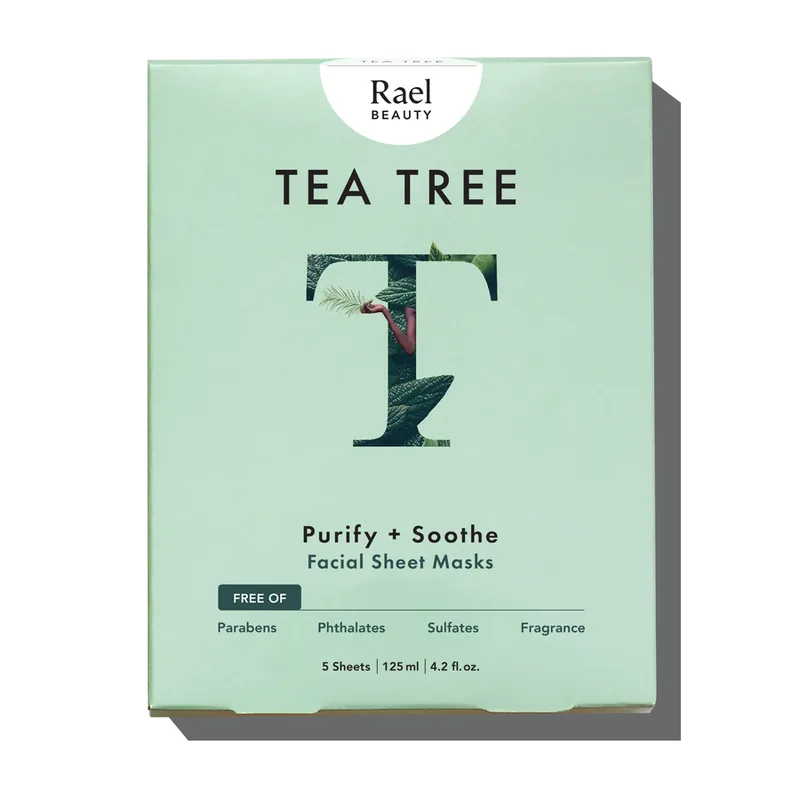
Tea Tree Face Masks
Tea Tree + Cica Sheet Mask
 Verified reviewer
Pros & cons.
- +Tea tree oil (terpinen-4-ol) has reasonable evidence for mild antibacterial activity against acne-driving bacteria
- +Centella asiatica adds anti-inflammation alongside the tea tree's antibacterial — the two acne-care arms working together
- +Chamomile extract reinforces the soothing positioning
- +Bamboo-derived substrate, vegan, cruelty-free
- +Appropriate for the follicular phase when oily T-zone skin is more common — but works any time skin needs antibacterial soothing
- +$3.40 per mask is fair for the category
- −Tea tree oil is a potential irritant and contact allergen; sensitive skin should patch-test first
- −Single-use plastic wrappers
- −Won't replace daily salicylic acid for established acne
- −Tea tree scent is more present than in the other variants
The full review.
The Rael Tea Tree Face Masks are the antibacterial-leaning variant in Rael’s cycle-synced sheet mask range — bamboo-substrate masks infused with tea tree oil, centella asiatica, and chamomile extract. Positioned for the follicular phase of the menstrual cycle when sebum production typically rises, the formula works any time skin needs a soothing antibacterial intervention without the irritation of stronger acne actives.
Tea tree oil is one of the few plant-derived antibacterials with a substantive clinical evidence base for acne care. The active compound, terpinen-4-ol, has demonstrated activity against Cutibacterium acnes (the primary acne-driving bacteria). A 2007 randomized clinical trial compared 5% tea tree gel against 5% benzoyl peroxide and found similar reductions in acne lesions at 3 months, with markedly less skin irritation — though slower onset. Sheet mask concentrations are much lower than 5% (typically 0.1–1% in essence form), so the per-application effect is correspondingly more modest.
The centella asiatica addition complements the tea tree mechanistically. Where tea tree targets the bacterial arm of acne biology, centella targets the inflammation arm — the triterpenes (madecassoside, asiaticoside, asiatic acid) reduce inflammatory markers and accelerate barrier recovery. The two together cover two of acne’s four pathophysiological arms, with the other two (keratinization, sebum) handled by other products in the Miracle Clear line.
Tea tree oil is also one of the few sheet mask ingredients that carries a real sensitivity risk. Roughly 1-2% of the population reacts to tea tree as a contact allergen, and a smaller fraction reacts with primary irritation. Anyone with a history of plant-essential-oil sensitivity should patch-test on the jawline before applying a full sheet to the face. For users without that history, the sheet mask concentration is well below the irritation threshold and the cumulative weekly contact produces a real, if modest, anti-acne effect.
At $16.99 for 5 masks ($3.40 each), the per-mask cost matches the rest of the cycle-synced range. The Tea Tree variant has a more present scent than the other three — not unpleasant but noticeable. Use 1–2 times per week; skip on the same night as leave-on BHA serums to avoid over-stacking the active load.
Not ideal for
Anyone with known tea tree oil sensitivity. Genuinely dry skin — use the Hydration variant instead. People expecting tea tree to replace benzoyl peroxide or salicylic acid for established acne — tea tree is the gentler complement, not a substitute.
Ingredient analysis.
Skin match.
The science.
Tea tree oil's evidence base
Tea tree oil (Melaleuca alternifolia) is one of the few plant-derived antibacterials with a substantive clinical evidence base for acne. The active compound, terpinen-4-ol, has demonstrated activity against Cutibacterium acnes in vitro at concentrations achievable in topical applications. A 2007 randomized clinical trial compared 5% tea tree gel against 5% benzoyl peroxide and found the tea tree group had similar reductions in acne lesions at 3 months, with markedly less skin irritation — though slower onset.
Sheet mask concentrations are much lower than the 5% used in studies — typically 0.1-1% in essence form. The cumulative effect from weekly use is correspondingly more modest. Treat the Tea Tree mask as a soothing-and-mild- antibacterial weekly intervention rather than an acne treatment.
The centella asiatica addition complements the tea tree mechanistically. Where tea tree targets the bacterial arm of acne biology, centella targets the inflammation arm. The triterpenes (madecassoside, asiaticoside, asiatic acid) reduce inflammatory markers and accelerate barrier recovery. The two together cover two of acne's four pathophysiological arms — the other two (keratinization and sebum) are addressed by BHA and niacinamide in other products in the line.
References
- Tea tree oil clinical evidence — Indian Journal of Dermatology, Venereology and Leprology (2007)
- Centella asiatica in dermatology — Indian Journal of Pharmacology (2015)
Where it fits in your routine.
Cleanse and dry skin. Apply mask, align cutouts. Leave 15–20 minutes. Remove, pat remaining essence in. Follow with light moisturizer. Use 1–2x per week; skip the night you used a BHA leave-on.
$16.99 for 5 = $3.40 each. Same per-mask cost as the rest of the cycle range.
Combination and oily skin types whose monthly hormonal cycle includes a follicular-phase T-zone oil surge. Acne-prone skin looking for an antibacterial-leaning weekly treatment that's gentler than salicylic.
Anyone with known tea tree oil sensitivity. Genuinely dry skin — use the Hydration variant instead.
Product details.
Bamboo-derived sheet substrate saturated with essence
Mild tea tree/herbal
5 individually wrapped masks per box
All Year (especially helpful for summer T-zone oil)
The backstory.
The follicular-phase variant in Rael's cycle-synced range — leaning into the antibacterial side of acne care with tea tree oil and centella asiatica.
About Rael
K-beauty / cycle careRael was founded in 2017 by three Korean-American women — Yanghee Paik, Aness An, Binna Won. Sheet masks launched 2020 as part of the first skincare expansion beyond feminine care.
Common myths.
Tea tree oil replaces benzoyl peroxide for acne.
Tea tree has antibacterial activity but at far lower potency than benzoyl peroxide. Clinical studies show tea tree at 5% can be similarly effective to benzoyl peroxide 5% but with slower onset and modestly less acne reduction. They're not equivalent, but tea tree is a useful gentler alternative for users who can't tolerate BP.
FAQ.
Will tea tree dry out my skin?
At the dilution used in sheet mask essence, no — there's enough glycerin and hyaluronic acid to keep the formula net-hydrating. Tea tree oil can be drying at higher concentrations (the undiluted essential oil definitely is), but the sheet mask format keeps it within tolerable range.
How is this different from a salicylic acid mask?
Different mechanism. Salicylic acid is a beta-hydroxy acid that exfoliates inside the sebum-filled follicle. Tea tree is a topical antibacterial that addresses the *C. acnes* arm of acne biology. Both work for acne; they work differently. Tea tree is gentler and slower; salicylic is more direct and more drying.
Is it safe for sensitive skin?
Tea tree oil is a potential irritant and contact allergen — about 1-2% of the population reacts to it. Patch-test on the jawline first if you have a history of plant-essential-oil sensitivity. For the vast majority of users at sheet mask concentrations, it's well-tolerated.
Can I use it on active acne?
Yes, with care. The hydration + soothing + mild antibacterial combination is appropriate for the kind of mild inflammatory acne the mask is positioned for. Don't apply over actively oozing or weeping lesions; let those drain first.
What the community says.
"Tea tree scent feels appropriately "doing something""
"Reduces oily forehead overnight"
"Centella addition makes it not stripping"
"Works well as a once-a-week T-zone reset"
"Tea tree scent is stronger than the other variants"
"Single-use plastic packaging"
"Won't clear established acne on its own"
People also looked at.