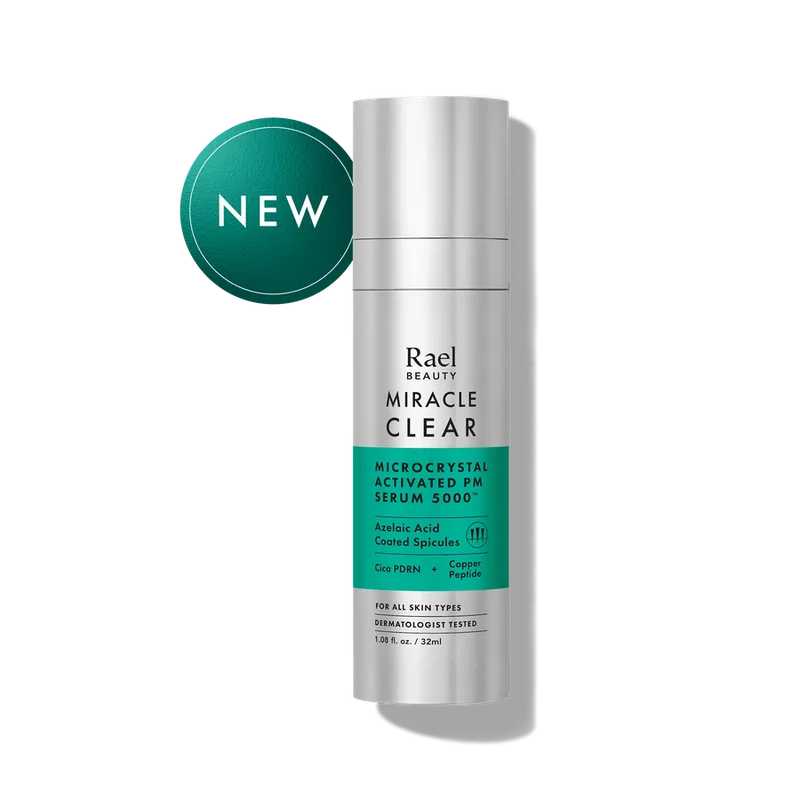
Miracle Clear Microcrystal Activated PM Serum 5000
Advanced Spicule Serum
 Verified reviewer
Pros & cons.
- +Higher spicule density than the 2000 — designed for advanced users with established tolerance
- +Copper peptides add an anti-aging pathway (collagen support) that the 2000 doesn't have
- +Cica PDRN combines centella's anti-inflammatory action with PDRN's recovery mechanism
- +Reported 342% absorption improvement — substantial vs the 2000's 185% (though both are in the same small study)
- +Same azelaic acid coating on spicules — keeps the acne/PIH function while adding anti-aging
- +Fragrance free, vegan, cruelty free
- −More intense embedding sensation than the 2000 — uncomfortable for many users
- −Topical PDRN evidence is much less developed than injectable PDRN
- −$24.99 for 1 fl oz is the highest serum price in the Rael line
- −Same 20-participant study; small sample limits the strength of the absorption claim
- −Not for daily use — strict 2x weekly cadence ceiling
- −Sensitive skin should not start here — go to the 2000 first
The full review.
The Rael Miracle Clear PM Serum 5000 is the advanced-strength variant of Rael’s spicule technology serum line — higher spicule density and a more ambitious active payload than the 2000, designed for users with established tolerance who want the anti-aging additions (copper peptides, PDRN) layered onto the acne-and-PIH function (azelaic acid). The “5000” designation references the increased spicule concentration; the practical difference is that this serum delivers more intense embedding sensation and stronger active effects.
The formulation logic is targeting both acne biology and skin aging simultaneously, which is unusual at this price point. Azelaic acid coated on the spicules handles the acne, rosacea, and post-inflammatory hyperpigmentation work — the same role as in the 2000, just at higher delivery efficiency. Copper peptides (GHK-Cu) are the anti-aging addition: a tripeptide-copper complex with reasonable evidence for fibroblast activation and collagen synthesis. Cica PDRN — combining centella asiatica with salmon-derived polydeoxyribonucleotide — adds an emerging recovery-active pathway, though the topical PDRN evidence is less developed than the injectable use case.
Rael’s 20-participant clinical study reports 342% improvement in active absorption versus passive control — substantially higher than the 2000’s 185%. The mechanism is plausible (higher spicule density creates more micro-channels in the stratum corneum, which means more passage for co-applied actives), but the small sample size means specific percentage claims should be treated as preliminary. The direction of effect is consistent with the underlying technology.
The user experience differs noticeably from the 2000. The higher spicule density produces a more intense embedding sensation — most users describe 1–2 minutes of strong tingle versus 30 seconds with the 2000. The copper peptide has a faint metallic note that some users find off-putting. For users prepared for the sensation, the perception is that the serum “feels stronger” — which matches the formulation’s actual increase in active delivery.
At $24.99 for 1 fl oz, this is the highest-priced serum in Rael’s line. Comparable advanced K-beauty spicule serums (Mary&May Idebenone serum, By Wishtrend Heartleaf Mild Spot Treatment) run $20–28/oz. Rael’s premium for the copper peptide + PDRN additions on top of the spicule technology is fair for the niche.
Not ideal for
Sensitive or rosacea-prone skin — use the 2000 if spicule technology is needed at all. First-time spicule users — the intensity is significant; start with the 2000. Anyone whose acne is the primary concern with no anti-aging interest — the 2000 covers the acne function at lower cost and lower intensity. Pregnant individuals — the combined active load (azelaic + PDRN + copper peptide) is harder to evaluate than the 2000’s simpler payload; consult your OB.
Ingredient analysis.
Skin match.
The science.
Why higher spicule density + copper peptides + PDRN
The 5000 is the more ambitious of Rael's two PM Serum variants — higher spicule density for more aggressive active delivery, plus a payload that targets both acne biology (azelaic acid) and skin aging (copper peptides, PDRN) simultaneously.
Copper peptides — specifically GHK-Cu (glycyl-L-histidyl-L-lysine bound to copper) — have a reasonable evidence base for fibroblast activation, collagen synthesis, and wound healing. Studies show topical GHK-Cu can improve skin firmness and texture over weeks of use. The mechanism involves the peptide-copper complex acting as a signaling molecule that stimulates the extracellular matrix proteins skin needs to maintain structure. For an acne sufferer who's also dealing with the early-aging changes that come with chronic inflammation, copper peptides target a different pathway than retinoids do.
Cica PDRN — combining centella asiatica with salmon-derived polydeoxyribonucleotide — is the more speculative addition. Centella's evidence base for anti-inflammatory and barrier-recovery effects is reasonable; topical PDRN evidence is less developed than injectable PDRN, which has documented effects on fibroblast activity. The spicule delivery mechanism may improve PDRN's penetration, but the topical evidence base remains preliminary.
Rael's clinical study (20 participants) reports 342% improved absorption of co-applied actives compared to passive control — substantially higher than the 2000's 185%. The mechanism is plausible (higher spicule density = more micro-channels = better penetration), but the small sample size means the specific percentage should be treated as preliminary.
References
- GHK-Cu copper peptide in dermatology — BioMed Research International (2015)
- Topical PDRN emerging research — Journal of Cosmetic Dermatology (2022)
- Azelaic acid in dermatology — American Journal of Clinical Dermatology (2007)
Where it fits in your routine.
PM only. Cleanse and tone. Apply 3–5 drops; press into skin. The embedding sensation is more intense than the 2000 — expect 1–2 minutes of noticeable tingle. Wait 5–10 minutes before moisturizer. Use 2x weekly max. Always SPF the morning after.
$24.99 for 1 fl oz = $24.99/oz. The highest serum price in the Rael line; comparable to advanced K-beauty spicule serums.
Users with established spicule tolerance from the 2000. Combination/oily acne-prone skin also showing early signs of aging (fine lines, loss of firmness). People prioritizing the copper peptide + PDRN anti-aging addition.
Sensitive skin — use the 2000 first. Active rosacea. Anyone uncomfortable with the spicule sensation at the 2000 level. Pregnant individuals — consult OB about all the actives in this formulation.
Product details.
Lightweight serum with visible spicule particles (denser than the 2000)
Fragrance free
1 fl oz dropper bottle
12 months after opening
All Year
The backstory.
Advanced-strength variant of Rael's spicule technology PM serum — higher spicule density and a stronger active payload (copper peptides + cica PDRN) than the 2000. For users with established spicule tolerance who want the anti-aging additions on top of the acne-and-PIH function.
About Rael
K-beauty / acne-care + anti-agingRael was founded in 2017 by three Korean-American women — Yanghee Paik, Aness An, Binna Won. The PM Serum line launched 2024; the 5000 strength is the most clinically ambitious product Rael has released to date.
Common myths.
Higher number = more effective for everyone.
The 5000 is more intense, not universally better. For users with stable, non-sensitive acne-and-aging skin, it can outperform the 2000. For sensitive, easily-reactive skin, it can cause damage that the 2000 wouldn't. Match strength to skin tolerance, not to ambition.
FAQ.
Should I start with the 5000 or the 2000?
Always start with the 2000 if you've never used spicule technology before. The 5000's higher spicule density produces a more intense embedding sensation that's uncomfortable for many users. Establish tolerance with the 2000 for 4–6 weeks, then step up to the 5000 if your skin handles it well.
What does GHK-Cu (copper peptide) actually do?
Glycyl-L-histidyl-L-lysine-copper is a small peptide-copper complex with reasonable evidence for fibroblast activation and collagen synthesis. Studies show topical GHK-Cu can improve skin firmness and texture over weeks of consistent use. The evidence is more developed than for some K-beauty actives but less robust than for retinoids and vitamin C.
Is the 342% absorption claim real?
Based on Rael's 20-participant clinical study, the formula achieved 342% improved absorption of co-applied actives over a passive control. Sample size is small but the mechanism (spicule-mediated stratum corneum bypass) is plausible. The specific percentage should be treated as preliminary; the direction of effect is consistent with the underlying technology.
Can I use the 2000 and 5000 in the same week?
Yes, with care. The recommended pattern is alternating — 2000 one night, 5000 a different night, with at least one rest night between. Don't apply both same night.
Why is this not for sensitive skin?
The higher spicule density and the more aggressive active payload (copper peptides have a faint metallic tingle, PDRN's mechanism is more invasive) push the irritation budget above what most sensitive skin can absorb. The 2000 is the sensitive-friendly version.
What the community says.
"Visibly firmer skin texture after 6–8 weeks"
"Copper peptides + spicule delivery feels like clinical-grade skincare"
"Stronger than the 2000 in a way that's noticeable"
"Pairs well with PM moisturizer on the right cadence"
"Embedding sensation is much more intense than the 2000"
"Pricey per ounce"
"PDRN evidence is mostly injectable, not topical"
"Easy to over-use and trigger irritation"
People also looked at.