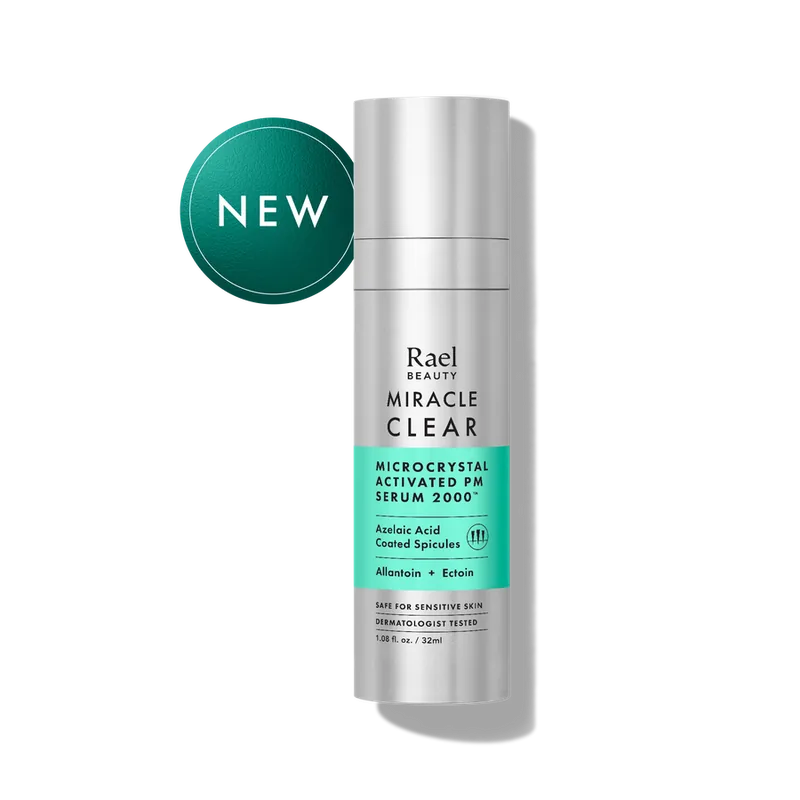
Miracle Clear Microcrystal Activated PM Serum 2000
Beginner Spicule Serum
 Verified reviewer
Pros & cons.
- +Spicule technology delivers leave-on actives at higher effective concentration than passive topicals (185% improved absorption in Rael's 20-participant clinical study)
- +Azelaic acid coating on the spicules adds an anti-inflammatory + tyrosinase-inhibition pathway
- +Allantoin and ectoin in the active payload — both well-tolerated soothing-and-hydration actives
- +Beginner-friendly strength means usable 2–3x weekly on sensitive skin
- +Fragrance free, vegan, cruelty free
- +Built specifically for the gap between leave-on serums (low penetration) and microneedle patches (single-spot delivery)
- −Spicule technology is novel — clinical evidence is limited to Rael's own 20-participant study
- −The microscopic sea sponge particles cause noticeable tingling on application; some users find it uncomfortable
- −$22.99 for 1 fl oz = $22.99/oz, premium pricing
- −20-participant study is on the small side for definitive efficacy claims
- −Not for daily use — 2–3x weekly maximum cadence
- −Spicules can trigger irritation on sensitive or compromised barrier skin
The full review.
The Rael Miracle Clear Microcrystal Activated PM Serum 2000 is Rael’s foray into spicule technology — a leave-on serum containing microscopic sea sponge spicules that embed in the upper stratum corneum and create transient micro-channels for enhanced active delivery. The “2000” designation is the beginner strength; the “5000” is the advanced version. The format sits between conventional leave-on serums (passive delivery, low effective absorption) and microneedle patches (active delivery, single-spot use).
Spicule technology has been used in K-beauty for several years, primarily in spot treatments and post-procedure serums. Marine sponge spicules are silica-based microscopic particles (50–200 µm) that physically embed in skin on application. The embedded spicules create micro-channels that enhance the absorption of co-applied actives — mechanism similar to microneedles, in a leave-on serum vehicle that can be applied across the whole face rather than spot-by-spot. Rael’s PM Serum 2000 brings this format into the mainstream Miracle Clear lineup.
The key formulation choice is what’s coated on the spicules. Azelaic acid — a well-evidenced acne and pigmentation active — is coated directly on the sponge particles, so it deposits in the stratum corneum where the spicules embed. Azelaic acid has good clinical data for inflammatory acne, rosacea improvement, and post-inflammatory hyperpigmentation fading; topical application typically delivers a modest dose to skin, but spicule-mediated delivery should achieve a higher effective concentration. Rael’s 20-participant clinical study reports 185% improvement in absorption of co-applied actives, consistent with the mechanism but limited by sample size.
The supporting payload includes allantoin (a soothing keratolytic that offsets the spicule embedding sensation), ectoin (an osmolyte with reasonable evidence for barrier support), and niacinamide (the standard B3 anti-inflammatory). The combination is designed to deliver the azelaic acid’s active work while keeping the spicule mechanism tolerable for sensitive skin — which is why this 2000 strength is positioned as the beginner version.
The actual user experience involves a noticeable prickly/tingling sensation on application as the spicules embed. The intensity is subjective — most users describe it as uncomfortable for the first 30 seconds and then fine. Sensitive skin users sometimes report ongoing tingle for 5–10 minutes. This isn’t pain in the medical sense, but it’s the kind of sensation that some users find distressing and others find satisfying (“it feels like it’s working”). If you experience persistent burning or visible irritation, the product isn’t right for you.
At $22.99 for 1 fl oz, the per-ounce cost is premium for the category. Comparable spicule-equipped Korean serums (VT Cica, Mary&May) run $15–25/oz; non-spicule centella + azelaic serums (Cosrx, Tiam) are typically $10–18/oz. The Rael premium reflects the K-aesthetic positioning and the brand’s manufacturing investment in the spicule technology.
Not ideal for
Sensitive skin that doesn’t tolerate the embedding sensation — patch-test on the jawline before committing. Active rosacea or compromised barrier — the mechanism worsens both. Pregnant individuals — consult OB; azelaic acid is generally considered safe in pregnancy but the spicule novelty adds a precautionary concern.
Ingredient analysis.
Skin match.
The science.
Spicule technology — between leave-on serums and microneedle patches
Topical actives face the stratum corneum penetration problem. Leave-on serums deliver actives passively, with most of the applied dose not crossing the barrier. Microneedle patches address this with short dissolvable needles that bypass the barrier — but the format limits use to specific spots.
Spicule technology is a middle path. Marine sponge spicules are microscopic silica-based particles (50–200 µm) that physically embed in the upper stratum corneum on application. The embedded spicules create transient micro-channels that enhance the absorption of co-applied actives — similar mechanism to microneedles, in a leave-on serum vehicle that can be applied across the whole face rather than spot-by-spot.
The format has been used in K-beauty for several years, primarily in spot treatments and post-procedure serums. Rael's PM Serum 2000 brings it into the mainstream Miracle Clear lineup, with azelaic acid coated on the spicules themselves. Azelaic acid is a well-established acne and pigmentation active with reasonable clinical evidence for inflammatory acne treatment, rosacea improvement, and PIH fading. Coating the spicules with azelaic acid delivers it deeper than topical application alone.
Rael's 20-participant clinical study reports 185% improvement in absorption of allantoin and ectoin from the product. The mechanism is plausible based on the spicule literature; the small sample size means the specific percentage should be treated as preliminary rather than definitive. The direction of effect — improved delivery vs passive topicals — is consistent with the underlying mechanism.
References
- Sponge spicule cosmetics — Marine Drugs (2017)
- Azelaic acid in dermatology — American Journal of Clinical Dermatology (2007)
Where it fits in your routine.
PM only. Cleanse and tone. Apply 3–5 drops to face, pressing — not rubbing — into skin. The spicule sensation is normal. Wait 5–10 minutes before layering moisturizer. Use 2–3x per week. Apply SPF the morning after; spicule treatments increase photosensitivity.
$22.99 for 1 fl oz. Premium pricing for the format; novel technology so direct comparisons are limited. Cosrx's RX Centella PCA Serum (no spicules) is around $14/oz; spicule-equipped Korean serums (VT Cica, Mary&May spicule serums) run $15–25/oz. Rael sits mid-premium for the category.
Users curious about spicule technology with an established BHA tolerance. Acne-prone skin looking for deeper active delivery than passive serums. People who don't want to commit to patch-based microneedle delivery.
Sensitive skin that doesn't tolerate the embedding sensation. Anyone with active rosacea or compromised barrier. Pregnant individuals (azelaic acid is generally OK but consult OB).
Product details.
Lightweight serum with visible spicule particles
Fragrance free
1 fl oz dropper bottle
12 months after opening
All Year
The backstory.
Rael's foray into spicule technology — sea sponge particles that create transient micro-channels in the stratum corneum, enhancing absorption of co-applied actives. The 2000 is the beginner strength; the 5000 steps up to advanced users.
About Rael
K-beauty / acne-careRael was founded in 2017 by three Korean-American women — Yanghee Paik, Aness An, Binna Won. The PM Serum line launched 2024, bringing spicule technology (popular in K-beauty for several years) into Rael's lineup.
Common myths.
Spicule technology is just exfoliation in disguise.
Spicules don't exfoliate the surface the way an acid or scrub does — they embed in the stratum corneum and create channels. The mechanism is closer to microneedling than to exfoliation. The two have overlapping effects (cell turnover acceleration, active penetration) but different mechanisms.
FAQ.
What is spicule technology and how is it different from microneedles?
Sea sponge spicules are microscopic silica-based particles (typical size 50–200 µm — much shorter than even the shortest dissolvable polymer microneedles). When applied to skin, they embed in the upper stratum corneum, creating transient micro-channels. The mechanism is similar to microneedle patches (bypass the stratum corneum barrier), but the format is a leave-on serum rather than a patch. The micro-channels reportedly enhance absorption of co-applied actives.
Does it hurt?
A noticeable prickly/tingling sensation is normal on application as the spicules embed. The intensity is subjective — most users describe it as "uncomfortable for 30 seconds, then fine." Sensitive skin users sometimes report ongoing tingle for 5–10 minutes. If you experience persistent burning or visible irritation, this isn't the right product for you.
How does the 2000 differ from the 5000?
The 2000 (beginner) has lower spicule concentration and a milder active payload — allantoin + ectoin for soothing. The 5000 (advanced) has higher spicule concentration and stronger actives — copper peptides + cica PDRN. Start with the 2000 and step up to the 5000 once you've established tolerance.
How often can I use it?
2–3x per week PM is the recommended cadence. Daily use over-stimulates skin even at the 2000 strength.
Can I use it with retinol or BHA?
Not the same night. Both retinoid and BHA already disrupt the stratum corneum; layering spicules on top is over-stimulation. Alternate — spicules on one PM, retinoid on another.
Is the clinical study credible?
It's small (20 participants) and Rael-run, which is the lower end of evidence quality. The 185% absorption improvement claim is plausible based on the mechanism but should be treated as preliminary. Independent replication on a larger sample would strengthen the case.
What the community says.
"Tingling on application feels like it's doing something"
"Visibly clearer after a few uses"
"Azelaic acid is hard to find at this concentration in K-beauty"
"Niacinamide + azelaic combination is smart"
"Less invasive than microneedle patches"
"Tingling sensation is intense"
"Pricey per ounce"
"Small clinical study"
"Spicule sensation freaks some users out"
People also looked at.