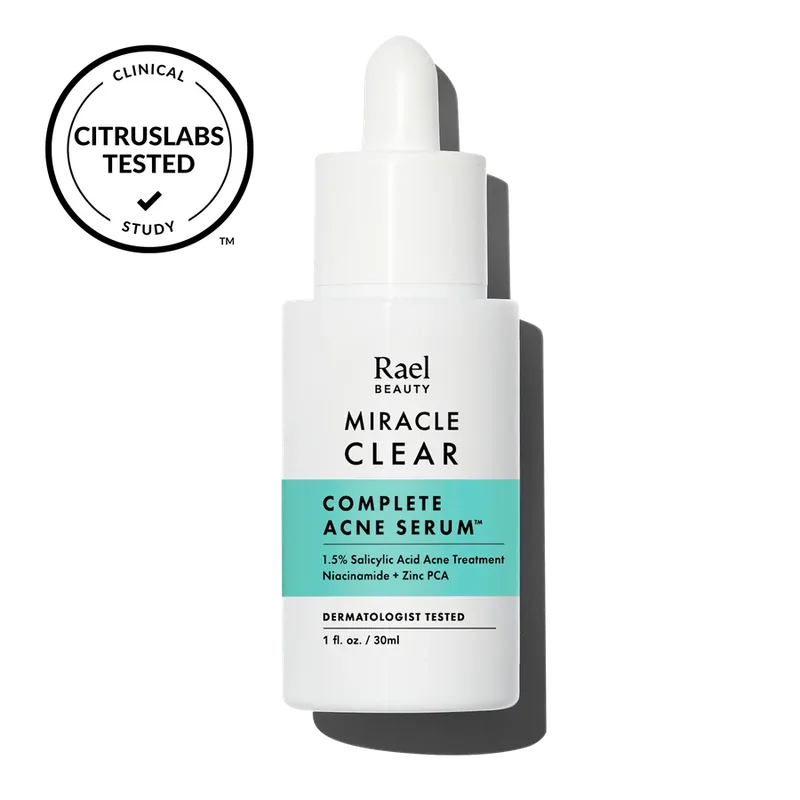
Miracle Clear Complete Acne Serum
1.5% BHA + Niacinamide Serum
 Verified reviewer
Pros & cons.
- +1.5% salicylic acid sits in the sweet spot — enough for real follicular work, low enough to use daily without rebound irritation
- +Niacinamide at 2% is the right clinical concentration for sebum reduction, redness control, and post-inflammatory mark fading
- +Zinc PCA adds a separate sebum-regulation mechanism that complements the niacinamide
- +Jojoba oil + panthenol counter the dryness that most BHA serums cause — actually leave-on-able for sensitive skin
- +Mono-material packaging (bottle, dropper, cap all PET) means the whole bottle is curbside recyclable
- +Brand clinical claim of visible improvement in 7 days, continuous improvement over 8 weeks — modest but consistent with BHA pharmacology
- +Sodium hyaluronate adds hydration so the active load doesn't feel stripping
- −$19.99 for 1 fl oz is at the high end for a 1.5% BHA serum (Paula's Choice 2% BHA is half the per-ounce price)
- −Mono-material dropper is stiff and finicky — Rael acknowledges this in their own product copy
- −Contains jojoba oil, which is non-comedogenic but a small fraction of acne-prone users still react
- −1.5% BHA is gentler than the 2% Paula's Choice / The Ordinary leave-ons; severe comedonal acne may need the higher concentration
- −Glycolic + other AHA stacking with this serum will push most skin into over-exfoliation territory
The full review.
The Rael Miracle Clear Complete Acne Serum is the active treatment step of the Miracle Clear regimen — a 1.5% salicylic-acid leave-on serum bundled with 2% niacinamide and 0.5% zinc PCA in a fragrance-free hydrating base. It’s the line’s most complete formulation and the SKU that carried Rael into the OTC drug category (the salicylic acid percentage triggers the FDA Drug Facts panel).
The formulation is a smart consolidation. Most acne routines built from individual SKUs end up with a BHA serum (typically The Ordinary or Paula’s Choice), a niacinamide serum (The Ordinary 10% Niacinamide), and possibly a zinc-based oil-control product layered on top. Rael’s serum collapses those into a single bottle at clinically meaningful concentrations: 1.5% salicylic acid is enough for real follicular work, 2% niacinamide is at the lower end of the studied sebum-regulation range but plenty for daily maintenance, and 0.5% zinc PCA adds the K-beauty oil-control mechanism without overlapping the niacinamide pathway.
The dermatology evidence supports this stacking. A 2019 randomized trial in the Journal of Cosmetic Dermatology found that combined topical salicylic acid + niacinamide significantly outperformed salicylic acid alone at 8 weeks for inflammatory acne lesions. The mechanism is straightforward: BHA addresses the keratinization arm of acne (the keratin plug trapping sebum), niacinamide addresses the sebum production and inflammation arms simultaneously, and zinc PCA contributes a third mechanism via 5-alpha reductase inhibition. Few OTC acne products actually formulate against all three arms; most are single-active products that handle only one mechanism.
The base is the K-beauty signature. Jojoba oil is the second-most-prominent emollient — non-comedogenic, structurally similar to human sebum, and notably under-used in Western acne formulations because of an outdated fear of oils. Panthenol and sodium hyaluronate handle the humectant load. The result is a leave-on BHA serum that doesn’t feel stripping after application — which matters because the most common reason people abandon BHA serums is the tight, dry feeling 30 minutes in. Rael’s serum doesn’t do that.
Where the product is worth questioning is price. $19.99 for 1 fl oz is at the upper end of the BHA serum category. Paula’s Choice 2% BHA Liquid Exfoliant runs $8.50/oz at 4 fl oz; The Ordinary’s Salicylic Acid 2% Solution is under $4/oz. Rael’s premium is for the niacinamide + zinc + jojoba additions, the K-beauty-style base, and the mono-material recyclable PET packaging (which is genuinely innovative — most cosmetics packaging is mixed-material and not curbside recyclable). For users who would otherwise buy a BHA serum + a niacinamide serum + a zinc product, the combined cost is comparable. For users who just want BHA, it’s expensive.
Rael’s own 8-week clinical study (36 participants, age 18–55) reports visible improvement in acne and clarity at 7 days, continuing through 8 weeks. The sample size is small but the trial design is reasonable and the direction is consistent with the broader literature. In practice, users tend to see smoother T-zone in 1–2 weeks, fewer closed comedones by week 4, and post-inflammatory marks fading by week 6–8.
Not ideal for
Severe nodulocystic acne is a dermatologist conversation, not an OTC serum question — see a dermatologist about prescription retinoids or oral therapy. Active rosacea and seborrheic dermatitis will react badly to the acid load. Users with extremely dry skin should layer this with extra hydration steps; the formula is well-balanced for combination/oily but won’t supply enough moisture for genuinely dry skin on its own.
Ingredient analysis.
Full INCI list
Active Ingredient: Salicylic Acid 1.5%. Inactive Ingredients: Water, Propanediol, Glycerin, Simmondsia Chinensis (Jojoba) Seed Oil, Niacinamide, Sodium Citrate, C13-15 Alkane, Panthenol, Gluconolactone, Silica, Zinc PCA, Lysolecithin, Sclerotium Gum, Succinic Acid, Caprylyl Glycol, Xanthan Gum, 1,2-Hexanediol, Sodium Hyaluronate, Disodium EDTA, Tocopherol.
Skin match.
The science.
Why 1.5% salicylic with 2% niacinamide is a smart formulation
Acne is a multifactorial condition. The American Academy of Dermatology's framework identifies four mechanisms: excess sebum production, abnormal keratinization in the follicle, Cutibacterium acnes proliferation, and inflammation. Salicylic acid addresses the keratinization arm — it dissolves the keratin plug that traps sebum and bacteria in the follicle. Niacinamide addresses two other arms simultaneously: it reduces sebum production by ~30% in clinical studies and it has well-documented anti-inflammatory effects on acne lesions.
Stacking BHA + niacinamide in a single formulation is the most evidence-supported combination in OTC acne care. A 2019 randomized trial in the Journal of Cosmetic Dermatology found that a combined topical of 2% salicylic acid + 4% niacinamide produced significantly greater reductions in inflammatory lesion count at 8 weeks than salicylic acid alone. The Rael formulation runs slightly lower on both (1.5% / 2%) for daily-use tolerability but operates on the same mechanism.
The zinc PCA inclusion is the K-beauty signature. Zinc binds to PCA (a humectant naturally found in skin's NMF) and the resulting complex reduces sebum production through a different pathway than niacinamide — inhibition of 5-alpha reductase, the enzyme that converts testosterone to DHT, which is a key driver of sebaceous gland activity. The evidence base for topical zinc is more limited than for niacinamide, but the mechanism is plausible and the safety profile is excellent.
The myth about niacinamide + salicylic acid pH conflict has been thoroughly debunked. Niacinamide is stable across the 3.0–6.0 pH range that covers all BHA formulations, and the supposed conversion to nicotinic acid (the irritation concern) requires temperatures and pH extremes well outside skincare formulations.
References
- The acne treatment landscape — Journal of the American Academy of Dermatology (2016)
- Topical niacinamide for acne — International Journal of Dermatology (1995)
- Combined salicylic acid + niacinamide for acne — Journal of Cosmetic Dermatology (2019)
Where it fits in your routine.
Apply 3–5 drops to clean, dry skin after cleanser and toner, before moisturizer. Pat — don't rub — into the T-zone and any acne-prone areas. Wait 5–10 minutes before layering moisturizer or sunscreen. Start at 3x weekly, ramping to nightly as tolerance builds. Always layer SPF the morning after — BHA increases UV sensitivity for ~24 hours.
$19.99 for 1 fl oz ($20/oz) is on the higher end for a 1.5% BHA serum. Paula's Choice 2% BHA at 4 fl oz runs $8.50/oz. The premium Rael charges is for the niacinamide + zinc PCA + panthenol additions, the K-beauty-style base, and the recyclable mono-material packaging. For users who would otherwise buy Paula's BHA + a separate 10% niacinamide serum, Rael is competitive on combined cost.
Combination and oily skin with consistent comedonal acne, blackheads, or T-zone congestion. People looking for one serum to do BHA + niacinamide + zinc in a fragrance-free base.
Severe nodulocystic acne — see a dermatologist about prescription retinoids. Pregnant individuals whose OB has restricted BHA. Anyone already running a 2%+ BHA — pick one, not both.
Product details.
Lightweight clear serum, mildly viscous
Fragrance free
1 fl oz mono-material PET dropper bottle (fully recyclable as a single material)
12 months
All Year
The backstory.
Step 3 of Rael's Miracle Clear regimen — and arguably the keystone product of the line. Whereas the cleanser delivers a 0.5% maintenance dose of salicylic, this serum delivers the 1.5% treatment dose alongside niacinamide and zinc PCA. It launched in 2024 as Rael's first OTC drug-classified product (the salicylic acid percentage triggers OTC labeling).
About Rael
K-beauty / acne-careRael was founded in 2017 by three Korean-American women — Yanghee Paik, Aness An, Binna Won — initially around organic-cotton period care, expanding into skincare with the Miracle Patch in 2019 and the Miracle Clear regimen in 2023–24. Skincare is manufactured in South Korea; the brand has invested visibly in sustainable packaging, with this serum being the first SKU to ship in mono-material recyclable PET.
Common myths.
Higher salicylic acid percentage always equals better acne results.
Acne studies on salicylic acid plateau around 1.5–2%; doubling the concentration doesn't double the result. What changes is the irritation budget — and an irritated, barrier-compromised face often *looks* worse than untreated acne. 1.5% with good barrier support outperforms 4% with no support for most users.
Niacinamide and salicylic acid can't be used together because of pH conflict.
This is an old internet myth. Niacinamide is stable across the pH range of typical BHA formulations (3.0–5.0). Studies show no meaningful conversion to nicotinic acid in the same product. Brands have been stacking them for years without irritation reports beyond what the BHA alone produces.
FAQ.
How does this compare to Paula's Choice 2% BHA Liquid Exfoliant?
Paula's Choice runs 2% salicylic acid in a simpler formula (essentially BHA + green tea + chamomile). It's slightly stronger and substantially cheaper per ounce ($34 for 4 oz = $8.50/oz vs Rael at $20/oz). Rael adds 2% niacinamide, zinc PCA, jojoba, and panthenol — a more complete formula that does sebum regulation and barrier support alongside the BHA. Paula's wins on price-per-active; Rael wins on breadth and tolerability.
Can I use this with retinol?
Yes, but alternate days unless you have time-tested high tolerance. The typical schedule is BHA serum on even nights and retinoid on odd nights. Stacking both same-night is over-exfoliating for the majority of users for the first 8–12 weeks. Once tolerance builds you can layer (BHA first, wait 15 min, retinoid on top), but for new users alternate.
Will it bleach my towels like benzoyl peroxide does?
No — salicylic acid doesn't oxidize fabric the way benzoyl peroxide does. This is a meaningful practical advantage if you've ever ruined a pillowcase with BP.
Is the clinical study claim real?
Rael cites a 36-participant 8-week clinical study showing improvement in acne and clarity at 7 days, continuing through 8 weeks. 36 participants is on the small side for a definitive trial but typical for cosmetic clinical claims; the direction is consistent with broader salicylic acid + niacinamide literature.
How long does the bottle last?
At ~1.5 mL per application twice a day (face only, not body), 1 fl oz (~30 mL) lasts about 10 days at twice-daily use or 20 days at once-daily. Practical reality: most users go once daily because of the active load, which puts the bottle at ~3 weeks. Refill cadence is roughly monthly at sustained use.
Is this OK during pregnancy?
1.5% topical salicylic acid is generally considered safe in pregnancy under the ACOG framework — the systemic absorption from a small leave-on area is negligible. That said, many OBs advise against any BHA during pregnancy out of caution. If your OB has said avoid BHA, skip this. Otherwise the rest of the formulation is unproblematic.
What the community says.
"Visibly less congestion in the T-zone after 2 weeks"
"Doesn't sting like other BHA serums I've tried"
"The dropper makes dosing easy once you get past the stiffness"
"Works well stacked with adapalene on alternate nights"
"Recyclable packaging is a genuine differentiator"
"Expensive for the percentage compared to The Ordinary or Paula's Choice"
"Mono-material dropper is stiff — Rael even warns about it in their copy"
"Wish it came in a larger size"
"Light tingling on freshly-cleansed skin"
Featured in.
People also looked at.