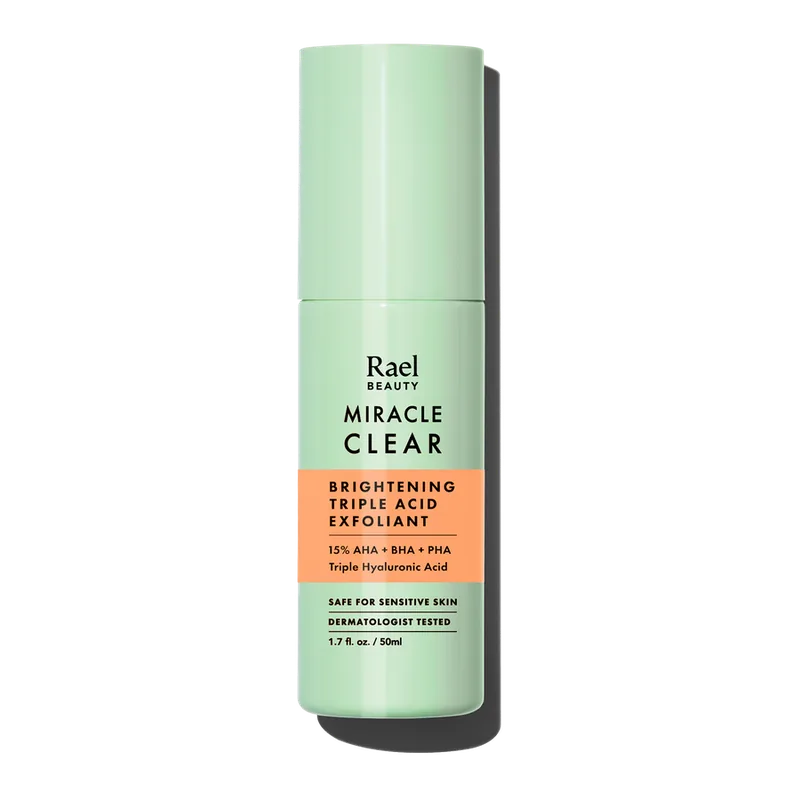
Miracle Clear Brightening Triple Acid Exfoliant
AHA/BHA/PHA Liquid Exfoliant
 Verified reviewer
Pros & cons.
- +Triple-acid stack hits the three exfoliation pathways simultaneously — glycolic for surface, salicylic for follicles, gluconolactone for sensitive tolerance
- +Three molecular weights of hyaluronic acid (HMW, MMW, LMW) provide layered hydration that offsets the acid load
- +Linoleic acid (apple extract derived) supports barrier function — meaningful for an exfoliant product
- +Niacinamide and arbutin in the supporting cast add real brightening pathways alongside the acid resurfacing
- +Designed for once or twice weekly use, not daily — Rael correctly positions this as a treatment product, not a routine step
- +Fragrance free, alcohol free — no irritation-budget hidden costs beyond the actives themselves
- −Acid percentages aren't disclosed — Rael won't say how much glycolic, salicylic, or PHA the formula contains
- −$18.99 for 3.4 fl oz puts it at $5.60/oz, higher than The Ordinary's AHA 30% + BHA 2% Peeling Solution at ~$1.60/oz
- −Over-exfoliation risk for users already running a daily BHA serum or retinoid; needs careful integration
- −Not appropriate for sensitive, rosacea-prone, or actively flaring eczema skin
- −Apple stem cell extract included for marketing reasons — there's no meaningful evidence for "stem cell" cosmetic claims
The full review.
The Rael Miracle Clear Brightening Triple Acid Exfoliant is the most active product in Rael’s Miracle Clear line and the one most easily misused. Launched in 2024 as a weekly “treatment” step on top of the daily routine, it combines glycolic acid (AHA), salicylic acid (BHA), and gluconolactone (PHA) in a single leave-on formula — supplemented with niacinamide, arbutin, three molecular weights of hyaluronic acid, and linoleic acid. The complexity is the formulation’s strength; the active load is also why it needs careful integration with the rest of a routine.
The three-acid framework hits exfoliation at three different depths simultaneously. Glycolic acid is the smallest alpha-hydroxy acid by molecular weight, which gives it the deepest stratum corneum penetration — it loosens the bonds between corneocytes (dead skin cells), accelerates turnover, and at higher concentrations stimulates collagen synthesis. Salicylic acid is lipophilic and penetrates the sebum-filled follicle, dissolving the keratin plug that traps oil and bacteria at the root of comedonal acne. Gluconolactone is a polyhydroxy acid — a larger molecule with slower penetration and a built-in humectant function, which gives the formula a tolerance buffer that pure AHA + BHA combinations lack.
This sort of triple-acid formulation isn’t common because it’s hard to do well. The three acids have different optimal pH ranges, different solubility requirements, and different stability profiles. Most “triple acid” products on the market end up underdosing one or two of the acids to maintain formulation stability. Rael’s formulation doesn’t disclose the percentages, which is a legitimate criticism — The Ordinary’s 30% AHA + 2% BHA Peeling Solution discloses both, and that transparency lets users gauge the product against their tolerance. Rael’s positioning is for weekly use at presumably moderate concentrations; that’s reasonable but harder to verify without disclosed numbers.
The supporting cast is where the formula does its best work. Niacinamide blocks melanosome transfer between melanocytes and keratinocytes — a brightening pathway that doesn’t depend on exfoliation. Arbutin is a glycoside of hydroquinone that slowly inhibits tyrosinase over weeks of use; modest evidence base but excellent safety profile. Together they accumulate on top of the acid resurfacing, which makes the cumulative anti-PIH effect more reliable than from an acid-only formula. The three molecular weights of hyaluronic acid plus linoleic acid handle the hydration-and-barrier-support side, which is what lets the formula get away with the active load.
Use cadence matters a lot for this product. Once a week is the right starting point; twice weekly is the ceiling for most users; daily use is over-exfoliation for almost everyone and causes the rebound damage the rest of the Miracle Clear line was built to prevent. Skip your daily BHA serum and any retinoid on the nights you use this exfoliant. Always apply SPF the next morning — acid exfoliants increase photosensitivity for 24–48 hours.
At $18.99 for 3.4 fl oz ($5.60/oz), the per-ounce price sits between budget peels (The Ordinary AHA 30% + BHA 2% at ~$1.60/oz) and prestige (Drunk Elephant T.L.C. Babyfacial at ~$30/oz). For an at-home weekly exfoliant with a multi-acid stack plus brightening adjuncts plus layered hydration, the value is fair for the category. The 3.4 oz bottle lasts roughly 12–16 weeks at once-weekly use, which is one of the better refill cadences in the lineup.
Not ideal for
Sensitive, rosacea-prone, or active eczema skin will react badly to the acid load even at weekly use. Users without an established BHA tolerance should start with a simpler acid product first. Anyone unwilling to commit to daily SPF — the photosensitivity window after this product is real and the next-day UV damage will offset the brightening benefit. Pregnant individuals should consult their OB about the salicylic acid component; while topical OTC concentrations are generally considered safe, some OBs restrict any BHA.
Ingredient analysis.
Full INCI list
Water/Aqua, Glycolic Acid, Butylene Glycol, Glycerin, Hydroxyethyl Acrylate/Sodium Acryloyldimethyl Taurate Copolymer, Propanediol, Isohexadecane, Sodium Hydroxide, 1,2-Hexanediol, Pyrus Malus (Apple) Fruit Extract, Salicylic Acid, Gluconolactone, Niacinamide, Arbutin, Sodium Hyaluronate, Hyaluronic Acid, Linoleic Acid, Polysorbate 60, Allantoin, Disodium EDTA, Tocopherol.
Skin match.
The science.
Why an AHA + BHA + PHA stack works (and why it's hard to formulate)
The three acid families occupy distinct biochemical niches in exfoliation. Alpha-hydroxy acids — glycolic, lactic, mandelic — are small water-soluble molecules that work on the skin surface, loosening corneocyte adhesion and accelerating turnover. Beta-hydroxy acid (just salicylic for cosmetic purposes) is lipid-soluble and penetrates the oil-filled follicle to dissolve the keratin plug at acne's source. Polyhydroxy acids — gluconolactone and lactobionic acid — are larger molecules with slower penetration and a built-in humectant function.
Single-acid formulas pick one mechanism. Two-acid formulas (AHA + BHA, the most common combination) hit the surface and the follicle simultaneously and consistently outperform either alone in clinical studies. Adding PHA to the stack is less common because the formulation challenge is real: the three acids have different optimal pH ranges, different solubility profiles, and different stability requirements. Most "triple acid" products end up underdosing one or two of the acids to maintain formulation stability.
Where the Rael formulation works specifically is in the supporting cast. Niacinamide and arbutin add brightening pathways that don't depend on exfoliation — niacinamide blocks melanosome transfer between melanocytes and keratinocytes; arbutin gradually inhibits tyrosinase. These mechanisms accumulate alongside the acid resurfacing, so the net effect on post-inflammatory hyperpigmentation is more reliable than from an acid-only formula. The layered hyaluronic acid + linoleic acid hydration offsets the barrier disruption that all chemical exfoliants cause.
References
- AHA + BHA combination therapy — Journal of Cosmetic Dermatology (2015)
- Polyhydroxy acids in dermatology — Dermatologic Surgery (2004)
- Niacinamide and skin pigmentation — British Journal of Dermatology (2002)
Where it fits in your routine.
PM only. After cleanser and toner, apply 3–5 drops to clean dry skin. Pat — don't rub — into face, avoiding the eye area and any actively broken skin. Wait 10 minutes before moisturizer. Skip your daily BHA serum and retinoid that night. Always SPF the morning after — acid exfoliants increase photosensitivity for 24–48 hours. Start at once weekly; do not exceed twice weekly.
$18.99 for 3.4 fl oz is $5.60/oz — above budget options (The Ordinary AHA 30% + BHA 2% Peel is ~$1.60/oz) and below prestige peels (Drunk Elephant T.L.C. Babyfacial is ~$30/oz). For an at-home weekly exfoliant with multiple acids, niacinamide, arbutin, and triple-MW hyaluronic acid, the value is fair for the category.
Anyone with dull, uneven, or texturally rough skin who already tolerates a basic BHA routine. Acne-clear skin looking for the next-step brightening + smoothing treatment. Users with post-inflammatory hyperpigmentation from healed acne.
Sensitive, rosacea-prone, or active eczema skin. Users without a multi-step active routine in place already (start with a BHA first). Anyone unwilling to commit to daily SPF.
Product details.
Lightweight liquid, slightly viscous; absorbs in 60 seconds
Fragrance free
3.4 fl oz amber glass dropper bottle
12 months
All Year (winter use requires extra hydration; summer use requires strict SPF)
The backstory.
The most active product in Rael's Miracle Clear line — and the one most often misused. Launched in 2024 as the weekly "treatment" addition to the regimen, this triple-acid formula sits on top of the daily routine rather than replacing any step. Users who treat it as a daily step over-exfoliate quickly; users who treat it as a once-weekly spa-equivalent get the better outcomes.
About Rael
K-beauty / acne-careRael was founded in 2017 by three Korean-American women — Yanghee Paik, Aness An, Binna Won — initially around organic-cotton period care, expanding into skincare with the Miracle Patch in 2019 and the Miracle Clear regimen in 2023–24. The Triple Acid Exfoliant is among the most clinically ambitious products the brand has launched, bringing the Miracle Clear line into the resurfacing/brightening category.
Common myths.
A "triple acid" formula is three times as effective as a single acid.
The three acids in this formula penetrate to different depths and exfoliate via different mechanisms — they're complementary, not additive. The combined effect is meaningfully better than any single acid alone, but it's not 3x. The PHA inclusion especially is for tolerability, not extra punch.
PHAs are too gentle to do anything.
Gluconolactone and lactobionic acid have meaningful exfoliation effects at the right concentrations — they're not just placeholders. The "gentleness" is in tolerability profile (less stinging, less penetration depth), not in efficacy at adequate dosing.
FAQ.
How often should I use it?
Once a week to start, ramping to twice weekly only if your skin tolerates it. Three or more nights a week with this product on top of a daily acne routine is over-exfoliation for almost everyone — you'll see redness, peeling, and paradoxically more breakouts as the barrier collapses.
What are the actual acid percentages?
Rael doesn't disclose them — a known frustration with the formula. The position of glycolic acid second in the INCI suggests a meaningful concentration (likely 5–8%); salicylic and gluconolactone are deeper in the list at presumably lower percentages. For comparison, The Ordinary's 30%/2% AHA/BHA Peel discloses its concentrations openly.
Can I use this on the same nights as my retinoid?
No. Stacking a triple-acid exfoliant with a leave-on retinoid on the same night will cause severe irritation in almost all users. Alternate: retinoid on (say) Mon/Wed/Fri, this exfoliant on Sat or Sun, gentle nights in between.
How does it compare to Drunk Elephant T.L.C. Sukari Babyfacial?
Sukari is 25% AHA + 2% BHA — a peel-strength product designed for monthly use as an at-home facial. Rael's Triple Acid is positioned for weekly use at lower (undisclosed) percentages with PHA added for tolerability. Drunk Elephant is stronger and more dramatic per use; Rael is gentler and more frequent. Different use cases.
Will it brighten my dark spots?
Slowly, yes — over 8–12 weeks of consistent weekly use. The acid resurfacing accelerates turnover of pigmented cells; the niacinamide blocks new melanin transfer; arbutin gradually inhibits tyrosinase. For faster fading, combine with daily niacinamide serum and rigorous sun protection.
Is the apple stem cell extract doing anything?
Probably not meaningfully. "Plant stem cell" extracts are a common cosmetic marketing claim with limited clinical evidence for benefit at the concentrations used in skincare. The active brightening pathways here are the acids, niacinamide, and arbutin — the apple extract is supporting cast at best.
What the community says.
"Noticeably smoother skin within 2-3 weekly applications"
"Post-acne marks are fading faster than with niacinamide alone"
"The PHA inclusion means less stinging than other AHA peels I've tried"
"Layered HA keeps the skin from feeling stripped"
"Works without leaving the next-morning sensitivity I get from glycolic alone"
"Concentrations aren't disclosed"
"Pricey compared to The Ordinary"
"Easy to overuse and over-exfoliate"
"The apple stem cell marketing feels gimmicky"
Featured in.
People also looked at.