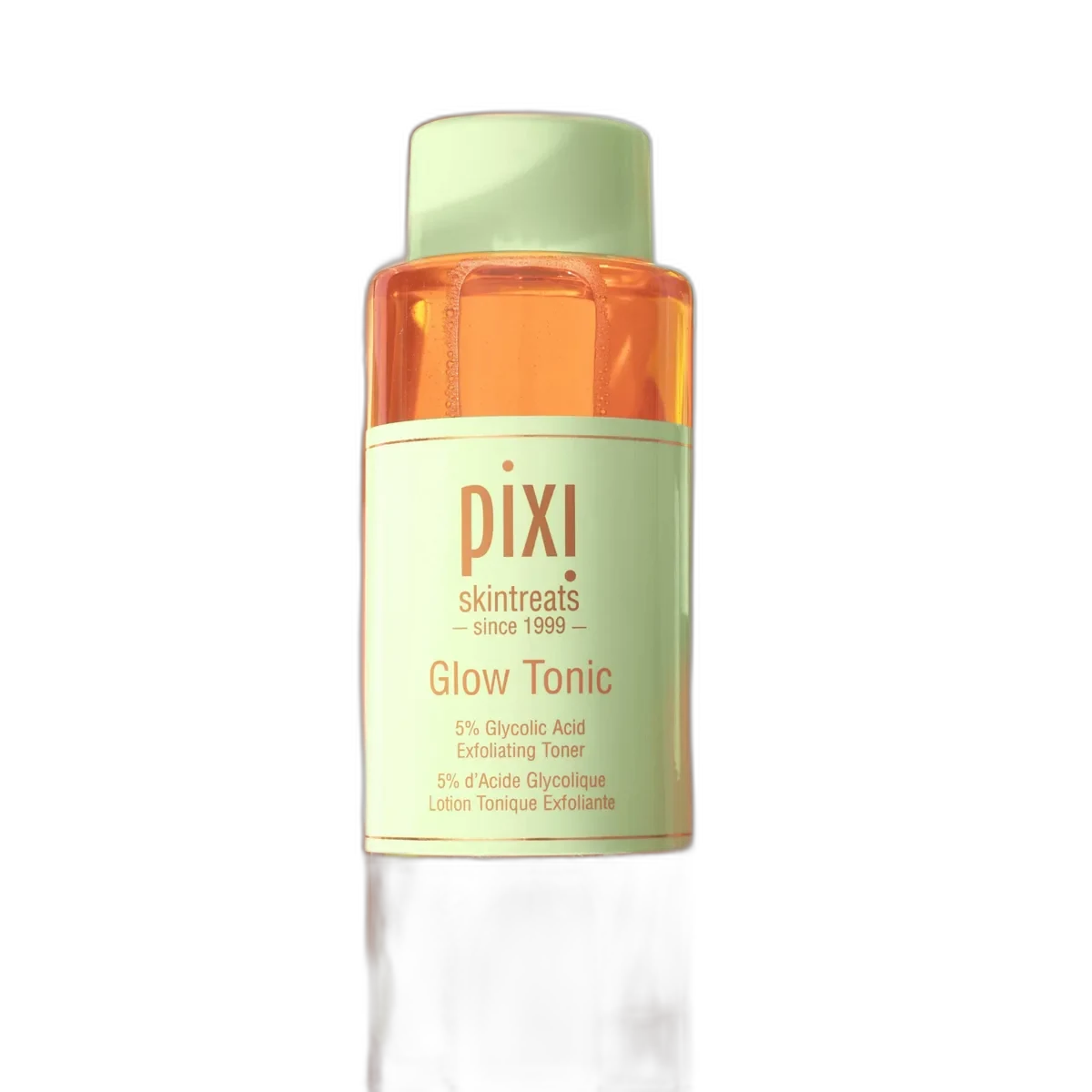
Glow Tonic 5% Glycolic Acid Exfoliating Toner
Cult Classic Glow Starter
 Verified reviewer
Pros & cons.
- +Category-defining formula with 15+ years of proven real-world results
- +Natural moisturizing factor complex replenishes hydration that glycolic acid strips away
- +Gentle enough for daily use with a partially neutralized pH of 4.0
- +Immediate brightness boost noticeable from the very first application
- +Three size options including a low-commitment 100ml travel size for first-timers
- +Aloe vera base soothes and hydrates while glycolic acid exfoliates
- +Exceptional value at roughly $0.12 per use for the standard size
- −Contains added fragrance plus nine declared fragrance allergens
- −pH of 4.0-4.5 limits potency for users seeking aggressive exfoliation
- −Witch hazel extract may concern ingredient-conscious consumers despite being used as extract
- −Not fungal acne safe due to PEG-40 Hydrogenated Castor Oil
- −Colorants (Caramel, Red 4) are cosmetically unnecessary additions to the formula
The full review.
In 2012, aesthetician Caroline Hirons wrote a blog post comparing a $29 toner from a niche London beauty brand to the Biologique Recherche P50 — a product worshipped by skincare obsessives and priced accordingly. The resulting stampede crashed Pixi’s website, emptied shelves at every stockist, and created a multi-month waitlist for a product that had been quietly existing without fanfare for a couple of years. The Glow Tonic didn’t just become a bestseller. It became the template. Every affordable glycolic acid toner that followed — and there are now dozens — is essentially a response to this formula.
So the question, in 2026, is whether the original still justifies its reputation in a market it accidentally created. The short answer is yes, though not for the reasons most people think.
About Pixi Glow Tonic
The headline active is 5% glycolic acid, the smallest and most penetrative of the alpha hydroxy acids. But here’s the nuance that separates informed users from casual label-readers: the sodium hydroxide in the formula partially neutralizes the acid, bringing the pH to approximately 4.0-4.5. This means the free acid percentage — the amount actually available to exfoliate — is lower than the 5% on the label suggests. For some, this is a dealbreaker. For the audience this product was designed for, it’s a feature.
A pH of 4.0 still promotes meaningful cell turnover. A 2021 study published in the Journal of Cosmetic Dermatology by Narda et al. demonstrated that glycolic acid adjusted to pH 4 stimulates collagen production and epidermal renewal without triggering the inflammatory response associated with lower-pH formulations. In practice, this translates to a toner that actually works as a daily product rather than a weekly treatment you need to schedule around your social life.
What Sets It Apart
What genuinely sets Glow Tonic apart from its imitators is the supporting cast. Aloe barbadensis leaf juice sits second on the INCI list, providing a soothing, hydrating base that counterbalances the acid’s exfoliating action. But the real star is the natural moisturizing factor complex — an unusual blend of fructose, glucose, sucrose, urea, dextrin, and amino acids (alanine, glutamic acid, aspartic acid) that mimics the skin’s own hydration system. Most glycolic acid toners strip and move on. This one strips and replaces. It’s a meaningful formulation choice that explains why Glow Tonic feels hydrating rather than tight, even for people whose skin doesn’t love acids.
Witch hazel extract adds astringent pore-refining properties, while horse chestnut and ginseng root extracts contribute antioxidant support and circulatory stimulation — the latter likely contributing to the immediate glow that users report from the very first swipe. Panthenol and biotin round out the formula with additional skin-conditioning benefits.
Texture
The texture is essentially water. It has the faintest milky quality and a signature pale orange tint (from caramel and Red 4 colorants, not from the actives), but on a cotton pad it feels like you’re swiping water across your face. It absorbs within seconds, leaves absolutely no residue, and layers under serums and moisturizers as though it isn’t there. This invisibility is a huge part of its appeal — it adds a meaningful active step to your routine without adding any time, texture, or fuss.
Scent
Now for the uncomfortable truth: it contains fragrance. Not just a whisper of it — the INCI list includes Parfum/Fragrance plus nine individually declared fragrance allergens, including limonene, linalool, citral, and geraniol. The scent is mild and pleasant — a soft floral with herbal undertones that dissipates quickly — but for fragrance-sensitive or reactive skin types, this is a legitimate concern that no amount of cult status should override. In a product designed for daily exfoliation, added fragrance is a choice that many formulation-forward brands have since moved away from.
Performance
Performance is where Glow Tonic earns its millions of devotees. The first use delivers a subtle but real brightness boost — skin looks more alive, more polished, more there. Over the first one to two weeks, texture smooths noticeably. By the four to eight week mark, dark spots begin to fade, pore appearance refines, and the overall evenness of skin tone improves. These results are well-documented across thousands of reviews and are consistent with what glycolic acid at this concentration and pH should deliver according to the clinical literature.
Limitations
The limitations are equally clear. This is not a product for people who need aggressive exfoliation — those with stubborn hyperpigmentation, deep texture issues, or experienced AHA users will likely find the potency ceiling frustrating. The pH compromise that makes it so gentle also caps its effectiveness. It’s a daily maintenance product, not a treatment-strength intervention.
Common Complaints
The fragrance issue deserves repeating because it’s the most common complaint in reviews, and it’s the most avoidable flaw. In 2026, adding fragrance to an acid toner feels like an aesthetic choice that prioritizes the unboxing experience over formulation purity. Pixi could remove it tomorrow and the product would only be better for it.
Value
Value is genuinely excellent. At $29 for 250ml — roughly three to four months of twice-daily use — the per-use cost is negligible. A 100ml travel size at $15 lowers the barrier to trying it, and the 500ml jumbo size offers even better per-ml value for the converted. When you consider that the Biologique Recherche P50 that inspired the comparison costs significantly more for less product, the value proposition is striking.
Pixi Glow Tonic is not the most potent glycolic acid toner you can buy. It is not the most elegant. It is not the most pure. What it is, fifteen years and countless imitators later, is the most proven. The formula works, the NMF complex is genuinely clever, and the price makes the risk of trying it essentially zero. If you’ve never used a glycolic acid toner and want to understand what the fuss is about, this is still the one to reach for. If you’ve outgrown it, you probably have Glow Tonic to thank for teaching your skin what it likes.
Ingredient analysis.
Full INCI list · pH 4
Water/Aqua/Eau, Aloe Barbadensis Leaf Juice, Glycolic Acid, Butylene Glycol, Glycerin, Sodium Hydroxide, Hamamelis Virginiana (Witch Hazel) Leaf Extract, Aesculus Hippocastanum (Horse Chestnut) Seed Extract, Hexylene Glycol, Fructose, Glucose, Sucrose, Urea, Dextrin, Alanine, Glutamic Acid, Aspartic Acid, Hexyl Nicotinate, Panax Ginseng Root Extract, Ethylhexylglycerin, Disodium EDTA, Biotin, Panthenol, PPG-26-Buteth-26, PEG-40 Hydrogenated Castor Oil, Phenoxyethanol, Parfum/Fragrance, Caramel, Benzyl Benzoate, Citral, Citronellol, Coumarin, Geraniol, Hexyl Cinnamal, Hydroxycitronellal, Limonene, Linalool, CI 14700 (Red 4)
Skin match.
The science.
The Science
Glycolic acid has a molecular weight of 76 Da, the smallest of the alpha hydroxy acids. This size lets it penetrate the stratum corneum more effectively than larger AHAs like lactic or mandelic acid. Glow Tonic works for gentle daily exfoliation at a 5% concentration and pH 4.0. A 1997 study on how glycolic acid acts on human stratum corneum shows that low concentrations (2-5%) weaken intercellular cohesion in the stratum disjunctum — the outermost dead skin layer — without disrupting barrier structures or significantly increasing transepidermal water loss.
The formulation's pH determines its efficacy. Narda et al. published a study in the Journal of Cosmetic Dermatology (2021) showing that glycolic acid at pH 4 increased total collagen levels by 5-10% and stimulated epidermal renewal without triggering proinflammatory TNF-alpha in human skin explants. This justifies daily use — the formula promotes renewal without the inflammatory cascade that lower-pH formulations can trigger.
Thibault et al. (Dermatologic Surgery, 1998) conducted a double-blind randomized clinical trial on 75 volunteers using 5% glycolic acid cream versus placebo over three months. They found statistically significant improvements in skin texture and discoloration. Although this study used a cream vehicle instead of a toner, the active concentration matches Glow Tonic's, and the results support the efficacy of this percentage.
The NMF complex of sugars, urea, and amino acids matters because glycolic acid's exfoliating mechanism removes some of the skin's natural moisturizing factors along with dead corneocytes. By adding these NMF components to the toner, the formula partially compensates for this depletion in real time — a method supported by research showing that topical NMF components improve stratum corneum hydration and barrier function.
References
- Glycolic acid adjusted to pH 4 stimulates collagen production and epidermal renewal without affecting levels of proinflammatory TNF-alpha in human skin explants — Journal of Cosmetic Dermatology (2021)
- A Double-Blind Randomized Clinical Trial on the Effectiveness of a Daily Glycolic Acid 5% Formulation in the Treatment of Photoaging — Dermatologic Surgery (1998)
- Mode of action of glycolic acid on human stratum corneum: ultrastructural and functional evaluation of the epidermal barrier — Archives of Dermatological Research (1997)
Dermatologist Perspective
Dermatologists often recommend glycolic acid toners for anti-aging and brightening routines; 5% is a safe concentration for over-the-counter daily use. Board-certified dermatologists say the partially neutralized pH of Glow Tonic suits AHA beginners, though patients wanting more aggressive results may need higher-concentration or lower-pH formulations under medical guidance. Fragrance is unnecessary in a product for daily chemical exfoliation, and dermatologists advise that patients with rosacea, eczema, or compromised barriers should patch test or avoid AHA toners. SPF use is mandatory when using any glycolic acid product because AHAs increase photosensitivity.
Where it fits in your routine.
Soak a cotton pad with Glow Tonic after cleansing. Sweep it across your face and neck, but avoid the immediate eye area. Wait 30-60 seconds for absorption before applying your next product. Use it morning and evening, but start once daily (preferably PM) for the first 1-2 weeks to check tolerance. Always follow with moisturizer. Use SPF 30 or higher every morning — glycolic acid increases photosensitivity even if used only at night.
At $29 for 250ml, Glow Tonic lasts about 3-4 months with twice-daily use, costing roughly $0.12 per use. Two other sizes exist: a 100ml travel size at $15 for testing, and a 500ml jumbo size at approximately $45 with the best per-ml value. For context, clinical brand glycolic acid toners usually cost $30-45 for 100-200ml. The value is high because many cheaper alternatives omit the NMF complex and botanical ingredients. Pixi's 25+ year track record builds confidence — this formula is proven and Pixi delivers consistency.
AHA beginners can use this for gentle, proven glycolic acid exfoliation. It works as a low-maintenance daily toner that shows visible brightness, smoother texture, and gradual dark spot fading without over-exfoliation risks.
Avoid this formula if you have fragrance sensitivity, active rosacea, eczema, or a compromised skin barrier. Experienced AHA users seeking potent exfoliation will find the partially neutralized pH too gentle.
Product details.
The consistency is watery and almost like water, with a transparent pale orange tint. It glides smoothly on a cotton pad and absorbs within seconds.
It has a noticeable floral fragrance with mild herbal notes. It smells like rose with a touch of ginseng freshness and dissipates quickly after application.
A transparent plastic bottle shows the signature orange-tinted liquid and has a Pixi's mint-green screw cap. The 500ml jumbo size uses a pump dispenser. It comes in a branded cardboard outer box.
Expect immediate tingling or very mild stinging for 30-60 seconds. This is normal; the glycolic acid is working. Skin feels smoother and slightly tighter after one use. If tingling is intense or persists, use it every other day. Most users see brighter skin tone within the first week.
3-4 months with twice-daily use (250ml standard size)
12 months
All Year
The backstory.
Glow Tonic became a phenomenon in 2012 when aesthetician Caroline Hirons compared it to the cult-favorite Biologique Recherche P50 Lotion — a product that costs three times as much. The resulting demand crashed Pixi's website and created months-long waitlists. A bottle reportedly sells every three seconds worldwide, and it transformed Pixi from a makeup-focused boutique brand into a legitimate skincare player.
About Pixi
Established Brand (5–20 years)Swedish makeup artist Petra Strand founded Pixi in 1999 in London. The Glow Tonic is the brand's signature product and a global best-selling toner with a 15+ year following. Pixi is not dermatologist-developed, but the brand keeps formulation quality consistent across its product line.
Common myths.
Higher glycolic acid percentage always means better results
Glow Tonic uses 5% glycolic acid at pH 4.0 for gentle daily exfoliation. This partially neutralized glycolic acid promotes cell turnover. A 2021 Journal of Cosmetic Dermatology study shows glycolic acid at pH 4 stimulates collagen production without triggering inflammation.
Glycolic acid toners are too harsh for regular use
Aloe vera (second ingredient), an NMF complex of sugars and amino acids, and soothing botanicals buffer this formula. This daily-use toner works well for most non-sensitive skin types, unlike treatment-strength glycolic products.
FAQ.
Is Pixi Glow Tonic good for acne?
Yes — the 5% glycolic acid promotes cell turnover to prevent clogged pores, and regular use fades post-acne dark marks. It is a maintenance exfoliant, not an acne treatment. For active inflammatory acne, use it on alternate nights with targeted treatments like salicylic acid or benzoyl peroxide.
Can I use Pixi Glow Tonic every day?
Most non-sensitive skin types can use it once or twice daily. The pH of 4.0-4.5 and aloe-based formula make it gentler than treatment-strength AHA products. Use it once daily at first, then increase frequency based on skin response over the first two weeks.
Does Pixi Glow Tonic contain alcohol?
No — the formula contains no denatured alcohol or ethanol. The witch hazel is a leaf extract, not the alcohol-based distillate found in many witch hazel products. The formula is alcohol-free.
Can I use Pixi Glow Tonic with retinol?
Yes, but use care. If you are new to both, use them on alternate nights instead of layering them. Experienced users can use Glow Tonic then retinol in one PM routine, but watch for irritation and always follow with moisturizer.
Is Pixi Glow Tonic pregnancy-safe?
Most dermatologists consider 5% Glycolic acid safe during pregnancy because AHAs do not penetrate deeply enough to cause systemic risk. However, consult your OB-GYN before adding any new active to your routine during pregnancy.
What size Pixi Glow Tonic should I buy?
The 250ml standard size ($29) balances value and commitment best. If you have not used a glycolic acid toner before, the 100ml travel size ($15) tests tolerance. The 500ml jumbo size has the best per-ml value for confirmed devotees. ---
What the community says.
"Visibly brighter, glowing skin from the very first use"
"Smooths skin texture and refines pore appearance over time"
"Gentle enough for daily use without causing dryness"
"Excellent value compared to high-end glycolic acid toners"
"Helps fade dark spots and post-acne marks with consistent use"
"Contains fragrance which can irritate sensitive skin"
"Can cause stinging or burning around the eye area"
"pH is higher than ideal for maximum AHA effectiveness"
"Some users experience initial breakouts during adjustment period"
"Witch hazel inclusion concerns ingredient-conscious consumers"