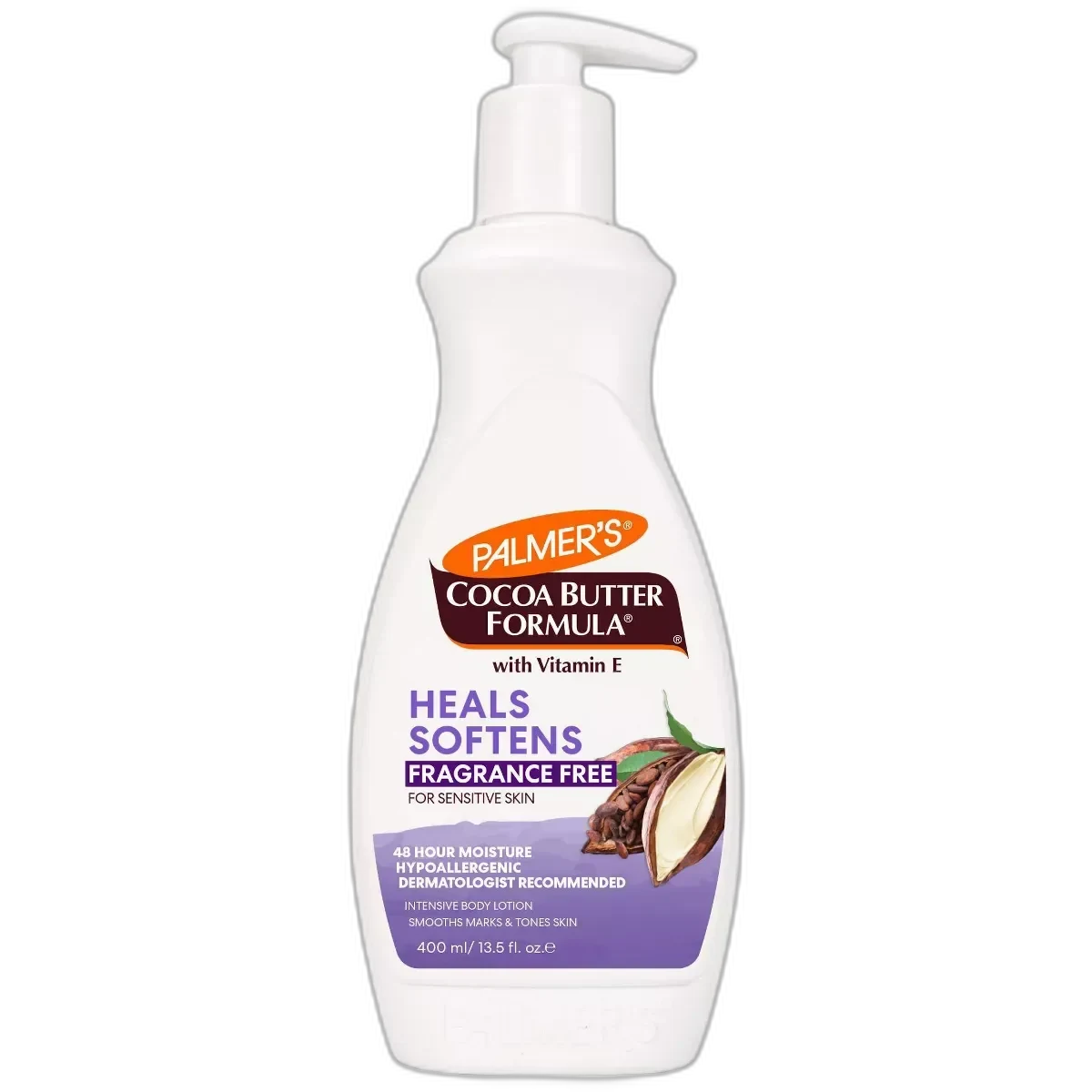
Cocoa Butter Formula Body Lotion Fragrance Free
Budget Body Care Staple
 Verified reviewer
Pros & cons.
- +Exceptional value at under six dollars for a 13.5 oz pump bottle of petrolatum-enriched body lotion
- +Proven moisturizing formula with glycerin, petrolatum, and cocoa butter that delivers reliable all-day hydration
- +Effectively fragrance-free with no noticeable scent for scent-sensitive users
- +Lighter texture than expected absorbs within minutes without greasy residue on clothing
- +Well-suited for eczema-prone skin with its occlusive, barrier-supporting base
- +Available in multiple sizes including a large 20 oz pump bottle for even better value
- +Nearly fifty years of continuous market presence backing the core formula
- −Contains botanical oils (orange, rosemary, chamomile) despite the fragrance-free label
- −Mineral oil and propylene glycol may not appeal to consumers seeking cleaner formulations
- −Pump mechanism on larger bottles reported as unreliable by some users
- −Not rich enough for users expecting traditional thick cocoa butter consistency
- −Contains coconut oil and mineral oil which are comedogenic if used on acne-prone body areas
The full review.
Millions of Americans share a specific scent memory: the warm, sweet smell of Palmer’s Cocoa Butter. It exists in childhood bathrooms, on grandmothers’ nightstands, and in the habit of rubbing lotion into ashy elbows after a bath. Palmer’s made a cultural artifact, not just a body lotion. What happens when you remove that recognizable scent?
The Fragrance Free version of Palmer’s Cocoa Butter Formula is the answer. It is a more interesting product than simple scent subtraction suggests. Removing the fragrance does more than quiet the nose; it reveals the structure of a formula refined over nearly fifty years of continuous production.
Texture
The texture is lighter than the original. This surprises first-time users expecting the thick, waxy feel of traditional cocoa butter. This is a proper lotion—it pours from its pump bottle, spreads easily, and absorbs within a couple of minutes on damp skin. It leaves a subtle satin finish instead of a greasy film, a notable achievement for a formula built on petrolatum and palm oil. You can dress within five minutes of application without residue on clothing.
Reality
The moisturizing architecture is straightforward and proven. Glycerin, a well-studied humectant in dermatology, sits at position three to pull water into the upper skin layers. Petrolatum at position four creates an occlusive seal to prevent water loss—a combination dermatological literature ranks among the most effective basic moisturizing strategies. The cocoa butter and coconut oil add emollient richness, using fatty acids that mimic skin lipids to fill the rough, cracked texture of chronically dry skin.
About Palmer’s
Palmer’s separates its formula from generic cocoa butter products using Cocoa Mass Polyphenols. These antioxidant compounds in cocoa show protective effects on skin cells in laboratory studies. Including both cocoa extract and cocoa seed butter aims to deliver these polyphenols alongside traditional emollient benefits. Whether the concentration in a rinse-off lotion provides meaningful antioxidant activity is debatable, but the claim has real chemistry behind it, even if clinical relevance is modest.
Scent
The fragrance-free claim requires examination. The formula lacks synthetic fragrance compounds and EU-regulated fragrance allergens; for most, the lotion is genuinely unscented. However, the ingredient list includes orange oil, rosemary leaf oil, chamomile flower oil, and Ormenis multicaulis oil. These are functional ingredients, likely for skin-conditioning, but they are botanical oils with aromatic compounds and potential for sensitization. For most fragrance-sensitive users, this is a non-issue because these oils are at very low concentrations and produce no perceptible scent. People with diagnosed contact allergies to specific botanicals should note this.
Works for
In daily use, the lotion performs like a standard drugstore body moisturizer. Applied to damp skin after a shower, it provides all-day hydration in most climates. In cold, dry winter months, very dry skin types may need a second application or a layer of body oil underneath. For eczema-prone skin, the petrolatum-heavy base creates the protective barrier dermatologists frequently recommend, and the fragrance-free formulation removes a common eczema flare trigger.
Packaging
The packaging is utilitarian Palmer’s—a brown plastic pump bottle that is functional rather than designed. The pump dispenses a reasonable amount per press, though some users report needing to prime it or seeing inconsistent flow. For a product at this price point, the packaging is acceptable.
Best for
The value proposition distinguishes this product. At roughly five to six dollars for 13.5 fluid ounces, you pay less than forty cents per ounce for a body lotion with petrolatum, glycerin, cocoa butter, coconut oil, and vitamin E. That is extraordinary. Even with generous twice-daily full-body application, one bottle lasts two to three months. Larger sizes offer better per-unit economics, and Amazon multi-packs lower the price per bottle further.
Not ideal for
There are limitations. The formula contains mineral oil and propylene glycol, which some consumers avoid due to personal preference rather than safety; both are well-studied and safe in cosmetics but carry perception baggage. The texture is pleasant but not luxurious. This is not a body lotion for the sensory experience; it is the one you buy because it works reliably, costs almost nothing, and has proven itself since the year your parents graduated high school.
Palmer’s Cocoa Butter Formula Fragrance Free does not try to be exciting. It tries to be effective, affordable, and gentle enough for sensitive skin. It succeeds on all three counts. For anyone wanting to use Palmer’s without the scent, this is the lotion that was waiting.
Ingredient analysis.
Full INCI list
Water (Aqua), Elaeis Guineensis (Palm) Oil, Glycerin, Petrolatum, Theobroma Cacao (Cocoa) Extract, Glyceryl Stearate, Propylene Glycol, Cocos Nucifera (Coconut) Oil, Mineral Oil (Paraffinum Liquidum), Cetyl Alcohol, Dimethicone, Theobroma Cacao (Cocoa) Seed Butter, Tocopherol, Tocopheryl Acetate, Citrus Aurantium Dulcis (Orange) Oil, Citrus Aurantium Dulcis (Orange) Peel Extract, Rosmarinus Officinalis (Rosemary) Leaf Oil, Anthemis Nobilis Flower Oil, Ormenis Multicaulis Oil, Carthamus Tinctorius (Safflower) Seed Oil, Helianthus Annuus (Sunflower) Seed Oil, Phenoxyethanol, PEG-8 Stearate, Hydroxyethylcellulose, Behentrimonium Methosulfate, Ethylhexylglycerin, Butylene Glycol, Sodium Acetate, Isopropyl Alcohol, Myristyl Alcohol, Stearyl Alcohol, Lauryl Alcohol, Cellulose, CI 19140 (Yellow 5), CI 15510 (Orange 4)
Skin match.
The science.
The Science
This formula uses a documented humectant-occlusive strategy to moisturize. Glycerin is a highly studied dermatological humectant; a 2008 review in the British Journal of Dermatology confirmed that glycerin at concentrations above 2% improves stratum corneum hydration and barrier function. Since it is third in this formula, the concentration is likely 3-8%.
Petrolatum is the gold standard occlusive agent. Classic dermatological literature shows it reduces transepidermal water loss (TEWL) by up to 99%. A 1992 study by Ghadially et al. in the Journal of Clinical Investigation showed that petrolatum prevents moisture loss and penetrates the intercellular lipid domains of the stratum corneum to support barrier repair.
Cocoa butter (Theobroma cacao seed butter) has approximately 57-64% saturated fatty acids (mostly stearic and palmitic acids), which creates its solid-at-room-temperature texture and occlusive properties. The Cocoa Mass Polyphenols Palmer's mentions are real; a 2014 study in the Journal of Cosmetic Dermatology showed cocoa polyphenols provide antioxidant and photoprotective effects on human skin cells in vitro, though clinical relevance in a topical lotion formulation is less established.
The dual vitamin E system (tocopherol and tocopheryl acetate) provides immediate antioxidant activity and sustained release. Skin enzymes convert the ester prodrug tocopheryl acetate to active tocopherol over time, extending antioxidant protection. A 2016 review in the Indian Dermatology Online Journal confirmed topical vitamin E supports wound healing and reduces scar formation, though evidence is stronger for concentrated vitamin E than for body lotion concentrations.
References
- The role of glycerol and glycerol-containing creams in maintaining skin barrier function — British Journal of Dermatology (2008)
- Petrolatum: Barrier repair and antimicrobial responses underlying this 'inert' moisturizer — Journal of Clinical Investigation (1992)
- Antioxidant and photoprotective effects of cocoa polyphenols on human skin cells — Journal of Cosmetic Dermatology (2014)
Dermatologist Perspective
Dermatologists often recommend simple, petrolatum-based moisturizers as first-line treatments for dry skin and eczema. The Palmer's Fragrance Free formula follows this guidance; its glycerin-petrolatum backbone uses the humectant-occlusive combination the American Academy of Dermatology recommends for skin hydration. Board-certified dermatologists note the fragrance-free formulation removes a common cause of contact dermatitis in body care, though botanical oils mean it contains potential sensitizers. For patients with chronic dry skin or mild eczema needing an affordable daily body moisturizer, dermatologists consider this a reasonable option due to its accessibility and price point.
Where it fits in your routine.
Apply a generous amount to damp skin right after bathing. Water helps the glycerin and humectants work better, while the petrolatum seals moisture in. Massage in upward, circular motions, focusing on rough areas like elbows, knees, shins, and heels. Apply twice daily for maximum hydration. Wait 2-3 minutes for full absorption before dressing. For very dry skin or dry conditions, layer over a body oil or apply a thicker coat to problem areas at night.
This offers top value in body care. At approximately $5.49 for 13.5 fluid ounces, the cost is under $0.41 per ounce—low for a formula with petrolatum, glycerin, cocoa butter, coconut oil, and vitamin E. The 8.5 oz bottle at around $5.00 has a slightly higher per-ounce cost, while Amazon multi-packs lower unit costs further. For a daily-use body lotion applied to large surface areas twice daily, the price-to-performance ratio beats almost anything in the drugstore category. Only products with significantly simpler formulations compete at this price point.
Dry to normal skin types needing a reliable, affordable, fragrance-free daily body moisturizer. It works well for eczema-prone individuals, people sensitive to the original Palmer's scent, and budget-conscious consumers wanting proven moisturizing ingredients without a prestige markup.
Petrolatum and coconut oil may feel too occlusive for oily or acne-prone body skin. The formula contains orange, rosemary, and chamomile oils, so users with contact allergies to specific botanical oils should be aware, even with the fragrance-free label. This lotion prioritizes function over indulgence and lacks a luxurious sensory experience.
Product details.
This creamy, velvety lotion is lighter than most cocoa butter formulas. It absorbs quickly without a heavy residue, but leaves a slight satin sheen on skin.
Fragrance-free with no added synthetic fragrance. A faint, barely perceptible natural scent from the cocoa butter and plant oils exists up close, but it does not linger or project.
Opaque brown-bronze plastic pump bottle with Palmer's signature gold accents. The fragrance-free variant uses a green or teal banner on the front label to separate it from the scented original. The pump works for daily use, but some users report occasional priming issues.
The lotion spreads easily on first application and absorbs within minutes on damp skin. It causes no tingling, warming, or adjustment period. Skin feels softer and smoother immediately under a light protective layer. Results are consistent from the first use—no purging or transition period.
2-3 months with twice-daily full-body application
12 months
All Year
The backstory.
Palmer's Cocoa Butter Formula launched in 1975 and quickly became a cultural touchstone, particularly in Black communities where it earned a reputation as a trusted solution for dry skin and stretch marks. The fragrance-free variant was developed to serve consumers who loved the moisturizing performance but couldn't tolerate or preferred to skip the distinctive sweet cocoa scent — a scent so recognizable it has its own devoted following and vocal detractors.
About Palmer's
Legacy Brand (20+ years)E.T. Browne Drug Co. produces Palmer's. Founded in 1840, it is one of America's oldest skincare companies. The Cocoa Butter Formula line launched in 1975 and is the #1 cocoa butter brand in the U.S., selling in over 80 countries. The brand has cultural significance as a trusted staple for multiple generations.
What the community says.
"Exceptional moisturization that lasts until the next day without reapplication"
"Non-greasy formula that absorbs well for a cocoa butter product"
"Outstanding value at under six dollars for a large bottle"
"Works remarkably well for eczema and chronically dry skin"
"Truly unscented option for those sensitive to the original cocoa butter smell"
"Some batches have inconsistent texture that can feel greasier than expected"
"Contains botanical oils that may concern truly sensitive skin users despite fragrance-free label"
"Not as thick or rich as some users expect from a cocoa butter product"
"Pump mechanism on larger bottles can be unreliable or difficult to prime"
"Contains mineral oil and petrolatum which some consumers prefer to avoid"