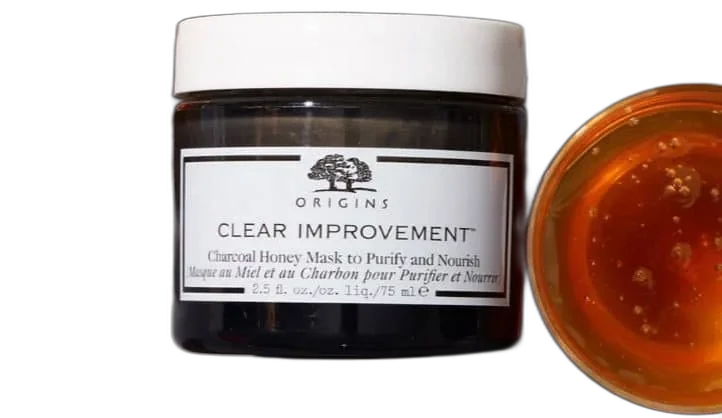
Clear Improvement Charcoal Honey Mask
Purify-Without-Punishing Pick
 Verified reviewer
Pros & cons.
- +Honey and hyaluronic acid transform the clay mask experience from drying to nourishing
- +Delivers visible pore-clearing results with a post-mask glow instead of tightness
- +Broader skin type suitability than the original Active Charcoal Mask — works for combination and normal skin
- +Rich, golden texture spreads easily and rinses clean without stubborn residue
- +Caffeine and jojoba esters add antioxidant and barrier-support benefits beyond basic purification
- +Triple-clay plus charcoal system provides genuine deep-cleansing efficacy
- −Seven essential oils and five fragrance allergens make this highly sensitizing for reactive skin
- −Not vegan — contains honey (being phased out for a vegan reformulation)
- −Aromatherapeutic scent is strong and polarizing — not subtle
- −Less effective at aggressive oil removal than the fragrance-free Active Charcoal Mask
- −Being discontinued in favor of the vegan Rich Purifying Charcoal Mask — availability may decline
The full review.
The original Clear Improvement Active Charcoal Mask was a phenomenon. It also had a problem: it worked beautifully for oily skin and left everyone else feeling like they had washed their face with sandpaper and regret. Origins clearly heard the feedback, because in 2018 they released this — a charcoal mask reformulated with golden wildflower honey to deliver the pore-clearing action without the punishing dryness. The concept is elegant. The execution is mostly successful, with one significant caveat.
The formula retains the core purifying engine of its sibling — bentonite, montmorillonite, and kaolin clays alongside bamboo charcoal powder. These are the ingredients doing the actual pore-clearing work, binding to excess sebum and surface debris through ionic exchange and physical adsorption. But where the Active Charcoal Mask surrounds these clays with nothing more than water and glycerin, the Honey Mask embeds them in a rich matrix of humectants and emollients.
Honey is the headliner, and it transforms the masking experience. As a natural humectant, honey draws moisture from the air into the skin, counteracting the dehydrating pull of the clays in real time. It also contains naturally occurring amino acids, antioxidants, and trace minerals that contribute to skin conditioning. The practical effect is immediately noticeable: instead of the aggressive tightening that clay masks typically produce as they dry, this mask tightens gently, almost reluctantly. Your skin feels held rather than constricted.
Sodium hyaluronate — the low-molecular-weight form of hyaluronic acid — reinforces the hydration strategy. Where honey works on the surface, hyaluronic acid can penetrate deeper into the skin layers, ensuring that the purifying action above does not create a drought below. Jojoba esters add a lipid-replenishing element, mimicking the skin’s natural sebum to maintain barrier integrity during the masking process. Caffeine rounds out the actives with antioxidant protection and mild vasoconstrictive properties that can reduce temporary redness.
The texture alone tells you this is a different animal from the original. Where the Active Charcoal Mask is austere and gray-black, this one is warm and golden, with visible honey swirls in the paste. It spreads like a rich balm rather than a stiff clay, and it rinses off easily without the stubborn residue that pure clay masks leave behind. Post-rinse, skin looks genuinely luminous — not just clean, but glowy, as if the honey has left a thin veil of radiance.
Now for the caveat that cannot be overlooked. Origins added seven essential oils to this formula: lavender, lemon peel, ylang ylang, spearmint, rosemary, clove bud, and wintergreen. These produce a warm, aromatherapeutic scent that many users love. They also introduce five identified fragrance allergens: limonene, linalool, eugenol, citral, and benzyl benzoate. This is a remarkably high sensitizing potential for a product designed to be gentler than its predecessor.
The irony is sharp. The Charcoal Honey Mask solves the dryness problem that limited the original’s audience, then immediately limits its own audience with a fragrance profile that rules out anyone with reactive or sensitive skin. The original Active Charcoal Mask, by contrast, is completely fragrance-free. If your main barrier to using the original was dryness, the Honey Mask is a genuine improvement. If your barrier was sensitivity, this product is actually worse.
This matters because Origins is now transitioning the formula to a vegan version — the Rich Purifying Charcoal Mask — that replaces honey with chia seed oil and shea butter. Whether the reformulation also addresses the essential oil load remains to be seen, but it is worth noting that the product as reviewed here may become harder to find as the transition progresses.
For its intended audience — normal-to-combination skin that wants deep-pore cleansing without the stripped, tight aftermath of a pure clay mask — the Charcoal Honey Mask genuinely delivers. The honey turns what is typically a necessary evil into something you might actually look forward to. The radiant post-mask glow is real, the pore refinement is visible, and the formula does not punish your skin for wanting clean pores.
At thirty-five dollars, it is priced slightly above the Active Charcoal Mask, which is fair given the more complex formulation. The jar lasts three to four months with weekly use. As a bridge product between aggressive purification and gentle nourishment, it found a real niche — one that the incoming vegan reformulation will hopefully maintain.
Ingredient analysis.
Full INCI list
Water, Butylene Glycol, Bentonite, Montmorillonite, Honey, Polysorbate 20, PEG-100 Stearate, Polybutene, Jojoba Esters, Lavandula Angustifolia (Lavender) Oil, Citrus Limon (Lemon) Peel Oil, Cananga Odorata Flower Oil, Mentha Viridis (Spearmint) Leaf Oil, Rosmarinus Officinalis Leaf Oil, Eugenia Caryophyllus (Clove) Bud Oil, Gaultheria Procumbens (Wintergreen) Leaf Oil, Citrus Aurantium Amara (Bitter Orange) Flower Extract, Triethyl Citrate, Ethyl Phenylacetate, Limonene, Linalool, Eugenol, Citral, Benzyl Benzoate, Yeast Extract, Kaolin, Charcoal Powder, Caffeine, Sodium Hyaluronate, Glycerin, Trehalose, Lecithin, Ethylhexylglycerin, Xanthan Gum, Caprylyl Glycol, PEG-150 Distearate, Silica, Hexylene Glycol, Disodium EDTA, Tetrasodium EDTA, Dehydroacetic Acid, Phenoxyethanol, Mica, Titanium Dioxide (CI 77891), Iron Oxides (CI 77491, CI 77492, CI 77499)
Skin match.
The science.
The Science
Researchers study honey extensively for wound healing and dermatology. Its high sugar content allows it to hydrogen-bond with water, drawing moisture into the skin surface. A 2013 review in the Journal of Cosmetic Dermatology documented honey's antioxidant, anti-inflammatory, and humectant properties in topical skin applications; it shows honey reduces transepidermal water loss when applied under occlusive conditions.
The clay system in this formula — bentonite, montmorillonite, and kaolin — works via ion exchange and physical adsorption. Bentonite has a high cation exchange capacity, so it binds to positively charged organic molecules on the skin surface, such as proteins and some sebum components. Combined with charcoal's physical adsorption, the system purifies via two mechanisms.
Low molecular weight sodium hyaluronate (typically under 50 kDa) penetrates the stratum corneum to hydrate deeper than high-molecular-weight hyaluronic acid. In a clay mask formulation, this penetration matters — it hydrates below the surface layer the clays dry, creating a gradient that prevents the tightness common with pure clay masks.
Caffeine provides antioxidant activity by scavenging reactive oxygen species, and its vasoconstrictive properties can temporarily reduce erythema and redness. While this formula likely has a modest concentration, it adds value to a mask designed for a gentler, more nourishing experience.
Dermatologist Perspective
Dermatologists like pairing purifying clays with humectants like honey and hyaluronic acid, as this helps more people use clay masks without barrier compromise. However, the extensive essential oil blend is a concern dermatologists frequently flag. Board-certified dermatologists note that seven essential oils in one product increase the probability of contact sensitization, especially with repeated use. For patients seeking the purify-and-nourish benefit without fragrance risk, dermatologists often suggest the original fragrance-free Active Charcoal Mask followed by a hydrating sheet mask or serum.
Where it fits in your routine.
Cleanse your face and pat it dry. Apply an even layer to the entire face, but avoid the lips and eye area. Leave on for 10 minutes; the mask tightens gently, though less than a pure clay mask. Rinse well with lukewarm water. A washcloth helps, but is less necessary than with the Active Charcoal Mask. Follow with a hydrating toner and moisturizer. Use 1-2 times per week on evenings when you skip retinol and exfoliating acids.
At $35 for 2.5 oz, this costs slightly more than the $30 Active Charcoal Mask. Honey, hyaluronic acid, jojoba esters, and caffeine justify the higher price. Weekly use makes the jar last 3-4 months, costing about $2.50 per use. Because the formula is transitioning to a vegan version, retailers may discount remaining stock. This offers the best value for combination skin types who avoided clay masks because of dryness.
This mask works for combination and normal skin types wanting pore-clearing benefits without the harsh dryness of traditional clay masks. If the original Active Charcoal Mask felt too stripping, or if you want a nourishing rather than punishing masking ritual, the honey formula provides that balance.
Skip this if you have fragrance sensitivity or reactive skin — the seven essential oils and five identified allergens make this one of the more sensitizing charcoal masks. Also skip if you need vegan products, as this contains honey. Use the fragrance-free Active Charcoal Mask or the newer vegan Rich Purifying version instead.
Product details.
Thick, golden-tinted clay paste has visible honey swirls. It feels buttery and nourishing on application, unlike typical drying clay masks.
Warm, herbaceous blend of lavender, spearmint, and honey with subtle clove and wintergreen notes — distinctly aromatherapeutic
Glass-like jar with screw-top lid, available in travel and full sizes
The first application shows a texture different from standard clay masks — the honey makes it thick, like a balm. It tightens less than pure clay masks as it dries. After rinsing, skin looks luminous instead of matte, with a subtle glow from the honey's humectant effect. The herbal scent is strong and divisive.
3-4 months with once-weekly use (2.5 oz size)
12 months
All Year
The backstory.
Launched in 2018 as a gentler companion to Origins' blockbuster Active Charcoal Mask, the Charcoal Honey Mask was designed to bring the pore-clearing benefits of charcoal to skin types that found the original too drying. The addition of golden wildflower honey transformed the mask experience from purely extractive to dual-action purifying and nourishing. Origins is now transitioning this formula to a vegan version replacing honey with a chia seed oil complex.
About Origins
Leonard Lauder founded Origins in 1990 under The Estee Lauder Companies, starting the naturally derived prestige skincare category. The brand has over 35 years of plant science expertise and is moving its entire line to vegan formulations.
Common myths.
Honey in a mask provides antibacterial acne treatment.
Honey has documented antimicrobial properties, especially Manuka honey, but the honey in this formula works mainly as a humectant and skin conditioner. A 10-minute mask application lacks the concentration and contact time to provide clinically significant antibacterial effects on acne-causing bacteria.
Charcoal honey masks are gentle for sensitive skin because honey soothes.
Honey softens the clay's drying effect, but this formula contains seven essential oils and five identified fragrance allergens (limonene, linalool, eugenol, citral, benzyl benzoate). These ingredients make this charcoal mask one of the more sensitizing options, despite its gentler texture.
FAQ.
Is Origins Charcoal Honey Mask vegan?
No — the original Charcoal Honey Mask contains honey and is not vegan. Origins now offers a reformulated 'Rich Purifying Charcoal Mask' that uses a vegan chia seed oil and shea butter complex instead of honey. Choose the updated version if you want vegan formulations.
What's the difference between Origins Active Charcoal Mask and Charcoal Honey Mask?
The Active Charcoal Mask is fragrance-free and uses a higher clay concentration to absorb oil—best for oily skin. The Charcoal Honey Mask adds honey, hyaluronic acid, and jojoba esters to the purifying clays for hydration. This version suits combination and normal skin that finds pure clay masks too drying, but it contains multiple essential oils.
Can I use Origins Charcoal Honey Mask on dry skin?
Honey and hyaluronic acid make this more tolerable for dry skin than most clay masks, but clay and charcoal still absorb oil. If you have dry skin, apply a thinner layer, leave it on for 5-7 minutes instead of 10, and follow with a thick moisturizer. Use it no more than once per week.
Is Origins Charcoal Honey Mask safe for sensitive skin?
Despite its gentler honey-enriched texture, this mask contains seven essential oils and five fragrance allergens (limonene, linalool, eugenol, citral, benzyl benzoate). Sensitive and reactive skin types should avoid this product. The fragrance-free Active Charcoal Mask is a better option for sensitive skin.
How often should I use Origins Charcoal Honey Mask?
Use 1-2 times per week. The honey base makes it gentler than pure clay masks, so some combination skin types can tolerate twice-weekly use. Apply for 10 minutes on cleansed skin, rinse thoroughly, and follow with your regular skincare routine.
Community
What the community says.
"Honey makes this clay mask much less drying than typical charcoal masks"
"Skin looks radiant and glowy after rinsing rather than stripped"
"Pleasant herbal-honey scent from the essential oil blend"
"Works well for combination skin types who find pure clay masks too harsh"
"Noticeable pore refinement without the tight, uncomfortable post-mask feeling"
"Strong essential oil blend can irritate sensitive skin"
"Multiple fragrance allergens present — not suitable for reactive skin types"
"Contains honey — not vegan"
"Pricier than the original Active Charcoal Mask with less dramatic oil absorption"
"Being phased out in favor of the reformulated vegan Rich Purifying version"
People also looked at.